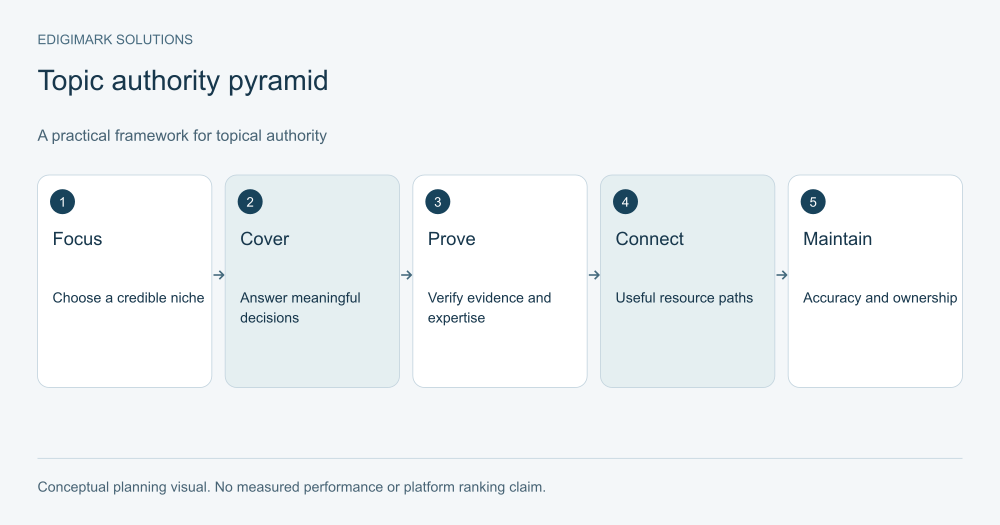
Topical authority is a useful marketing term for the credibility a business develops by explaining a subject accurately, answering meaningful questions and demonstrating relevant expertise. Build it through focused niche content coverage, reliable evidence and maintenance. Do not treat it as a single public Google score or assume that publishing many related articles automatically establishes expertise.
For a business, the practical test is whether a reader can use your resources to make a better decision and verify why the advice deserves attention. A broad library of generic summaries may look comprehensive while leaving important questions unanswered. A smaller set of clear, reviewed resources can provide a stronger foundation.
In this guide
- How is topical authority different from topic coverage?
- How does a clear niche guide topical authority?
- What does subject expertise look like on a page?
- How do you build niche content coverage around customer decisions?
- How do you identify content gaps that matter?
- What evidence should an authority-building program produce?
- What should an evidence inventory contain?
- How should subject experts review an authority-building resource?
- How do internal links support authority without becoming the whole strategy?
- What does an example of topical depth and evidence look like?
- What practices weaken an authority-building effort?
- How do you measure progress in topical authority?
- How should content authority be maintained?
- What does an initial authority-building plan look like?
- How should leaders review topical authority claims?
- Frequently asked questions
- Build credibility through useful, verifiable detail
How is topical authority different from topic coverage?
Coverage describes what your resources address. Authority adds the question of why someone should rely on them. A website can mention every part of an industry without providing accurate detail, original analysis or useful evidence.
For example, a hypothetical integration company could publish articles about data, automation, software and customer experience. That breadth does not show whether it understands field ownership, rollback planning or failed synchronization. The subject expertise becomes visible when it explains those decisions with verified conditions and clear tradeoffs.
Use a coverage map to identify important questions, then use an evidence map to assess how well you can answer them. These maps serve different purposes. The first finds missing tasks; the second reveals gaps in facts, review or practical explanation.
Avoid claiming a precise topical-authority threshold for Google unless the platform actually documents such a measure. Tool scores can organize a vendor’s observations, but they should not be presented as an internal search metric.
How does a clear niche guide topical authority?
A focused subject helps the team decide what it can explain and maintain. It also helps readers understand the site’s purpose. A company with limited specialist review capacity should not promise authoritative advice across unrelated fields.
Choose a niche connected to your real offer and audience. The subject should be broad enough to contain meaningful decisions but narrow enough for reliable coverage. “Technology” is usually too broad; “CRM integration planning for service teams” can provide a workable starting scope.
List what belongs outside that scope. A business may explain implementation planning without providing a tutorial for every connector. It may discuss process measurement without offering legal advice about every jurisdiction. Boundaries protect accuracy and make the content more useful.
Expand when the business has evidence, owners and a reason to serve another task. A popular adjacent keyword is not sufficient by itself. The new subject should add a meaningful connection for the audience.
What does subject expertise look like on a page?
It appears in accurate distinctions, conditions and explanations. A useful page can say which requirement changes a recommendation, why an approach fails and what information must be collected before implementation. Specific reasoning is stronger than repeatedly labeling the company an expert.
An implementation guide might identify who approves access, which system owns a field and how errors are reviewed. A comparison might show consistent criteria and circumstances where each alternative fits. A service page might state deliverables and exclusions clearly.
Evidence of involvement should be genuine. Do not invent a professional biography, reviewer or client experience. If a resource uses a hypothetical scenario, label it as such. If it draws on an interview, verify permission and represent the contributor’s actual role.
Google’s people-first guidance discusses experience, expertise and trust while explaining that E-E-A-T is not itself a specific ranking factor. Use the guidance for an honest quality review rather than converting it into a decorative score.
How do you build niche content coverage around customer decisions?
Collect the questions people ask before, during and after engaging with your offer. Group them into tasks such as understanding, evaluating, preparing, implementing and troubleshooting. Use the customer journey as a coverage model rather than filling every variation of a keyword.
For each task, identify what the reader needs to decide and what evidence would help. Some questions need a short explanation within an overview; others deserve a separate resource because their process or audience is different.
Review existing pages before planning new ones. A service page may need clearer prerequisites, and an article may need an approved example. Improving those assets can close a meaningful gap without expanding the URL count.
Connect relevant resources with digital marketing priorities so coverage supports the audience you actually want to serve. A content library should not drift into unrelated subjects merely because they have attractive estimated traffic.
How do you identify content gaps that matter?
A gap can be a missing question, weak evidence, unclear terminology or an absent next step. It is not always a missing article. A page may exist but fail to explain an exception that buyers repeatedly ask about.
Review recurring sales and support questions through approved summaries. Ask which concerns stall a decision or create mistakes. Remove personal details before sharing material with writers. The aim is to understand the task, not publish customer conversations verbatim.
Inspect comparable resources for decision coverage, not just headings. A competitor’s article may omit failure handling or audience-specific constraints. If your business can supply useful evidence, that may be a meaningful opportunity. Copying a longer outline is not the same as closing a gap.
Prioritize gaps by relevance, impact and evidence readiness. A commercially important topic may need specialist review before writing. Mark that dependency instead of treating every promising row as publication-ready.
What evidence should an authority-building program produce?
Create evidence that your company can explain and stand behind. It may include approved process diagrams, tested examples, transparent research, product documentation or accurately described case studies. The right form depends on the claim.
For original data, document collection, definitions, dates and limitations. A result without a method can look persuasive while remaining impossible to evaluate. Retain the underlying records according to the business’s data policy.
For a practical explanation, show the reasoning. A hypothetical example can compare two approaches under stated conditions. It becomes useful because the reader can understand the choice, not because the page pretends to report a customer outcome.
For a case study, confirm permission and trace the result to a measurement process. Explain what else changed and what the result does not establish. Do not turn one case into a universal promise for every buyer.
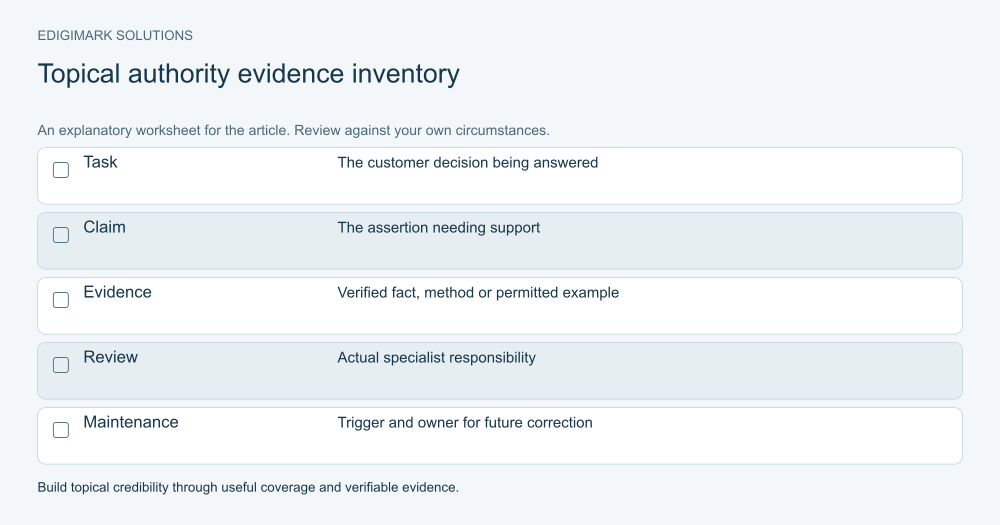
What should an evidence inventory contain?
Use a table with the claim, evidence type, source, responsible owner, permission status and review trigger. This connects editorial production with facts the business can actually use.
| Claim or explanation | Useful evidence | Review concern |
|---|---|---|
| A workflow follows a specific sequence | Approved process diagram | Has the process changed? |
| A connector supports a record type | Current verified documentation | Is the behavior version-dependent? |
| A project produced an outcome | Dated method and approved records | What else influenced the result? |
| An approach fits particular conditions | Transparent decision model | Are assumptions stated? |
| A service excludes custom work | Current scope owner approval | Does the commercial page agree? |
An inventory makes gaps visible before a writer fills them with confident language. It also gives future editors a route to verify facts when products or services change.
How should subject experts review an authority-building resource?
Choose the reviewer according to the facts involved. A product owner can verify current capability; an implementation lead can verify process; an analyst can verify a measurement method. A general editor may still need those specialists even when the prose is clear.
Give the reviewer specific claims and questions. “Please review this article” can produce a superficial approval. “Confirm these supported record types and the exception in the opening” directs attention to the information that matters.
Record what was checked and what remains uncertain. Do not imply broad expert endorsement when the reviewer checked only one section. If an unresolved fact is essential, narrow the claim or postpone that part of the resource.
Keep authorship and review information accurate. A page should represent actual responsibility, not a fabricated profile created to make the content look more authoritative. Clear accountability matters more than an elaborate biography.
How do internal links support authority without becoming the whole strategy?
Links help readers move between related explanations and find the level of detail they need. They can show the structure of a coherent subject, but they do not create evidence where none exists.
Link when a new decision arises. A resource discussing unreliable records can point to a relevant explanation of CRM integration. A process guide discussing repetitive handoffs can connect to marketing automation. The destination should help with the next uncertainty.
Keep architecture work separate from the evidence program. A neatly linked set of generic summaries remains generic. Improve the explanation and facts as well as the connections.
Review links when a destination changes scope. The incoming context should still make sense. Maintenance of relationships is part of preserving a useful body of knowledge.
What does an example of topical depth and evidence look like?
Imagine a hypothetical B2B service firm specializing in workflow automation. A broad introductory article says automation saves time, but it does not help a manager decide which process to automate. The content gap is practical selection criteria.
The company builds a planning resource comparing volume, rule stability, data readiness and failure impact. It adds a labeled scenario showing why a low-volume but high-risk approval may be a poor first experiment. A separate resource explains ownership and monitoring because those decisions need different detail.
Subject owners check the process claims. The writer avoids inventing savings percentages and uses transparent assumptions. The service page states what implementation support includes. Contextual links connect the resources where the next decision requires them.
This creates topical depth through meaningful reasoning. It does not require a claim that the company has become Google’s recognized authority. The audience receives a more useful resource set, and the business gains information it can maintain and share.
What practices weaken an authority-building effort?
Publishing unrelated topics to chase demand can blur the site’s purpose. Repeating the same generic advice across many pages can create the appearance of breadth without adding useful detail. Unverified claims and fake case results can undermine trust directly.
Do not equate quantity with completeness. A subject may need fewer resources with stronger evidence. If a new article adds only a different title, ask whether an existing page should be improved instead.
Google’s spam policies address scaled content produced primarily to manipulate rankings without helping users. The practical lesson is to make the user’s benefit and editorial responsibility real, regardless of the production tools involved.
Avoid presenting every tool recommendation as a platform requirement. Ask which customer problem the proposed change solves and what evidence supports it. A coherent program needs judgment, not a growing checklist of unexamined tactics.
How do you measure progress in topical authority?
Separate production quality, audience response and commercial outcomes. Quality measures can include verified evidence coverage and maintained resources. Audience observations can include relevant queries, useful page transitions and feedback. Commercial measures can include qualified inquiries where the data connects them.
Do not combine these into an invented Google authority score. A proprietary index may help your internal review if its method is clear, but label it as your own assessment.
Use data analytics to maintain definitions and distinguish page roles. A narrow implementation resource may support a valuable decision without attracting large traffic. A broad article may receive many visits from people outside the target audience.
Review results with sales and subject owners. Ask which questions the pages answer well and which misunderstandings persist. End with a concrete improvement: evidence, clarification, navigation or scope. Measurement should direct the next useful task.
How should content authority be maintained?
Give important pages owners and review triggers. A product change can affect capability claims, a service change can affect scope and a new process can affect diagrams. Update the relevant resources together when consistency matters.
Keep a change log with substantive checks and sources. A date change without verification can create false freshness. The record should explain what was reviewed and why the update occurred.
Periodically assess whether pages still have distinct purposes. Content can converge over several updates. Consolidate or refine scope when overlap obscures the information model.
Maintain capacity before expanding. A company that cannot review its existing technical library should solve that ownership problem before adding another series of complex guides.
What does an initial authority-building plan look like?
Choose one subject connected to your real offer. Inventory the existing resources and customer tasks. Select the most important gaps, identify evidence owners and improve a manageable set of pages.
For each resource, state the promise, evidence and review trigger. Publish incrementally, verify public delivery and inspect feedback. A small reliable body of work is a stronger starting point than a large plan with unresolved facts.
Expand when a new task adds meaningful usefulness. If the next article merely repeats the overview, reconsider it. If it addresses a genuine decision and the evidence exists, it can deepen the resource set.
How should leaders review topical authority claims?
Ask what the claim means operationally. If a proposal says it will “build authority,” request the customer tasks, evidence requirements and maintenance process behind that phrase. A credible plan should name the resources it will improve and explain why readers will find them more useful.
Ask how progress will be assessed without inventing a platform score. Relevant discovery, customer feedback and qualified outcomes can provide useful evidence, but they have different definitions and limitations. The report should preserve those distinctions.
Review production responsibility as well. Who checks technical facts? Who approves real examples? Who corrects outdated information? Who verifies the public page? These questions connect the promise of expertise with an accountable workflow.
Finally, inspect a sample resource yourself. Can you understand the recommendation, its conditions and its evidence? Does it explain something your customer actually needs to decide? If the answer is unclear, a large publishing schedule will not solve the underlying problem. Improve the model before scaling it.
Frequently asked questions
Is topical authority a Google score?
Do not treat the marketing term as a single public Google metric. Tools may create their own measures, but their scores should not be represented as access to internal ranking systems.
How many articles do we need to establish authority?
There is no universal article count. Focus on important customer decisions, useful depth and reliable evidence. A quota can encourage duplication and create maintenance obligations the team cannot meet.
Can a new business build credibility without case studies?
Yes, by providing accurate explanations, transparent decision models and verified process information. Use hypothetical examples honestly. Do not invent customer outcomes to imitate a more established competitor.
Are author biographies enough to demonstrate expertise?
No. Accurate context helps, but the page’s reasoning and facts still need verification. A biography cannot make an unsupported claim reliable or substitute for relevant review.
What should we improve first?
Choose an important recurring customer question that your team can answer with evidence. Improve the owning page, verify its facts and connect it with relevant resources before expanding into broader coverage.
Build credibility through useful, verifiable detail
Topical authority is most useful as a commitment to focused knowledge and reliable explanation. Choose the subject your business can serve, make evidence visible and maintain the answers. Contact Edigimark with your content gaps and subject owners to plan a practical search and evidence program.