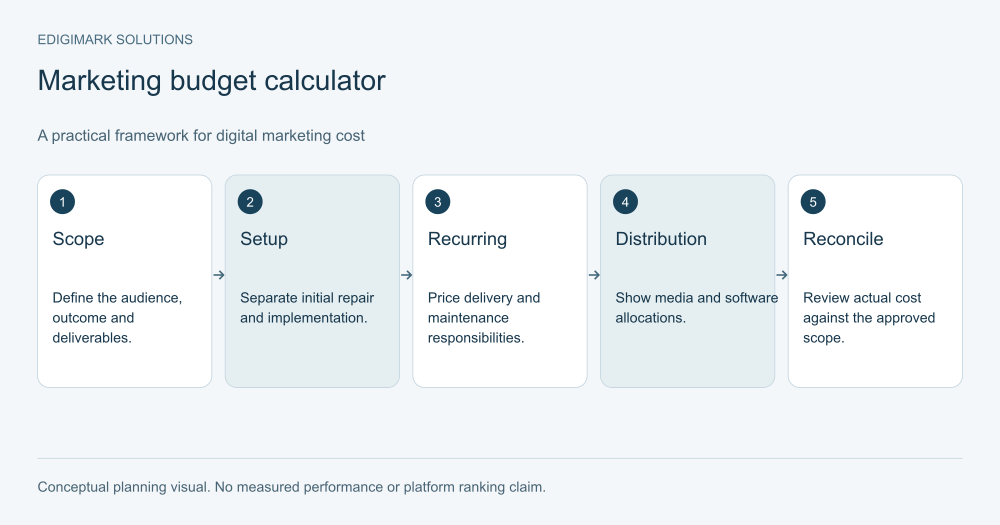

A digital marketing budget should allocate resources to a business goal, the customer journey needed to reach it and the capacity required to deliver the work. Start with constraints and existing performance, fund essential foundations, then assign channel and experiment budgets with explicit review rules. There is no universal percentage split that fits every business.
The budget is a decision document. It should explain what the business is funding, what it is deferring and what evidence would justify a change. This guide focuses on marketing budget allocation rather than predicting supplier prices or promising acquisition outcomes from a fixed spend.

In this guide
- What business decision should a digital marketing budget support?
- Which cash and capacity constraints should guide marketing allocation?
- How can existing marketing evidence guide acquisition investment?
- Which marketing foundations should be funded before expansion?
- How should funnel budget planning divide the customer journey?
- How should channel allocations be chosen?
- How does a hypothetical 100-unit marketing allocation show trade-offs?
- How should marketing experiments be funded and stopped?
- What role should a marketing contingency play?
- How should the budget calendar manage dependencies?
- Which budget records should finance and marketing share?
- How should a quarterly allocation review work?
- How should allocation changes be handed to delivery owners?
- Frequently asked questions about digital marketing budgets
What business decision should a digital marketing budget support?
Choose the outcome before choosing the channels. A business entering a market may need credible discovery and a way to evaluate early demand. A business receiving many enquiries may need better qualification and follow-up. A business losing existing customers may need lifecycle communication and product coordination rather than more acquisition activity.
State the outcome in terms the business can verify. “More awareness” is incomplete without identifying the audience and the decisions awareness should support. “More leads” is incomplete without defining eligibility, sales capacity and a meaningful next step.
Use an outcome statement such as: support qualified evaluations for one defined service among a named business segment during the next planning period. Then identify the evidence required: relevant visits, completed evaluation requests, accepted opportunities and later commercial outcomes. Distinguish leading evidence from results that take longer to observe.
This prevents a common allocation error: splitting money evenly across channels because every channel appears in a service list. Equal allocation may be administratively simple, but it does not establish a relationship with the commercial problem.
Which cash and capacity constraints should guide marketing allocation?
Record the cash ceiling, commitment period, internal review capacity, sales capacity and technical dependencies. The budget must work within all of them. A company can afford a production package financially while lacking the expert time to approve its content.
Identify fixed commitments. Existing licences, contracted services and required maintenance reduce the amount available for new experiments. Separate commitments from proposed investments so leadership understands which funds can still be redirected.
Add timing constraints. A seasonal launch, product release or market entry may create a specific readiness date. Work backwards from that date to identify research, implementation and approval needs. Do not schedule distribution before the destination and follow-up process are ready.
Finally, document what the plan cannot assume. Missing conversion data, uncertain sales-cycle length or an untested offer should remain visible. These gaps call for discovery or measurement work, not precise-looking forecasts built on guesses.
How can existing marketing evidence guide acquisition investment?
Review performance by audience, offer and meaningful customer action. A channel average can hide a strong segment and a weak one. Look for evidence that people reached the intended destination and progressed through a defined process.
Separate observation from interpretation. A low form completion rate may reflect unclear copy, poor traffic fit, excessive fields or a technical defect. Do not automatically conclude that the channel needs a larger budget or that the form needs fewer fields. Inspect the journey and relevant records first.
Where reliable history exists, use it to build scenarios with explicit assumptions. Where it does not, budget for learning. An initial acquisition investment might test an offer and validate the handoff rather than promise a revenue target the business cannot yet estimate credibly.
Connect marketing records to downstream stages through CRM integration. A large volume of submissions is less useful for allocation than knowing which submissions became eligible, accepted and commercially relevant conversations.
Which marketing foundations should be funded before expansion?
Foundation funding removes barriers that prevent other spending from working or being evaluated. It may cover technical repairs, clear positioning, analytics definitions, CRM fields, a priority landing page or an agreed enquiry process.
Choose the foundation based on a specific dependency. If a form fails on mobile, repairing it supports all campaigns using that destination. If sales and marketing use incompatible definitions, agreeing the stages improves the interpretation of future results. If product claims are unverified, an evidence library helps content and campaign teams work safely and consistently.
Avoid an unlimited foundation project. Define the required condition and a completion check. “Analytics improvement” can expand indefinitely; “the assessment request records the agreed event once and reaches the correct owner” is a verifiable deliverable.
Fund ongoing operation as well as setup. Tracking, templates and CRM integrations can fail after changes. Assign maintenance ownership and a review cadence rather than assuming a one-time repair remains reliable forever.
How should funnel budget planning divide the customer journey?
Funnel budget planning should reflect the buyer’s decisions rather than impose a rigid sequence on everyone. Customers may return to research, involve colleagues or move between channels. Use stages as an operating model, not a claim about every individual journey.
| Journey need | Work the budget may support | Useful evidence |
|---|---|---|
| Recognize a problem | Relevant explanations and audience distribution | Engagement with the intended problem |
| Explore approaches | Comparison content and practical examples | Use of evaluation resources |
| Assess the offer | Service pages, demonstrations and evidence | Eligible requests and specific questions |
| Take action | Usable forms and clear routing | Successful handoff and owner acceptance |
| Continue the relationship | Onboarding and relevant follow-up | Progress through an agreed lifecycle stage |
Match the investment to the current bottleneck. A business with adequate discovery but weak assessment pages may need content and conversion work. A business with strong conversion and limited reach may have a different distribution need. A business with unhandled enquiries needs operational capacity before a traffic expansion.
Do not assign all value to the final click when deciding which work to fund. Explanations, technical documentation and sales-support material may serve several stages. Review their use and business purpose alongside acquisition reporting, without claiming that every interaction caused a sale.
How should channel allocations be chosen?
Give each funded channel a job. Search content may explain a recurring buyer question. Paid campaigns may distribute a tested offer to a defined audience. Email may continue an opted-in relationship. Social content may demonstrate expertise or support a particular community.
Specify the destination and follow-up for each job. A channel should not receive a budget simply because the business already has an account. It needs a plausible route from audience attention to a useful action.
Compare channel needs with available capabilities. Content depends on research and expert review. Paid acquisition depends on creative, destinations, measurement and campaign management. Lifecycle work depends on eligible contacts, accurate records and operational rules. Each allocation includes supporting work, not just the visible channel spend.
Use the current platform’s budgeting rules when setting a paid allocation. Google’s budget overview distinguishes average daily budgets from spending limits and billed costs. Plan pacing and reconciliation using the actual campaign settings rather than treating the daily figure as a fixed daily invoice.
How does a hypothetical 100-unit marketing allocation show trade-offs?
Consider an illustrative plan with 100 budget units. It assigns 20 to foundations, 25 to content and evaluation resources, 30 to distribution, 15 to lifecycle and conversion work, and 10 to a reserve. These are invented units for a worked example, not recommended proportions or observed business results.
The allocation represents a hypothetical business that needs a usable enquiry journey and better evaluation content before expanding reach. Another business might need much less foundation work and more lifecycle support. A third might need to protect service capacity before funding acquisition at all.
Write the decision beside every allocation:
| Allocation | Hypothetical decision | Release condition |
|---|---|---|
| Foundation: 20 | Repair the assessment journey | Validation and owner acceptance |
| Content: 25 | Explain priority evaluation questions | Expert-reviewed facts and useful destinations |
| Distribution: 30 | Reach a defined segment | Destination and follow-up ready |
| Lifecycle/conversion: 15 | Improve the next customer action | Rules, ownership and measurement agreed |
| Reserve: 10 | Address justified uncertainty | Named approval and revised forecast |
This table shows why a budget can be staged. Distribution does not need to be released before the destination is ready. Reserve funding does not need to become miscellaneous spending. Conditions connect money to operating readiness.
How should marketing experiments be funded and stopped?
Create an experiment brief with a question, target audience, required inputs, cost ceiling, observation period and decision owner. Define what the experiment can establish and what remains outside its scope.
For example, a limited landing-page test might help assess whether a clearer evaluation offer improves eligible requests under comparable traffic conditions. It cannot establish long-term customer value without later commercial data. Keep those evidence levels separate.
Set a stop rule for invalid conditions as well as poor performance. Broken tracking, an unavailable offer or unhandled requests may require pausing the test because the evidence would be misleading. A campaign should not keep spending solely to reach an arbitrary test duration.
Avoid launching more experiments than the team can interpret. Several simultaneous changes to the offer, audience and destination may make the result difficult to explain. Fund a manageable learning programme, with enough review capacity to turn observations into decisions.
What role should a marketing contingency play?
A marketing contingency covers justified uncertainty. It should have an approval process and a clear purpose, such as an unexpected technical dependency, a verified production requirement or an opportunity that fits the strategy.
It is different from an experiment allocation. An experiment has a planned question and cost ceiling. A reserve handles a need that could not be fully specified when the budget was approved. Keeping them separate makes later reporting more honest.
Do not use contingency to conceal routine omissions. If every campaign needs creative production and reporting, those costs belong in the main plan. Repeated use of the reserve for predictable work means the scope should be corrected in the next forecast.
Document each reserve release: reason, amount, approver, expected deliverable and the changed commitment. This helps finance distinguish a legitimate change from uncontrolled scope growth.
How should the budget calendar manage dependencies?
Convert the plan into a calendar of readiness, commitments and review dates. A content programme may require interviews before production; an integration may require field mapping before configuration; a campaign may require destination approval before launch.
Use milestone funding where appropriate. A research phase can establish the priority questions, an implementation phase can deliver the destination, and a distribution phase can test demand. This creates natural review points without pretending every marketing task produces an immediate commercial result.
Salesforce’s campaign planning and pacing guidance connects planning with monitoring spend and performance. Apply that operational idea through a calendar your own team can maintain, using agreed definitions and actual finance records.
Account for approval delays. A plan that depends on a product expert should reserve their time. If a dependency slips, update the forecast and downstream launch date; do not leave the original budget calendar suggesting work will occur as planned.
Which budget records should finance and marketing share?
Maintain planned, committed, actual and forecast amounts for each funded workstream. Planned is the approved allocation; committed is the obligation already made; actual is the recognized spend; forecast is the expected final amount given current information.
Use consistent periods and currency treatment. A quarterly service fee and a monthly media report cannot be compared without aligning dates. Record taxes, credits and exchange assumptions according to the business’s accounting practice, with finance reviewing the treatment.
Attach an explanation to meaningful variances. A postponed launch, an approved scope change and an efficiency improvement can all reduce current spending, but they imply different decisions. Lower spend is not automatically better when the planned work has been delayed.
Connect the financial view with a concise evidence view. Show delivered assets, validated customer actions, eligible enquiries and relevant downstream progress. Data analytics can help reconcile these definitions, while the budget owner remains responsible for the allocation decision.
How should a quarterly allocation review work?
Begin with the goal and constraints. Has the offer changed? Can sales absorb additional enquiries? Are the original audience and market assumptions still reasonable? A budget review should reconsider the business situation rather than mechanically reward whichever dashboard number grew fastest.
Then inspect delivery and evidence. Identify work that completed, work that stalled and data that remain uncertain. Separate a weak idea from a badly implemented test: they may need different responses.
Choose among continuing, expanding, redesigning, pausing or retiring a workstream. Name the evidence supporting the choice and the resources required next. Expansion should include production, destination and follow-up capacity, not just more media spend.
Record the change in the plan. A review without a revised owner, allocation or milestone is only a discussion. The updated budget should show what the business is now committed to doing.
How should allocation changes be handed to delivery owners?
For each approved change, identify the workstream, revised amount, deliverable, owner and effective date. Update dependent production and follow-up plans so the team does not continue operating from the previous allocation.
Confirm whether the change affects already committed work. Redirecting an uncommitted experiment is different from cancelling a signed production scope. The budget owner and relevant finance contact should reconcile the obligations before recording the revised forecast.
Keep a concise decision history. It helps the next review explain why the allocation changed and whether the expected work occurred.
Frequently asked questions about digital marketing budgets
What percentage of revenue should marketing receive?
There is no universally appropriate percentage. Begin with the objective, constraints, required capabilities and commercial economics. Revenue-based percentages can provide a financial boundary, but they do not determine a useful channel plan.
Should a new business spend equally on all channels?
Equal allocation does not establish audience fit or operating readiness. Choose a manageable set of channels with clear jobs, destinations and follow-up, then learn before expanding.
How much should be held for experiments?
Use the cost of defined learning questions and the team’s capacity to evaluate them. An arbitrary percentage can fund more tests than the business can interpret or too little work to answer a meaningful question.
Is contingency the same as unused budget?
No. A contingency is an approved reserve with a release process. Unused funds may reflect delay, changed scope or lower usage and need their own explanation.
Should the budget change every month?
Monitor it regularly, but change allocations for a documented reason. Review readiness, delivery, commercial evidence and commitments rather than reacting to short-term fluctuations alone.
How can Edigimark help connect allocation and execution?
Edigimark can align digital marketing planning, marketing automation and customer journey improvements around a defined goal. Discuss your current priorities to develop a budget with clear responsibilities and review conditions.
Put the ideas to work
Explore our connected growth services →