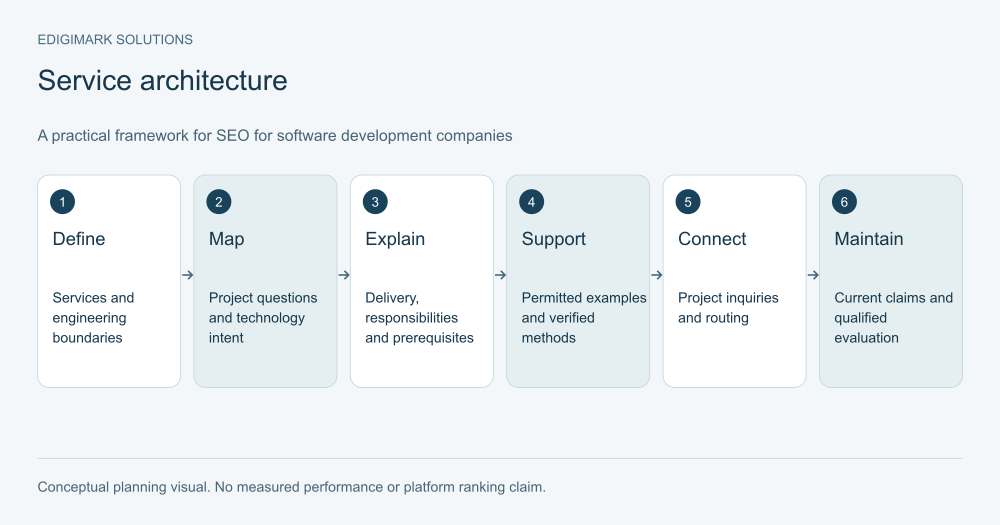
SEO for software development companies should help suitable clients evaluate engineering capability, delivery process and project fit. Build clear service pages, explain verified technology experience and publish useful examples of technical decisions. Connect those resources to a realistic discovery process, then review qualified project inquiries rather than relying on traffic totals alone.
A client choosing a development partner needs more than a list of frameworks. They need to understand the work the company can own, the information required to scope it and how delivery and handoff are handled. Search content is useful when it makes those decisions clearer.
This guide focuses on development agency SEO, including software development service pages, technology SEO keywords and industry development content. It does not prescribe one technology stack or promise that any page will rank. The planning examples are hypothetical and require adaptation to the company’s actual capabilities.
In this guide
- Which priorities guide SEO for software development companies?
- How should technology SEO keywords be researched?
- What should software development service pages explain?
- When does a development agency technology page deserve its own URL?
- How should industry development content show useful specificity?
- How can development agency content demonstrate engineering reasoning?
- What should a development case study contain?
- How should development agencies compare delivery models?
- What should an illustrative development content plan include?
- What can a development company’s own website demonstrate?
- How should the project inquiry path qualify demand?
- How should development agency SEO be measured?
- How should engineers and writers collaborate efficiently?
- Frequently asked questions
- Make engineering capability understandable and verifiable
Which priorities guide SEO for software development companies?
Write the services the team currently delivers and the responsibilities it accepts. Discovery, custom application development, modernization, integration and ongoing maintenance are different engagements. Clarify where one ends and another begins.
Describe suitable project conditions. The company may specialize in certain application types, stages or technical environments. Those conditions can help the right buyer recognize fit and reduce inquiries the team cannot responsibly accept.
Distinguish capability from general familiarity. A developer having explored a framework is not equivalent to a team being prepared to deliver and maintain a project with it. Use the delivery owner’s verification before publishing a service claim.
Record exclusions and dependencies. A project may require client access, existing documentation or a discovery stage before an implementation estimate. Keep those conditions visible instead of using a universal fixed-time promise.
Connect the scope with digital marketing services. The search program should reflect the engineering offer, rather than broaden it merely to match attractive phrases.
How should technology SEO keywords be researched?
Begin with the buyer’s project task. A query about migration planning, an API integration or a development partner can represent different needs even when the same technology name appears. The task determines what evidence and page format are useful.
Collect approved summaries from discovery calls and project preparation. Identify recurring requirements, misunderstandings and questions that determine fit. Keep confidential architecture or prospect information out of public briefs.
Distinguish learning intent from vendor evaluation. A code tutorial may attract developers who want a direct solution rather than a commercial engagement. It can still be useful, but the roadmap should explain why that audience matters to the company.
Review demand evidence and uncertainty. Current search observations can support planning; tool suggestions remain hypotheses until checked. Do not invent search volumes, technology adoption figures or growth rates to justify a topic.
Map each important query group to an owning task and resource. Combine variants that ask the same question, and separate genuinely different decisions. A page for every framework-and-industry combination can create a large library without useful depth.
What should software development service pages explain?
Open with the service and appropriate project situation. Explain what the team produces, how the work begins and what the client must supply. A buyer should understand the engagement before reading a generic list of benefits.
Describe deliverables in terms the company can verify. Discovery outputs, implemented features, documentation and handoff activities should reflect the actual offer. Avoid implying that every engagement includes all possible services.
Explain the process without making an unsupported timeline promise. A useful page can describe discovery, planning, implementation, review and handoff while stating that scope depends on requirements. The sequence should match the team’s real method.
State collaboration responsibilities. Who supplies domain decisions? Who approves changes? Who owns access and acceptance? These questions help a client prepare and distinguish a suitable engagement from a vague outsourced development promise.
Offer an appropriate next step. A discovery conversation can gather the problem, current system and desired outcome before scope is proposed. Explain what information is useful and what should be shared later through an approved process.
When does a development agency technology page deserve its own URL?
Create a technology page when the company can explain a distinct verified capability and buyer decision. The resource might describe an implementation approach, migration concern or relevant integration pattern. A list of logos is insufficient by itself.
Explain what the team does with the technology. Describe application types, responsibilities and relevant conditions. Avoid claiming that a tool is universally best simply because the company offers services involving it.
Use current primary documentation for specific technical claims. If the page mentions a version-dependent function, verify the version and condition. A historical experience should not silently become a promise about every current release.
Connect technology and service meaningfully. The reader should understand which engagement fits their need, while the owning service page remains responsible for delivery scope. Do not duplicate the complete service explanation on every stack page.
Maintain an evidence owner for important claims. Technology pages can become stale as interfaces and supported configurations change. Review them when the relevant capability or delivery method changes, rather than only during an annual content campaign.
How should industry development content show useful specificity?
Choose an industry only when the company has relevant verifiable knowledge. Explain the workflow, system relationships and operational constraints that affect a project. Merely replacing the industry name in a standard template does not provide that context.
Separate domain experience from regulated expertise. The fact that a team has built an application in an industry does not automatically establish every certification or assurance a buyer might require. Material claims need the responsible specialist’s verification and approved scope.
Describe what must be discovered before choosing an implementation. A workflow may involve several actors, existing systems and exception paths. The content can provide preparation questions without pretending to know the client’s full environment.
Use permitted case material or a labeled hypothetical example. Protect sensitive business and technical details. A conceptual workflow can help a reader understand the approach without implying it belongs to an identifiable client.
Link to the relevant service and technology resources where useful. The industry page should explain context, not become a disconnected promotional landing page that repeats every capability.
How can development agency content demonstrate engineering reasoning?
Publish explanations of genuine technical decisions the team can discuss publicly. For example, a resource can show how to assess data ownership in an integration or prepare a modernization assessment. The value lies in the reasoning and conditions, not only the final recommendation.
Describe alternatives under consistent criteria. Explain which requirement makes an option suitable and which tradeoff matters. Avoid presenting one stack as universally superior when project constraints vary.
Use a worked example to make the method concrete. Clearly identify hypothetical assumptions and show how changing one assumption affects the decision. This can be more informative than a broad list of best practices.
Separate observation from measured result. A developer’s reasoned interpretation can be useful, but it should not be labeled as a benchmark unless a benchmark was actually conducted. Explain the method when publishing test results.
Attribute actual specialist involvement honestly where published. Do not invent a reviewer, profile or credential to make an article appear more authoritative. The evidence should be useful on its own terms.
What should a development case study contain?
Begin with an approved starting situation and scope. Explain the problem the work addressed, the relevant constraints and the team’s responsibility. Avoid giving the impression that the provider owned work completed by other parties.
Describe the decision process and delivery. Show why a particular approach fit the requirements and what was implemented. Permitted diagrams and annotated screenshots can clarify architecture, but they must not reveal sensitive details.
Report only outcomes the evidence supports. If the project delivered a working feature, state that fact. If a performance improvement is claimed, provide comparable measurements, conditions and a method. A successful release does not automatically establish a revenue improvement.
Keep client permissions and public evidence scope clear. A logo or quotation should not imply endorsement beyond what the company is authorized to publish. An anonymized case still needs a truthful account of the underlying work.
If a result cannot be published, choose an appropriate alternative. A method guide or conceptual example can demonstrate reasoning without inventing numbers or disguising private work as a public case.
How should development agencies compare delivery models?
Explain options such as a scoped project, ongoing team support or a discovery engagement according to the company’s actual offer. Use consistent criteria: responsibility, preparation, collaboration, change handling and handoff. A reader should understand the practical differences.
Avoid treating one model as universally superior. A defined task can fit a scoped engagement, while uncertain requirements may need discovery before implementation. The useful explanation identifies conditions that change the choice.
State what requires a separate agreement or review. Public content can describe the process, while specific commercial and contractual details belong to the appropriate engagement discussion. Do not promise a generic arrangement for every client.
Include the client’s operating responsibilities. Ownership of requirements, acceptance and ongoing administration can influence success. A page that describes only the agency’s activity leaves an important part of the decision unexplained.
Connect the comparison to a preparation resource or suitable inquiry action. The next step should help the buyer resolve uncertainty rather than push them toward a model before their task is understood.
What should an illustrative development content plan include?
Imagine a hypothetical agency focusing on application modernization and integration. Its current website lists many frameworks but leaves discovery and handoff unclear. Sales repeatedly explains how the agency assesses the current application, establishes data ownership and scopes the implementation.
The first release improves the two owning service pages. Each explains deliverables, client responsibilities and prerequisites. A modernization preparation guide helps readers collect useful context, while an integration decision resource explains record ownership and exceptions through a labeled conceptual example.
A technology page is added only when the delivery team can verify a distinct capability. An industry resource follows when relevant workflow evidence is available. The plan excludes speculative combinations that would offer little beyond substituted names.
The inquiry action asks for the business problem and current system at an appropriate level. Sensitive code, credentials and detailed configuration are handled through the later approved process. The team verifies routing and response ownership.
The plan creates useful evaluation resources without assuming a performance result. Actual discovery observations and inquiry fit would guide later work. The example shows a prioritization method, not an Edigimark client case.
What can a development company’s own website demonstrate?
The public site can show attention to clear explanation and delivery, but it should not be presented as proof of every engineering capability. Assess the actual audience journey: navigation, readable content, working examples and a reliable inquiry route.
Check important content in the delivered page. Google’s developer SEO guide recommends inspecting how the site is seen and using discoverable links. For a technical service company, the practical review should also confirm that demonstrations and assets work outside the editing environment.
Use meaningful text alongside visual material. An architecture illustration should have a useful explanation rather than require readers to infer its purpose from unfamiliar symbols. A screenshot needs an accurate label and relevant context.
Use web development to resolve template, rendering or form issues. Give implementation tasks a reproducible problem and acceptance condition so the result can be checked.
Maintain public resources as the offer changes. A technology rename, retired service or new delivery boundary should trigger review of affected pages and links. Consistency is part of the website’s usefulness.
How should the project inquiry path qualify demand?
Ask for the information needed to decide whether a conversation is appropriate. A project goal, current context and desired type of help may be enough initially. Avoid making a general form the collection point for secrets or sensitive technical files.
Explain what the first discussion provides. It may clarify requirements and fit rather than deliver a final estimate. A clear expectation is more useful than implying that every request receives an immediate fixed-price proposal.
Test the website-to-business handoff. Use CRM integration where records need reliable routing and context. Confirm that the receiving team can distinguish project types and takes responsibility for the request.
Review friction through conversion rate optimization when evidence supports a specific hypothesis. Simplifying an action should preserve the information needed for useful qualification.
Record why inquiries do not fit. Unsupported technology, unsuitable scope and lack of preparation require different editorial or business responses. Do not place every rejected request under one unexplained poor-quality label.
How should development agency SEO be measured?
Separate discovery, inquiries and accepted project evaluations. Use data analytics to align periods, channel definitions and event delivery. A traffic chart cannot establish that the agency attracted work it can serve.
Review page families against project fit. A tutorial can attract a relevant technical audience while generating few direct inquiries. A service resource can attract fewer visitors while answering a decisive buying question. Explain the intended role before comparing them.
Use approved sales feedback to identify unclear scope. If the same prerequisite repeatedly needs explanation, improve the owning page. If appropriate inquiries fail to reach the team, fix routing before commissioning another content batch.
Keep attribution limits visible. Project decisions can involve several people and offline conversations. Report the chosen model and observed outcomes without claiming a complete causal account of every influence.
How should engineers and writers collaborate efficiently?
Give engineers specific review questions. Ask whether a prerequisite is correct, whether a proposed example reflects the method and whether a capability claim exceeds current delivery scope. A precise review request makes limited specialist time more useful.
Let editors handle explanation and navigation while preserving conditions. Simplifying a sentence should not erase the exception that changes its meaning. Use a shared factual record for claims appearing across several pages.
Keep an evidence backlog for topics not yet ready. A benchmark may need a test, an industry claim may need specialist input and a case study may need permission. The availability of a draft does not make those dependencies disappear.
Reserve maintenance capacity. Technical content is a continuing responsibility, especially when it names versions, interfaces or implementation approaches. Publish a resource set the team can keep accurate.
Frequently asked questions
Should development companies publish pages for every framework?
Only where they can explain a distinct verified capability and useful buyer task. A long set of logo pages may add little information and create a maintenance burden.
Can technical tutorials support agency SEO?
They can serve a relevant audience when the company has useful knowledge to share. Define their role and connect suitable next resources without assuming every tutorial reader is a project buyer.
How do we show expertise without public client data?
Use verified methods, permitted examples and clearly labeled hypothetical decisions. Do not invent results or reveal confidential work to make the content appear stronger.
Should service pages promise a delivery timeline?
Use only timelines the company can responsibly support under stated conditions. When scope is uncertain, explain discovery and the factors required before a project schedule is agreed.
What should count as a qualified development inquiry?
Define fit using the actual service, project context and delivery capacity. An inquiry should not become qualified merely because it mentions a technology the site covers.
Make engineering capability understandable and verifiable
Build clear service resources, explain useful technical decisions and connect an appropriate discovery route. Maintain the facts as the offer evolves. Contact Edigimark with your services, evidence and current website to scope a development company SEO plan.