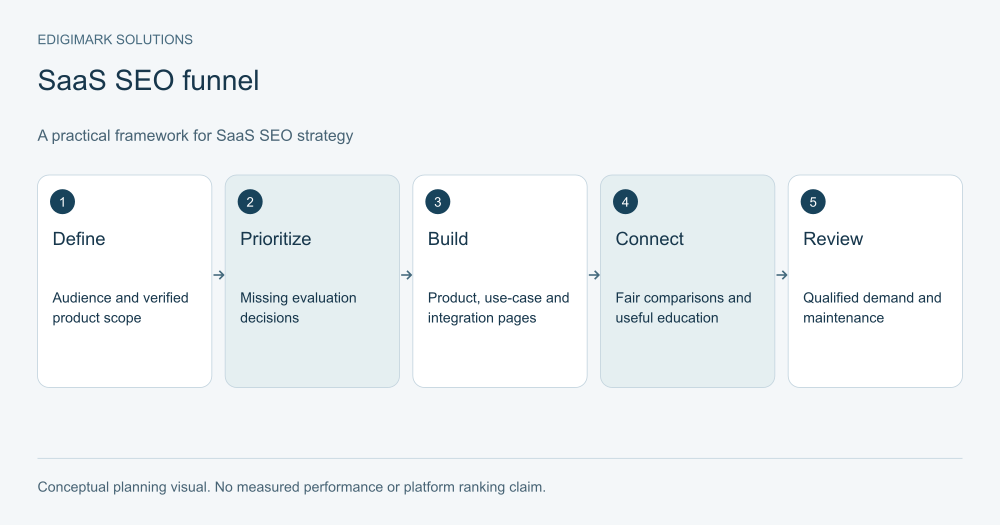
A useful SaaS SEO strategy prioritizes the pages that help the right customer understand the product, evaluate fit and take an appropriate next step. Build accurate product, use-case, integration and comparison resources before expanding a large educational library. Connect the resources through meaningful links and judge progress using qualified demand alongside search observations.
There is no universally best page sequence. A mature product with clear demand may need stronger comparison resources; a new category may need explanations of the problem and workflow. Start with the audience, current product capability and actual evaluation questions. A template copied from another SaaS business cannot supply those facts.
This guide focuses on page selection and content architecture. It provides a practical SaaS product page SEO framework without promising rankings or assuming that a visit becomes revenue. The examples are hypothetical and should be adapted to verified product capabilities.
In this guide
- What should a SaaS SEO strategy clarify before keyword research?
- Which SaaS pages should you build or improve first?
- How should SaaS product page SEO explain capability?
- When do SaaS use-case pages add useful detail?
- What makes SaaS integration pages credible?
- How should SaaS comparison pages treat alternatives?
- How do SaaS content clusters connect education to evaluation?
- What technical delivery issues deserve attention on a SaaS site?
- How should a SaaS SEO strategy connect with conversion?
- What would an illustrative SaaS page roadmap look like?
- How should teams maintain SaaS product evidence?
- What should the SaaS SEO review report show?
- Frequently asked questions
- Build the SaaS evaluation journey before scaling the library
What should a SaaS SEO strategy clarify before keyword research?
Write the product’s useful job and intended customer in specific terms. “A platform that transforms work” does not tell a researcher which tasks matter. “A tool for assigning and tracking service requests across a distributed operations team” creates a more concrete starting point.
Document prerequisites and constraints. The product may require an existing system, work only with selected data types or offer certain functions on particular plans. Those conditions belong in the product truth record before writers create pages around broad capability phrases.
Separate the user from the buyer where necessary. Someone searching for a workflow tutorial may use the tool, while someone comparing deployment approaches may approve it. Both can be relevant, but they need different evidence and next steps.
Review real evaluation questions with sales and product teams. Record questions that recur, objections that reveal poor fit and facts prospects repeatedly misunderstand. Use sanitized summaries rather than exposing private prospect details. This creates an evidence-based planning input without inventing search volume.
Coordinate the resulting scope through digital marketing services. The SEO program should explain the actual offer and connect with product-led or sales-led acquisition as appropriate.
Which SaaS pages should you build or improve first?
Audit existing pages against useful decisions. Identify where readers can understand the core product, assess their workflow, verify compatibility, compare approaches and begin an evaluation. A missing decision resource can be more urgent than another broad awareness article.
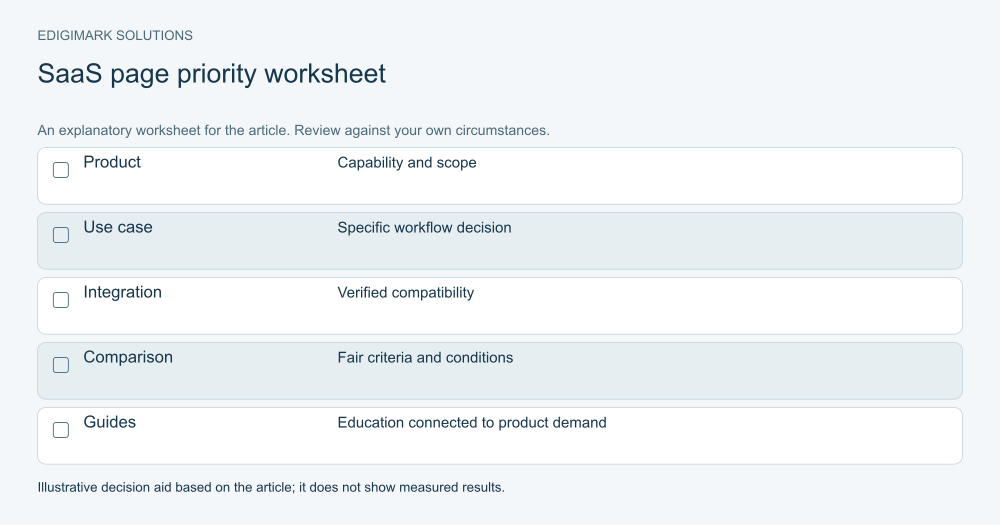
Use a priority worksheet with five page families: product, use case, integration, comparison and education. For each candidate, note the audience, evidence available, owning URL, appropriate action and maintenance responsibility. Include a practical reason for its priority.
Check whether an existing page already owns the task. If two pages explain the same capability to the same audience, improve the clearer resource or distinguish their purposes. A new keyword variation does not automatically justify another URL.
Treat commercial relevance as one factor, not a license to write sales copy that omits conditions. A high-intent page still needs a useful answer. The best priority is often where genuine audience need, product fit and publishable evidence overlap.
Avoid assigning precise traffic or pipeline forecasts without a defensible model. A planning estimate should show assumptions and uncertainty. The roadmap can remain useful when demand evidence is qualitative, provided it says so.
How should SaaS product page SEO explain capability?
Start with what the product does, who it serves and the important qualification. Explain the workflow in concrete terms before listing secondary benefits. Buyers should understand the offer without translating abstract brand language into operational meaning.
Show supported functions with accurate screenshots or demonstrations where available. Label illustrative diagrams as illustrations. Do not imply that a conceptual screen is an actual released feature, and do not publish a future roadmap item as an existing capability.
Make boundaries easy to find. Explain plan dependencies, setup requirements and meaningful exclusions. A limitation hidden below several promotional sections can make the opening promise misleading. Put decisive conditions close to the capability they affect.
Connect the page to a suitable action. A self-service product might offer a trial; a complex implementation might need a demo or readiness conversation. Describe what happens next so the reader can judge the commitment.
Have product owners verify terminology and availability. Maintain a fact record for claims used across the website so one feature change does not leave contradictory pages behind. Clear ownership matters more than a one-time launch review.
When do SaaS use-case pages add useful detail?
A use-case page is valuable when a workflow changes the reader’s evaluation. For example, assigning internal requests and managing external customer requests may share a tool but differ in permissions, communication and reporting needs. Explain the actual differences.
Build the page around the starting problem, actors, steps, prerequisites and observable result. Avoid merely replacing an industry name inside generic product copy. A reader should learn something specific about their situation.
Explain how the product fits and where another approach may be appropriate. A small team with a simple process may not need the same deployment as a complex organization. Useful qualification can reduce confusion even when it narrows the potential audience.
Use approved examples or a clearly labeled hypothetical workflow. A diagram showing request intake, assignment, completion and review can clarify the process without pretending to prove customer performance. Measured claims require an actual method and source.
Link to the owning product and implementation resources when the reader needs detail. A use case should not duplicate every specification; it should connect the relevant facts to the audience’s decision.
What makes SaaS integration pages credible?
Publish SaaS integration pages only for verified connections or clearly described implementation approaches. Distinguish a native connection, a third-party connector, an API-based project and a manual export. These approaches have different responsibilities and limitations.
Describe the supported workflow rather than relying on two logos. Which records move, in which direction, under what trigger and with what prerequisites? Readers should understand whether the integration solves their actual problem.
Explain ownership and failure handling at the appropriate level. State what the product does and what the customer or implementation partner must configure. Avoid implying that every combination of fields or system editions is supported.
Keep technical references current. If detailed setup instructions are maintained elsewhere, link to the owning documentation and summarize the important business conditions. Do not create a stale marketing version of a procedure that changes frequently.
Use CRM integration when evaluating the wider handoff between product, website and sales records. The service should be scoped to the actual systems and workflow, rather than inferred from an integration keyword.
How should SaaS comparison pages treat alternatives?
Use consistent criteria that matter to the buyer. Compare workflow fit, requirements, capabilities, implementation responsibilities and relevant cost components under stated assumptions. A useful comparison lets readers see how the choice changes with their situation.
Verify facts about each named alternative from current primary documentation. Record the review date and avoid converting a plan-specific limitation into a universal statement. If a fact cannot be checked, leave it unresolved or narrow the comparison.
Declare your relationship to the product. A vendor’s comparison can still help buyers when its perspective and method are clear. Invented independence, fabricated tests or unverified user ratings undermine that usefulness.
Include conditions where another approach fits better. A simple process might work with an existing tool; a specialized requirement may need a different product. Honest qualification supports a more informed evaluation.
Maintain the page as products change. SaaS comparison pages are not permanent launch assets. Assign an owner and a review trigger for important capability or packaging changes. Fairness depends on the current details, not only the original wording.
How do SaaS content clusters connect education to evaluation?
Choose a topic cluster around a coherent task. For a request-management product, the cluster might cover intake design, ownership rules, escalation and reporting. These resources share context while each answers a distinct operational question.
Use educational pages to explain the problem and decision, then connect them to the relevant product or use case where useful. Readers should not have to navigate an unrelated blog archive to understand the next step.
Let the owning page hold the deepest answer to a task. A broad guide can summarize a setup concern and link to technical documentation. A comparison can link to the verified integration explanation. Avoid repeating the same full answer across several resources.
Link with descriptive language and a real destination. Google Search Essentials includes crawlable links among its core practices. For readers, the more important editorial test is whether the link promises useful information that the destination actually supplies.
Review the cluster after publication. Missing links, obsolete pages and confusing overlap can appear as the product library grows. A simple task map helps editors preserve a coherent resource set.
What technical delivery issues deserve attention on a SaaS site?
Check that important public explanations are accessible outside the authenticated application. A marketing page that depends on a login cannot serve the same discovery role as a public resource. Product access and public education can have different requirements.
Inspect titles, descriptions, heading structure, images and important content on the actual public URL. Confirm that the intended page is delivered, links work and meaningful information is not lost in the template. Use the site’s appropriate inspection tools for indexing questions.
Review mobile navigation and the evaluation action. A demo form can become difficult to use on a small screen even when the main article is readable. An important comparison table should remain understandable without requiring readers to guess which values belong together.
Use web development when delivery problems require implementation changes. Keep each issue tied to a page, reproducible behavior and acceptance condition. “Improve SEO” is not a sufficient development task.
Maintain URLs deliberately. When a product capability is renamed or retired, review the destination, public scope, links and any migration needs. An old page should not continue promising unavailable functions merely because it once attracted visits.
How should a SaaS SEO strategy connect with conversion?
Match the next step to readiness. A reader learning a category may need a practical guide; a reader checking compatibility may need documentation; a reader comparing options may need an evaluation conversation. One aggressive demo prompt cannot serve every stage equally well.
Explain what the action requires. State whether it begins a trial, sends a request or books a conversation. Keep the request proportionate to the task. Asking for extensive implementation detail before providing a simple answer can obstruct useful evaluation.
Test the full path, including receiving systems and response ownership. A form confirmation does not prove the sales team received the request. Document how suitable inquiries are handled and what happens to unsuitable ones.
Use conversion rate optimization to investigate specific friction in the journey. Change the explanation or interaction because evidence supports a hypothesis, then inspect the outcome under comparable definitions.
Avoid treating every submission as qualified demand. Sales and marketing should agree on fit criteria and report reasons for rejection. A page can generate many requests while failing to attract the customers the product can serve.
What would an illustrative SaaS page roadmap look like?
Imagine a hypothetical service-request product. Its current website has a broad homepage and several unrelated productivity articles. Sales repeatedly explains who owns a request, how notifications work and which systems can supply intake records. Those documented questions define the initial roadmap.
First, improve the product page with a clear workflow, prerequisites and verified scope. Next, add a use-case page for internal operations requests. Then publish an integration explanation for a connection the technical team has actually tested. A fair comparison page follows when the team can verify alternatives under consistent criteria.
The supporting cluster covers intake information, ownership design and escalation decisions. Each article owns one task and connects to the appropriate product resource. The roadmap excludes speculative integration pages until the underlying capability is established.
The team records launch dates and qualification rules. If inquiries reveal confusion about a plan requirement, it corrects the relevant page. If the demo handoff fails, it fixes delivery. It does not assume that another batch of awareness articles will solve either problem.
This example demonstrates prioritization, not a reported client result. The business would still need its own evidence, product approvals and measurement to assess performance.
How should teams maintain SaaS product evidence?
Create a small shared record for important public claims. Include capability, condition, owning documentation, approving specialist and review trigger. This supports consistent wording across product, integration and comparison pages.
Tie content review to product changes. A new integration version, retired feature or packaging change should trigger review of the pages that reference it. The content team needs to know which claims depend on the change, rather than discovering contradictions through customer complaints.
Separate roadmap communication from released capability. A future feature can be discussed accurately as planned when the company approves that communication, but it should not appear in a current capability table as available. Preserve the distinction in metadata and visual labels too.
Keep correction records brief and useful. Note what changed, which resources were checked and who approved the update. This makes maintenance repeatable as the product library grows.
What should the SaaS SEO review report show?
Report the important page families and the audience decisions they support. Include current publication or delivery issues, observed search demand and qualified inquiry patterns. Use data analytics to align definitions and inspect changes in tracking before interpreting trends.
Keep attribution limits visible. An educational page may contribute to an evaluation without receiving the final tracked click, while a branded visit may reflect several earlier influences. Explain the model used rather than assigning all value to the last visible page.
Use the report to prioritize the next correction or release. A product scope gap, unsupported integration claim or confusing comparison criterion can be more actionable than a broad site average. Make the decision and responsible owner clear.
Frequently asked questions
Should SaaS companies start with blog posts?
Start with the most important missing audience decision. Product and evaluation resources often deserve attention, but a new category may also require useful education. Audit the current journey before choosing a page type.
Can we publish pages for every integration keyword?
Only publish claims the product or delivery team can verify. Describe the actual connection and conditions. Keyword demand does not establish compatibility or justify misleading capability pages.
Are competitor comparison pages useful?
They can help buyers when the criteria are relevant, facts are current and the vendor perspective is clear. Unverified ratings or selective comparisons weaken the resource.
How many pages should a SaaS content cluster contain?
Enough to answer its distinct useful tasks. A page count does not establish coverage. Expand when there is a real question, relevant evidence and maintenance capacity.
How do we know the strategy is attracting suitable buyers?
Review qualified inquiries and evaluation feedback under agreed criteria alongside discovery observations. Inspect which pages set accurate expectations, and record why inquiries do not fit.
Build the SaaS evaluation journey before scaling the library
Choose useful decisions, publish verified product evidence and connect the next step. Maintain the page families as the product evolves. Contact Edigimark with your product, audience and existing pages to scope a SaaS SEO roadmap that supports informed evaluation.