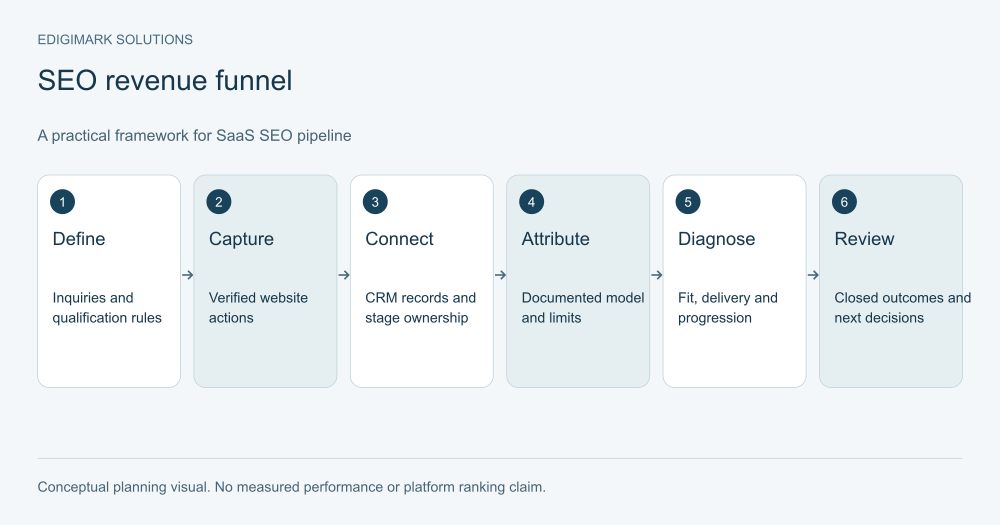
To build a SaaS SEO pipeline, connect relevant search visits to recorded inquiries, agreed qualification stages and the sales opportunities they actually become. Define those stages before reporting results, verify the website-to-CRM handoff and review lead fit alongside discovery. Organic traffic can support pipeline, but traffic totals alone do not establish qualified demand or revenue.
The practical challenge is continuity. A search visit happens in one system, a request in another and a commercial outcome later in the CRM. Different teams may also use different definitions of a lead. A useful measurement process resolves those differences and makes the remaining attribution limits clear.
This guide focuses on organic lead qualification and measurement. It complements page planning by showing how to diagnose where a relevant audience loses momentum. The examples are illustrative; they do not describe measured Edigimark client results.

In this guide
- What exactly counts as a SaaS SEO pipeline?
- How should you define SEO MQL to SQL stages?
- Which website actions should enter the organic lead process?
- What information should the website-to-CRM handoff preserve?
- How should organic pipeline attribution be presented?
- How can offline qualification connect with online measurement?
- How do you diagnose a gap between organic traffic and leads?
- How do you diagnose leads that fail to become opportunities?
- How should SaaS organic revenue be measured?
- What does an illustrative SaaS SEO pipeline diagnosis look like?
- What should a useful organic pipeline dashboard contain?
- How can SaaS SEO pipeline definitions stay reliable as the product grows?
- Frequently asked questions
- Connect search demand with a reliable commercial process
What exactly counts as a SaaS SEO pipeline?
Define the business unit first. A self-service product may treat a paid subscription as the commercial outcome. A sales-led product may use an accepted opportunity with a documented need and scoped evaluation. Those are different processes and should not share an unexplained pipeline label.
Describe what makes a record organic under the chosen model. Is it the first observed acquisition channel, the inquiry session or an approved attribution rule? Write the rule explicitly. Otherwise two reports can disagree simply because they answer different questions.
Separate the record from the monetary estimate. An opportunity can exist before its value is reliable. If the CRM uses an estimated contract value, label it as estimated pipeline and explain the calculation. Do not present open opportunity value as collected revenue.
Include qualification and timing. A newly created inquiry may need review, and a recent cohort may not have had time to become an opportunity. Pipeline reporting should preserve those states rather than treating incomplete records as permanent failures.
Use data analytics to align definitions across the measurement systems. A clear business dictionary is a prerequisite for a meaningful dashboard.
How should you define SEO MQL to SQL stages?
Write the marketing-qualified lead definition in observable terms. It might include a relevant business type, a supported use case and a request that indicates evaluation. The actual criteria should match the company’s process, not a generic scoring template.
Define the sales-qualified lead separately. Sales may need to verify the problem, confirm scope and establish whether an evaluation is appropriate. A form asking for a demo does not by itself prove that those conditions exist.
Agree on who changes each stage and what evidence is required. Record the transition date, responsible owner and rejection or loss reason where useful. This lets the team distinguish poor fit from a delayed review or incomplete information.
Do not make qualification depend only on content engagement. Reading several articles can indicate interest, but it does not establish a compatible requirement or commercial readiness. Use behavioral observations alongside the necessary business evidence.
Review the definitions with sales on real sanitized examples. A vague rule such as “strong interest” can produce inconsistent classifications. If two reviewers disagree, clarify the criterion before interpreting the conversion rate.
Which website actions should enter the organic lead process?
List the important actions and their meaning. A newsletter subscription, documentation view, trial signup and demo request serve different purposes. Recording all of them as equivalent leads can inflate the apparent commercial contribution.
Choose the action that begins each relevant journey. A request should create an identifiable business record in the receiving system under the company’s approved data practices. A content download may belong to an earlier engagement category unless the business has a reason to qualify it differently.
Google Analytics’ recommended events distinguishes lead generation, qualification and later conversion events. Use those names according to their documented meaning where they fit your implementation, and define the company’s actual business criteria behind each transition.
Test whether the action succeeds. Confirm required fields, confirmation behavior, receiving destination and routing. Avoid counting a button click as a completed request if the submission can fail afterward. The measurement should match the real process.
Coordinate the handoff through CRM integration. The goal is reliable records and responsibility, rather than merely having a connection between two logos on an architecture diagram.
What information should the website-to-CRM handoff preserve?
Create a field dictionary for the minimum useful context. This might include inquiry type, relevant product or service, submission time and approved acquisition context. Keep definitions and formats stable enough that the receiving team can use them.
Identify which system owns each field. A later CRM update should not accidentally erase useful original context, and a website retry should not overwrite a verified qualification decision. Document the intended behavior for conflicting or missing values.
Plan duplicate handling. One person may submit twice, several people may represent one company and one company may have multiple evaluations. Decide how the CRM treats those situations before reporting pipeline totals.
Preserve a way to diagnose failures. Authorized teams need to know whether a request was accepted, rejected or retried and where responsibility lies. A silent failure can make a good page appear to produce no demand.
Avoid sending unnecessary personal information into analytics. Keep implementation aligned with current platform rules and the business’s approved data practices. Qualification detail can remain in the appropriate controlled business system while reporting uses suitable aggregated definitions.
How should organic pipeline attribution be presented?
Choose a model and state what it observes. First-touch acquisition can help describe where a relationship began in the available data. Inquiry-session attribution can help describe the final recorded website action. Neither captures every influence on a long evaluation.
Keep branded and nonbranded discovery distinct when the data supports it. A branded search can reflect earlier product exposure, a referral or a sales conversation. Assigning its entire outcome to a new educational page would require evidence beyond the final visit.
Explain identity and coverage limits. Cross-device visits, missing tracking context and offline interactions can leave gaps. A report should not quietly turn unknown context into proof that one channel did nothing.
Use Google’s lead acquisition report documentation to understand that report’s channel and metric scope. Its qualified-lead measure is based on users with the relevant event, so it should not be assumed to equal the CRM’s count of distinct opportunities.
Show influenced activity only under a stated rule. For example, an account might have viewed a selected resource before opportunity creation within a chosen window. Label that observation carefully; it does not establish that the resource caused the opportunity.
How can offline qualification connect with online measurement?
Start with the business workflow and a reliable CRM stage record. Decide which approved transitions are useful to report in another system and how they will be validated. Avoid exporting every internal note merely because a technical connection allows it.
For GA4 implementations that need additional server-side or offline events, Google’s Measurement Protocol documentation describes a mechanism that supplements existing collection. It is not a promise of complete attribution, and implementation should follow the current technical requirements and policies.
Assign an implementation owner to validate the chosen approach. The owner should check event meaning, identifiers, permitted fields, delivery and duplicate behavior. A successful request to an endpoint does not prove that the eventual report reflects the intended business definition.
Reconcile a controlled sample against the CRM. Select approved test or appropriate historical records, inspect the transition and compare the receiving report under its own scope. Resolve discrepancies before using the report to make acquisition decisions.
Keep a correction path for mistaken transitions. Sales processes change and people can misclassify records. The reporting design should explain how corrections appear and whether historical comparisons need qualification.
How do you diagnose a gap between organic traffic and leads?
Begin with audience relevance. Inspect which pages and query groups bring visitors where that data is available. A broad educational topic can attract people who have no need for the product. Strong traffic from that audience does not automatically indicate an effective commercial journey.
Next, inspect the promise. Does the page explain the actual product and its conditions? A generic benefit claim can attract interest while setting expectations the product cannot fulfill. Review the mismatch before making the action more prominent.
Check the next step. A reader evaluating compatibility might need verified requirements before booking a demo. A reader ready to evaluate might be blocked by a vague call to action or an unnecessarily difficult form.
Verify delivery and routing. If requests fail or arrive without useful context, the acquisition team may misdiagnose a technical or operational problem as a content problem. Test the full path, not only the visible page.
Use conversion rate optimization to examine a specific hypothesis about friction. Define the expected behavioral change and any quality measure before altering the journey.
How do you diagnose leads that fail to become opportunities?
Review rejection reasons under consistent categories. Unsupported use case, incompatible organization, incomplete information and lack of readiness imply different actions. A single “bad lead” label is too broad to guide improvement.
Check whether the page communicates the decisive qualification condition. If many requests concern an unavailable deployment option, make that boundary easier to understand. The goal is appropriate expectations, even if accurate qualification reduces raw submissions.
Inspect response ownership and time records. A suitable inquiry can stall because nobody accepts responsibility or the receiving team lacks context. Content cannot fix a broken sales workflow by itself.
Review the MQL definition if sales rejects many records that satisfy it. The teams may be using incompatible criteria. Clarify the definition using examples rather than assuming that one team should accept the other’s count.
Avoid promising that an editorial change will solve every rejection. Some issues belong to product scope, delivery capacity or commercial fit. The SEO program should identify the constraint and route it to the appropriate owner.
How should SaaS organic revenue be measured?
Define the revenue unit and recognition used in the report. Contract value, first payment, recurring revenue and cash received are different concepts. Use the business’s approved definition and label it precisely rather than placing them under one generic revenue total.
Separate closed outcomes from open pipeline. Report the period of opportunity creation and the period of closure when both matter. A cohort that generated opportunities recently may need more time before its closed outcomes are comparable with an older cohort.
State the attribution model alongside the monetary figure. “Organic-associated closed revenue under our inquiry-session rule” is more informative than an unexplained SEO revenue number. Preserve unknown or mixed context instead of forcing every record into a confident assignment.
Avoid assigning a monetary value to a lead as though it were realized revenue. A modeled value can support internal planning when the assumptions are documented, but the label should make that distinction visible.
Reconcile business totals with the system of record. If a dashboard and CRM disagree, inspect filters, dates, duplicates, definitions and updates before declaring growth. A striking chart is not a substitute for a consistent calculation.
What does an illustrative SaaS SEO pipeline diagnosis look like?
Consider a hypothetical SaaS company receiving organic demo requests for a scheduling product. Marketing reports submissions, while sales reports accepted opportunities. The two numbers are different, but nobody has documented the stage criteria or whether repeat submissions create additional records.
The team first defines an inquiry, qualified lead and accepted opportunity. It reviews a sanitized sample and discovers three distinct problems: requests for an unsupported feature, duplicate inquiries from one evaluation and a routing failure that leaves some requests unassigned.
Each problem gets a different response. Product and editorial owners clarify the feature boundary on the relevant page. The CRM owner defines duplicate treatment. The operational owner fixes routing and confirms that a test request reaches the right team.
The revised report shows the definitions and any change in counting. It does not compare the new count with the old count as though both measured the same thing. After the measurement stabilizes, the team examines whether lead fit and opportunity progression improve.
This is a process example, not a measured success story. Its purpose is to show how qualification and delivery evidence create actionable work that a traffic chart alone would miss.
What should a useful organic pipeline dashboard contain?
Include relevant discovery observations, completed inquiries, qualification stages, accepted opportunities and closed outcomes under clear definitions. Display dates, attribution rule, coverage limits and any material tracking or process change.
Show rejection and loss reasons at a useful level of aggregation. They help the team decide whether to clarify scope, change a resource, repair delivery or review the audience. Protect sensitive detail and avoid turning an operational report into a public customer record.
Use denominators carefully. A rate between stages should use compatible records and a sensible observation period. Dividing opportunities created this month by unrelated submissions this month can create a misleading result when progression takes time.
Attach a decision and owner to important findings. A dashboard should lead to a defined change or investigation. Avoid celebrating a high number that nobody can connect to a useful business action.
How can SaaS SEO pipeline definitions stay reliable as the product grows?
Review qualification definitions when the product, audience or sales process changes. New use cases can alter which inquiries fit, and a new self-service path can change how commercial outcomes appear. Preserve the effective dates of those changes.
Use marketing automation for appropriate routing, reminders and status synchronization. Verify the business logic before automating it; a fast workflow with the wrong stage rule can spread errors more efficiently.
Keep a measurement change log. A renamed event, revised channel rule or CRM migration can affect comparisons. Analysts need to know when the observed series changed meaning, rather than attributing every variation to search performance.
Train contributors with concrete examples. Show which record qualifies, which remains under review and which fails the fit criteria. Shared definitions are easier to maintain when people can apply them consistently.
Frequently asked questions
Does more organic traffic mean more SaaS pipeline?
It creates more observed visits, but qualified pipeline depends on audience fit, product scope, the inquiry journey and sales progression. Review those conditions before assuming a commercial outcome.
Should every demo request be an MQL?
Use the company’s agreed criteria. A request can be relevant, unsuitable, duplicate or incomplete. Record the state accurately rather than applying qualification automatically to every submission.
Can GA4 replace the CRM for opportunity reporting?
Use each system according to its scope. Analytics can support acquisition observations, while the CRM may own commercial stages. Align definitions and reconcile records rather than assuming the counts are equivalent.
What is the right attribution model for SEO?
Choose a model that answers the business question and explain its limits. Several models can be useful, but none should be presented as complete causal proof of every influence.
How should we report pipeline before deals close?
Show accepted opportunities and any estimated value under clear definitions. Keep open pipeline separate from closed revenue, and explain that recent cohorts may still be progressing.
Connect search demand with a reliable commercial process
Define the stages, verify the handoff and inspect the reasons records progress or stall. Use those observations to improve content and operations together. Contact Edigimark with your current definitions, website actions and CRM workflow to scope an organic pipeline measurement plan.