A SaaS demand generation strategy connects a specific customer problem with useful content, relevant distribution, clear product evaluation and lifecycle follow-up. Start with the ideal customer profile and sales motion, then give SEO, paid media, partnerships, account programs and email distinct jobs. Judge the system by qualified evaluation and commercial progression, alongside the learning each channel provides.
SaaS introduces an additional constraint: acquiring interest in a promise is different from helping someone experience the product’s value. Your demand plan should lead to an evaluation the product and customer-success team can support. A large audience interested in a feature you cannot reliably deliver is an expensive distraction.
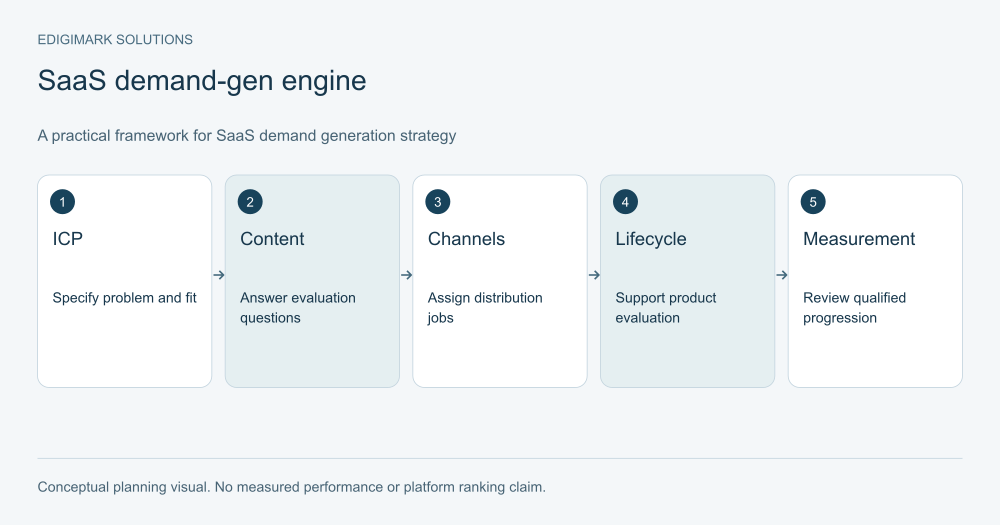
An editorial planning diagram; stages and examples are illustrative.
How do you define a SaaS audience before selecting channels?
Describe the company, recurring workflow problem, triggering event and implementation conditions. Include the people who experience the pain and those who approve technical or commercial risk. “All growing businesses” is rarely specific enough to guide an effective asset or campaign.
A hypothetical scheduling product might focus on multi-location service companies that coordinate staff availability manually. Its useful trigger could be adding locations or replacing a fragmented process. Its implementation condition might require a named operations owner and supported calendar systems. These details tell the team which questions to explain and which enquiries to qualify.
Use sales conversations, product research and support themes to identify repeated uncertainty. Do prospects misunderstand the workflow? Are they worried about migration? Does the integration list determine fit? Build the demand plan around those decisions rather than a calendar of broad productivity topics.
Keep segment exclusions visible. A technically capable product may still be unsuitable for a company with no process owner or unsupported data requirements. Clear exclusions help preserve sales time and the prospect’s time.
How does the sales motion affect demand generation?
A self-service product needs buyers to understand the use case and reach a meaningful product action without extensive human guidance. A sales-assisted product needs an evaluation route that brings the right people and information into a conversation. A hybrid product needs explicit rules for when assistance becomes useful.
Do not measure every motion by the same conversion. A trial registration can be useful for self-service, but a sign-up that never reaches a relevant product task may indicate curiosity rather than fit. A qualified technical assessment can be useful for enterprise evaluation even when it produces fewer form submissions.
Create a definition of a successful evaluation. It should describe evidence of product fit and a next decision, not merely the completion of a marketing action. For example, an authorized prospect may configure a representative workflow, assess a supported integration or confirm a rollout owner. The exact task depends on the product.
Coordinate this definition with product and sales. Marketing should not promise an evaluation experience that requires unavailable functionality or unplanned implementation assistance.
What should SaaS content demand actually address?
Develop content around the buyer’s uncertainty at each stage. Problem explanations help a reader recognize a relevant workflow issue. Use-case pages connect that issue to an accurate product capability. Comparison pages explain trade-offs. Integration and implementation resources support technical review.
| Buying task | Useful resource | Next meaningful action |
|---|---|---|
| Recognize a recurring problem | Diagnostic or operating guide | Assess whether the issue applies |
| Compare approaches | Transparent comparison | Shortlist an appropriate method |
| Check product fit | Use-case and compatibility information | Confirm relevant requirements |
| Assess implementation | Migration and rollout guidance | Identify the implementation owner |
| Evaluate value | Representative trial task or assessment | Decide whether to progress |
SaaS content demand is strengthened by useful specificity. Explain which data must be available, how permissions affect a workflow or which responsibilities remain with the customer. Avoid vague claims that a product “automates everything.”
Keep one authoritative explanation for frequently changing facts. If an integration capability changes, the product page, help resource, comparison and sales asset should be reviewed together. Contradictory descriptions can undermine a technically sound evaluation.
Edigimark’s digital marketing services can help organize these resources around a shared audience and buying journey rather than isolated channel calendars.
How should SEO capture existing SaaS demand?
Prioritize queries and pages that help the intended customer make a buying decision. Problem, use-case, integration and alternative questions often reveal distinct tasks. A broad introductory query may attract many readers while producing little useful evaluation.
Use actual search and sales evidence where available. Group questions by the decision they represent. If several variants ask the same underlying question, develop one substantial page instead of competing versions with minor wording changes.
Google’s Search Essentials provide the baseline for technical eligibility and useful search content. They do not offer a guaranteed traffic or pipeline formula. The commercial priorities described here are a planning method for choosing which useful pages to build first.
Link supporting resources to relevant product or service destinations. The link should help the reader continue the task. A migration explanation can lead to implementation requirements; a use-case resource can lead to a representative product evaluation. Internal links should explain the relationship rather than repeating the same promotional anchor everywhere.
What should paid media test before it scales?
Specify the audience, problem statement, offer and intended learning. Paid search can test whether explicit investigation of a use case leads to qualified evaluation. Audience-based distribution can test whether a relevant problem resonates with people who may not be searching yet.
These are different tests. Do not dismiss an educational asset because it does not behave like a high-intent commercial landing page, and do not evaluate a demo campaign solely through attention metrics.
Begin with a destination that accurately describes the offer. State the trial or assessment requirements and what happens next. Keep the ad’s promise consistent with the page and product experience. A strong click rate followed by unsuitable enquiries may reveal a misleading message rather than a successful acquisition strategy.
Track qualified outcomes back to the campaign where the data permits. Preserve unknown coverage. Avoid assuming that every trial created after an ad exposure was caused by the ad. Define the review period according to your actual sales and evaluation process.
Where do SaaS ABM channels fit?
Account-based programs are useful when a limited set of companies has meaningful value and the team can support a coordinated evaluation. They require shared account selection, stakeholder understanding and sales capacity. A list of company names alone is not an account strategy.
For a hypothetical enterprise workflow product, technical review, procurement and operational adoption may involve different roles. The program should supply relevant information for each: compatibility and architecture for technical reviewers, rollout responsibilities for operations, and transparent scope for commercial approvers.
LinkedIn’s account-based marketing course treats account segmentation, buying committees, content and measurement as connected responsibilities. The practical implication is to design the program around account decisions, not simply to upload a list and run an advertisement.
Use shared resources where the underlying questions are common. Reserve bespoke work for accounts where it helps a genuine decision. Personalization should reflect relevant needs and verified facts, without implying access to confidential information or inventing knowledge about an account’s internal problems.
How does SaaS lifecycle marketing connect interest to evaluation?
Let follow-up support the next task. A registered researcher may need a problem explanation. A trial user may need guidance for a specific product action. An active sales evaluation may need an implementation resource. A customer should enter an adoption path rather than remain in acquisition messaging.
Write enrollment, exit and suppression rules. The rules should consider preferences, product state, sales activity and the purpose of the original exchange. Avoid sending several overlapping sequences because the same person entered through different assets.
Do not overinterpret activity. Opening an email or visiting a page can justify a useful next resource, but it does not prove buying authority or product fit. Keep suitability and behavioral signals separate when reviewing qualification.
Marketing automation services can connect this content map with actual lifecycle states. The useful outcome is a coherent operating path with exception handling and accountable owners.
What data architecture supports SaaS demand measurement?
Connect marketing interactions, contacts, companies, evaluations and opportunities with documented identifiers and timestamps. Product activity can support evaluation analysis when collected and used appropriately. Finance remains the source for the commercial revenue definition your business adopts.
Decide whether each report counts people, accounts, trials or opportunities. Multiple users from one company can participate in one evaluation. Treating every user as a separate deal inflates apparent pipeline. An expansion opportunity should also remain distinguishable from a new-customer opportunity.
Define who owns the stage and each critical field. If the CRM owns sales status, the marketing system should not repeatedly overwrite it with stale data. If the product owns activation events, describe exactly which action constitutes the event and how duplicates are handled.
CRM integration services can support these relationships. Test the join using a real or authorized test journey, rather than assuming that connected applications produce trustworthy commercial data automatically.
Which SaaS demand measurement metrics belong in the report?
Show audience relevance, evaluation quality and commercial progression. Leading indicators can include meaningful engagement with decision resources or completion of a representative evaluation task. Commercial indicators include sales acceptance, opportunity progression, closed outcomes and the cost of the program.
Use cohorts to connect earlier activity with later outcomes. A long evaluation cycle means the prospects introduced this month may not be the deals closing this month. State the cohort event, observation period and sample size so comparisons remain interpretable.
Report quality alongside volume. If trial registrations rise while the intended segment’s activation falls, inspect the message and audience. If qualified assessments rise but opportunities stall, inspect implementation questions and sales follow-up.
Attribution is a view of recorded relationships rather than complete proof of causation. Keep unknown source coverage visible and supplement it with appropriate buyer-reported discovery information. Data analytics services can help combine these signals without giving incomplete tracking more certainty than it deserves.
How do you turn the strategy into a manageable operating cycle?
Choose one audience, one recurring problem and one evaluation route. Audit the resources that support that route, then fix the largest gap. A clear compatibility page may be more useful than launching another broad awareness campaign.
Write a hypothesis for each investment. A hypothetical integration guide might aim to reduce uncertainty about supported workflows. A paid test might assess whether a problem statement attracts the intended segment. A lifecycle change might help suitable trial users reach a meaningful product task.
Assign an owner, evidence source and review date. At the review, distinguish strategy findings from delivery failures. A broken form, missing product event or unassigned enquiry means the operating system failed; it does not reliably test demand.
Maintain a short backlog of buyer questions, content gaps, conversion problems and data issues. Prioritize by commercial relevance and effort. This keeps the strategy connected to actual learning instead of becoming a static annual slide.
What does a complete SaaS demand brief look like?
For the hypothetical scheduling product, the audience is a multi-location operator with recurring coordination difficulty. The buying group includes operations, a system owner and a commercial approver. The educational asset diagnoses process fragmentation; the evaluation resource explains compatibility and implementation; the commercial action is a scoped workflow assessment.
The brief defines exclusions, the responsible follow-up owner and the evidence required for acceptance. Distribution uses a small set of relevant search topics and one partner or paid test. Lifecycle messages respond to the requested task rather than automatically treating every reader as a sales-ready buyer.
The measurement plan records the initial interaction where available, the request, qualification decision, evaluation outcome and commercial stage. It also records unanswered questions and unknown tracking coverage. This makes the next investment decision more informed without claiming the entire journey is observable.
A SaaS demand generation strategy improves when buyer understanding, evaluation design and operational reliability improve together. Contact Edigimark to identify the first segment, evaluation route and channel responsibilities for your plan.
Which questions belong in the strategy worksheet?
Write the audience’s current workflow in plain language. Describe what becomes difficult as the company grows, what the product can change and which responsibilities remain with the customer. This prevents the channel plan from drifting into a generic promise about efficiency.
Record the minimum conditions for a useful evaluation. Does the prospect need a representative data set? A system administrator? Agreement on a pilot team? If these conditions are unavailable, the next useful step may be preparation rather than an immediate trial.
Name the evidence owner for every important claim. Product owns capability accuracy, implementation owns rollout requirements, sales owns commercial scope and analytics owns metric definitions. A writer should be able to identify where a factual statement will be checked before publication.
Document the intended channel role in one sentence. “Capture people investigating this supported use case” is clearer than “grow SEO.” “Test whether this problem statement resonates with this segment” is clearer than “scale paid.” This makes the report easier to interpret when several channels run together.
Finally, specify the next investment decision. The team may decide to expand a useful integration topic, improve a stalled evaluation resource or stop an unsuitable audience test. Write the evidence required for that decision before reviewing results. Otherwise, the same data can become a justification for whichever action was preferred from the beginning.
The completed worksheet should connect audience fit, evaluation conditions, claim ownership, channel responsibility and a review decision. It is useful because another team member can inspect the plan and understand what to do next without relying on the original strategist’s assumptions.
Frequently asked questions
Should a SaaS demand strategy prioritize trials or demos?
Choose the action that matches the sales motion and product evaluation. A trial works when users can reach meaningful value with the available guidance. A demo or assessment may fit products requiring technical review or coordinated implementation.
Can a new SaaS product use demand generation before it has customer results?
Yes. Explain the problem, capabilities, prerequisites and evaluation method honestly. Use clearly labeled illustrative examples. Do not substitute invented case studies or measured outcomes for evidence you do not have.
Are SaaS ABM channels necessary for every product?
No. Account programs suit specific economic and organizational conditions. A self-service product serving a broad market may benefit more from scalable search, product education and lifecycle work than bespoke account campaigns.
What if the team gets many trials but few qualified accounts?
Inspect the audience, promise, product-fit criteria and evaluation task. Registration volume can conceal a mismatch. Review cohorts and relevant product behavior before deciding to increase acquisition spend.
Who should own the strategy?
A named marketing owner should coordinate the plan with product, sales, customer success and analytics. Those teams own important parts of evaluation and commercial progression, so the strategy needs shared definitions and feedback.
Put the ideas to work
Explore our connected growth services →