On-page SEO is the work of making an individual page relevant, clear and useful for the people it is meant to serve. It includes choosing the right task, writing an accurate title and opening, organizing headings, explaining entities, adding reliable evidence and connecting readers to appropriate resources. The work should improve the page’s purpose, not merely increase keyword repetition.
A page can pass a tool’s checks while failing its audience. It might have a keyword in the title but never explain the service’s scope. It might contain many headings but omit the prerequisites a buyer needs. Start by deciding what someone should understand or do after reading, then optimize the elements that support that outcome.
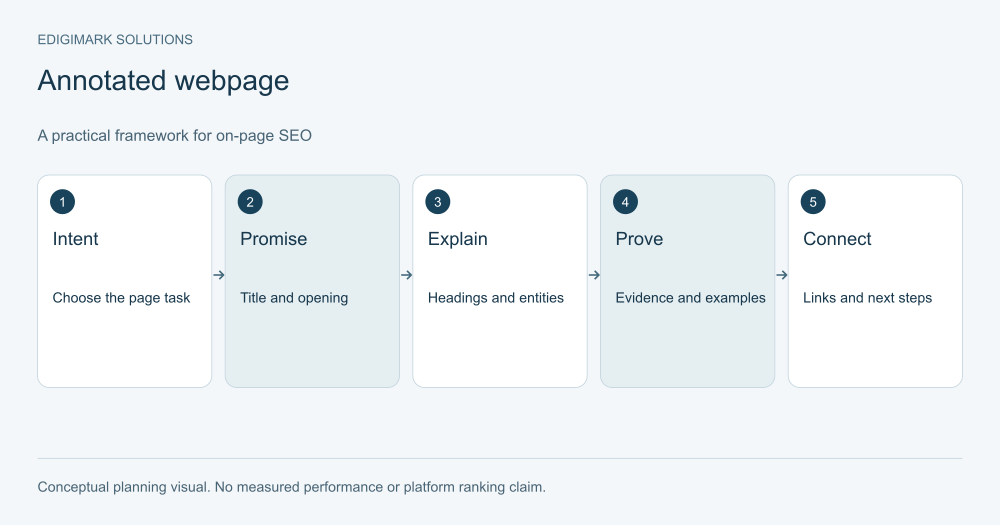
Conceptual framework for on-page SEO; examples are illustrative.
How does page search intent guide on-page optimization?
Define the task before editing. Is the reader learning a concept, comparing alternatives, evaluating a service or solving a specific problem? These tasks can share vocabulary while requiring different page types. A service page should explain the offer; a tutorial should help complete the task; a comparison should make tradeoffs visible.
Review current results for the intended query and compare them with your actual customer questions. The results are evidence about available interpretations, not an instruction to copy their headings. If your audience’s need is narrower, state the scope clearly and build a page that addresses it well.
For a hypothetical integration company, “CRM integration” could mean a definition, a connector setup or a professional implementation service. An article explaining the concept should not pretend to be a step-by-step configuration guide. A commercial page should not hide its deliverables behind a generic definition.
Write a page-purpose sentence that a colleague can challenge. “This page helps an operations manager decide whether the standard integration covers their records” is more useful than “This page targets CRM keywords.” It suggests the evidence, limitations and next step the page needs.
How should you choose the primary and supporting keywords?
Use one primary phrase as a clear description of the page’s central task. Supporting phrases should represent related questions or concepts that genuinely belong in the explanation. Do not force every phrase into a heading if that changes the meaning or makes the text awkward.
Keep separate pages distinct by purpose. If two articles answer the same question for the same audience with the same evidence, a different keyword is not enough to justify both. Consider consolidation or refine their scopes before investing in further optimization.
Use the audience’s language while defining necessary specialist terms. A buyer may ask about “connecting systems,” while your implementation team talks about synchronization, field mapping and error handling. The page can explain those relationships naturally rather than choosing either jargon or vague simplification.
Record the decision in the brief. Keyword selection, intent and page type should be traceable so future editors understand why the resource exists. Without that context, updates can gradually shift the page toward a different audience and create overlap.
What makes SEO title tags useful?
Write a title that identifies the topic and the value the page actually delivers. A useful title makes relevance easy to judge. Avoid generic openings that could describe any page, exaggerated outcomes and numbers unsupported by the content.
Google’s title-link documentation explains that the displayed title can draw on several sources. A saved title is therefore an input, not a guarantee of exactly what every result will show. Keep the title, main heading and visible purpose consistent.
For a hypothetical guide, “CRM Integration Planning: Scope, Fields and Failure Rules” is more informative than “Unlock Revolutionary Business Success.” The first title gives a reader a reason to open the page and gives the writer a concrete promise to fulfill.
Judge length by readability and the information hierarchy, rather than treating a single character limit as a universal law. Put the distinguishing information where it can be understood quickly. If a brand suffix crowds out the useful meaning, reconsider the construction.
How do meta descriptions support relevance?
Use the description to summarize the task, useful content and key condition. It should help a potential visitor decide whether the page fits. Do not promise guaranteed rankings, savings or results that the page cannot substantiate.
Google’s snippet guidance explains that snippets may be generated from page content or an appropriate description. The practical implication is to make both accurate. Optimizing only a saved field cannot compensate for an unclear or misleading opening paragraph.
Write a distinct description for a distinct page. A repeated company slogan wastes an opportunity to explain the resource. A description that lists several keywords without a connected promise is also difficult to read.
Check public delivery after saving. On a headless website, the frontend may use a fallback, a different field or cached information. Inspect the actual page response so the title and description work you completed is visible where intended.
What should the opening answer do?
Answer the central question early, then establish scope. The reader should understand what the page covers, who it helps and what conditions change the recommendation. Avoid a long generic introduction about the importance of technology or marketing.
For an implementation decision, a useful opening might say which standard records can be synchronized and which require custom mapping. The explanation can then show the process. Removing all qualifications to make the opening shorter would make it less accurate, not better optimized.
Give the page a clear progression. An article can move from definition to choice, from choice to implementation and from implementation to verification. A service page can move from problem and scope to process, evidence and inquiry. Choose the progression that serves the task.
How should heading structure organize the page?
Use a main heading that names the resource and section headings that reveal its reasoning. Subheadings should divide a section into meaningful parts. Review the hierarchy in the actual public page because a template may add its own heading above imported content.
Read only the headings during review. Can you infer the page’s purpose and locate a specific concern? “How are conflicting records handled?” communicates more than “Advanced capabilities” when the reader is checking an integration risk.
Question headings can be helpful, but every heading need not be a question. A sequence or reference section may benefit from a descriptive label. The aim is navigation and understanding, not a mechanical pattern imposed on every article.
Keep headings honest. If a section promises a complete checklist, it needs enough detail to support that claim. If it covers only a starting assessment, say so. A compelling heading should accurately frame the content beneath it.
How do entities and related concepts improve the explanation?
Identify the actual company, product, service, person or system under discussion when ambiguity matters. Pronouns can become confusing in comparisons. “The billing platform owns invoice status” is clearer than “It owns that information” after several systems have been introduced.
Explain relationships, not just names. A CRM record can feed an automation workflow; a workflow may depend on consent, field quality and an approval rule. Those relationships help the reader understand why the implementation choice matters.
Do not turn related concepts into a bag of phrases. A page about automation should not add unrelated technologies simply because a tool suggests them. Include a concept when it explains a prerequisite, an alternative, a failure mode or a next decision.
Use consistent terminology within the page and across linked resources. If “lead,” “contact” and “account” mean different things in your process, define them. Treating them as interchangeable for stylistic variety can create factual confusion.
What evidence should on-page SEO include?
Match the evidence to the promise. A service comparison needs defined criteria. A product capability needs current documentation or verification. A claimed result needs a method, timeframe and context. A hypothetical example needs clear labeling and stated assumptions.
Keep sources near the claims they support. Readers should not have to guess which link establishes a fact. Avoid citing a broad homepage for a precise technical behavior when a relevant documentation page exists.
Originality can come from a useful explanation or decision model, but do not imply first-hand experience you do not have. A clearly labeled planning scenario can be valuable without becoming a fabricated customer story. An actual case requires approval and traceable records.
Assign a reviewer for information that can change. A writer may produce excellent prose while missing an updated compatibility limitation. The owner of the fact should check it before publication and know which changes require future review.
How should internal links support the next decision?
Link where another resource helps the reader continue. A guide explaining disconnected systems may naturally connect to CRM integration. A resource about repeated manual handoffs may point to marketing automation. The destination should answer the next uncertainty.
Google’s link guidance recommends crawlable links and descriptive anchor text. Use wording that makes the destination predictable, with enough surrounding context to explain why it belongs. Avoid strings of adjacent links that interrupt the sentence.
Do not insert every service into every article. Select relevant resources and maintain their destinations as the site changes. A working link can still be misleading if the destination has shifted purpose since the article was written.
Review links in both directions where useful. A new supporting article needs a meaningful route from an existing resource, not only outgoing links. The website’s structure should help visitors discover the page as part of a coherent information journey.
How do you choose images and supporting visuals?
Use an image or diagram when it clarifies something the text makes difficult: sequence, relationships, comparison or a worked calculation. A decorative stock image should not displace a useful answer or become the page’s primary evidence.
Write accurate alt text and a caption where context matters. Google’s image guidance is a primary reference for image search considerations. Describe the informative content rather than using the field to repeat unrelated commercial phrases.
Label a conceptual diagram as conceptual. A funnel drawing is not a measured conversion model, and a hypothetical chart is not a before-and-after result. If you do have real data, explain the method and dates so readers can interpret it.
Check the visual on a small screen. Diagram labels that look good in a design tool can become unreadable in a narrow article layout. A table may need a different presentation rather than merely shrinking the text.
What does a worked on-page optimization example look like?
Imagine a hypothetical service page with a broad title, several paragraphs of promotional language and an inquiry form. The company wants more suitable implementation requests. The review finds that visitors cannot tell whether historical data migration is included.
The revised page defines the standard scope near the opening. It adds a table of included tasks, prerequisites and custom work. A process section explains discovery, configuration, testing and handoff. A short FAQ answers who owns source-data cleanup and what happens when records conflict.
The title now identifies the implementation service, and the description summarizes scope and planning. Internal links connect to relevant explanations without replacing the commercial page’s purpose. The form tells users what information to provide and what the team does next.
Verification happens on the public page. The team checks the visible heading hierarchy, metadata, links, mobile table and form receipt. Later, data analytics connects inquiries with qualification. The example describes an approach; it does not claim a measured lift or guaranteed lead volume.
How should you evaluate the page after publication?
Start by confirming delivery, then review whether the right audience reaches the page and completes its intended task. A page can be technically published but missing its saved description or a critical diagram. Resolve those issues before interpreting performance.
Use metrics suited to the page role. A commercial page can be reviewed through qualified inquiries and progression. An educational guide may need engagement with the next useful resource. A support page may need task completion and feedback rather than form submissions.
Record changes in scope, campaigns and measurement definitions alongside results. An observed increase does not prove one title edit caused it. Keep the baseline and use careful language about what was measured and what remains inferred.
What should an on-page optimization handoff contain?
Prepare a compact specification for the person implementing the changes. Include the page-purpose sentence, revised title and description, expected heading hierarchy, new content blocks, visual requirements and intended internal destinations. Keep proposed changes separate from observations of the existing public page.
For each important claim, identify the approving subject owner. If a section explains integration scope, the implementation owner should verify it. If a visual illustrates the sequence, the reviewer should confirm that the diagram and prose agree. This prevents the production team from polishing a claim that later needs to be removed.
Include public acceptance checks. The reviewer should be able to find the intended title, one meaningful main heading, the correct canonical and functioning contextual links. A mobile reader should be able to understand the same answer without clipped tables or tiny visual labels.
Keep the metadata specification distinct from visible copy. A description summarizes the resource; the opening explains the answer. They can agree without being identical. Copying every saved field into the article body can create awkward repetition and reduce the quality of the introduction.
How do you maintain a page after the initial optimization?
Give the page a review trigger tied to its facts. A changed feature, service exclusion, comparison criterion or source can require an update before the next scheduled review. Keep the date of the substantive check and what was verified.
Listen for customer misunderstanding. If sales repeatedly explains an exception that the article barely mentions, move that condition closer to the answer. If a reader reaches a linked service page and still cannot understand the offer, review the destination rather than adding more links.
Avoid cosmetic updates that leave the underlying problem intact. Changing a date or rearranging headings is not a substitute for checking the information. Maintenance should preserve the page’s useful promise as the business and audience evolve.
Frequently asked questions
How often should we use the primary keyword?
Use it where it describes the topic naturally, including an appropriate title and opening. There is no reason to distort sentences to hit a mechanical repetition target. Clarity, scope and useful detail should guide the wording.
Can on-page SEO fix a weak offer?
It can clarify the offer and expose missing information, but it cannot create capabilities the business lacks. Positioning, product fit and sales execution remain part of the wider commercial problem.
Should every article have a table of contents?
Use one when the resource’s length and structure make navigation helpful. Verify that its links reach the intended headings. A short focused answer may not need an additional navigation component.
Should we keep changing titles until traffic rises?
First diagnose audience, page purpose, technical delivery and other changes. Repeated title edits without a hypothesis can obscure the record and distract from a more important information gap.
Is a plugin score proof of strong on-page optimization?
It is evidence of the plugin’s own checks, not a complete quality judgment. Inspect intent, facts, examples and public delivery separately. A useful page should remain defensible without referring to a score.
Optimize the page around a useful promise
Choose the reader’s task, write a clear promise and supply the evidence to fulfill it. Edigimark’s digital marketing services can connect page-level improvements with an acquisition plan. Contact the team with a page you want to improve and the business outcome it should support.