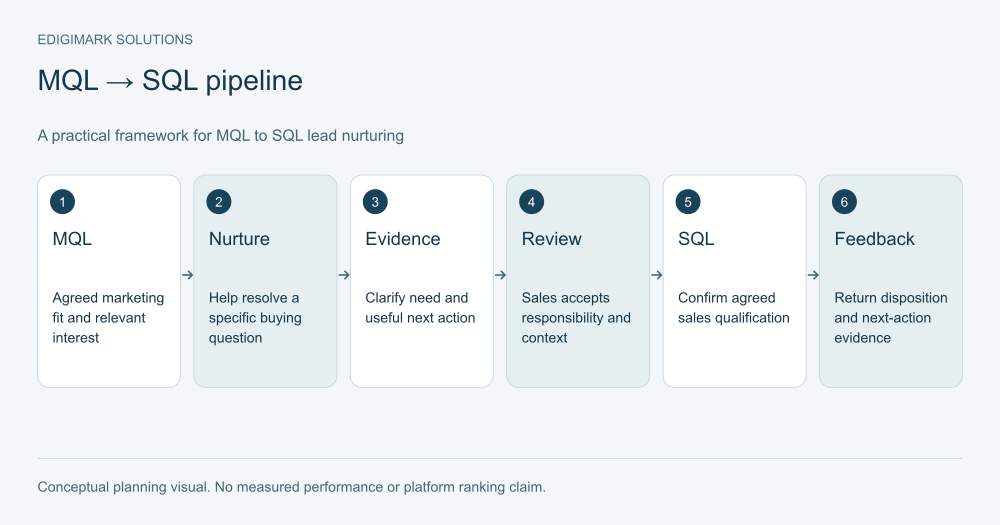
MQL to SQL lead nurturing helps a marketing-qualified lead resolve relevant buying questions while the business gathers enough evidence for a useful sales conversation. Define marketing and sales qualification together, nurture around the person’s actual needs, and hand over context when an agreed condition is met. A download count or email click alone should not decide readiness.
The practical challenge is often the gap between two teams’ expectations. Marketing may count someone as qualified because they match a campaign profile. Sales may expect a confirmed need and willingness to talk. Both can be reasonable, but the process fails when the same label hides different meanings.
Build the transition around evidence and responsibility. The purpose is to make the next conversation useful, rather than move every record through a funnel as quickly as possible.
In this guide
- What are marketing qualified leads and sales qualified leads?
- Why do MQLs fail to become useful sales conversations?
- How should sales marketing alignment define qualification?
- Which evidence should support nurture qualification?
- How should MQL to SQL lead nurturing segments be defined?
- What should lead nurture content help the buyer resolve?
- How should email nurture support qualification milestones?
- What should lead scoring contribute to MQL to SQL qualification?
- When should an MQL be handed to sales?
- What belongs in the sales handoff record?
- How should sales acceptance and rejection be recorded?
- How should MQL to SQL conversion be measured?
- What does a practical qualification example look like?
- How should the MQL to SQL process be improved over time?
- How should nurture qualification handle an unresolved lead?
- Frequently asked questions
What are marketing qualified leads and sales qualified leads?
Marketing qualified leads are contacts that meet a business’s agreed marketing qualification conditions. Sales qualified leads have met the conditions the sales team uses for a meaningful sales pursuit. The exact definitions depend on the offer, audience and sales process.
Do not copy a vendor’s default stage labels and assume the teams share their meaning. HubSpot’s lifecycle stage documentation illustrates how lifecycle labels represent relationship progression; the business still needs to define its own operational criteria.
Write the observable conditions behind each label. For an MQL, those may include account suitability and a relevant expressed interest. For an SQL, they may include a confirmed problem, an appropriate discussion and acceptance by the responsible salesperson.
Keep uncertainty visible. A relevant role without a known need is not the same as an unsuitable lead. An explicit enquiry with incomplete profile data may warrant human review before a scoring model has enough information.
Why do MQLs fail to become useful sales conversations?
Some contacts are too early in their decision. Others are studying a subject for research, supporting a colleague or looking for an option the business does not provide. These cases require different responses.
Operational issues can also interrupt progress. A request may lack ownership, arrive without context or receive generic messages after someone has already spoken to sales. The problem is not always the quality of the lead.
Investigate rejected handoffs with specific reasons. “Bad lead” cannot guide a repair. “Suitable account, but the contact wanted implementation documentation rather than a sales meeting” points to a content and routing decision.
Marketing automation and CRM integration should help distinguish audience fit, timing, missing information and process failures. Treating them all as a single conversion-rate problem hides the work needed.
How should sales marketing alignment define qualification?
Bring marketing, sales and the operational owner together around real examples. Review accepted conversations, declined handoffs and records that remained unresolved. Focus on what the receiving team needed to make a decision.
Agree definitions for MQL, sales review, accepted handoff and SQL if those are separate states. Some businesses need an acceptance stage before qualification because sales must confirm the need in conversation.
Document exclusions and exceptions. Existing customers, support requests, partner enquiries and direct requests from incomplete profiles may require separate routes. A useful definition describes those cases rather than forcing them into the standard path.
Assign authority to update the definitions. Changing a threshold can change reported MQL volume without changing underlying demand. Record the effective date and reason so performance reports remain interpretable.
Which evidence should support nurture qualification?
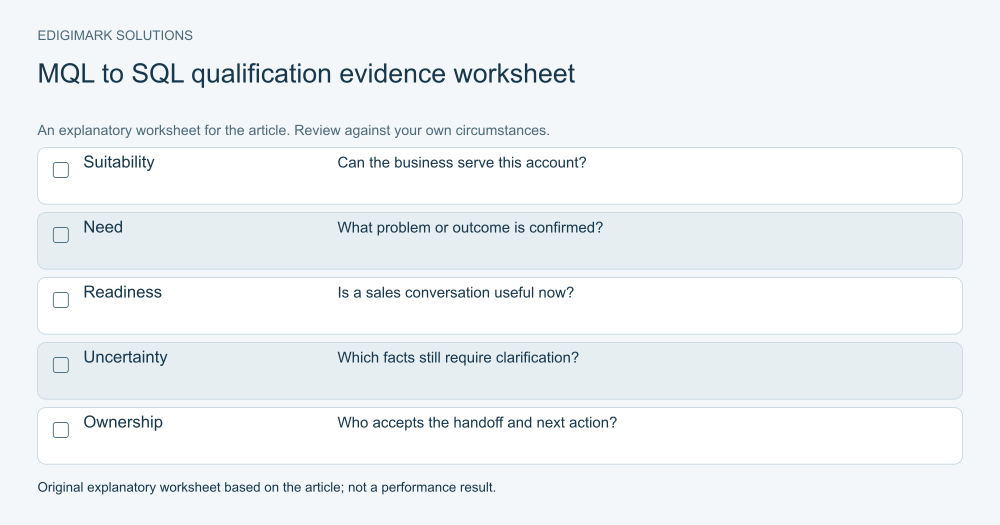
Separate suitability, expressed need and readiness to act. Suitability concerns whether the business can serve the account. Expressed need concerns the problem or outcome the person is considering. Readiness concerns whether a relevant next conversation is appropriate now.
Use verified facts where possible. A stated implementation requirement is stronger evidence than an inferred interest from a page view. Record the source and date for information likely to change.
Treat engagement as context. Reading several resources can identify a subject worth exploring, but it does not prove budget, authority or a purchase timeline. Avoid pretending the system knows more than the record supports.
The supporting qualification worksheet should show the evidence, uncertainty and next action for each dimension. Its value is to make a judgement inspectable, not assign a universal numerical definition of a good lead.
How should MQL to SQL lead nurturing segments be defined?
Segment by the question or condition that changes the useful response. A prospect comparing implementation approaches needs different content from someone who has selected an approach and needs to assess delivery requirements.
Use explicit interests, known constraints and relationship status. Avoid creating dozens of branches for attributes that do not affect the next decision. Each branch adds content, maintenance and testing requirements.
Provide a path for unknown information. A lead without a confirmed use case might receive a brief explanation of options or a voluntary question about their needs. It should not be placed into an arbitrary product segment.
Review company-level context as well as individual activity. Several people from one account may be exploring different concerns, while an existing opportunity already has an owner. Coordinate those relationships so nurture does not restart a generic introduction in the middle of a specific evaluation.
What should lead nurture content help the buyer resolve?
Begin with the question expressed at capture. If someone requested a guide to replacing a CRM, help them understand migration prerequisites, data ownership and implementation choices before assuming they need a product demonstration.
Develop content around actual decision barriers. Useful subjects include scope, feasibility, integration, ownership, commercial fit and evidence of relevant experience. The right content depends on the offer and the audience’s stage.
Use truthful, specific proof. A verified example should identify its context and limitations. An illustrative scenario should be labelled as an illustration. Do not invent customer results or imply that one outcome is typical.
Give each asset an appropriate next action. A requirements worksheet might invite the person to check their readiness. A relevant delivery example might invite a discussion about a comparable situation. Digital marketing should connect the content with the customer question rather than simply fill a campaign calendar.
How should email nurture support qualification milestones?
Use email to deliver relevant information and invite voluntary progress. A sequence can move from problem clarity to options, implementation requirements and a discussion offer, but the person may take a different route.
Keep content and qualification rules separate. Sending the final email does not make someone sales-ready. A reply naming a specific requirement may matter more than completing the entire sequence.
Set sensible timing based on the context and appropriate preferences. A requested consultation needs a direct response; it should not wait behind an educational nurture schedule. A general resource request may call for a less immediate approach.
Define what happens when a person replies, opts out, starts a sales conversation or becomes a customer. These changes should alter or stop the generic path. Salesforce’s automated lead nurturing overview describes the importance of clean data and coordination; the practical rules still require business-specific design.
What should lead scoring contribute to MQL to SQL qualification?
Lead scoring can help prioritise review when the business has evidence that certain characteristics or actions are useful. Keep suitability and engagement distinguishable so a frequent reader from an unsuitable account does not automatically outrank a relevant direct enquiry.
Use meaningful signals and prevent repeated low-value activity from accumulating unlimited weight. The model should identify a useful next action, not reward the person who produces the most trackable events.
Make the threshold a reviewable business rule. Agree what happens when it is reached, who responds and which exceptions bypass it. Scores without action ownership create apparent qualification without actual progress.
Validate using accepted and rejected handoffs. If high-score leads repeatedly lack a relevant need, investigate the signals. If suitable direct requests score too low, create the appropriate route rather than waiting for additional browsing activity.
When should an MQL be handed to sales?
Hand over when the agreed condition indicates that sales can take a useful next action. That may be an explicit meeting request, a confirmed relevant need or a combination of suitability and meaningful interest that warrants review.
Distinguish an internal alert from an accepted handoff. The receiving team needs to confirm responsibility, inspect the context and choose the next action. A notification delivery does not prove the lead is being handled.
Create a fallback for unassigned or unresolved requests. Route the exception to a named person who can reassign or clarify it. Time expectations should reflect the promise made to the lead and the team’s actual operating capacity.
Keep a clear route for direct requests. A person who asks a specific sales question should receive an appropriate response even if the standard MQL model lacks enough information to categorise them.
What belongs in the sales handoff record?
Include the original request, relevant account information, known need, important constraints and the evidence supporting the handoff. Show where the information came from and what remains uncertain.
Summarise meaningful activity rather than attaching an unexplained list of every recorded click. A salesperson needs to know the subject the person is considering and the reason a conversation may be useful.
Identify the current owner, next action and any relevant communication preference. If another team is already engaged, make that relationship visible before creating a competing response.
CRM integration should ensure that this context reaches the receiving record reliably. A carefully written nurture programme loses value when sales sees only a name and an ambiguous campaign label.
How should sales acceptance and rejection be recorded?
Use specific, limited disposition options with room for context. Useful categories may distinguish fit mismatch, timing, unclear need, duplicate relationship and operational failure. Define each category so teams apply it consistently.
Record the next action as well as the reason. A relevant but early lead may return to suitable nurture; an unsuitable account may leave the acquisition path; a routing error needs process repair.
Avoid automatically recycling every rejected lead into the same sequence. The person’s circumstances and preferences matter. A confirmed mismatch is different from a postponed project.
Review the feedback together. Rejection data should improve targeting, content, qualification and operations. It is less useful when used only to allocate blame for monthly totals.
How should MQL to SQL conversion be measured?
Define the counted transition and observation period. Are you measuring MQLs that sales accepted, contacts later marked SQL, or opportunities created? These are related but different outcomes.
Use a cohort when the sales cycle requires time. Leads entering near the end of a reporting period have had less opportunity to progress than earlier leads. A simple same-month total can mix acquisition timing with qualification performance.
Report eligible MQLs, accepted handoffs, SQLs and relevant rejection reasons with clear definitions. Data analytics can help preserve the link between stage movement and the original lead without overstating attribution.
Inspect quality alongside volume. A looser MQL definition can create more records and a lower acceptance rate. A stricter rule can improve the rate while excluding suitable requests. The business needs both the counts and the explanation to judge the change.
What does a practical qualification example look like?
Imagine a hypothetical company offering CRM implementation. A contact at a suitable business requests a migration guide but has not stated a project timeline. Marketing records the interest and sends relevant planning information through an eligible nurture path.
The contact later replies that their team needs to move data from two systems and wants to discuss feasibility. The response provides a concrete need. A designated owner reviews it, accepts the handoff and prepares questions about data scope and responsibility.
Generic nurture pauses while that conversation proceeds. Sales records whether the business can help and what must happen next. If the project is postponed, any later nurture is based on that context and the person’s preferences.
This illustration does not report a client result. It shows why voluntary clarification, ownership and useful context can matter more than an arbitrary number of interactions.
How should the MQL to SQL process be improved over time?
Start with a small review of actual cases rather than changing every rule at once. Compare accepted leads, rejected leads and unresolved handoffs to find the most consequential gap.
Choose a focused repair, such as clearer capture questions, a missing proof asset, a routing fallback or a qualification definition. Write the expected behaviour and test the affected path before expanding it.
Record the change and its effective date. Follow the next eligible cohort long enough to observe the relevant transition. Keep commercial and operational explanations separate when both change together.
Ask Edigimark to align nurture and sales qualification when MQL volume looks healthy but the receiving team lacks the context or process to create useful conversations.
How should nurture qualification handle an unresolved lead?
Create a visible state for records that need clarification. Identify the missing information and the owner responsible for deciding the next action. This prevents uncertainty from becoming a permanent hidden queue.
For a suitable account with an unclear request, a person may ask one useful question rather than send another generic asset. For an early-stage interest, a relevant educational path may remain appropriate if the person is eligible and wants that communication.
Set a review point appropriate to the situation. If there is no new information, preserve the uncertainty instead of marking the lead qualified simply to clear the queue. The team should be able to distinguish a lead waiting for a response, a deliberately paused relationship and a record that needs correction. Those distinctions help marketing improve the nurture path and help sales avoid repeatedly pursuing the same unresolved case without context.
Frequently asked questions
Is an MQL automatically an SQL after enough emails?
No. Receiving or engaging with messages does not confirm sales readiness. Qualification should depend on agreed evidence and the receiving team’s appropriate next action.
Should every MQL receive the same nurture sequence?
No. Use meaningful differences in need, context and relationship status to select relevant content. Keep the number of paths manageable and provide a clear route for unknown information.
What is the most useful sales feedback on an MQL?
Specific disposition, relevant context and the next action. A reason such as timing or fit mismatch can inform a repair; an unexplained “bad lead” label usually cannot.
Can a direct enquiry bypass the lead score threshold?
Yes, when the agreed process provides an appropriate human review route. An explicit request should not be ignored because a model lacks sufficient historical activity to assign a high score.
How long should MQL to SQL nurturing take?
There is no universal duration. The person’s needs, decision process and your offer determine the useful pace. Respond directly to explicit requests and measure progression over a period appropriate to the sales cycle.