Marketing automation uses software and defined rules to carry out repeatable marketing actions, such as capturing an enquiry, delivering relevant nurture content, identifying a useful sales signal and assigning follow-up. It works best when the business has reliable data, an agreed customer journey and people responsible for exceptions. Automating an unclear process usually makes its problems harder to see.
For a growing business, the first question is where a repeatable task is being missed or handled inconsistently. A complicated workflow is not inherently more valuable than a dependable enquiry acknowledgement and an accountable sales handoff.
This guide explains the operating model from capture to follow-up. Use it to plan the process before selecting features or connecting every available channel.

In this guide
- What does marketing automation actually automate?
- When is a growing business ready for marketing automation?
- How should the automation journey be mapped?
- What should lead capture automation include?
- How should records be validated before a workflow continues?
- What makes automated nurture useful?
- How should segmentation guide marketing automation?
- What role should lead scoring play in marketing automation?
- How should sales handoff automation work?
- How should automation and the CRM work together?
- What should an automation pilot look like?
- Which automation metrics help a business make decisions?
- What commonly causes marketing automation to fail?
- How should growing businesses choose automation tools?
- How should automation content and rules be maintained?
- What should the team agree before launching marketing automation?
- Frequently asked questions
What does marketing automation actually automate?
Salesforce’s marketing automation guide describes technology that manages marketing processes and campaigns through workflows. Those workflows can coordinate actions across channels, but their usefulness depends on the instructions and information provided.
In practical terms, automation can recognise a defined event, check eligibility, perform an action and update a record. A submitted request might trigger delivery of the requested information and create a task for a relevant team member.
The business still decides what the event means. A guide download may indicate interest in a subject; it does not automatically prove purchase readiness. A submitted demo request deserves a different response from casual content engagement.
Marketing automation should therefore begin with process design. The platform implements decisions, while people define the promise, message, ownership and conditions that make those decisions appropriate.
When is a growing business ready for marketing automation?
Look for a recurring process with a clear purpose and enough consistency to describe. Examples include delivering requested resources, routing enquiries, sending relevant onboarding information and reminding an owner about an unresolved request.
Readiness also requires usable records. The team needs to know which person or account a record describes, which information is reliable and which communications are appropriate. Duplicate identities and unclear preferences can undermine even a simple workflow.
Consider who maintains the process. Someone must review failures, update content and remove obsolete rules. If nobody can own those tasks, start by establishing responsibility rather than buying additional complexity.
A small business can begin with a narrow workflow. A larger business may need deeper integration and governance. Size alone does not decide readiness; the repeatability, information quality and operational ownership matter more.
How should the automation journey be mapped?
Draw the customer action and the business response together. Start with an event such as a resource request, enquiry or trial signup. Then identify what the person expects and what the business needs to do.
For each step, specify the input, eligibility check, action, owner and exit. Include what happens when a record is incomplete, a person opts out, sales starts a conversation or the integration fails.
Keep lifecycle states distinct from message activity. Receiving an email does not make someone qualified. Moving a contact to a new stage should represent an agreed condition, supported by evidence the team can inspect.
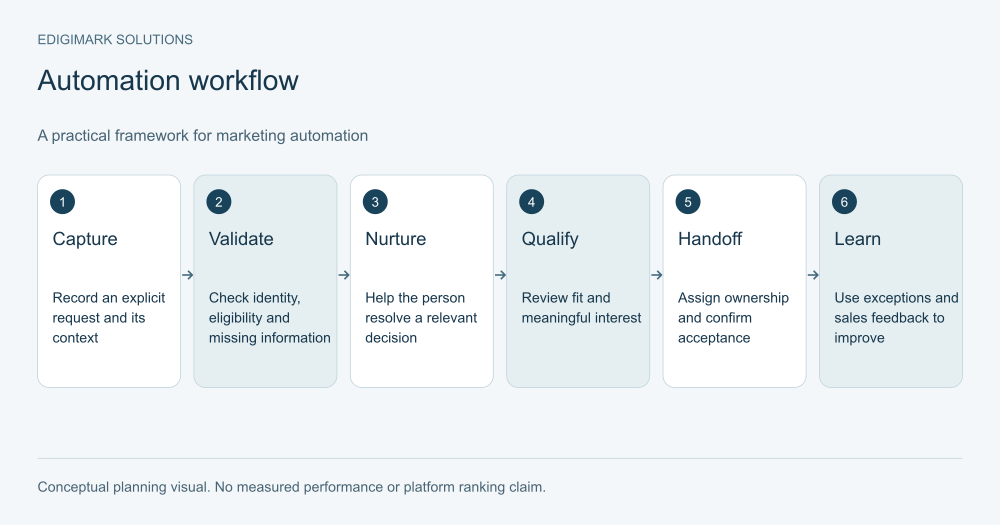
The featured workflow should show capture, validation, relevant nurture, qualification and handoff, with feedback returning to the process. This is an operating map rather than a promise that every captured contact will become a customer.
What should lead capture automation include?
Lead capture automation should record the request accurately, deliver what was promised and connect it with the correct follow-up. Review the form and the destination system together.
Collect information needed for the immediate purpose. A long form can be justified when the action requires detailed information, but fields without a clear use add work for the visitor and the team.
Preserve the request context: the relevant page or offer, submitted details, time and appropriate communication preferences. The person handling the request should not have to infer why the lead appeared from an unexplained source label.
Test the complete route with authorised records. Verify the visible confirmation, operational delivery, matching or creation of the CRM record and ownership. Web development and CRM integration need a shared acceptance test so a successful form submission is not mistaken for a completed handoff.
How should records be validated before a workflow continues?
Define the information necessary for the next action and what happens when it is absent. A routing rule requiring a region needs an explicit fallback when the region is unknown.
Distinguish an invalid value from an unknown value. Unknown company size should not silently become the smallest segment, nor should an unclear role be treated as decision-making authority.
Resolve duplicates according to an intentional identity rule. A repeat enquiry from an existing contact may require an updated request and a task for the current owner, rather than a second disconnected contact.
Keep eligibility visible. Communication preference, existing opportunity, customer status and active human conversations can change the appropriate path. Validation is the point where the workflow confirms that the proposed action still fits the record.
What makes automated nurture useful?
Automated nurture should help a person resolve a relevant question over time. It can explain requirements, compare approaches, show verified evidence or prepare the person for a discussion when their situation warrants it.
Begin with the interest the person expressed. A resource about migration planning should lead to content that helps with migration decisions, rather than immediately switching to an unrelated offer because it is the campaign priority.
Design messages around progress in understanding. One message might clarify the problem, another explain options and another show implementation requirements. Each needs a reason to exist and a sensible next action.
Give the person control. Relevant preference options and an appropriate exit are part of the experience. Silence does not justify indefinitely increasing contact frequency. A nurture path should be reviewed for relevance, outcomes and fatigue rather than judged only by the number of messages sent.
How should segmentation guide marketing automation?
Segment using information that changes the useful response. Product interest, stated need, customer status or a verified implementation requirement may influence which content fits.
Avoid building branches for every available property. More segments mean more messages, rules and test cases to maintain. A segment deserves a separate path when the customer question or business action differs materially.
Use explicit information where possible and label inferred information appropriately. A single page visit may suggest an interest but is weaker evidence than a request that names a specific challenge.
Review small and empty segments. A complicated plan can look personalised while leaving some people without a coherent route. Start with a few meaningful paths and add distinctions when evidence shows a need.
What role should lead scoring play in marketing automation?
Lead scoring can help prioritise review by combining evidence about suitability and interest. It should support a decision, rather than turn every tracked action into an unquestioned sales instruction.
Separate fit from engagement. A person can interact frequently without representing a suitable account, while a strong-fit company can submit a direct request without a long activity history.
Agree the response to a score or category before implementation. The outcome might be a review task, a relevant nurture path or a handoff. A threshold without an owner and an action is only a reporting label.
Validate the model against sales feedback and meaningful outcomes. Repeated low-value activity should not endlessly increase priority. Direct requests also need a clear route even when scoring data is incomplete.
How should sales handoff automation work?
Sales handoff automation should assign responsibility and provide useful context when the agreed condition is met. It should not simply add a name to a queue that nobody checks.
Include the request, relevant company information, known requirements, recent meaningful actions and any unresolved question. Distinguish facts from assumptions so the recipient understands what is confirmed.
Define acknowledgement and escalation. If the owner is unavailable or the request stays unresolved, someone needs to see the exception. The process should describe who can reassign it and how the customer receives an appropriate response.
Pause competing generic messages when a human conversation begins. Sales and marketing should agree which communications remain useful during that period. The handoff completes when the receiving team accepts responsibility and records the next action, not when an automated notification is sent.
How should automation and the CRM work together?
The CRM can hold the relationship, account, ownership and sales outcome, while the automation system manages eligible actions and campaign progression. Platforms can overlap, so define responsibility by field and task rather than by a simplistic product boundary.
Write a field map identifying the source, destination, meaning, update direction and conflict rule. A subscription preference and a sales stage need different treatment because they represent different decisions.
Use a stable matching approach and inspect failures. Connections can appear healthy while specific records are rejected, delayed or associated incorrectly. Someone must monitor the exceptions and know how to resolve them.
CRM integration should make context accessible to both teams without copying unnecessary information everywhere. The goal is reliable shared understanding, not the largest possible synchronised dataset.
What should an automation pilot look like?
Choose a contained process with a clear failure to improve. For example, a hypothetical B2B company might find that demo requests reach an inbox but lack ownership. The pilot would focus on request validation, assignment, acknowledgement and exception handling.
Document the current behaviour and expected result. Use authorised test records that represent a new contact, existing contact, existing customer, missing routing field and unavailable owner.
Review the message, record changes and operational task for each case. Confirm exits and duplicate prevention. Begin with a controlled eligible audience before expanding the workflow.
Report whether the process became more reliable and whether the assigned team can use the context. The pilot does not need an invented revenue uplift to demonstrate that a previously missed operational task now has a dependable route.
Which automation metrics help a business make decisions?
Measure the process and the commercial outcome separately. Process measures include delivery failures, unassigned requests, time to acknowledgement and records missing essential context.
Commercial measures might include accepted enquiries, qualified conversations, opportunities and eventual revenue where the data supports that view. Define what each state means and account for the time required to observe later outcomes.
Use eligible audience counts as denominators when comparing workflows. A path with stricter entry criteria can have a higher completion rate without being a better approach for the same audience.
Data analytics can connect the reports while preserving their limits. An automation completion count is not a count of satisfied customers, and an email engagement measure is not proof of buying intent.
What commonly causes marketing automation to fail?
Unclear lifecycle definitions can send people to the wrong path. Missing ownership can leave apparent handoffs unresolved. Old content can make a correctly functioning workflow deliver an inaccurate message.
Overlapping campaigns are another problem. Several individually reasonable workflows can produce an unreasonable combined experience. Review contact frequency and current human activity across the programme.
Treating every action as qualification can overwhelm sales. Treating every exception as a reason to add another branch can make the system difficult to maintain. Investigate the process and information first.
Keep the recovery route clear. A failed connection or broken message link should create a visible task for an owner, with an appropriate way to pause the affected process. The team needs to understand the consequence of stopping it as well as the consequence of leaving it running.
How should growing businesses choose automation tools?
Create requirements from the planned workflows: records, triggers, actions, integrations, reporting, permissions and exception handling. Ask a vendor to demonstrate those requirements with representative scenarios.
Verify the actual subscription and implementation needs. A product family name does not prove that every desired feature is included. Consider contacts, seats, support, integration work and ongoing ownership in the evaluation.
Assess usability for the people maintaining the system. They need to understand why a record entered a path, what happened and how to correct a problem. A feature-rich tool can still be a poor fit for an unsupported operating model.
Avoid buying solely for speculative future workflows. Choose enough capability for a credible plan, with a clear approach to expansion when additional needs are validated.
How should automation content and rules be maintained?
Give each workflow an owner, purpose, entry criteria, exits and review trigger. Keep its message assets and connected fields discoverable. When a service or offer changes, the owner should know which automation paths use it.
Record consequential changes and their effective dates. A new qualification rule can change reported stage counts even if demand stays the same. Historical interpretation requires that context.
Review inactive paths and retire obsolete campaigns with their dependencies. Keeping every old workflow enabled makes it harder to explain the customer experience and identify conflicts.
Ask Edigimark to build a practical automation roadmap if capture, nurture and sales response currently operate as separate processes. A useful roadmap starts with a reliable customer promise and ends with verified responsibility for the next action.
What should the team agree before launching marketing automation?
Write a short operating agreement covering the customer promise, eligibility, responsible team and intended outcome. Ask the receiving team to review a sample record and confirm that the information supports its next action.
Agree how failures are detected and which person can pause the workflow. If a form remains available while follow-up is paused, the business still needs an alternative way to handle incoming requests.
Confirm the review schedule and the conditions that require an earlier check, such as an offer change, new integration or revised qualification rule. These decisions make maintenance part of the launch rather than a task left for someone to discover later. Keep the agreement with the workflow documentation so new team members can understand the process without reconstructing it from the editor.
Frequently asked questions
Is marketing automation only for large businesses?
No. Smaller teams can use it for repeatable tasks with clear rules and ownership. Start with a process that solves a real operational problem and expand when the data and maintenance capacity support it.
Can marketing automation replace sales follow-up?
It can acknowledge requests, provide context and coordinate tasks. Human follow-up remains important when someone needs a judgement, a tailored recommendation or a conversation about specific requirements.
What should a business automate first?
Choose a recurring task with a clear purpose, reliable inputs and an accountable owner. Capturing and routing an explicit enquiry is often easier to define and verify than a complex multi-channel nurture programme.
Does lead scoring guarantee that a contact is ready to buy?
No. A score summarises selected evidence and helps prioritise review. Its usefulness depends on the model, data quality and validation against actual sales feedback and outcomes.
How do you know an automation workflow is working?
Test eligibility, messages, record changes, ownership, exits and exceptions. Then monitor operational reliability and meaningful commercial outcomes using clear definitions and appropriate observation periods.