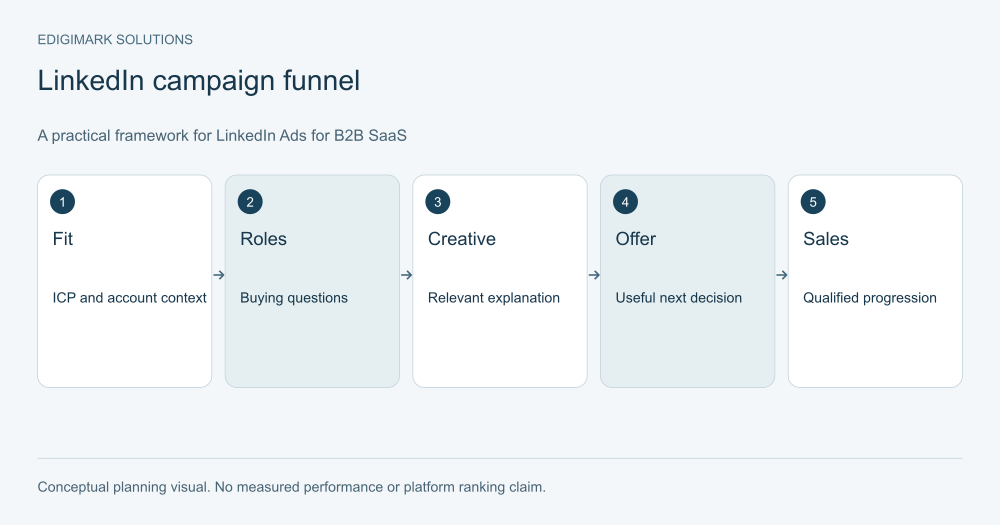
LinkedIn Ads for B2B SaaS should connect a well-defined professional audience with an offer that helps it make a relevant product decision. Start with the ideal customer profile and buying roles, create useful messages for those roles, and connect every lead with appropriate delivery and follow-up. Evaluate qualified progression rather than treating a prefilled form submission as evidence that a person wants to buy software.
Professional targeting gives a campaign useful context, but it does not replace product fit or buyer readiness. A finance director can match the intended role and still have no need for your product. The campaign needs to explain a relevant problem and offer a sensible next step.
In this guide
- What should LinkedIn Ads for B2B SaaS define first?
- How should account targeting and role targeting work together?
- How narrow should SaaS LinkedIn campaigns be?
- What should SaaS LinkedIn campaigns offer at different stages?
- How should SaaS LinkedIn campaigns communicate a useful idea?
- When should LinkedIn lead gen forms be used?
- What should LinkedIn Ads for B2B SaaS landing pages explain?
- How should SaaS retargeting be sequenced?
- How should LinkedIn lead gen forms connect with the CRM?
- What should LinkedIn Ads for B2B SaaS measurement include?
- How should the first SaaS LinkedIn campaigns review be organised?
- What mistakes weaken LinkedIn Ads for SaaS?
- How can SaaS LinkedIn campaigns expand responsibly?
- What does a practical account targeting review look like?
- What should SaaS LinkedIn campaigns preserve during a handoff?
- Frequently asked questions
What should LinkedIn Ads for B2B SaaS define first?
Write the ideal customer profile as conditions the product can support. Include the workflow, business type, relevant size or complexity, geography and technical prerequisites. Avoid defining the audience only by a prestigious job title.
Identify buying roles separately. The user, technical reviewer, budget owner and internal advocate may have different questions. A user wants to know how the workflow improves; a technical reviewer wants compatibility and requirements; a budget owner needs scope and commercial justification.
Decide what the campaign should accomplish now. It might introduce a problem, help an account evaluate an approach or invite a product conversation. The offer and measurement should match that purpose.
Bring sales and product into the definition. Their knowledge helps prevent advertising capabilities the software does not yet provide or reaching accounts whose requirements the team cannot fulfil.
This work belongs in the wider digital marketing strategy so the campaign has a clear role in the search, content and sales journey.
How should account targeting and role targeting work together?
Account targeting can concentrate attention on relevant organisations, while role criteria help describe the people you want to reach within them. LinkedIn’s targeting guidance describes professional criteria and company or contact audience options. The available combinations and matching should be checked in the actual account.
Do not assume that an uploaded account list produces complete coverage of every intended company or buying role. Data quality, matching and platform delivery all affect the audience reached.
Start with a credible account selection method. A list of companies is useful when it reflects product fit and a commercial strategy. It is less useful when it consists of famous brands selected without knowing whether they have the relevant need.
Review audience reports and lead examples where available. Job titles and functions vary between organisations. A role that controls a purchase in one business may be an influencer in another. Use the information to improve the audience definition without pretending the campaign can identify every stakeholder perfectly.
How narrow should SaaS LinkedIn campaigns be?
Narrow enough to preserve relevance and broad enough to support the campaign’s purpose and delivery. There is no universal audience size that makes every B2B campaign efficient.
Excessive layering can exclude suitable people whose profiles use different terminology. Excessive breadth can dilute the message and attract unsupported accounts. Review the audience estimate and the actual records reached rather than judging the setup by the number of filters used.
Separate audiences when the distinction changes the offer or message. Technical evaluators may need an integration guide, while operational users may need a workflow explanation. Splitting every minor title variation can create unnecessary management work.
Record the reason for each distinction. This helps later reviews decide whether the structure still supports the business or whether groups should be combined, refined or removed.
What should SaaS LinkedIn campaigns offer at different stages?
For an audience unfamiliar with the problem, offer a useful explanation or diagnostic resource. A hypothetical inventory software provider might explain the operational symptoms of fragmented stock information and provide a worksheet to assess the workflow.
For an audience considering solutions, offer a comparison of approaches, an implementation guide or a product explanation. Make the resource specific enough that it provides value beyond a disguised brochure.
For people ready to evaluate the product, a demo or consultation can be appropriate. Explain what it covers, who should attend and any preparation required. Do not assume that every professional audience member is ready for that commitment.
These stages are planning categories, not a guaranteed sequence followed by every buyer. A person may enter at evaluation, share the resource with a colleague or return later through another channel.
How should SaaS LinkedIn campaigns communicate a useful idea?
Make the message concrete. Describe a recognisable workflow problem or a decision the reader needs to make. “Compare three ways to route purchase approvals” gives a clearer reason to engage than “Transform your business with innovation.”
Use visuals that explain the idea: a process diagram, a readable product view or a clearly labelled comparison. Avoid filling a small creative with dense text that requires zooming to understand.
Keep claims aligned with the landing page and the current product. If the creative mentions a supported integration, the destination should explain its scope and prerequisites. If it mentions an outcome, use reliable evidence and context rather than implying a guaranteed result.
Test meaningful message differences. One version might focus on the operational problem, another on implementation concerns. The comparison should help the team understand which explanation serves the intended audience, not merely which decorative variation draws more clicks.
When should LinkedIn lead gen forms be used?
LinkedIn Lead Gen Forms can reduce entry effort through prefilled information and support delivery of leads to connected systems. They can be useful when the offer and next step are clear.
Choose the fields according to qualification and fulfilment needs. A resource download may need less information than a tailored product discussion. Do not collect details simply because a field is available.
Explain the promised resource and subsequent communication. Provide an appropriate confirmation and make delivery reliable. A low-friction form loses value when the promised content never arrives or the lead enters an unrelated sequence.
Compare native forms with website forms using the quality and progression of the resulting records. A higher completion rate can be useful, but it does not prove a stronger buying signal. The form is one part of the offer, not a qualification system by itself.
What should LinkedIn Ads for B2B SaaS landing pages explain?
The page should show the product’s role, the intended user, relevant workflow and next action. Include practical details about fit, implementation and compatibility where those influence the decision.
Use genuine product evidence where available. A demonstration or real screenshot can clarify how the software works. If an illustration shows a hypothetical workflow, label it accordingly. Do not invent customer results or present a conceptual diagram as a captured product interface.
Make the form and any scheduling route usable on mobile and desktop. Test error states and confirm receipt by the appropriate owner. Explain what happens after submission so the visitor can make an informed choice.
Conversion rate optimization helps assess that decision path, and web development handles the implementation needed to keep it reliable.
How should SaaS retargeting be sequenced?
Retargeting should provide an appropriate next resource, where the user choices and platform rules permit the audience use. It should not simply repeat the same demo demand to everyone who encountered the brand.
LinkedIn’s Matched Audiences documentation describes engagement-based and other audience options. Check the actual availability, data requirements and audience conditions before building the plan around them.
Consider the action already taken. Someone who watched an introductory explanation may need a practical guide. Someone who opened a product page may need implementation context. Someone who requested a demo should usually enter the relevant human process rather than continue receiving generic invitations to request one.
Use suppression deliberately. Exclude or redirect existing customers, active opportunities and people whose requests have already been fulfilled where the systems and permitted data support that treatment. The purpose is relevant continuation, not maximum repetition.
How should LinkedIn lead gen forms connect with the CRM?
Preserve the offer, audience or campaign context, relevant form information and the action requested. Define the owner, routing rule and next step. Sales should not need to guess why the person entered the database.
Check field mapping and duplicates. A lead record should not overwrite important customer information merely because the person completed another form. Decide how existing accounts and contacts are handled.
CRM integration can connect the records, while marketing automation can deliver the resource, acknowledge the request and notify the assigned owner. Test the full flow before promoting the offer.
Give sales a short guide to the campaign. It should explain the audience, offer, likely readiness and useful conversation starter. A resource downloader may need a different response from a person requesting an immediate product evaluation.
What should LinkedIn Ads for B2B SaaS measurement include?
Measure the initial action and the meaningful progression that follows. Keep resource downloads, valid leads, qualified leads, meetings and opportunities distinguishable where the business can record them reliably.
LinkedIn’s conversion tracking guidance describes options for sharing relevant actions with the platform. Implementation needs appropriate data use, accurate event definitions and verification. Do not assume that installing a tag proves all downstream actions are recorded correctly.
Review attribution settings. A person may view an ad and later return through search or another route. Platform-attributed conversions can overlap with other systems and should not be added together uncritically as unique customers.
Data analytics can help reconcile the observed journey with CRM outcomes. Keep the limits visible, especially when buying decisions involve colleagues and a long evaluation period.
How should the first SaaS LinkedIn campaigns review be organised?
Verify offer delivery and measurement first. Confirm that forms complete, resources arrive, leads reach the right owner and outcome fields are updated consistently.
Then inspect the audience and quality. Review accepted, rejected and ambiguous leads with identifying information removed. Ask whether the campaign reached relevant accounts and whether the offer created useful expectations.
Review the creative and destination together. A high engagement rate with poor qualification may indicate an interesting message aimed at the wrong decision or a resource with weak product relevance. A relevant audience with little action may need a clearer offer or page.
Decide what to change and why. Avoid simultaneous revisions to audience, offer, creative and tracking unless a material failure requires it. Record the hypothesis and the evidence needed at the next review.
What mistakes weaken LinkedIn Ads for SaaS?
One mistake is treating a job title as a complete ideal customer profile. Product fit also depends on the organisation, workflow and technical environment.
Another is using a low-commitment offer to generate leads, then evaluating those records as though they requested a sales meeting. The sequence should reflect the action and readiness.
Teams also weaken learning by optimising only for raw CPL, failing to deliver the promised resource or leaving duplicate and existing-customer handling undefined. A smooth native form cannot compensate for a broken operational process.
Finally, avoid presenting platform case-study statistics as expected results for your own campaign. Your audience, offer and setup differ. Use current evidence from the campaign and customer process to make the next decision.
How can SaaS LinkedIn campaigns expand responsibly?
Expand a specific audience, offer or buying role because the existing evidence supports a clear opportunity. Confirm that the product and sales process can serve the additional demand and that the new message remains accurate.
Keep quality definitions stable so the team can distinguish increased reach from diluted fit. Compare cohorts with sufficient maturity, particularly when opportunities take time to develop.
The campaign should become a more informed route to useful conversations. Ask Edigimark to review your LinkedIn SaaS journey if professional targeting, resource delivery and sales outcomes are not yet connected.
What does a practical account targeting review look like?
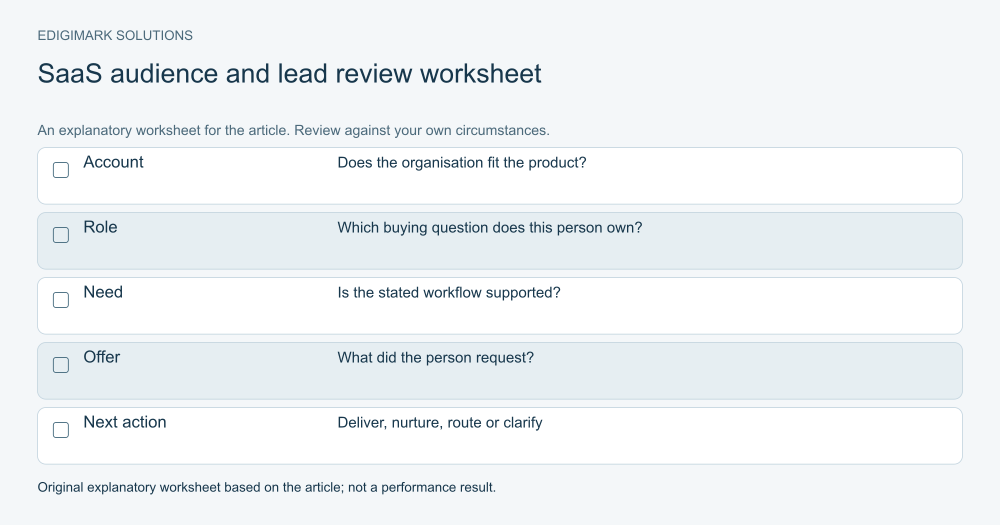
Take a small anonymised sample of leads and discuss the organisation, role, stated need and action requested. Include people who progressed, people who did not fit and cases whose readiness is unclear. This is a qualitative review to locate patterns, not a statistically representative account of the whole market.
Ask product colleagues whether the stated use cases are supported. Ask sales whether the offer prepared people for the conversation. Ask marketing whether the creative and targeting implied something different. A repeated mismatch can often be expressed as a clear task, such as clarifying a deployment prerequisite or changing the resource’s introduction.
Review the account list separately. Some organisations may fit the desired industry but lack the workflow the software addresses. Others may be appropriate but use different role terminology. Refine the definition from concrete evidence rather than adding more filters after every rejection.
What should SaaS LinkedIn campaigns preserve during a handoff?
Keep the audience rationale, approved claims, offer-delivery instructions, qualification definitions and change log together. Include the person responsible for a failed integration and the process for existing contacts.
Record the current uncertainties and next review decision. A new campaign owner should know whether the team is testing problem resonance, product evaluation or qualified meeting demand. Otherwise, they may optimise a resource campaign for a metric that no longer reflects its purpose.
This operational record makes the campaign more durable. It also helps an external partner improve the work without discarding the product and sales learning that made the initial setup useful.
Frequently asked questions
Should every SaaS company advertise on LinkedIn?
No. The product, audience, economics and available offers need to justify a test. Professional targeting can be useful when the audience is identifiable by work context, but it does not guarantee demand. Start with a defined question and a bounded commitment.
Are job titles enough to define the audience?
Usually not. Roles vary across companies, and a suitable title does not prove product fit or buying readiness. Include the relevant organisational and workflow conditions, then inspect actual audience and lead records to refine the definition.
Do native forms produce better leads than website forms?
Not universally. They can make entry easier, while website pages can provide a different amount of context and qualification. Compare valid and qualified outcomes for the actual offer. Completion rate alone does not establish commercial quality.
Should resource downloaders receive an immediate demo sequence?
The response should reflect what they requested and the communication they agreed to receive. Deliver the resource first and offer a relevant next step. Do not pretend that an educational download was a request for a sales demonstration.
Which metric should guide expansion?
Use qualified progression, appropriate cost and capacity alongside reach and engagement. A mature opportunity view is useful when available, but early campaigns may need intermediate evidence. Keep uncertainty explicit and avoid scaling solely because raw lead volume increased.