How to choose a digital marketing agency starts with a reviewable scope, relevant expertise and dependable operating responsibilities. Use the 25 questions below to compare evidence, methods, ownership and reporting. A strong proposal should explain what will be done, why it fits your business, how it will be verified and which assumptions remain uncertain.
Do not choose solely through a low fee, large content count or guaranteed result. The agency must be able to connect its work with your audience, offer, technical environment and response capacity.
In this guide
- How to choose a digital marketing agency: what preparation helps?
- Which 25 agency questions should you ask?
- How should agency answers and supporting evidence be compared?
- Which agency-selection red flags deserve closer review?
- What should a suitable first agency engagement include?
- How can a buyer compare proposals against a common scenario?
- What should a limited agency pilot include?
- What should the buyer verify before signing a wider scope?
- How should the final agency decision be documented?
- Frequently asked questions
How to choose a digital marketing agency: what preparation helps?
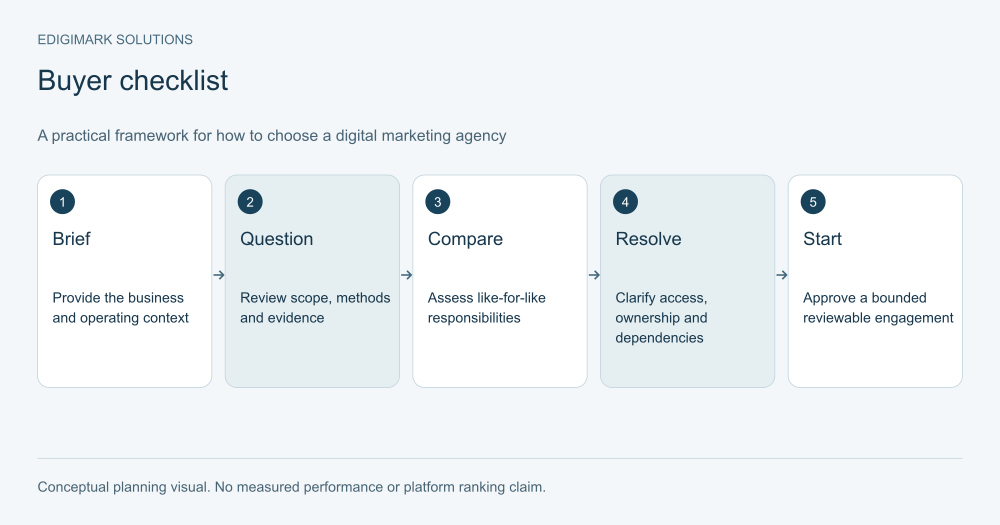
Begin marketing agency evaluation with a short business brief: intended customers, offer, buying journey, current constraints, existing systems and the decision you want the engagement to support. Include exclusions and important delivery requirements. This gives each provider the same context.
Google’s SEO-provider guidance recommends reviewing experience, methods and realistic expectations. It applies specifically to SEO; the questions here broaden the operating review to a full marketing engagement.
Ask for written answers and examples where appropriate. Compare the concrete scope and evidence rather than the confidence of a presentation. A provider can have a useful process without promising control over external search systems or buyer decisions.
Which 25 agency questions should you ask?
1. Which business outcome will this scope support?
Ask the agency to connect proposed work to a defined commercial or operational decision. More traffic, content or leads needs a meaning in your buying journey. Request the intended audience, useful action and downstream responsibility rather than accepting a broad growth promise.
2. How will you establish audience and offer fit?
Request the research method, inputs needed and how uncertainty will be handled. The agency should ask about suitable customers, exclusions, buying triggers and delivery constraints. A channel recommendation before this discussion may solve the wrong problem.
3. What is included in the scope of work?
Ask for actual tasks, deliverables, cadence and owners. A service name such as SEO or automation is not a complete scope. Confirm whether implementation, factual review, visual production and public verification are included or depend on your team.
4. What is excluded or separately charged?
Request exclusions for media, software, development, specialist research and additional production. Clarify how unexpected work is assessed. This makes proposals comparable and avoids assuming that a monthly fee covers every discipline on the agency website.
5. Who will do the work?
Ask which roles are assigned and how they contribute. Identify the accountable lead and relevant specialist capacity. A sales presentation by a senior person does not by itself establish that the delivery team has the same expertise.
6. What relevant examples can you show?
Request work samples connected to a similar audience, task or technical constraint. Ask what the agency actually performed and what evidence supports the outcome. Keep examples distinct from a promise that your business will achieve the same result.
7. How do you verify client-result claims?
Ask for the definition, period and context behind reported outcomes. Find out whether figures are actual, attributed or projected. The provider should not need fabricated certainty or unexplained percentages to describe useful work.
8. How do you set expectations?
Request assumptions, dependencies and review milestones. Distinguish completion of a deliverable from observed market or revenue outcomes. A credible plan explains uncertainty and what the team can control rather than guaranteeing external selection or demand.
9. How do you choose channels?
Ask how audience behavior, offer readiness, destination quality and response capacity influence the recommendation. Request the job each channel performs. A standard package can be a starting option, but it should still address your actual constraint.
10. How will you research keywords and intent?
Request sources, market assumptions and the rationale for distinct pages. Unverified volume or difficulty should be labeled. Ask how overlapping intent is consolidated so production does not create several resources answering the same decision.
11. How do you verify important content claims?
Request a process for sources, approved product facts and review ownership. Ask how illustrative examples are labeled and how obsolete information is maintained. A polished draft needs more than a grammar check before publication.
12. How is AI used in the engagement?
Ask which tasks are assisted, what data is provided and who reviews the result. Separate drafting from sending, publishing and changing records. The agency should represent actual authorship and review truthfully rather than disguising assistance.
13. What is the public-page verification process?
Ask how the agency checks live content, headings, metadata, canonical URLs, links and images. This matters when the CMS and frontend differ. Saved plugin fields should not be claimed as implemented until public behavior is inspected.
14. How will conversion actions be defined?
Request definitions for enquiry, qualified lead, accepted lead and opportunity. Different actions need different reporting and follow-up. A high form count alone does not establish commercial usefulness.
15. How will marketing and sales coordinate?
Ask who receives enquiries, what qualification evidence accompanies them and how acceptance or rejection returns feedback. Define ownership and escalation. Campaign delivery should connect to a real response process rather than end at an alert.
16. Which reporting definitions will you use?
Request a metric dictionary with units, dates and data owners. Ask whether reports count people, accounts or deals and how costs are treated. Consistent definitions make comparisons useful and prevent apparent improvement through relabeling.
17. How will you handle attribution uncertainty?
Ask which model, window and eligible interactions are used. Request unknown source coverage and a distinction between association and causal evidence. A provider should not confidently assign every deal to the last recorded campaign.
18. How will planned and actual costs be reconciled?
Request spending visibility, invoice or platform reconciliation and the approval process for changes. Include internal coordination and shared production costs when assessing the full engagement. Clarify the difference between a planning forecast and incurred cost.
19. Who owns accounts and deliverable assets?
Clarify administration, reporting access, source files and transfer procedures. The business should understand how it can inspect and maintain work during the engagement and afterwards. Ownership details belong in a concrete agreement reviewed by the responsible parties.
20. What access is actually necessary?
Ask for the least access sufficient for the current task and how access changes are handled. Read-only diagnosis and implementation need different authority. Avoid broad permanent access without a defined operating reason and accountable owner.
21. How are site or configuration changes approved?
Request a reviewable proposal describing intended behavior, scope, risk and validation. Establish which actions are already included and which require separate authorization. The provider should preserve an audit of meaningful changes.
22. How do you test automation and integrations?
Ask about duplicates, missing context, existing customers, preference changes and failed writes. Request evidence of actual tests rather than a diagram of the ideal path. A retry should not produce repeated messages or duplicate commercial records.
23. How will we communicate and resolve blockers?
Agree on a usable cadence, decision owners and escalation route. Ask how the agency identifies information or access it needs from your team. Clear dependencies reduce delays without pressuring either party to bypass review.
24. What happens when evidence contradicts the plan?
Ask how the team changes audience, offer, resource, routing or investment. Request examples of a decision process, without demanding confidential client detail. A useful provider can explain how findings alter the work rather than defending every original recommendation.
25. How will handoff and continuity work?
Request an inventory of active campaigns, resources, rules, credentials handling and reporting definitions at transition. Clarify ongoing maintenance and outstanding issues. A clean handoff preserves the ability to operate the system without reconstructing it from scattered messages.
How should agency answers and supporting evidence be compared?
Use a simple scorecard for relevance, evidence, clarity of scope, capability, ownership and measurement. Record the reason for each assessment. A numerical total should not hide a serious gap, such as unclear account ownership or unsupported outcome claims.
Compare like-for-like scope. One proposal may include technical implementation and another may only provide recommendations. One may include production and another may require your team to supply approved assets. Identify these differences before comparing price.
Ask follow-up questions where the answer remains vague. The objective is a concrete operating plan, not a perfect sales script. Important dependencies and limitations should be visible enough for your team to decide.
Which agency-selection red flags deserve closer review?
Unsupported guarantees, unexplained methods, fabricated metrics and vague deliverables deserve scrutiny. So do contradictory ownership terms and a plan that needs access or capacity nobody can provide.
Be careful when an agency treats a plugin score as the entire success definition. Editorial tools can support review, but actual public implementation and commercial usefulness still need evidence. The same applies to dashboards that hide unknown coverage or count pipeline as realized revenue.
What should a suitable first agency engagement include?
Begin with an agreed business question and a bounded scope. The first phase might diagnose a funnel gap, repair a technical template or build decision resources for a defined audience. Specify the deliverables, owners and verification before work begins.
Edigimark’s digital marketing services can support a scope discussion. Depending on the actual need, web development, marketing automation, CRM integration, data analytics and conversion rate optimization can be assessed as specific responsibilities.
Contact Edigimark with your business brief and use these questions to evaluate the proposed work on the same evidence standard you would apply to any provider.
How can a buyer compare proposals against a common scenario?
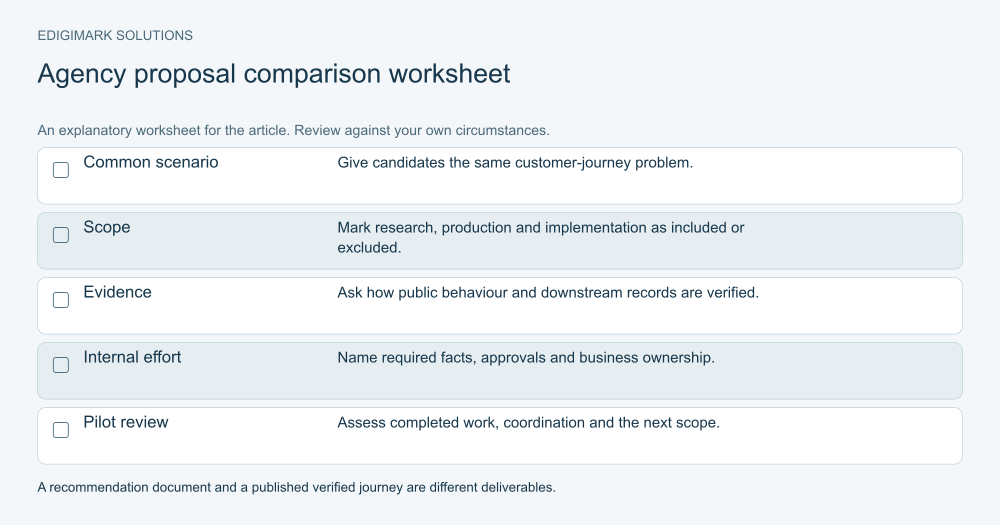
Give candidates the same hypothetical scenario: the business receives enquiries for a service, but eligibility is unclear and the handoff is inconsistent. Ask each agency to explain what it would inspect, what inputs it needs, which work it proposes and how it would verify the public journey and downstream record.
Compare the reasoning before comparing the fee. One proposal may fund additional traffic while another begins with offer clarity and routing. Ask each to explain the dependency and expected evidence. A confident recommendation without inspection may reveal that the scope is based on a generic package rather than the actual situation.
Normalize the scope in a table. Include research, expert input, copy, creative, development, tracking, CRM work, maintenance and reporting. Mark each as included, excluded, optional or unknown. Add the business’s internal responsibilities beside the supplier’s work.
Use the same expected deliverable to discuss implementation. A recommendation document is different from a published, checked landing page. A tracking plan is different from a validated event. A CRM design is different from a functioning routing process. The price comparison should reflect those differences.
Avoid rewarding unnecessary complexity. A large tool list or a long report can look substantial without resolving the customer problem. Ask which component supports which task and what could be omitted without losing the required outcome.
What should a limited agency pilot include?
Choose a bounded problem, a written scope, a responsible business owner and a review date. The pilot might cover diagnosing and improving one priority enquiry journey. It should identify the systems and templates included, required access, source facts and approvals.
Set acceptance criteria around deliverables the team can verify. These might include a clarified offer, approved page content, a working form, a correct CRM assignment and a concise measurement note. The criteria should not guarantee an external ranking or a fixed number of customers from a short implementation.
Include communication and exception handling in the review. How does the agency raise missing facts? What happens when a dependency delays delivery? Does it explain trade-offs before changing scope? These behaviours affect the usefulness of the working relationship beyond the initial task.
Record the result in a short review: completed work, verification evidence, remaining issues, internal effort and recommended next scope. A successful pilot can justify expansion with clear dependencies; it should not automatically commit the business to every service the agency sells.
What should the buyer verify before signing a wider scope?
Check that the final agency scope of work reflects the discussion and explicitly identifies exclusions. Confirm account ownership, access permissions, asset handover, change approval, revision terms and the reporting period. Ask who owns the relationship and who performs specialist tasks.
Verify that agency reporting requirements support your decisions. A report should explain relevant evidence, its limitations and the next action. If the business values eligible evaluations, the report should not rely solely on reach or raw submissions.
Confirm your own readiness. Reserve expert review time, name the internal decision maker and make required facts available. A supplier can be capable while the engagement stalls because the business cannot provide inputs or approvals.
Finally, preserve the agreed rationale. The chosen agency should fit the task, evidence standard, capacity and working model. A disciplined selection process creates a shared operating brief rather than only a list of favourable impressions from a sales call.
How should the final agency decision be documented?
Record the task the agency is being selected to perform, the evidence supporting the choice and the remaining conditions. Identify why the proposed scope fits the business’s current gap, what internal resources it needs and how the first review will assess delivery.
Keep the comparison criteria consistent across candidates. A persuasive presentation should not quietly replace the agreed evidence standard. Note material unknowns and obtain clarification before turning them into contractual assumptions.
Share the final brief with the delivery team and internal owners. Selection discussions often contain context that never reaches implementation. A concise handover covering goals, facts, dependencies, responsibilities and acceptance criteria gives the engagement a clearer starting point.
Frequently asked questions
Should I choose the cheapest agency?
Compare the full scope, capability, ownership and review effort. A low fee may be appropriate for a limited task, but it does not establish value for a broader engagement.
Does industry experience guarantee fit?
No. It can provide useful context, but the provider still needs to understand your offer, systems and current constraints. Ask for relevant work and a concrete plan.
Should an agency guarantee rankings or revenue?
External outcomes involve uncertainty. Ask for realistic assumptions, controllable deliverables and actual verification. Guarantees should not replace evidence about the work.
Is a long retainer necessary to begin?
The suitable structure depends on the scope and buying decision. A bounded diagnostic or implementation phase can help establish fit before a wider operating engagement.
What should I bring to the first meeting?
Your audience, offer, buying journey, current systems, constraints and available commercial evidence. A clear brief helps the provider propose useful work and makes competing proposals easier to compare.
Put the ideas to work
Explore our connected growth services →