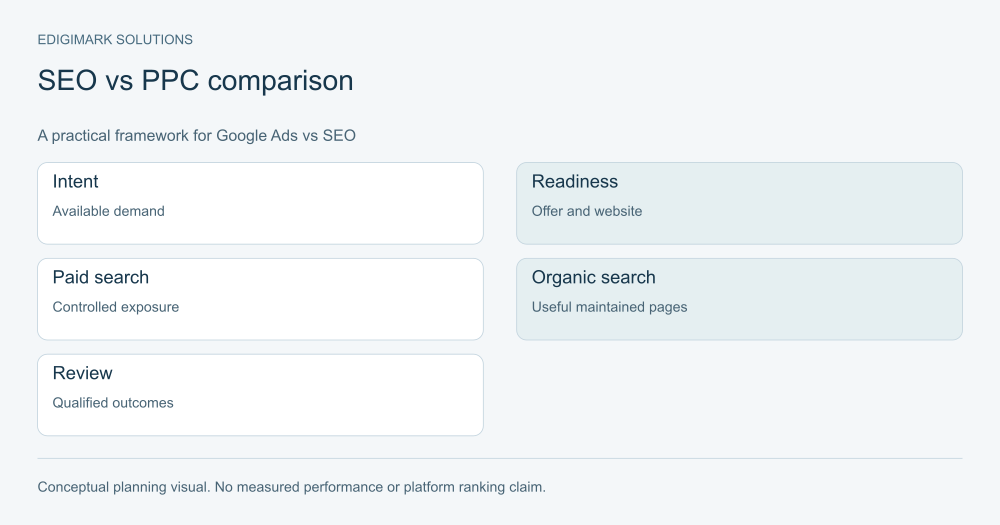
Google Ads vs SEO is a decision about how to capture search demand, how quickly you need to learn and what resources you can sustain. Google Ads can put a relevant offer into paid search auctions once the campaign is approved and eligible; SEO develops your website’s usefulness and organic visibility over time. Neither guarantees customers. Choose the investment by the demand available, the quality of your offer, acquisition economics and operational readiness.
Many businesses frame the decision as a permanent choice between two rival channels. A more useful approach is to identify what each should do in the acquisition plan. Paid search can test an offer or reach relevant demand while the organic site develops. SEO can support commercial pages, evaluation resources and questions that do not justify a paid click.
What do Google Ads vs SEO investments actually deliver?
With Google Ads, you pay to participate in advertising auctions under the campaign’s targeting and bidding settings. The result depends on competition, relevance, budget, campaign configuration and the visitor’s response. Launching a campaign does not mean your ad will appear for every relevant search or that every click will be appropriate.
SEO improves the site’s ability to be discovered and understood in organic search. The work can include technical fixes, clearer commercial pages, useful supporting content and appropriate internal links. Google’s Search Essentials describes eligibility and recommended practices; it does not promise inclusion or a particular ranking.
Both channels ultimately send people to an offer. If the page is confusing or the service is unsuitable, changing the acquisition source does not repair the problem. This is why digital marketing planning should connect search acquisition with the website and follow-up process.
How quickly can paid vs organic search contribute?
Paid search generally offers a faster route to controlled exposure once prerequisites are ready. That can be valuable when you need to test a specific message, reach a time-sensitive audience or learn which searches produce relevant enquiries.
However, exposure is different from validated performance. You still need reliable measurement, sufficient relevant traffic, an appropriate conversion process and time for downstream sales outcomes. A long B2B sales cycle does not disappear because the visit came from an ad.
SEO often requires a longer period of implementation and observation. A technical repair may improve accessibility quickly, while a new commercial topic can take longer to establish visibility. The timing depends on the site and market; a supplier cannot responsibly guarantee a uniform result date.
For an urgent commercial deadline, ask whether the site and fulfilment process can support paid traffic now. For sustained growth, ask whether the business can maintain useful pages and technical quality. Different answers may justify different allocations rather than one channel winning every time.
What does paid vs organic search actually cost?
Organic search does not normally charge the publisher for each visit, but producing and maintaining the destination costs money and time. Research, writing, subject review, development, measurement and updates all belong in the SEO cost model.
Paid search has visible media spend alongside management, creative, landing page and tracking costs. Comparing ad spend alone with the salary of an SEO writer gives an incomplete picture of both channels.
Calculate a practical total for each route. For paid search, include the campaign and page work required to acquire and handle leads. For SEO, include the resources required to build and maintain the pages and fix material issues. Then relate those costs to suitable outcomes over an appropriate period.
Avoid treating past SEO production costs as a reason to keep every page forever. Content still needs review, and some pages may no longer serve the business. Equally, do not assume that stopping ad spend leaves no value at all: the campaign may have generated customers and useful learning, even though future paid exposure stops.
What do intent and demand tell you about SEO vs PPC?
Inspect the searches your business could serve. A narrow product or service query may support a direct commercial page. A broad educational question may be useful for SEO but too distant from purchase to justify paid traffic under your economics.
Look at the current result format. Product listings, local results, comparison pages and explanatory resources represent different opportunities. A campaign should not send every query to the homepage simply because that is the easiest URL to use.
For a hypothetical payroll consultancy, “payroll implementation support” may be a direct service opportunity. “What is payroll?” could attract many people who have no need for the consultancy. The distinction is relevance, not simply which phrase has more estimated searches.
Paid vs organic search planning should therefore share one audience and intent map. Different channels may address different parts of that map, but both should be connected to offers the company can deliver accurately.
How do acquisition economics shape a search acquisition budget?
Start with the value of a customer and the acceptable cost to acquire one. Use contribution margin or another agreed profitability basis rather than revenue alone where possible. Include the time and costs required to turn an enquiry into a customer.
For lead generation, an affordable lead cost depends on conversion quality. A campaign producing cheap enquiries may be expensive per customer if most are unsuitable. A more expensive lead can be commercially sensible when it is much more likely to progress.
Use a sensitivity model instead of a single confident forecast. Change the assumed cost per click, visitor-to-lead rate and lead-to-customer rate to see how the result moves. Mark uncertain inputs clearly and replace them with observed data when enough evidence exists.
SEO economics require a longer evaluation window and an appropriate treatment of shared work. A technical fix or commercial page can support multiple channels. Do not allocate every shared website cost to SEO and then compare it with an ad campaign that benefits from the same improvement.
When should paid vs organic search favor Google Ads?
Google Ads can deserve priority when relevant search demand is identifiable, the business needs near-term exposure, the offer is ready and the economics allow a bounded test. It can also support a new location or service while organic pages develop.
Define what the test is meant to establish. It might ask whether a particular service query produces suitable enquiries, whether one offer attracts better prospects than another, or whether a landing page explains the proposition clearly enough. Set a budget limit and a decision point before launch.
Be cautious when the service cannot handle additional enquiries, tracking is broken or the landing page is incomplete. Paid traffic can reveal those problems, but it can also consume budget while the team avoids fixing them.
Google’s conversion goal documentation explains how campaign goals relate to conversion actions. Review the actual setup so that the campaign’s optimisation target represents the intended business outcome rather than an easy but weak interaction.
When should paid vs organic search favor SEO?
SEO can deserve priority when the business has a sustainable offer, relevant questions to answer and the capacity to maintain a useful website. It is particularly valuable when buyers need information across several decisions and the site currently leaves those questions unanswered.
Start with commercial foundations rather than assuming a blog programme must come first. A clear service page, a useful comparison or a well-structured product category can be more important than a broad educational article.
SEO also deserves attention when technical problems reduce the usefulness of the site for everyone. Broken navigation, accidental indexing restrictions or duplicated commercial pages are website issues with acquisition consequences. They should not wait until the business decides which channel has the better return.
The limit is patience without learning. An ongoing SEO programme should produce accurate pages, repaired issues and increasingly useful evidence about the audience. “It takes time” is not a sufficient explanation for work that has no clear purpose or review process.
How should SEO PPC trade-offs affect a limited budget?
With a limited budget, reduce the number of simultaneous experiments. A business may get clearer learning from one focused paid campaign and a small set of strong organic pages than from many campaigns and a large weak content calendar.
Choose the immediate bottleneck. If the company has an excellent offer but almost no relevant exposure, a paid test may help. If the website cannot explain the offer or convert suitable visitors, page improvements may deserve the first investment. If technical issues block important pages, repair them before expecting either channel to perform well.
Keep a reserve for work revealed by the test. A campaign can uncover a necessary form change or a missing explanation. An SEO review can reveal a navigation problem. A plan that spends the entire budget on acquisition leaves no room to address those findings.
Agree on what would justify expanding, reducing or pausing each activity. This turns budget allocation into a decision process rather than a monthly debate based on whichever metric looks best that week.
How can an SEO vs PPC plan connect the channels?
Paid search terms can reveal audience language and offer response, subject to the data available in the account. That learning can inform commercial page improvements and editorial research. It does not prove that the same wording will rank organically or that every paid search term deserves a separate page.
Organic pages can support paid visitors who research the brand after seeing an ad. Clear documentation, comparisons and service explanations give buyers more information when they return through another route.
Both channels benefit from conversion rate optimization and a reliable follow-up process. A useful page improvement may increase the quality of enquiries from several sources, so record the change and assess its effects across the relevant traffic segments.
Coordinate calendars too. A service launch needs accurate organic pages before paid campaigns advertise it. A seasonal promotion needs consistent terms on the page, in ads and in the fulfilment process.
What should the search acquisition budget dashboard show?
Show spend and effort alongside relevant outcomes. For paid search, include qualified lead cost or appropriate customer acquisition measures, not only clicks and raw conversions. For SEO, include relevant visibility, useful visits, enquiries and observed commercial progress.
Keep brand and non-brand activity distinguishable where practical. A person searching the company name may already know the business from another channel. That traffic can be valuable, but it should not automatically be interpreted as newly created demand.
Allow for conversion lag. A recent lead cohort may not have reached the point where sales can judge it. Compare cohorts with similar maturity instead of ranking this month’s fresh enquiries against last quarter’s closed customers.
Document attribution limits and any measurement changes. If a tracking repair suddenly increases recorded conversions, the dashboard should explain that context. Data analytics helps organise the evidence, while CRM integration can connect lead outcomes with the acquisition records where appropriate.
What would a combined Google Ads vs SEO plan look like?
Consider an illustrative business offering a specialist installation service. Its initial site explains the service poorly, and the team has a limited acquisition budget. The first phase fixes the commercial page, adds preparation information and verifies the enquiry process.
The second phase launches a focused paid search test for relevant service queries while the organic site develops. The team reviews enquiry suitability and records the questions prospects still ask. It uses those questions to improve the page and create a supporting guide.
The third phase reallocates effort based on observed demand, customer quality and operational capacity. If paid enquiries are unsuitable, it reviews targeting and the offer before increasing spend. If organic visitors ask useful questions but cannot find the action, it improves the journey.
This is a hypothetical sequence, not a performance claim or a fixed formula. Its value is that each investment solves a defined problem and creates evidence for the next decision.
How do you make the Google Ads vs SEO investment choice?
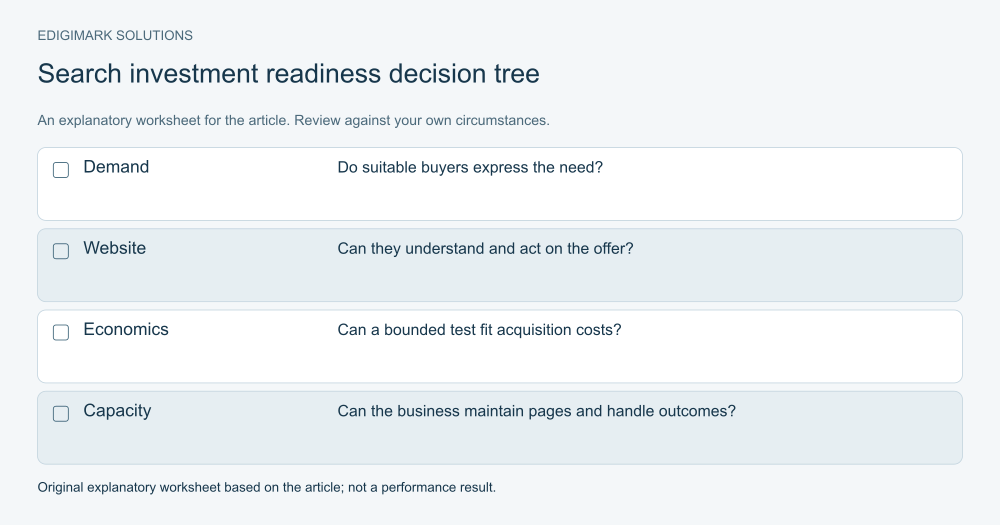
Answer four questions: Do suitable buyers search for the offer? Is the website ready to serve them? Can the business afford a controlled acquisition test? Can it maintain useful organic pages over time?
If several answers are uncertain, begin with the work that clarifies them. Avoid committing a large budget based on a generic claim that one channel is cheaper, faster or more sustainable for every company.
The right allocation can change as the business matures, the market shifts and the website improves. Review it using qualified outcomes and realistic costs. Discuss your search investment with Edigimark to build a plan around those decisions.
What should you ask a supplier about the search acquisition budget?
Ask which audience and decision the proposal targets, which pages are needed and how lead or purchase quality will be judged. Request a clear separation of media spend, management, content, development and measurement work. The scope should explain what the business must provide and what the supplier owns.
Ask how the plan will respond if initial assumptions prove wrong. A supplier should be able to describe a review process and decision criteria without guaranteeing rankings, clicks or sales. Also ask how the work will be maintained after launch: campaigns need oversight, and organic pages need updates.
Finally, request reporting that connects activity to appropriate outcomes. A proposal built entirely around impressions or publishing volume leaves the commercial question unresolved. The best comparison is between concrete plans for your business, rather than two generic claims about channel superiority.
Frequently asked questions
Which is cheaper: Google Ads or SEO?
Neither is universally cheaper per customer. Ads include media and operating costs; SEO includes production, development and maintenance. Compare total cost with suitable outcomes over a realistic period. A low cost per click or a large organic traffic total does not settle the question.
Can Google Ads improve organic rankings?
Buying ads does not purchase better organic rankings. Paid campaigns can provide useful audience and offer learning, but organic visibility depends on the site and search systems. Keep the distinction clear when reviewing a proposal that claims paid spend will directly improve SEO positions.
Should a new business use both immediately?
Only when it has the readiness and resources to do both properly. Establish an accurate offer, usable page and measurement first. A small paid test alongside a focused organic foundation can be reasonable, but spreading limited resources across many activities can weaken learning.
Should ads stop when SEO performs well?
Review the marginal value rather than stopping automatically. Paid and organic results may reach different queries or serve different goals. Assess qualified outcomes, overlap and total cost. A carefully bounded test can help when the business wants to understand the effect of changing the allocation.
What metric should decide the channel mix?
Use a commercial measure appropriate to the business, such as customer acquisition cost, qualified opportunity cost or contribution after acquisition. Combine it with capacity, timing and attribution limitations. No single traffic or platform metric captures every reason to invest in search.