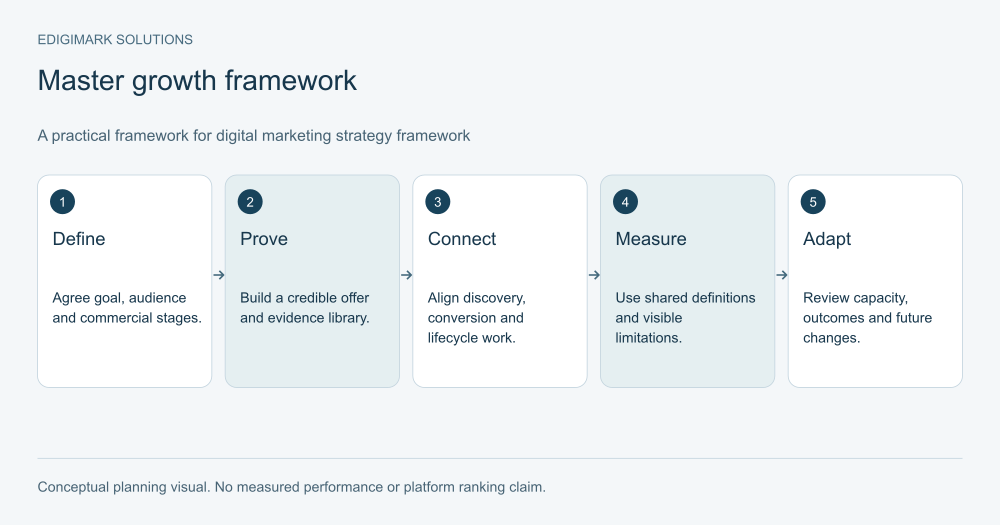
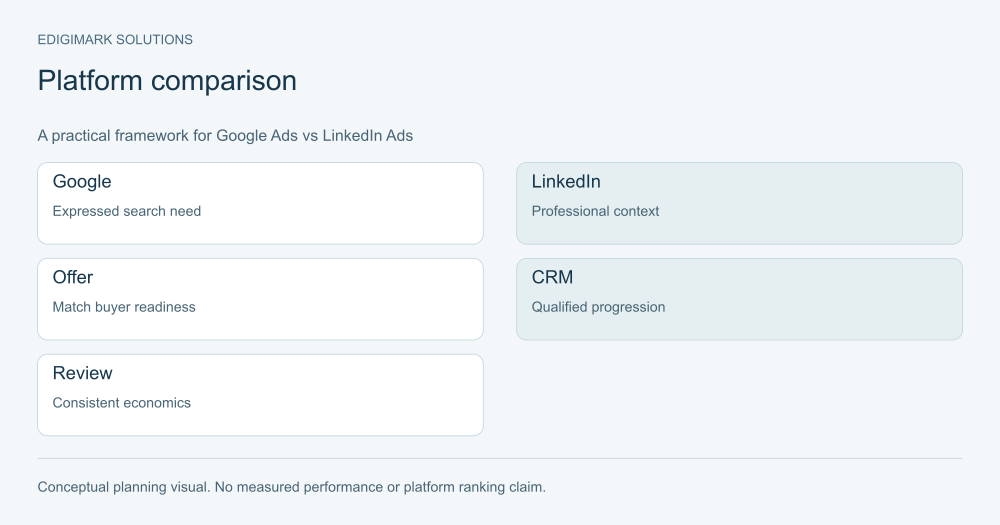
Google Ads vs LinkedIn Ads is a B2B channel decision about the signal you want to reach. Google search campaigns can connect an offer with people expressing a relevant need through a query. LinkedIn can reach professional audiences through role, company and other audience criteria, even when those people are not currently searching for your category. Choose and compare the channels using qualified outcomes, buying context and realistic costs rather than raw CPL alone.
The platforms can serve complementary roles. Search can capture an active evaluation question; professional audience advertising can introduce a useful idea to a buying group. Neither signal proves that a person is ready to purchase. The offer, page and follow-up process still determine whether attention becomes a productive conversation.
What does Google Ads vs LinkedIn Ads compare in practice?
The most useful comparison separates intent from identity. A search query tells you something about the task or question being expressed. Professional targeting tells you something about the audience you intend to reach. Both can be relevant, but they are different kinds of evidence.
A hypothetical operations director searching for “warehouse planning software” gives an explicit category signal. The same role encountering a useful warehouse-planning guide on LinkedIn may be relevant without being in an active buying process.
Use that distinction to choose an offer. A commercial search may suit a product evaluation page. A professional audience campaign may need an explanation of the problem before asking for a meeting. Sending both audiences to the same generic demo form can obscure the difference in readiness.
An integrated digital marketing plan should assign each channel a purpose and a definition of success rather than demand identical behaviour from every visitor.
How does search intent differ from audience targeting?
Search intent is inferred from the query and the result context. It can indicate research, comparison, navigation or a commercial task. The inference is useful but imperfect: broad terms may have several meanings, and a specific query may come from a person outside your supported market.
Audience targeting can identify a professional group likely to care about the problem. LinkedIn’s targeting documentation describes criteria such as job title, company, industry and seniority, alongside audience options using a business’s own data. Those criteria support audience planning; they do not certify purchasing authority or current intent.
Review the actual audience reached and the enquiries received. A job title can vary across organisations, and one role may be an influencer in one company but a decision-maker in another. Search queries also need ongoing relevance checks.
The choice is therefore not “intent is good and targeting is bad,” or the reverse. It is which signal fits the task your campaign needs to perform.
When is Google search a stronger starting point?
Search can be a useful starting point when buyers already look for the category, problem or service and the business has a relevant destination. It can help test how a specific query group responds to an accurate offer.
Inspect the available demand. A niche B2B product may have limited category searches, while adjacent problem searches may be broader but less commercially direct. Validate the meaning of the queries before treating a tool’s estimated volume as an acquisition forecast.
The landing page should answer the decision behind the query. An integration evaluator needs compatibility and implementation information. A buyer seeking a managed service needs scope, process and appropriate proof.
Search is less straightforward when the market does not yet know the category or when the most available queries attract an audience the product cannot serve. In that case, educational work and other channels may be needed alongside the search foundation.
When is LinkedIn a stronger starting point?
LinkedIn can be useful when the intended audience is more easily defined by professional context than by search wording. A campaign aimed at a particular buying role, industry or account group can introduce a problem or resource relevant to that context.
This can support account-based work, category education and engagement with a buying group. The content should provide a reason for that person to pay attention. A generic product claim placed in front of a precise audience is still generic.
Check the audience’s practical reach and the campaign’s available options in the account. Do not make the plan depend on a targeting feature remembered from an old screenshot. Platform interfaces and eligibility can change.
LinkedIn’s Matched Audiences guidance describes options using company or contact data and engagement-based audiences. Use appropriate data and permissions, and recognise that matching does not guarantee complete account coverage.
How should the offers differ across the two platforms?
Match the offer with readiness. A person searching for a provider may welcome a relevant consultation or product demonstration. A professional audience unfamiliar with the problem may need a diagnostic guide, a concrete explanation or an event with a useful agenda.
Avoid assigning all LinkedIn activity to awareness and all Google activity to purchase. Some LinkedIn audiences are already engaged; some search queries are very early-stage. Use the actual campaign context rather than a fixed platform stereotype.
Explain what the offer provides and what happens after the action. A resource download should deliver the resource. A meeting request should explain the meeting. Clear expectations support useful follow-up and reduce disappointment.
If you test the same offer on both channels, document the differences in audience and intent. The result can inform the plan, but it will not be a pure experiment isolating only the platform.
Are LinkedIn lead forms comparable with website forms?
They create different experiences. LinkedIn Lead Gen Forms can use prefilled professional profile information and connect leads with a CRM or marketing automation process. A website form places the action within your own page and can provide a different amount of explanation and qualification.
Reduced entry effort can be helpful, but a completed native form does not prove strong buying intent. The offer and subsequent progression still need evaluation. A website form can also be easy to complete yet poorly qualified.
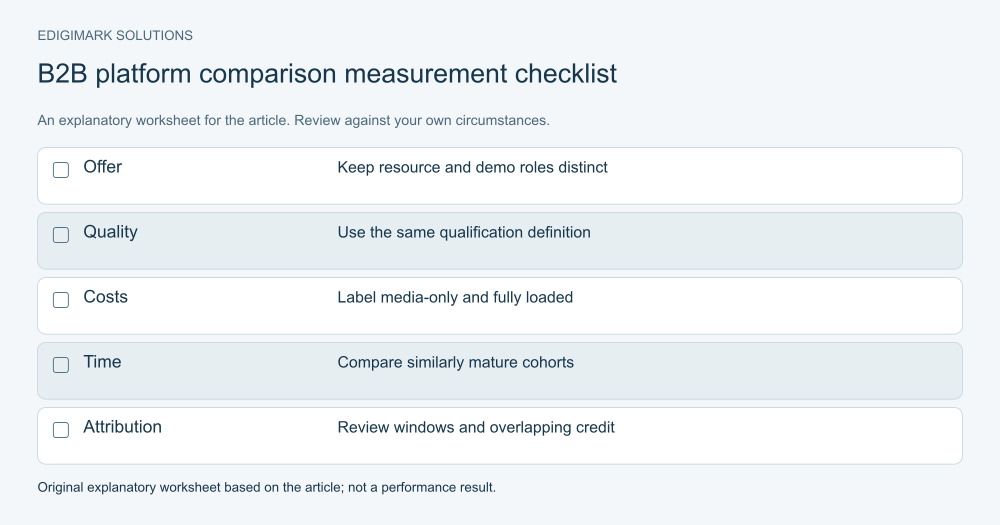
Compare valid leads, fit, engagement with the promised resource and downstream outcomes. Ensure the follow-up process delivers what each form promised. If one channel offers a guide and the other requests a demo, raw CPL is not a like-for-like measure.
CRM integration can preserve the form and campaign context so sales understands the request rather than receiving an undifferentiated lead list.
How should a qualified lead comparison be calculated?
Agree on qualification before comparing channels. Define the supported audience, need and next stage. Apply the criteria consistently, and record rejection reasons that can guide marketing decisions.
Calculate costs at several stages: raw lead, valid lead, qualified lead, meeting and opportunity where reliable data is available. Include counts so the team can see how much evidence supports each average.
For an illustrative comparison, one channel might generate 30 submissions and six qualified leads, while another generates 12 submissions and six qualified leads. The raw counts differ, but qualified cost depends on the respective spend. Later progression could still differ. These are invented examples, not platform benchmarks.
Include management, creative and page costs consistently when comparing total acquisition. Media-only measures remain useful for campaign management, but should be labelled separately from fully loaded economics.
Why do attribution settings matter in a platform comparison?
Platforms may credit outcomes using different windows and interaction rules. A person can see an ad, later search the brand and submit a form. Both systems may describe part of that journey, and their reported conversions should not automatically be added together as unique customers.
LinkedIn’s conversion-window guidance explains how lookback settings affect attribution. Google’s conversion goal documentation explains how configured actions support campaign goals. Review the actual settings in both accounts when interpreting the reports.
Maintain a CRM or business outcome view where appropriate, with clear definitions and known limitations. Use platform reporting for platform optimisation and connected commercial reporting for budget decisions, recognising that neither reconstructs every influence perfectly.
Data analytics can help reconcile the evidence without claiming that one source is an infallible account of the buying journey.
How can the platforms support a longer B2B buying process?
A buyer may need several resources and involve several colleagues. Search can answer an active question about the category or implementation. Professional audience campaigns can distribute useful material to relevant roles or accounts. Retargeting can provide another appropriate resource where consent and platform rules permit it.
Sequence the content around decisions rather than repeatedly showing the same sales demand. A technical evaluator may need documentation; a budget owner may need scope and commercial context; a user may need to understand the workflow.
Keep the follow-up connected to the action. Someone who requested an educational resource should not receive a message pretending they asked for a sales demonstration. Marketing automation can support contextual delivery and suppression when a conversation starts.
Measure progression over a suitable period. A longer journey needs cohort views and sales feedback, not only this week’s platform conversion count.
What budget constraints should influence the channel choice?
Consider the cost of producing the right assets and operating the campaign, not only the expected media cost. A professional audience campaign may need a strong resource and tailored creative. A search campaign may need several focused commercial destinations and ongoing query review.
If the budget is limited, choose the most informative initial test. A narrow commercial search test may clarify demand for an existing service. A focused role-based resource campaign may clarify whether the problem resonates with the intended group.
Avoid launching many small campaigns merely to claim a multichannel presence. Fragmented spend can produce too little evidence for a useful decision. Define the question, the scope and the commercial limit first.
Reserve resources for improvements the test may reveal, including page changes, qualification or follow-up. Conversion rate optimization can improve the destination shared by the channels when the problem sits after the click.
How should you structure a fair initial review?
Begin with measurement validity and offer delivery. Confirm that forms work, leads reach the business and the promised resource or response is provided. Then review audience relevance, lead quality and downstream progress.
Compare cohorts with enough time to mature. If one campaign launched later, its opportunities may not yet have the same time to develop. If the offers differ, explain the intended roles rather than ranking them by a single metric.
Inspect examples. A short review of accepted, rejected and ambiguous leads can reveal why a channel looks strong or weak. Use anonymised records and practical reasons rather than exposing personal data in a general marketing report.
End with a decision: improve the offer, repair the page, narrow the audience, expand a proven segment or wait for more evidence. “LinkedIn is expensive” and “Google is competitive” are observations requiring context, not complete diagnoses.
What mistakes should B2B teams avoid?
Do not treat job title as proof of buying readiness or a search query as proof of organisational fit. Both signals need an appropriate offer and qualification.
Do not compare a low-commitment download with a qualified demo request using raw CPL alone. Do not sum platform-attributed conversions and report them as unique customers without reconciling the records. Do not judge fresh leads against mature opportunities.
Avoid pushing identical creative and copy into every channel. The underlying offer can remain consistent while the explanation reflects how the visitor encounters it.
Finally, keep sales feedback in the process. A campaign can look efficient in the advertising account while producing confusion or unsuitable enquiries downstream. The useful channel mix connects acquisition activity with the commercial reality.
How do you choose the next investment?
Choose the platform or combination that addresses the most important current gap with a credible test. If active category demand exists and the page is ready, search may be a sensible first step. If the audience is identifiable but does not yet search for the category, professional audience education may deserve attention.
The choice can change as the business learns. A successful resource campaign may reveal search language worth answering. A search campaign may reveal buying roles that need supporting materials. Keep those insights connected.
Discuss your B2B paid channel mix with Edigimark if you need a plan that compares fit, intent and qualified outcomes on a consistent basis.
What should the channel decision document contain?
Write the business objective, the audience signal each platform is intended to reach and the offer used to serve that audience. Include the qualification definition, the attribution settings to review and the costs included in the comparison.
Record the uncertainty explicitly. The team may know that the audience fits while remaining unsure about buying readiness. It may know that search demand exists while remaining unsure whether the offer converts suitable visitors. Those are different questions and should produce different tests.
Add the decision criteria for the next review. Expansion might require credible qualified outcomes and available delivery capacity. A pause might follow a broken journey or repeated unsupported enquiries. A hold might reflect insufficiently mature outcomes.
This document keeps the platform discussion tied to the business. It also prevents a new account manager from replacing the original purpose with a generic goal such as reducing every CPL. The useful question remains whether the channel is fulfilling its assigned role at an acceptable cost.
Frequently asked questions
Which platform usually has a lower B2B CPL?
There is no universal answer useful for every business. Offers, audience, market and lead definitions affect the result. Compare raw and qualified lead costs using consistent criteria, then examine opportunity and customer progression. An industry average cannot replace your acquisition economics.
Should a B2B company use both platforms?
Use both when each has a defined role and the team can operate and measure them properly. A limited budget may justify beginning with one focused test. Add the second channel when it addresses a clear gap rather than simply completing a channel checklist.
Is LinkedIn only for awareness?
No. It can support different objectives and audiences, including engaged prospects and account-based activity. The appropriate offer depends on readiness and campaign context. Equally, not every Google search is a purchase query; some searches are educational.
Can Google Ads target a buying committee?
Search can reach people asking relevant questions, but a query alone does not identify every role in a buying committee. Use the campaign’s available targeting and the wider content journey appropriately. Do not imply complete account coverage from a search campaign.
What should decide whether to move budget between platforms?
Use qualified outcomes, total costs, cohort maturity, demand and operational capacity. Check measurement differences and offer roles before making the move. A change should address a specific opportunity or problem, with a review plan that explains what evidence comes next.
Put the ideas to work
Explore our connected growth services →