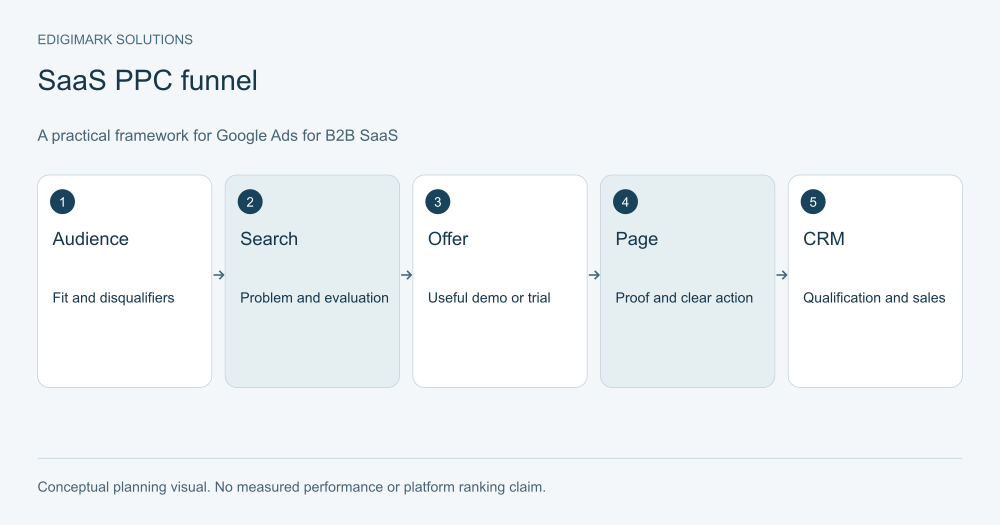
Google Ads for B2B SaaS works best when search intent, the offer, the landing page and lead qualification describe the same buyer decision. Build campaigns around problems and evaluation searches your product can genuinely serve, measure meaningful enquiries and downstream outcomes, and give sales the context needed to follow up. Optimising for the cheapest form submission can produce activity without a useful SaaS pipeline.
A business software purchase can involve users, technical reviewers and budget owners. Those people may search differently and arrive at different stages of readiness. SaaS paid search should recognise that variety while keeping the initial campaign structure simple enough to operate and learn from.
What must Google Ads for B2B SaaS qualify before launch?
Write the ideal customer profile in operational terms: business type, relevant workflow, supported geography, deployment requirements and the conditions that make the product a fit. Include disqualifiers too. A product designed for teams may not suit individual users; software requiring an existing platform may not suit buyers without that platform.
Translate those conditions into the page and follow-up process. The visitor should be able to understand whether the product fits before submitting a form. Sales should receive the details needed for a useful discussion without forcing the visitor through an interrogation.
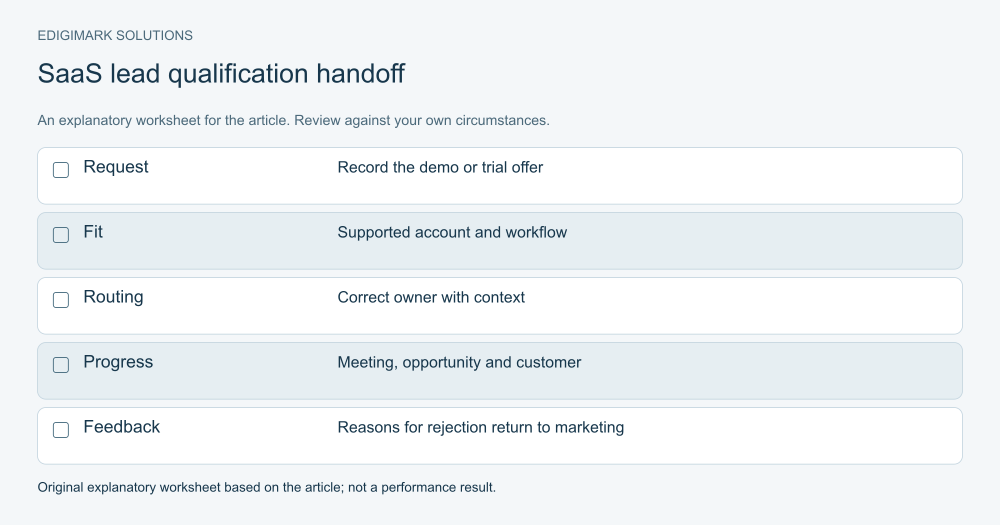
Agree on the outcome the campaign is meant to produce. A demo request is a request for a product conversation, not automatically an opportunity. A trial signup is not the same as activation. Define the progression from initial action to qualified lead, meeting, opportunity and customer according to the business’s actual process.
This alignment belongs in the wider digital marketing plan so paid search does not operate with a different definition of success from sales and product teams.
How should SaaS paid search keywords be grouped?
Group queries by the decision they express. Problem searches ask how to solve a workflow issue. Category searches look for a type of software. Alternative and comparison searches evaluate approaches or providers. Integration searches check compatibility. Brand searches concern an already-known company or product.
For a hypothetical invoice approval platform, “invoice approval software” suggests a different destination from “how to reduce invoice approval delays.” The first may need a commercial product page; the second may need an explanation that helps the buyer assess the problem. Whether the second query deserves paid budget depends on the acquisition economics and the offer available.
Inspect actual search results and account search-term data where available. A phrase can have several meanings. “Approval app” could include personal tasks, business workflows or unrelated software. Do not assume that a broad phrase represents the exact audience the sales team wants.
Maintain a shared intent map rather than separate disconnected keyword lists for every campaign manager. It should connect the query group, intended audience, offer, page and meaningful outcome. That makes later performance reviews more useful than a table of keywords and clicks alone.
How much structure do SaaS paid search campaigns need initially?
Create distinctions where they support a real operating decision. Brand and non-brand campaigns may need separate reporting. Different geographies may need different offers or budgets. A product category and a specialised integration may warrant distinct messaging and pages.
Avoid splitting every minor keyword variation into its own isolated campaign. Excessive fragmentation makes budgets and learning harder to manage. Equally, placing unrelated products, regions and intents in one undifferentiated campaign makes it difficult to diagnose why enquiries are unsuitable.
Choose a manageable starting structure and record the reason for each separation. Review it when there is enough evidence to identify a useful distinction. The structure should support decisions about targeting, budget and messaging, not simply mirror a spreadsheet’s layout.
Match types and automation settings need to be understood in the current account context. Inspect the queries actually reached, apply appropriate exclusions and review the quality of the resulting leads. A setting is not a substitute for ongoing relevance checks.
What offer should demo request campaigns make?
The offer should match the buyer’s immediate decision. A category evaluator may want a product demonstration. A technical reviewer may need an integration explanation. An early-stage prospect may benefit from a diagnostic guide, provided the economics justify promoting it.
Demo request campaigns need a clear promise. Explain what the demonstration covers, who it suits and what happens after the request. A visitor should not discover later that the “demo” is only a generic sales call with no product context.
Trials need honest prerequisites. If meaningful evaluation requires data import, setup or team participation, make that clear. A campaign that attracts many signups but few usable trials may have an offer problem rather than a bidding problem.
For downloadable resources, keep registration proportionate to the value and explain any subsequent communication. A worksheet download should not silently enrol a person in an unrelated sequence. Useful offers support informed decisions and create context for the next step.
How should SaaS paid search ads express the product’s value?
Describe a concrete problem and a credible capability. “Route invoice approvals to the right team” is more informative than “Transform finance forever.” Include a useful differentiator only when it can be substantiated, such as a supported integration or a specific workflow feature.
Qualify important limits early. If the product serves a particular business size or requires a specific environment, the ad and page should not imply universal suitability. Clear fit can reduce wasted attention, even if it also reduces some clicks.
Keep the ad, landing page and sales conversation consistent. A campaign advertising rapid setup should lead to a page that explains the conditions for setup and any required work. Unsupported superlatives and implied guarantees create expectations the team may not be able to meet.
Use variants to test meaningful differences: workflow problem, role-specific benefit or evaluation offer. Changing only punctuation or swapping a generic adjective provides less useful learning than testing a different explanation of the buyer’s task.
What do SaaS landing pages need to answer?
SaaS landing pages should help the visitor understand the product, assess fit and take an appropriate action. Give the page a focused headline, an explanation of the workflow, credible evidence and a clear next step. Do not make the buyer infer the product from abstract illustrations alone.
Show what the product does with actual screenshots or accurately labelled diagrams where possible. Explain implementation responsibilities, compatibility and the information required to begin. Link to deeper documentation when it helps a technical evaluator without overwhelming the main page.
Proof should answer the risk behind the purchase. A genuine case study needs context; a testimonial should be authentic and relevant. If customer evidence is not available, use a transparent worked example rather than inventing a result.
Keep forms usable on mobile and desktop. Request fields that support routing or qualification, and explain the next step after submission. Test error handling and confirm that a real lead reaches the correct owner.
Conversion rate optimization can help improve this experience, while web development handles the implementation needed to keep it reliable.
How should qualified conversion tracking be designed?
Begin with a measurement map. Identify the initial action, the systems recording it, the identifiers needed to connect later outcomes, and the people responsible for each stage. A form submission should appear in the CRM with enough context to investigate its source and quality where the setup permits.
Separate observation from optimisation. Some interactions help diagnose the journey but are weak business outcomes. Google’s documentation on primary and secondary conversion actions explains their roles in reporting and bidding, with goal configuration affecting how actions are used. Review the actual account setup rather than assuming the label alone tells the full story.
Where supported and appropriate, connect later qualification or sales outcomes back to the ad system. Google documents enhanced conversions for leads, including the use of eligible first-party information to help match offline outcomes. Implementation still requires suitable consent, policy compliance, accurate data and testing; it does not make every lead matchable.
Do not send fabricated values or treat every lead as equally valuable without examining the business process. Start with accurate definitions and a verified integration, then consider more advanced optimisation when the signal is reliable.
What should sales receive from demo request campaigns?
Give sales the stated need, product or campaign context, relevant qualification details and a record of what the visitor requested. Avoid forcing a salesperson to begin with “What are you interested in?” when the form already answered that question.
Define routing rules for territories, products and existing accounts. Decide who handles a duplicate request, a current customer, a partner enquiry or a person outside the supported market. The campaign report becomes clearer when these outcomes have consistent labels.
Agree on a response process that the team can deliver. The acknowledgement can confirm receipt and explain what happens next. A human follow-up should build on the request rather than repeat a generic sequence.
CRM integration connects these records, while marketing automation can support notifications and appropriate follow-up. Automation should stop or change when a person replies, books a meeting or becomes an active opportunity.
Which qualified conversion tracking metrics show whether campaigns work?
Review the full progression: relevant impressions and clicks, initial enquiries, qualified leads, meetings, opportunities and customers where the data is available. Keep the raw lead count visible, but do not let it replace quality.
Calculate costs at the stages that matter. Cost per qualified lead can be more informative than cost per form fill, while cost per opportunity helps connect campaign performance with sales. Interpret recent cohorts carefully because some leads have not had enough time to progress.
Compare segments with the same definitions and appropriate maturity. An integration campaign may produce fewer but more specific enquiries than a broad category campaign. The correct budget decision depends on qualified outcomes and scale potential, not just the cheaper average click.
Record attribution limitations. A buyer may return through another channel or involve a colleague before requesting a demo. Data analytics can organise observed evidence, but no dashboard should imply that it captures every influence on a complex purchase.
How should the first SaaS paid search campaign review proceed?
Start by checking measurement validity. Confirm that conversions are recorded once at the intended point, forms work and CRM outcomes are updated consistently. A broken conversion signal can make the rest of the analysis misleading.
Next, inspect relevance. Review search terms, locations and the actual enquiries received. Identify whether the offer attracted the intended business type and decision stage. Then inspect the landing-page journey for unclear messaging, missing proof or avoidable form friction.
Only after those checks should the team make broader decisions about bids, budget and expansion. Changing several variables at once can make learning harder. Record the hypothesis behind each meaningful change and allow an appropriate observation period.
If there are too few relevant observations to judge the campaign, say so. A small dataset may justify checking obvious problems, but it does not justify a confident claim that an entire market or platform cannot work.
What mistakes commonly weaken SaaS paid search?
One mistake is using a general homepage for every intent. A technical integration query and a broad category query often need different explanations. Another is promoting an offer that is easy to collect but poorly connected to a product decision.
A third is counting every submission as an equally useful lead. Spam, job enquiries and unsupported use cases can make the report look successful while sales sees little value. Maintain outcome definitions and inspect examples of both accepted and rejected leads.
Teams also lose learning when they change campaigns without recording why. A simple change log can explain whether later movement followed a page edit, an offer change, a tracking repair or a budget adjustment.
Finally, a campaign can fail operationally after a suitable enquiry arrives. Poor routing, missing context or repeated irrelevant follow-up should be investigated alongside keywords and ads.
How can SaaS paid search prepare a controlled expansion?
Expand only after the current campaign has a usable foundation and credible evidence. Add a new intent group, geography or offer because it addresses a specific opportunity, then define how its success will be judged.
Confirm that the product, landing page and sales team can support the expansion. A new market may need different terminology or implementation information. A new integration may need technical review. A larger budget may require more lead-handling capacity.
Keep the original learning visible so the team can distinguish improved scale from diluted quality. The goal is a repeatable route from relevant searches to useful conversations, not a continually rising conversion total with an unclear commercial meaning.
Ask Edigimark to review your SaaS search-to-sales journey if campaign activity and sales outcomes currently tell different stories.
What belongs in a campaign handover document?
Document the audience, the exclusions, the offer and the reason each campaign exists. Include the landing-page owner, tracking definitions, CRM stage definitions and the person responsible for resolving a routing failure. Record which settings were deliberately chosen and which still need validation.
Attach examples of a suitable lead and an unsuitable lead, with identifying information removed. These examples help a new campaign manager understand the business meaning behind the metrics. Keep approved product claims and important limitations in the same document so ad changes do not introduce unsupported promises.
The handover should also contain the change log and the next review decision. That makes continuity easier when responsibilities move between an internal team and an external partner. A campaign that only one person understands is harder to operate consistently, even when the original setup was sensible.
Frequently asked questions
Should B2B SaaS campaigns optimise for demos or trials?
Choose the action that fits the product’s evaluation process and produces useful downstream outcomes. A self-serve product may benefit from activated trials; a complex deployment may need qualified demonstrations. Review quality and progression rather than choosing the action that generates the largest initial count.
Are broad category keywords always too expensive?
No. Their value depends on relevance, competition, conversion quality and customer economics. Test a bounded set where the product is a credible match. A specific phrase is not automatically profitable, and a broad phrase is not automatically wasteful.
Should competitor campaigns be part of the initial plan?
Only when there is a clear evaluation use case and the team understands applicable advertising policies and legal considerations. Comparison content should be accurate and current. Do not build the starting plan around assumptions that another brand’s audience will necessarily fit your product.
How many form fields should a SaaS demo page use?
Use the information needed for a useful response and appropriate routing. Too little information can weaken qualification; unnecessary fields can create friction. Test the actual form with users and sales colleagues rather than following a universal field-count rule.
Can CRM data improve Google Ads decisions?
It can help when records and definitions are reliable and the integration is appropriate. Qualification, opportunity and customer outcomes provide more commercial context than raw forms alone. Verify matching, timing and data quality before treating imported outcomes as a dependable optimisation signal.