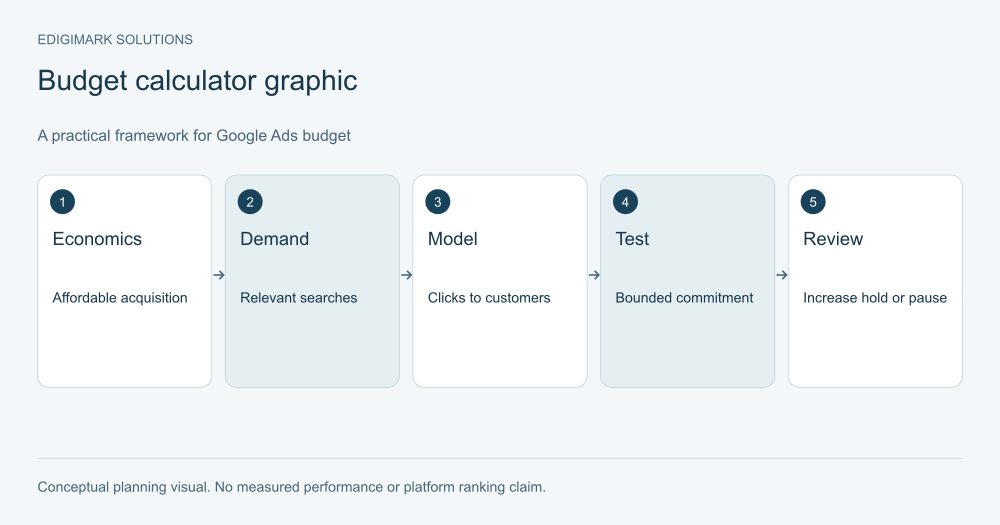
A Google Ads budget should come from your acquisition economics, relevant search demand and the amount you can commit to a controlled test. Estimate the cost of reaching suitable prospects, model how many become meaningful leads or customers, and include the landing page, management and follow-up work needed to make the spend useful. There is no universal monthly amount that makes Google Ads viable for every business.
The question is not only how much you can spend. It is what the spending must establish. A new campaign may need to validate search intent and lead quality. A mature campaign may need to reach more of a proven audience. Those goals call for different assumptions and review criteria.
How should a Google Ads budget connect to a commercial outcome?
Start with the commercial outcome. For an ecommerce campaign, that may be profitable orders. For a service company, it may be appropriate enquiries that can become customers. For a B2B software provider, it may be qualified demonstrations or opportunities rather than every form submission.
Define the audience, offer and geographical scope. A budget covering several products and countries is difficult to model without separating the different economics. Choose an initial scope that the team can manage and explain.
Record the constraints: available cash, sales capacity, delivery capacity and the period over which the business can wait for outcomes. A campaign can generate useful enquiries and still be inappropriate if the company cannot fulfil them or absorb the time between spending and payment.
Use the wider digital marketing plan to establish the role of paid search. The budget should fit the business objective rather than emerge from a generic percentage copied from another company.
How do you calculate an affordable acquisition cost?
Agree on the amount the business can spend to acquire a customer while meeting its margin and cash-flow requirements. Use a consistent basis for customer value. First-purchase revenue, contribution margin and expected lifetime value are different quantities and should not be substituted for each other casually.
For an early campaign, conservative assumptions are often easier to defend than a long lifetime-value projection with little supporting data. If the business relies on repeat purchases, show how much evidence exists for retention and what would happen if the repeat rate were lower.
For lead generation, use the probability that a lead becomes a customer. A simplified planning relationship is:
Affordable media cost per lead = allowable media acquisition cost per customer × lead-to-customer rate.
This relationship assumes that the allowable media acquisition cost has already accounted for the other relevant acquisition costs. If management, creative and sales costs still need to come from that allowance, reserve them before calculating the media limit.
The formula is a planning tool. It does not guarantee that the market will supply leads at the resulting price.
How does an acquisition cost model translate into a budget?
Once the business has a target outcome, estimate the activity required to reach it. For a simplified lead campaign:
Required leads = desired customers ÷ expected lead-to-customer rate.
Required clicks = required leads ÷ expected click-to-lead rate.
Estimated media budget = required clicks × expected average cost per click.
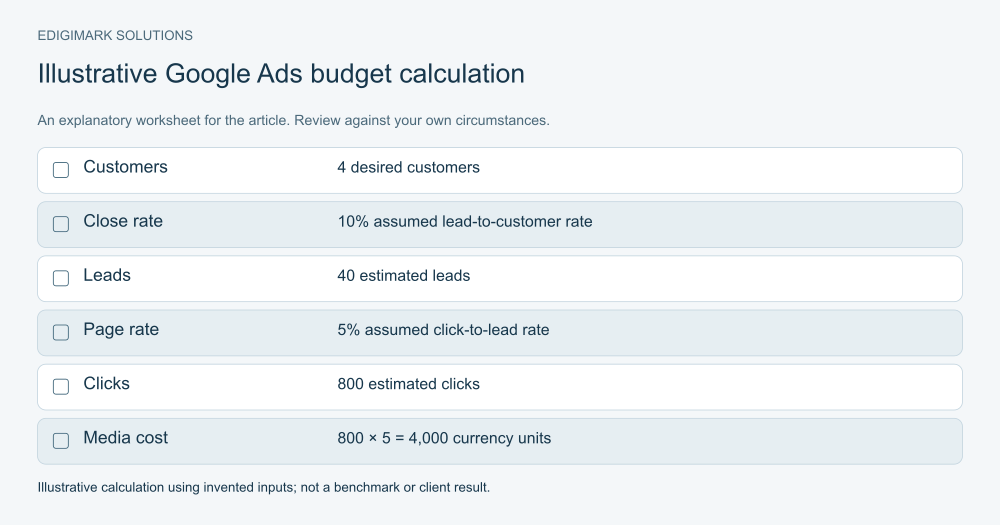
For an illustrative example, suppose a business wants four customers, expects one in ten leads to become a customer, and expects one in twenty relevant clicks to produce a lead. It would need an estimated 40 leads and 800 clicks. At an assumed average click cost of 5 currency units, the model produces 4,000 currency units in media spend.
These are invented inputs for a worked calculation, not a benchmark, forecast or Edigimark client result. Change any input and the required budget changes. The example also excludes management and other costs unless they are added separately.
Where should the click-cost and conversion assumptions come from?
Use relevant account history where it is reliable. Match the geography, intent, offer and time period as closely as possible. A branded campaign’s conversion rate may not describe a new non-brand campaign. A different product’s cost per click may not describe your category.
For a new account, tools can provide directional estimates. Google’s Keyword Planner documentation describes keyword ideas, historical estimates and forecasts. Its forecast guidance explains that predictions incorporate factors such as bids, budgets, seasonality and historical ad quality. Treat those outputs as estimates to investigate, not guaranteed results.
The landing-page conversion assumption may be particularly uncertain before launch. Use a range and explain why it was chosen. If no relevant evidence exists, label the assumption as unvalidated instead of presenting it as an industry standard.
Keep the model simple enough that everyone can see which assumptions drive it. A complicated spreadsheet with hidden optimistic inputs is less useful than a transparent calculation the team can update.
How should a conversion forecast handle uncertainty?
Build conservative, middle and optimistic scenarios. Vary the important uncertain inputs rather than changing only the media budget. In a lead campaign, click cost, click-to-lead rate and lead-to-customer rate often deserve attention.
For each scenario, show the expected media cost, lead volume, customer volume and whether the result fits the commercial constraints. Also show when outcomes might become visible. A lead that closes after a long evaluation period cannot fund next week’s advertising payment.
Do not average incompatible scenarios into one impressive number. If the optimistic case requires a page conversion rate the site has never achieved and a lead quality the sales team has never observed, keep that uncertainty visible.
The first campaign should replace assumptions with evidence where practical. Data analytics can help connect those observations, but the team must agree on definitions and avoid updating the model from noisy short-term fluctuations.
What is the difference between a test budget and a growth budget?
A test budget pays to answer defined questions under a limit. It might test whether a search group reaches suitable buyers, whether an offer produces meaningful enquiries or whether the follow-up process can handle the demand. It needs a decision point and an explanation of what evidence would justify the next phase.
A growth budget expands a route that already has credible evidence. It still needs oversight because higher spend can reach different audiences, compete in different auctions or expose capacity constraints. Historical efficiency does not guarantee that every additional unit of spend will perform equally well.
For a test, avoid scattering a small budget across too many products, regions and offers. For growth, avoid assuming that one profitable segment proves every adjacent segment. Define each expansion as a new decision with appropriate measurements.
There is no universal test amount or duration. Relevant click costs, conversion frequency and sales lag influence how much evidence the campaign can produce.
How do you set an average daily Google Ads spend limit?
Google Ads commonly uses an average daily budget rather than a fixed amount spent every day. For most campaigns, Google’s budget documentation describes a daily spending limit of up to twice the average daily budget and a monthly limit of 30.4 times that average, with exceptions and budget-change rules that should be checked for the actual campaign type.
That means a manager should not interpret the average daily setting as a strict daily cash cap. Review the applicable limits, budget report and billing arrangements before launch. If you change budgets during the month, inspect how the account calculates the resulting limits.
Use the platform setting alongside an internal review process. Decide who can change budgets, how increases are approved and when spend is checked. An account notification is helpful, but it does not replace responsibility for the commercial decision.
What costs belong outside the media budget?
Include the work needed to make the campaign usable: research, account setup, ad creation, landing-page development, tracking implementation, management and reporting. Add any specific creative or data integration requirements.
For lead generation, consider the cost and capacity of handling enquiries. A campaign can produce a large queue that the team cannot contact effectively. For ecommerce, consider stock, fulfilment, returns and the margin of the products being promoted.
Some costs benefit multiple channels. A clearer service page can help paid visitors and organic visitors. A tracking repair can improve reporting across the site. Record shared costs transparently rather than forcing every website improvement into the paid media return calculation.
Web development and conversion rate optimization should be included when the landing page needs work, not treated as optional extras after the ad spend has already been committed.
How should the budget be divided across campaigns?
Allocate by purpose, evidence and economics. A proven commercial query group may deserve a different commitment from an exploratory educational offer. Brand activity may need separate reporting from new-customer discovery. Different products can have different margins and sales processes.
Do not divide the budget equally simply because campaigns exist. Give each campaign a reason to receive spend and a measure that fits its role. If the overall budget is too small to support meaningful observation across the planned structure, reduce the number of simultaneous tests.
Avoid a rigid allocation that ignores new evidence. If a segment repeatedly produces unsuitable enquiries, investigate the cause before continuing to fund it by default. If a promising segment is constrained, check whether its quality and demand justify expansion.
Keep the decision record clear. A campaign receiving more budget should have an explanation tied to the business, not only a platform recommendation or a desire to spend the full monthly allowance.
What should happen when a campaign is limited by budget?
Being limited by budget does not automatically mean the budget should rise. It indicates a delivery constraint in the campaign’s current configuration. First examine whether the traffic and outcomes are appropriate and whether additional acquisition fits the economics.
Review the searches reached, lead suitability, conversion measurement and downstream progress. A campaign spending its allowance on weak outcomes needs diagnosis, not simply more money. A campaign producing credible qualified outcomes may deserve a controlled increase if the business can handle them.
Consider whether concentrating the existing budget would help. Excluding irrelevant demand, narrowing the offer or improving the page can change how the available resources are used. Record the effect rather than assuming every efficiency change will work.
Platform estimates and recommendations can inform the discussion, but the business remains responsible for cash, capacity and profitability.
How do you decide to increase, hold or pause spend?
Increase when the evidence supports useful demand, appropriate quality and manageable commercial risk. Hold when the campaign needs more observation or a specific improvement. Pause when a material problem makes continued spend uninformative or inappropriate, such as broken tracking, a unavailable offer or a failing enquiry route.
Use cohort maturity in the decision. Recent leads may not have reached the point where sales can assess them. Compare outcomes from periods with similar opportunity to progress, especially in B2B services or software.
Avoid making major changes from one unusually good or bad day. At the same time, do not wait for a scheduled review to repair an obvious form failure or stop advertising something the company cannot deliver.
Keep a change log containing the reason, date, owner and expected observation. This makes later results easier to interpret and helps a new account manager understand the plan.
What should a budget review meeting produce?
Bring the original assumptions, actual spend, relevant outcomes, lead quality and capacity information. Discuss which assumptions have become more credible and which remain unresolved. A review should end with a clear decision and the next evidence needed.
For example, a team may decide to hold spend while fixing a qualification problem, then compare the next mature cohort. Another may expand a specific service campaign because the leads fit the offer and the delivery team has capacity. Both are more useful than a blanket instruction to raise or lower all budgets.
Your Google Ads budget is a living acquisition plan. Talk to Edigimark about a model based on your actual offer if you need to connect media spending with meaningful outcomes and operational limits.
What should the calculator make visible to the team?
Keep inputs separate from calculated outputs. Label the expected click cost, click-to-lead rate, lead-to-customer rate and allowable acquisition cost, then show which values come from account evidence and which are assumptions. Include the currency and whether costs are media-only or fully loaded.
Add a capacity check. If the forecast produces more enquiries than the team can handle, the model has identified an operational constraint even if the projected economics look attractive. If the desired customer volume requires more relevant clicks than the market appears to supply, the model needs a different scope rather than a larger arbitrary budget.
Include an evidence date for historical inputs. A conversion rate observed before a substantial offer change may no longer be appropriate. A click-cost estimate for a different location should not silently enter the new plan.
Finally, let the review record show the decision alongside the calculation. A model can produce a proposed budget, while the business chooses a smaller bounded test because the assumptions remain uncertain. That is a reasonable commercial judgement when the reason is clear. The spreadsheet supports the decision; it does not make the decision automatically.
Frequently asked questions
Is there a minimum Google Ads budget that works for everyone?
No universal amount applies. Click costs, relevant demand, conversion frequency and commercial value vary. A suitable test must be large enough to answer its intended questions and small enough to fit the business’s constraints. A fixed monthly recommendation needs context before it is useful.
Should the budget be a percentage of revenue?
A percentage can provide an internal planning boundary, but it does not establish campaign viability. Model the offer, acquisition costs and capacity as well. Businesses with the same revenue can have very different margins, cash cycles and search opportunities.
Can a bigger budget fix poor conversion performance?
Only if the main issue is insufficient relevant exposure and the rest of the journey works. More spend does not repair broken tracking, unsuitable queries, an unclear offer or a failing form. Diagnose those issues before increasing the commitment.
Should management fees be included in acquisition cost?
Yes, when evaluating the total cost of acquisition, include relevant operating costs consistently. You can also report media-only measures for campaign management, but label them clearly. Comparing a media-only figure with a fully loaded figure produces a misleading conclusion.
How often should the budget model be updated?
Update when reliable new evidence or a material business change affects the assumptions. Examples include a new offer, changed margins, a tracking repair or enough mature outcomes to reassess lead quality. Frequent arbitrary changes can make the model less useful rather than more responsive.
Put the ideas to work
Explore our connected growth services →