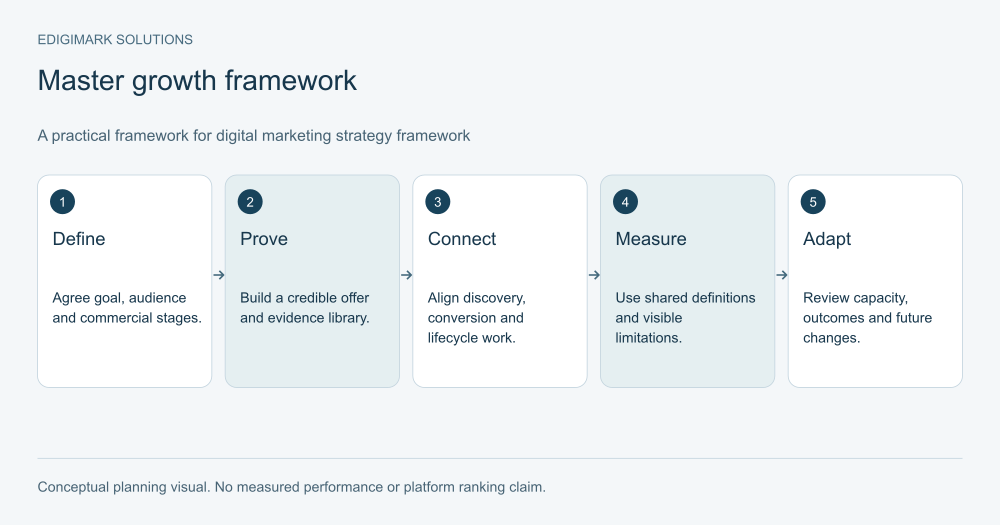
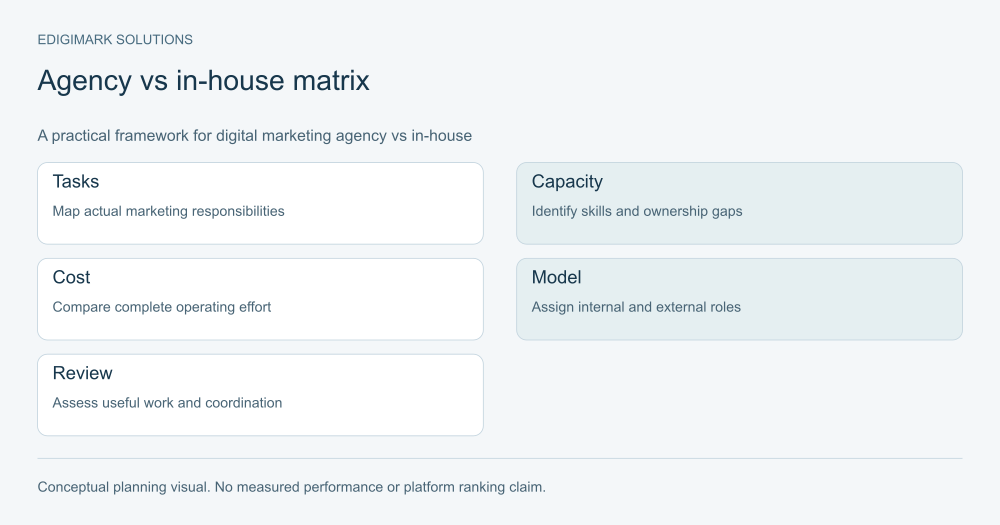
Digital marketing agency vs in-house is a choice about capabilities, ownership and operating effort. An internal team can provide continuous business context and close coordination; an agency can provide scoped expertise and additional delivery capacity. A hybrid marketing team can combine both when responsibilities, data access and decision authority are explicit. Compare the full work required, not only a salary or monthly fee.
There is no universal winner. The right model depends on your audience, sales motion, available leadership and the marketing tasks the business needs to perform. Start by identifying those tasks and the current capacity gap.
In this guide
- Digital marketing agency vs in-house: what should you compare first?
- Agency vs internal marketing team: how should hybrid work be compared?
- Which marketing staffing costs belong in the model comparison?
- When is in-house ownership especially useful?
- When is outsourced marketing expertise useful?
- What makes a hybrid marketing team work?
- How should speed and scalability be evaluated?
- How should marketing reporting responsibility be assigned?
- How should the final marketing operating-model decision be made?
- How should a responsibility worksheet compare the three models?
- Frequently asked questions
Digital marketing agency vs in-house: what should you compare first?
List the responsibilities: strategy, audience research, content, search, paid campaigns, website work, automation, analytics and commercial coordination. Decide which require continuous internal knowledge and which can be scoped externally.
An early business may need a strong internal owner before it needs a large production team. A mature business may need specialist implementation for a defined technical or channel gap. Neither situation is resolved by choosing a label without a responsibility map.
HubSpot’s outsourcing discussion describes a mix of internal and external resources as an option. Treat that as one operating possibility, then assess your own capabilities and ownership needs.
Agency vs internal marketing team: how should hybrid work be compared?
| Decision | In-house model | Agency model | Hybrid consideration |
|---|---|---|---|
| Business context | Ongoing access to internal decisions | Context must be supplied and maintained | Keep an internal strategy owner |
| Specialist work | Requires hiring, training or contractors | Can be scoped to relevant expertise | Buy the skill gap, not duplicate ownership |
| Capacity | Changes through staffing and prioritization | Changes through agreed scope and availability | Maintain a shared backlog |
| Data and accounts | Internal ownership must be organized | Access and handoff must be explicit | Preserve business control of critical assets |
| Speed | Depends on skills and internal approval | Depends on onboarding and scope | Fix dependencies before expecting acceleration |
| Reporting | Needs definitions and accountable analysis | Needs transparent evidence and limitations | Use one metric dictionary |
These are planning considerations, not measured performance claims about every provider or employee.
Which marketing staffing costs belong in the model comparison?
For an internal team, include compensation, recruitment, management, training, tools and the cost of capability gaps. For an agency, include the agreed fee, setup, media where relevant, production outside scope and the internal coordination required.
Marketing staffing costs should reflect the actual roles needed. One generalist may not provide the same technical, analytical and creative capacity as several specialists. Equally, an agency retainer may not include every discipline named on its website.
Use current quotes and local employment assumptions. Do not compare a complete external scope with one salary while ignoring the other resources needed internally. Do not assume an agency fee includes media or software unless the proposal says so.
Evaluate total completed work and useful quality. A lower cost can become expensive when the business spends substantial time correcting claims, repairing data or clarifying responsibilities.
When is in-house ownership especially useful?
Internal ownership is useful for product knowledge, commercial priorities, audience judgement and coordination with sales and delivery. These responsibilities need a dependable source of context even when execution is outsourced.
The business should maintain approved facts, offer scope and decision authority. An external team cannot responsibly invent those inputs. A named internal owner can resolve questions and keep the work aligned as the business changes.
In-house execution may also fit recurring work with predictable volume and stable capabilities, provided the team has the required expertise and review process. Hiring should follow the actual task portfolio rather than a generic department template.
When is outsourced marketing expertise useful?
An agency can be useful for a defined skill gap, implementation project or additional operating capacity. Assess the people who will perform the work, their relevant experience and the deliverables they propose.
Google’s SEO hiring guidance recommends examining experience, methods and realistic expectations for SEO providers. The broader agency decision should apply the same habit of seeking reviewable evidence rather than guarantees.
Ask for concrete work samples and an explanation of the process. A provider’s broad service list does not establish that your scope has the right specialist assigned. Request the responsibilities, assumptions and dependencies for the actual engagement.
Edigimark’s digital marketing services provide a relevant route to a scope discussion. Evaluate fit using your goals and evidence requirements rather than an unsupported assumption of superiority.
What makes a hybrid marketing team work?
Keep strategy, product truth and commercial priorities with a named business owner. Scope external responsibilities clearly: technical implementation, channel operations, content production or specialist analysis. Give each work item one accountable decision owner.
Use one backlog and metric dictionary. Several teams maintaining independent plans and definitions can create conflicting messages or duplicate work. Shared planning should identify dependencies and what must be reviewed before publication or launch.
Preserve access and asset ownership. Clarify account administration, source files, reporting access and handoff materials. A hybrid model needs the ability to inspect and maintain the work as people or suppliers change.
Web development, marketing automation and data analytics services can be scoped as specialist responsibilities when those are actual gaps.
How should speed and scalability be evaluated?
Inspect the workflow, not only promised turnaround. Work may depend on approved facts, subject-matter input, account access or technical review. An agency cannot responsibly bypass missing decisions to deliver faster, and an internal team cannot create capacity merely by accepting a larger backlog.
Define service levels the team can support and include review windows. Separate production time from business approval time. A useful plan makes those dependencies visible.
Scaling also creates downstream work. More campaigns may create more enquiries; more content requires maintenance; more automation creates operational dependencies. Compare the response and stewardship capacity alongside delivery volume.
How should marketing reporting responsibility be assigned?
Require consistent definitions for enquiries, qualification, opportunities, revenue and cost. State whether metrics count people, companies or deals. Separate pipeline from completed outcomes and preserve attribution uncertainty.
The report should explain the decision, evidence, limitation and next action. A collection of platform screenshots does not automatically connect the work to commercial usefulness. The internal owner should be able to inspect original records where appropriate.
CRM integration services can help preserve enquiry and opportunity context. Conversion rate optimization can examine whether the commercial experience delivers the promised exchange.
How should the final marketing operating-model decision be made?
Use a responsibility matrix and full cost scope. Identify the recurring capabilities the business needs, existing strengths and the most important gaps. Compare realistic internal and external ways to fill those gaps.
For a hypothetical SaaS business, product marketing and sales coordination might remain internal, while a technical content and analytics project is externally scoped. For a small service business, a broader agency engagement may still need one internal owner to approve facts and respond to enquiries.
Start with a bounded engagement or hiring plan whose outputs can be evaluated. Review useful quality, coordination effort and commercial relevance. Change the model when the evidence shows a gap, not merely because one category seems fashionable.
Contact Edigimark to map responsibilities and compare a concrete scope with your internal capability and capacity.
How should a responsibility worksheet compare the three models?
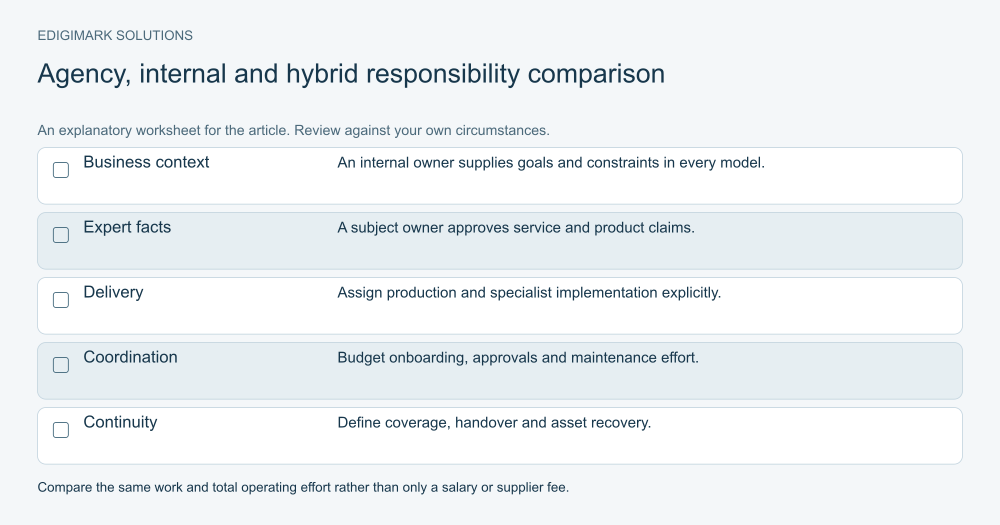
Use the same work list for every option: audience research, offer approval, source facts, production, implementation, reporting, follow-up and maintenance. For each task, name who performs it, who approves it and who supplies the inputs. Compare the capacity and coordination required, not only the headline cost.
In a hypothetical agency model, the supplier may produce campaign assets while an internal product owner approves technical claims. In an internal model, an employee may coordinate content but still need specialist development support. In a hybrid model, an internal lead can own priorities while an external specialist addresses a defined analytics gap. None of those arrangements removes the need for business-side authority.
Include coverage and continuity. Ask what happens during leave, staff turnover or the end of a supplier engagement. A documented process and recoverable assets can matter as much as the initial delivery speed. Avoid assuming an agency or an internal hire automatically provides continuity without examining the actual arrangement.
Then compare total operating effort: onboarding, expert interviews, approvals, meetings, correction and maintenance. Marketing staffing costs should reflect the resources needed to complete the work. Outsourced marketing expertise can fill a specific gap, but it still requires context and a responsible internal decision maker.
Use a pilot or initial scoped engagement when uncertainty is material. Choose work that reveals how the model handles evidence, coordination and implementation. Review the completed useful output and communication process before expanding the commitment.
Frequently asked questions
Is an agency always cheaper than hiring?
No. Compare the complete required scope, internal coordination, tools and ongoing work. A fee and a salary do not represent equivalent capabilities by themselves.
Should strategy always stay in-house?
The business needs accountable ownership of priorities and approved facts. External support can help develop strategy, but someone internal must resolve commercial context and decision authority.
Can an agency replace all internal marketing responsibility?
Execution can be widely scoped, but the business still needs ownership of facts, approvals, access and commercial follow-up. Define those responsibilities explicitly.
What is the main risk of a hybrid team?
Ambiguous ownership that creates conflicting plans, messages and data definitions. Use shared priorities and clear decision owners to make the model maintainable.
How should a business begin?
Map tasks and gaps, gather realistic costs and evaluate a concrete scope or role plan. Start with the capabilities the business actually needs.
Put the ideas to work
Explore our connected growth services →