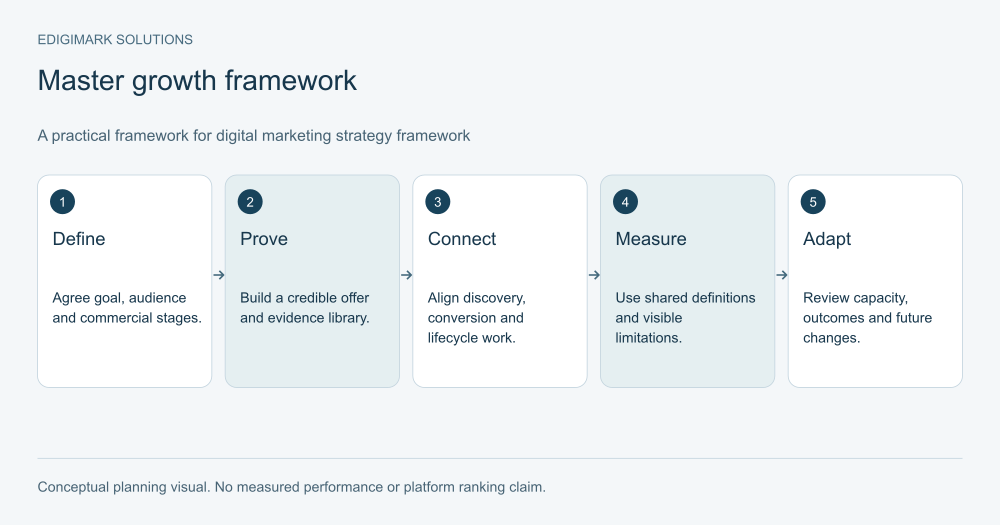
Demand generation vs lead generation is a difference in primary purpose: demand generation develops understanding and interest in an offer, while lead generation creates identifiable prospects for appropriate follow-up. Businesses usually need both. Choose the mix by the audience’s readiness, buying journey and your ability to turn enquiries into useful sales conversations.
Confusing the two creates distorted expectations. A useful educational campaign can be dismissed because it did not immediately produce demo requests. A form campaign can be celebrated for generating contacts even when those people have no relevant buying problem. Clear definitions improve both budget decisions and reporting.
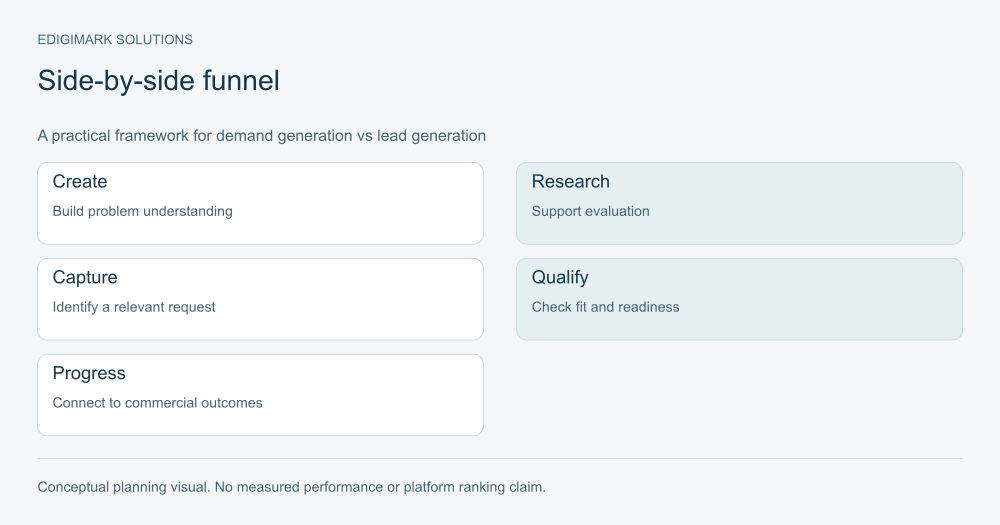
An editorial planning diagram; stages and examples are illustrative.
What is the practical difference in the work?
Demand creation helps an audience recognize a problem, evaluate its importance and understand possible solutions. Lead capture gives interested people a way to identify themselves and request a relevant next step. The first may happen anonymously; the second produces a record that must be handled responsibly.
Salesforce’s B2B demand generation explanation places demand generation across the customer journey rather than limiting it to contact capture. That broader perspective helps explain why a valuable marketing interaction does not always begin with a form.
For a hypothetical inventory software company, an open guide to stock-reconciliation mistakes can help a warehouse team understand its problem. A tailored workflow review can generate an enquiry from a company that recognizes the issue. The guide creates understanding; the review captures a specific request. Both can contribute to a purchase without deserving identical metrics.
How do the two approaches compare?
| Dimension | Demand generation | Lead generation |
|---|---|---|
| Main job | Build relevant awareness, understanding and confidence | Create identifiable prospects or requests |
| Audience state | May be unaware of the problem or early in research | Willing to exchange information or request contact |
| Typical asset purpose | Explain, diagnose, compare and support research | Offer an assessment, event, trial or conversation |
| Immediate evidence | Relevant engagement and evaluation behavior | Valid submissions and follow-up responses |
| Commercial review | Audience quality and later buying progression | Acceptance, qualification and opportunity outcomes |
| Common failure | Attention without a useful route to evaluation | Contact volume without fit or readiness |
This is an operating comparison, not a rule that permanently assigns each channel to one side. Search, social, webinars and email can serve either purpose depending on the offer and audience.
Does demand creation mean avoiding forms?
No. It means using forms when they help the exchange rather than adding them automatically. A buyer needs access to enough information to decide whether a conversation is worthwhile. Restricting every explanation can make that decision harder.
Consider the reader’s task. A comparison resource that must circulate among colleagues often benefits from open access. A personalized diagnostic needs details about the business. A live event may need registration to coordinate attendance and communication. The appropriate form follows the task.
Ask what information is necessary now. An assessment request may require the operational problem and a contact method. It may not require a long profile before the buyer understands the offer. More fields can collect more data while making the experience less useful.
The relationship between forms and later enquiries can be examined through conversion rate optimization. Evaluate submission quality as well as submission rate. Removing a clarifying question may increase volume while making qualification more difficult.
What does each approach require from the website?
Demand generation requires accurate explanations that are easy to discover, read and share. Lead generation requires a clear offer, an appropriate action, a working form and a dependable response. Both rely on a credible description of what the business actually provides.
A visitor should understand who the offer serves, which problem it addresses, what the process involves and what happens after an enquiry. Include genuine limitations. If the service cannot support a particular platform or company type, hiding that fact wastes both parties’ time.
Do not write every educational page as if the reader has already decided to buy. A person comparing approaches may need a decision table. A person requesting implementation help may need a scope discussion. Link the resources so the visitor can choose their own pace.
Web development services can help support accessible content layouts, reliable conversion paths and clear information architecture. These foundations affect whether either strategy can deliver a useful experience.
Which B2B funnel outcomes should you measure?
Evaluate each activity against its intended role, then review the connection to commercial outcomes. An introductory asset can be assessed through relevant audience engagement, repeat research activity and the quality of ensuing questions. A lead offer can be assessed through valid submissions, sales acceptance and opportunity creation.
Do not equate every download with a ready buyer. Salesforce’s lead qualification overview distinguishes fit and readiness in assessing which prospects warrant sales attention. Your internal definitions should be agreed with the people receiving the handoff.
Use a shared measurement dictionary. Define what constitutes an enquiry, accepted lead and opportunity. State whether the report counts people, companies or deals. Several people from one company may contribute to one evaluation; counting them as separate opportunities overstates the pipeline.
Demand activity often precedes identifiable tracking. A buyer may read a resource, discuss it privately and return through a different channel. Treat attribution as an incomplete view, and include customer-reported discovery information when appropriate. Do not force every purchase into a single confidently named source.
When should a business prioritize lead generation?
Prioritize lead generation when an identifiable buying audience has a clear problem, your offer can satisfy it and the sales process can handle the response. Existing demand still needs an effective capture path.
A hypothetical implementation partner receiving frequent enquiries about a supported integration may need a stronger assessment page and clearer follow-up. Adding broad awareness activity before fixing those paths can overlook a more immediate operating problem.
Before increasing traffic, inspect the offer, form, routing and sales acceptance. Can prospects understand the exchange? Does the next message answer their request? Is a person responsible for timely review? A lead campaign becomes expensive when the handoff is unreliable.
CRM integration can preserve original requests and connect them to commercial records. It should include duplicates, field ownership and rejected-lead feedback rather than merely copying contacts between applications.
When should a business prioritize audience education?
Prioritize education when the audience does not yet understand the problem, the category is unfamiliar or the buying decision involves substantial uncertainty. A more aggressive call to action will not necessarily solve those gaps.
Find the questions that repeatedly delay evaluations. Buyers may misunderstand implementation effort, compatibility, migration risk or the difference between alternative approaches. A clear explanation can help them decide whether to investigate further.
Use relevant examples without fabricating results. An illustrative workflow can show how a process changes. A transparent checklist can help a reader assess their own situation. Neither needs an invented success percentage to become useful.
Distribution still matters. A detailed guide that no relevant audience encounters cannot create much understanding. Choose channels where the problem is discussed and adapt the presentation to that context. Edigimark’s digital marketing services can coordinate these content and distribution decisions.
How can both approaches work in one operating plan?
Use one audience definition and one coherent buying journey. Provide open explanations for research, commercial resources for evaluation and explicit conversion opportunities for people ready to act. Connect the resulting enquiries to a feedback process.
For a hypothetical B2B software product, the sequence might begin with a problem diagnostic distributed through search and partner education. A comparison resource explains suitable use cases. An integration guide answers technical questions. A workflow assessment captures an active request. Follow-up then responds to the stated need.
This is not necessarily a linear journey. A referral may enter directly at the assessment. A stakeholder may first encounter the integration guide. The content should stand on its own while making adjacent information easy to find.
Allocate resources by the current constraint. If fit is strong but evaluations stall through confusion, improve educational and decision support. If educated buyers cannot find a commercial route, improve capture. If sales cannot handle enquiries, fix the operating process before buying more traffic.
How should you compare investment without false precision?
Compare the expected contribution, required capabilities and learning period of each activity. A demand program may require subject-matter access and repeated distribution. A lead program may require an offer, targeting, landing-page work and a dependable sales response.
Avoid a universal budget split. The right balance depends on the market, offer, sales cycle and evidence. A new category and an established implementation service face different constraints. Preserve a clear rationale for your allocation and define what evidence would change it.
Use data analytics services when the decision requires consistent cohort reporting across channels and CRM outcomes. Require unknown coverage and qualification changes to remain visible. A precise-looking attribution dashboard is less useful when the underlying definitions shift every month.
Review demand creation vs lead capture together, while keeping their immediate jobs distinct. The question is whether more relevant buyers are reaching useful evaluations, and where the system still loses them. Contact Edigimark to assess that constraint before choosing the next campaign.
How would the comparison change a real planning meeting?
Imagine a hypothetical professional-services business with a technically strong offer and a modest website. The team proposes a downloadable guide to increase leads. Before approving it, ask whether the immediate constraint is lack of problem understanding, lack of relevant reach, lack of a commercial action or weak follow-up.
If buyers do not understand when the service is needed, an open diagnostic may help more than a gated brochure. If buyers already search for the service but cannot assess fit, the service page needs clearer scope and prerequisites. If they request contact but receive slow or generic replies, neither a new guide nor additional reach addresses the central constraint.
The demand generation vs lead generation decision therefore begins with diagnosis. A channel recommendation made before this discussion can be perfectly executed and still solve the wrong problem.
What should a shared campaign brief specify?
Include the audience, buying situation, primary job, offer, destination, expected next action and feedback owner. Label whether the campaign principally develops understanding, captures a request or supports an active evaluation. It may serve secondary jobs, but the primary job determines its immediate review criteria.
For education, specify which misunderstanding the resource resolves and how the team will assess relevance. For lead capture, specify the information requested, qualification evidence and promised response. For evaluation support, specify which stakeholder or decision barrier the asset addresses.
Add the downstream connection. An education campaign should point to useful evaluation resources. A lead offer should preserve the context that made the person respond. An evaluation asset should be available to sales without relying on an unexplained download count.
Which mistakes make this lead generation comparison misleading?
Comparing raw costs across activities with different jobs is one mistake. A campaign buying assessment enquiries and a campaign distributing an introductory explanation do not have identical immediate outcomes. Compare cost against the defined task, then review the commercial connection over an appropriate period.
Another mistake is changing the lead definition when results disappoint. If every registration becomes a qualified lead halfway through a reporting period, apparent performance can improve without any change in buyer fit. Keep definitions versioned and show the effect of a change on comparisons.
A third mistake is assuming anonymous engagement cannot matter because it cannot be assigned to a contact. It can support a buying discussion. But unobserved influence is also not a license to claim revenue that the evidence cannot support. Present likely roles and observable outcomes separately.
How do you design an honest reporting page for both approaches?
Show the audience, intended job, delivery status and immediate evidence for each activity. Follow that with accepted enquiries, opportunities and closed outcomes for defined cohorts where the data supports the connection. Include known source coverage and the proportion of records that remain uncertain.
Add the buyer’s explanation where available. A voluntary discovery question can surface an earlier partner recommendation or resource that tracking missed. Preserve it as reported information rather than rewriting it to match the channel the dashboard prefers.
Record the next decision. Will the team improve the explanation, change distribution, refine the conversion offer or repair follow-up? A report should inform that action instead of ending with a collection of unrelated metrics.
What happens when the two teams disagree about success?
Return to the agreed commercial task. Marketing can show how an activity reached the relevant audience and supported evaluation. Sales can show whether the resulting conversations met fit criteria and what prevented progress. Both should inspect the same sample of records and original requests.
If the sample reveals incompatible enquiries, improve the offer or targeting. If it reveals strong requests that were ignored, improve the handoff. If it reveals early researchers being treated as immediate buyers, revise the follow-up. These are specific operating findings that help the two approaches work together.
The aim is a balanced system: people can learn without unnecessary friction, identify themselves when they want a next step, and receive a response that respects the exchange. That is more actionable than asking one side to win a terminology debate.
Frequently asked questions
Is lead generation part of demand generation?
In a broad operating definition, yes: capture is one responsibility within a larger demand program. Teams may use narrower labels internally. Agree on the work and outcomes before debating terminology.
Are ungated resources always demand generation?
No. Access format does not define the strategic job. An ungated pricing page can capture existing demand, while a registered educational event can develop understanding. Evaluate what the experience helps the reader do.
Which approach produces better leads?
Neither guarantees quality. Relevant education can improve readiness, and a specific offer can identify a useful buying request. Quality depends on audience fit, the exchange, qualification and the follow-up process.
Can a small business do both?
Yes. A helpful explanation, an accurate service page and a well-managed enquiry path can form a simple combined system. Add channels when you have a reason and the capacity to support them.
Should sales contact everyone who downloads a guide?
Follow the stated exchange, preferences and qualification criteria. A download alone may indicate research rather than a request for sales contact. Match follow-up to the person’s intention and your applicable communication requirements.
Put the ideas to work
Explore our connected growth services →