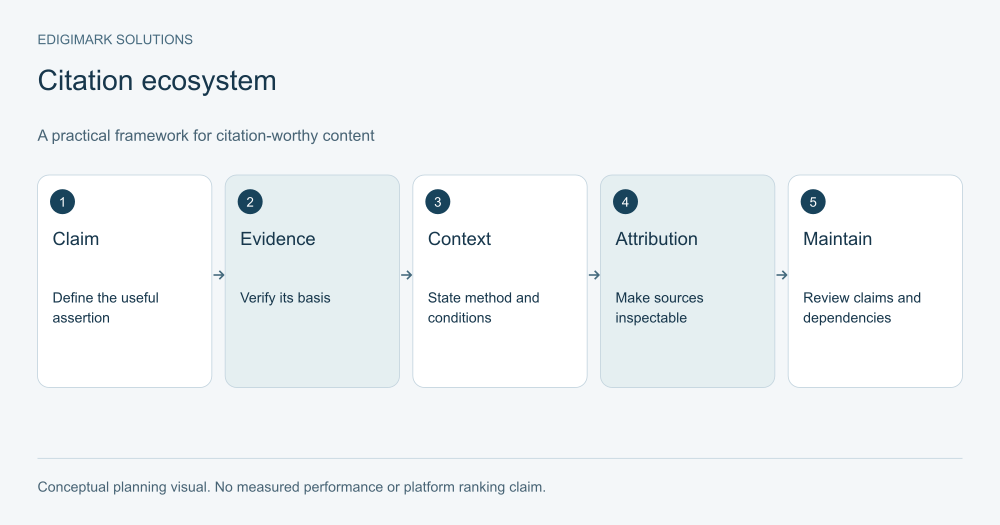
Citation-worthy content gives a reader information they can inspect, attribute and apply: a clear claim, a credible basis, useful context and transparent limitations. Build it through original research where appropriate, expert evidence, well-documented examples and accurate sources. No editorial technique can guarantee that an AI search service will cite your page.
The practical objective is to create a resource worth relying on. A statistics-filled article can still be weak if its numbers are unrelated or unverifiable. A page with no headline percentage can be strong when it explains a difficult decision and shows the evidence behind the recommendation.

In this guide
- What makes citation-worthy content useful as a source?
- How do you distinguish a claim from its evidence?
- What original research content can a business produce responsibly?
- What should a method section explain?
- How can expert evidence improve an article without invented authority?
- How should attributed sources be used?
- What does an evidence worksheet look like?
- How do you make a comparison citation-worthy?
- What evidence does a documented content example need?
- How should page structure support inspectable evidence?
- How do you measure AI search citations without confusing them with outcomes?
- What should an evidence review meeting decide?
- What mistakes make content less useful as a source?
- How do you maintain citation-worthy content?
- How would an evidence-led article be developed in practice?
- How should a citation-worthy article handle conflicting sources?
- Frequently asked questions
- Create a resource people can inspect and use
What makes citation-worthy content useful as a source?
It supplies information the reader needs and makes its basis visible. A source might define a technical behavior, explain a method, compare alternatives under stated criteria or report an observation with dates and conditions.
The claim should be specific enough to evaluate. “Automation transforms business” says little. A verified explanation of how a workflow handles an unmatched inquiry gives the reader a concrete fact or decision to use.
The context matters as much as the fact. An implementation result may depend on data quality, team capacity or concurrent changes. Removing those conditions can make a citation look stronger while making the resource less reliable.
Keep the page’s purpose clear. Evidence should support the central task rather than become a collection of impressive-looking numbers. A reader should understand why a statistic, diagram or example appears.
How do you distinguish a claim from its evidence?
Write the claim in one sentence, then identify what would establish it. A product capability needs current documentation or verification. A process recommendation needs visible reasoning. A measured outcome needs a method and records.
Do not use a source that merely discusses the same broad topic. If the article states a precise behavior, the linked resource should directly support that behavior. A general homepage is usually a weak basis for a technical assertion.
Keep recommendations distinct from observations. You can recommend a review process based on stated criteria without pretending the process has been proven to increase every company’s revenue. The reader should know where the evidence ends and judgment begins.
When a claim cannot be supported, narrow it or remove it. Adding more citations around an unsupported conclusion does not make the conclusion reliable.
What original research content can a business produce responsibly?
Choose a question the business can investigate with appropriate access and expertise. It may involve a workflow test, an analysis of approved records, a survey or a documented comparison. The research should answer a useful task rather than exist solely to manufacture a promotional statistic.
Define the method before collecting the data. Record the population, dates, measurement, exclusions and limitations. A result becomes difficult to evaluate if the team chooses the denominator only after seeing the outcome.
Use information the business is authorized to analyze and publish. Remove unnecessary personal or confidential details from editorial material. Where an actual customer example is involved, verify permission and approved scope before writing.
Do not disguise a small convenience sample as an industry-wide finding. It can still be useful when its scope is explicit. A transparent limited observation is stronger than an inflated universal claim.
What should a method section explain?
Explain what was examined, how records were selected, what was measured and when. Define important labels and calculations. State which observations were excluded and why.
Describe limitations that affect interpretation. A small sample, missing source information or concurrent process changes can constrain the conclusion. Put those limitations near the result rather than hiding them in unrelated fine print.
Retain underlying records according to the business’s approved policy. A future reviewer should be able to trace the published result to its basis. If nobody can reconstruct the calculation, maintenance becomes difficult.
Give the reader enough information to assess applicability. They do not need every internal detail, but they need the conditions that distinguish your observation from their situation.
How can expert evidence improve an article without invented authority?
Ask a person with relevant responsibility to explain the decision, conditions and failure modes. The useful contribution is specific reasoning, not a decorative quote saying the topic is important.
Prepare focused questions. What requirement changes the recommendation? What mistake recurs? Which assumption is often wrong? What would the reader need to verify before acting? These prompts produce usable detail.
Represent involvement accurately. A reviewer who checked a technical section should not be described as having authored or endorsed the whole article. Do not invent names, credentials or biographies to create the appearance of expertise.
Verify quotations and permission where quotations are used. You can also explain the approved reasoning in clear prose without creating a dramatic testimonial. The evidence should remain traceable internally.
How should attributed sources be used?
Place a source near the factual claim it supports and give the link a meaningful label. Prefer original documentation for platform behavior and the original study for a research finding. This makes the evidence easier to inspect.
Preserve the source’s scope. A study of one setting does not establish a universal outcome. A product document may apply to a particular version or configuration. Those conditions can materially change the reader’s decision.
Do not combine several weak claims into a stronger conclusion without reasoning. Sources can each be accurate while the article’s synthesis overstates what they establish. Explain the connection and uncertainty.
Review sources during updates. A working URL can point to revised content or a deprecated feature. Evidence maintenance includes checking meaning, not only whether the link returns a page.
What does an evidence worksheet look like?
Use this practical structure before drafting:
| Worksheet field | Question to answer | Example of a useful record |
|---|---|---|
| Claim | What does the page assert? | A defined record type can be synchronized |
| Basis | Where is it established? | Current verified documentation |
| Condition | What changes the answer? | Custom fields need separate mapping |
| Method | How was evidence produced? | Documented test or approved source review |
| Owner | Who checks future changes? | The responsible product or service lead |
| Publication status | Can it be used publicly? | Approved within a stated scope |
The example is illustrative. A real worksheet should contain actual sources and approvals. It is an internal production aid, not proof that a search service will select the page.
How do you make a comparison citation-worthy?
Define criteria before judging alternatives. Capability, implementation effort, maintenance, cost components and audience fit can all matter. Use the same criteria for each option and show where information is unknown.
Verify current facts and separate them from editorial judgments. A table entry can establish that an option supports a feature, while the recommendation depends on the user’s conditions. Do not collapse those steps into an unsupported “best” label.
Include circumstances where another approach is preferable. A fair comparison can be persuasive because it makes the decision clearer. Hiding tradeoffs undermines the resource’s usefulness.
Avoid implying that a competitor’s absence from your research means it lacks a capability. Unknown should remain unknown until verified. That distinction protects accuracy and makes the comparison maintainable.
What evidence does a documented content example need?
State whether the example is real or hypothetical. For a hypothetical scenario, show the assumptions and reasoning. For a real case, explain context, permission, method and limitations.
Use a concrete task rather than an invented success story. A scenario can show how a team chooses field ownership or routes ambiguous inquiries. It does not need an unsupported percentage improvement to teach the decision.
Keep visuals honest. A process diagram can explain sequence. A decision table can compare choices. A before-and-after chart requires actual measured data; otherwise use an explicitly conceptual illustration.
Connect the example to the reader’s next step. It should help apply the framework, not merely add a story between generic advice sections.
How should page structure support inspectable evidence?
Make the claim, source and condition easy to find together. A reader should not need to move between distant sections to understand whether a recommendation applies. Headings can name the decision and its evidence.
Use tables when records share comparable fields. Use prose when the relationship requires reasoning. A source-heavy table without explanation can conceal a mismatch between criteria or definitions.
Keep important information visible in the public experience. A diagram with tiny labels or a clipped method table prevents inspection. Work with web development when layout undermines the evidence.
Offer relevant detail through contextual links. A resource discussing measurement can point to data analytics where professional support fits. A resource about system relationships can connect to CRM integration when implementation scope becomes the next decision.
How do you measure AI search citations without confusing them with outcomes?
Track observed citations separately from visits and qualified actions. A citation shows a source reference under the available reporting conditions. It does not establish that someone clicked or that the page caused a sale.
Bing’s AI Performance documentation describes citation reporting across its supported experiences and distinguishes citation activity from traffic or authority. Use the current scope and definitions rather than labeling the report as all-platform visibility.
For manual observations, preserve prompt, platform, date and relevant conditions. Keep the sample stable for comparisons and label exploratory questions separately. A few observed answers are not a market-wide census.
Connect available website activity to business outcomes through data analytics and approved CRM records. Report what is identifiable and state attribution limits. Better evidence should improve decisions, not create a false appearance of precision.
What should an evidence review meeting decide?
Review the central claims first. Identify which are ready, which need a source check and which should be narrowed. Do not let a completed draft create pressure to publish an unresolved factual promise.
Ask whether the evidence actually helps the audience. A statistic can be accurate but irrelevant. A detailed example can be technically correct but address a task outside the article’s scope. Keep the page focused.
Assign owners for missing evidence and review triggers. Product behavior, service scope and original results may need different people. The editor should coordinate the explanation rather than pretend to own every fact.
Finish with a clear publication status. A page can be editorially drafted while important evidence remains unverified. Keep those states distinct in the production record.
What mistakes make content less useful as a source?
Unsupported absolutes, vague consensus claims and copied statistics can weaken an article. So can a missing method, outdated capability or invented reviewer. The appearance of evidence is not a substitute for its basis.
Another mistake is adding citations only at the end. Readers need to know which source supports which claim. Attribution should follow the reasoning rather than function as a decorative bibliography.
Avoid seeking inauthentic mentions to create a reputation. Build resources and relationships the business can represent accurately. An artificial reference network does not repair weak information on the page.
Do not promise a citation rate from an editorial technique. A useful evidence program can improve the resource while selection remains uncertain. Its business value should include clearer buyer understanding and maintainable public information.
How do you maintain citation-worthy content?
Create a claim inventory for important pages. Store the source, owner, conditions and last substantive check. A fact that changes should trigger review of dependent articles and visuals.
Review the conclusion when evidence changes. A new limitation may alter the opening answer or comparison, not just a footnote. Keep the page’s promise aligned with current information.
Maintain source links and methods. If an external document moves or changes, find the appropriate current basis or narrow the claim. A replacement link should support the same fact, not merely return a successful page.
Record substantive updates. A changed date without evidence review can create false freshness. The useful maintenance record says what was checked and why.
How would an evidence-led article be developed in practice?
Imagine a hypothetical software service team writing about record ownership in integrations. The central claim is that ownership rules must be defined before conflicting updates can be handled consistently. The team can explain the planning principle, but it should not assert identical behavior for every connector.
The evidence packet includes an approved field-map example and current documentation for any specific product behavior mentioned. A subject owner checks which statements are platform facts and which are planning recommendations. The writer labels the example hypothetical and shows why a field may have one authoritative source.
The article uses a small table: field, source owner, update direction and conflict response. It then explains how the team should decide those values. The visual communicates relationships rather than pretending to show a measured result.
The opening preserves the scope. It says the page is a planning framework, not a universal configuration tutorial. The next step asks the reader to list their systems and ownership decisions before reviewing implementation support.
After publication, the team can inspect whether the article is cited through available reporting and whether identifiable visits reach useful resources. It keeps those observations separate from commercial outcomes. The resource succeeds editorially when it helps a reader make the decision with a verifiable basis; a citation remains a possible additional observation.
How should a citation-worthy article handle conflicting sources?
First check whether they describe the same scope, date and configuration. A current official document and an older tutorial can both have been accurate under different conditions. Do not combine them into one confident claim without resolving that difference.
Prefer the appropriate current primary basis for platform behavior, then state uncertainty where it remains. If the disagreement affects the central answer, obtain subject review or narrow the resource. A source conflict can be a reason to pause one claim while still publishing other verified information.
Record the decision and the source versions used. A future editor should know why the article follows one interpretation. This is more useful than deleting the conflicting link and leaving the reasoning invisible.
If no reliable answer is available, say what needs verification. A transparent limit can help the reader ask the right question. It is preferable to inventing certainty because a polished conclusion seems more persuasive.
Frequently asked questions
Can we guarantee AI search citations with original data?
No. Original data can create a useful resource when its method and scope are sound, but selection remains uncertain. Do not turn an evidence investment into a guaranteed visibility claim.
Does every article need a survey or case study?
No. A clear, verified explanation or transparent decision model can add value. Choose evidence that supports the task rather than manufacturing research for every topic.
Are many outbound sources better than a few strong ones?
Use the sources needed to establish important claims. Quantity does not replace relevance or direct support. A few precise primary references can be more useful than a long list of tangential links.
Can a hypothetical example be citation-worthy?
It can be a useful explanation when labeled and reasoned transparently. It should not be presented as empirical evidence or a measured customer result.
What is the first evidence improvement to make?
Choose a central claim, identify its basis and put its conditions beside it. If the basis is missing, verify or narrow the claim before adding more persuasive language.
Create a resource people can inspect and use
Choose a useful claim, supply its basis and keep its limits visible. Edigimark’s digital marketing services can connect evidence-led content with search priorities. Contact the team with the claims, approved examples and subject owners you can support to plan a credible content resource.