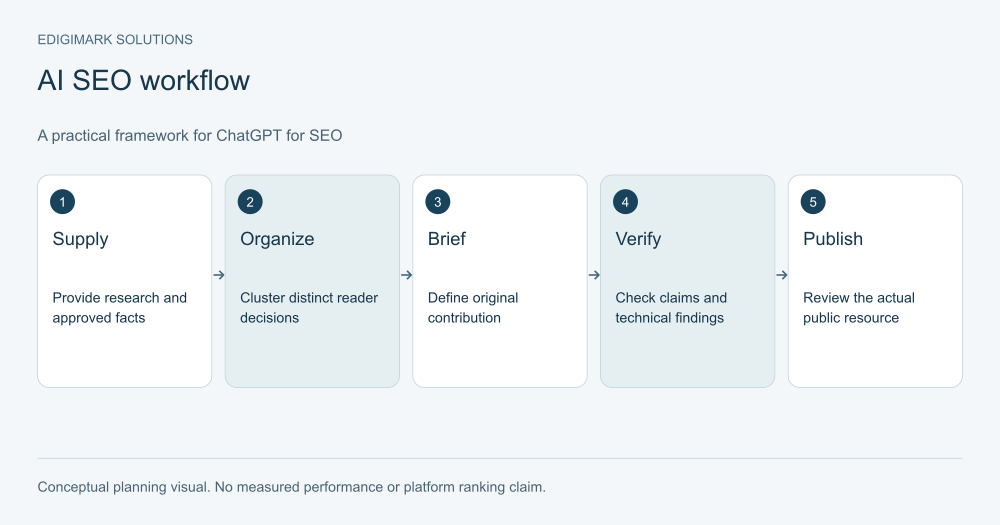
ChatGPT for SEO is most useful as an assistant for organizing supplied research, building briefs, reviewing outlines and checking a draft against approved facts. Use it to improve a defined task, then verify the evidence and actual website behavior. Do not ask it to manufacture search metrics, expertise or large volumes of near-identical pages.
The workflow below keeps research, drafting and publication decisions separate. It applies to a practical chat-based process; specific browsing, file and connected-tool capabilities depend on the account and features available when you use them.
In this guide
- What should you provide before using ChatGPT for SEO?
- How should ChatGPT keyword clustering work?
- How do SEO brief prompts preserve original value?
- How should AI outline review catch weak structure?
- What drafting instructions help prevent SEO spam?
- How should AI SEO fact checking be performed?
- Can ChatGPT help with technical SEO exports?
- How can ChatGPT improve an SEO report?
- What does a complete ChatGPT SEO workflow look like?
- How should SEO prompts be maintained as sources and tasks change?
- How should a generated SEO reporting explanation be checked?
- Frequently asked questions
What should you provide before using ChatGPT for SEO?
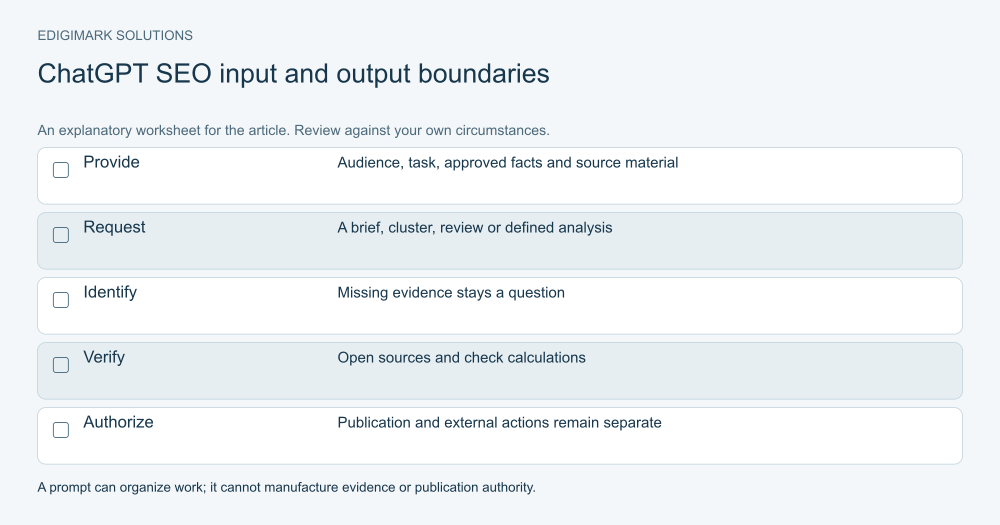
Provide the audience, business offer, reader decision, source material and expected output. Include important exclusions. If the article concerns a supported integration, supply accurate capabilities and implementation requirements rather than asking the model to infer them.
Use authorized information only. Remove unnecessary personal or confidential details from examples. A stronger prompt needs useful context, not unrestricted access to every customer record.
OpenAI’s prompting guide explains the importance of task and context in the user’s request. The SEO examples here apply that principle to concrete editorial work; they are not guarantees of a particular output or ranking result.
Ask the model to identify uncertainty. It should return missing evidence as a question, not fill the gap with a confident claim. Define the format so the result is easy to inspect.
How should ChatGPT keyword clustering work?
Supply a researched candidate list, existing page inventory and intended market. Ask for groups based on the underlying reader task, along with ambiguous items and the rationale for separation. The output should distinguish a comparison question from an implementation question even when wording overlaps.
A useful prompt is: “Group these supplied queries by the decision the reader wants to make. Identify which groups can share one page, which require distinct resources and which remain ambiguous. Use only the supplied data; do not invent volume, difficulty or market demand.”
Review the proposal against actual search research and commercial fit. ChatGPT can organize wording, but the organization is not independent validation that the keywords are valuable. Keep unverified candidates labeled as such.
Look for pages that would duplicate an existing task. A different primary phrase does not necessarily justify another article. Consolidation can make a resource more useful than producing several introductions with minor variations.
How do SEO brief prompts preserve original value?
Begin with the contribution the page should make. It might offer an implementation worksheet, a comparison model or an explanation of a recurring buyer question. Supply the evidence and expertise required to support that contribution.
Try: “Create a brief for [reader] deciding [task], using [approved material]. Include the direct answer, necessary sections, useful example, limitations and claim-check list. Mark unsupported facts as research questions. Do not imply first-hand experience or client results absent from the sources.”
Check that each section helps the decision. A brief that repeats broad benefits under several headings may generate an apparently substantial but unhelpful draft. Remove overlap before writing.
Edigimark’s digital marketing services can help connect this brief with audience, search and commercial priorities.
How should AI outline review catch weak structure?
Provide the brief and proposed outline, then ask which decisions are unanswered or repeated. Require the review to explain why a change helps the reader. This keeps the model from recommending more sections simply because the format can accommodate them.
A practical prompt is: “Review this outline against the reader’s decision. Identify repeated ideas, unsupported sections and missing implementation or comparison questions. Propose a revised sequence and explain the purpose of each section.”
Review headings as navigation. “How do you measure it?” may be unclear when removed from its paragraph. A heading naming the relevant metric or process helps a reader understand where to go. Use terms naturally rather than repeating a primary keyword mechanically.
Keep the direct answer near the start. Add context and exceptions where needed instead of withholding the answer behind a long introduction.
What drafting instructions help prevent SEO spam?
Draft from approved facts and the distinct reader task. Tell the system to avoid fabricated metrics, unverifiable claims, invented interviews and unnecessary repetition. Specify that examples must be labeled when illustrative.
Google’s spam policies address low-value scaled content. The practical response is to preserve publication judgement: the page needs a useful role and original contribution, not merely a target phrase.
Do not ask for one article per minor wording variant. Do not instruct the model to insert an arbitrary number of keyword repetitions regardless of readability. A useful page can cover related concepts naturally through a complete explanation.
Choose length according to the task. A narrow policy question may need a concise answer with necessary exceptions. A comprehensive implementation guide may need more detail, examples and worksheets. More words are not a substitute for useful decisions.
How should AI SEO fact checking be performed?
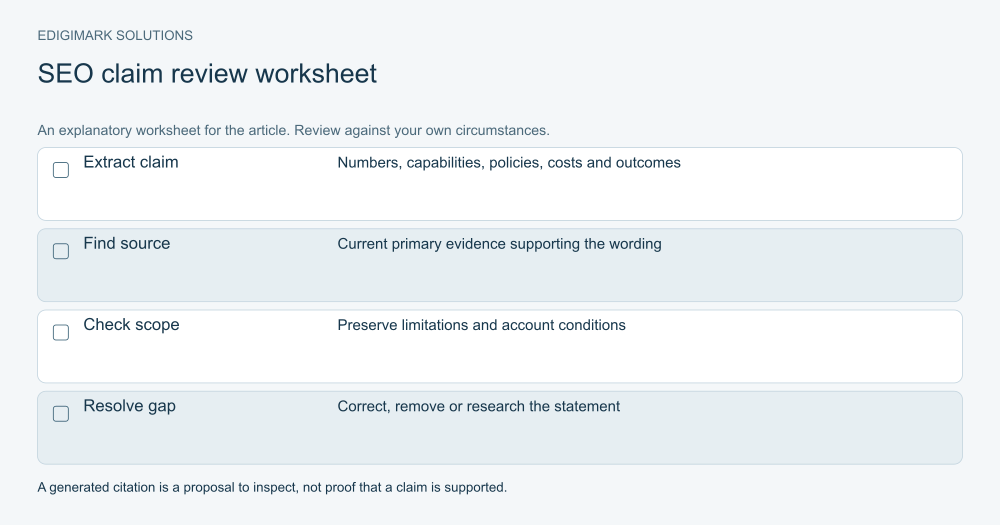
Use ChatGPT to produce a claim inventory, then verify claims against actual sources. Ask it to identify statements involving numbers, policies, capabilities, costs and outcomes. The inventory helps organize review; it is not verification by itself.
Try: “List the factual claims in this draft, their cited source and the exact support required. Flag missing or potentially outdated evidence. Separate editorial recommendations from statements presented as platform rules.”
Open sources and inspect whether they support the wording. A source can exist without supporting the specific claim. An old product page may describe a feature that has changed. A research result can apply to a narrow benchmark without supporting a universal promise.
Google’s AI-content guidance is a useful primary reference for the policy question. Use current official documentation for each platform topic rather than treating the model’s memory as authoritative.
Can ChatGPT help with technical SEO exports?
Yes, when given an authorized export and a defined analysis task. Ask it to find patterns, cite the relevant rows and propose checks. A crawl or indexation report can support triage, but the affected page’s intended purpose still matters.
Try: “Inspect this supplied export for patterns relevant to [issue]. Return the affected rows, observed evidence, possible explanations and next verification step. Do not propose a site change as confirmed until actual behavior and intended purpose are checked.”
Have a technical owner verify the finding. A redirect can be intentional, an excluded URL can be redundant, and a canonical signal needs context. The model should not have unrestricted deployment authority simply because it can draft a code change.
Web development services can support reviewed implementation and live-page verification when the issue is technical.
How can ChatGPT improve an SEO report?
Provide reconciled data and a metric dictionary. Ask for observations, questions and limitations, with numbers traceable to the input. Separate the arithmetic review from the narrative review.
Try: “Summarize this report for the stated business question. Distinguish observed changes, possible explanations and missing evidence. Use the supplied metric definitions and do not make causal claims from a correlation.”
Check denominators, dates and comparison periods. Search traffic, enquiries, accepted leads and opportunities are different measures. A smooth narrative can hide an inconsistent comparison if the input definitions are unclear.
Data analytics services can create the reliable measurement foundation. If content supports commercial enquiries, CRM integration helps preserve request and outcome context.
What does a complete ChatGPT SEO workflow look like?
For a hypothetical B2B integration guide, gather approved system capabilities, buyer questions and current technical documentation. Use ChatGPT to group the supplied questions and propose a brief. The editor selects a distinct task: helping buyers prepare for an integration assessment.
The outline includes prerequisites, data ownership, duplicate handling and test scenarios. ChatGPT reviews it for missing decisions. A draft is created from the approved material, with an illustrative workflow labeled as hypothetical.
The claim inventory identifies product and technical statements for verification. The subject-matter owner resolves them. The editor removes repetition and checks that the example explains an actual decision.
Publication then involves live checks: page content, headings, metadata, links and images. The process does not end when the model declares the draft finished. The responsible team verifies the real output.
How should SEO prompts be maintained as sources and tasks change?
Keep the prompt, inputs, review criteria and known failure examples together. Record changes that affect the output. OpenAI’s API prompting documentation recommends versioning and evaluation for production prompts; a chat-based editorial team can apply the same general discipline without assuming it has built an API integration.
Update source and capability material when the underlying facts change. Retest the prompt on representative tasks rather than relying on one successful example. Check whether review effort improves along with drafting speed.
AI-powered solutions and marketing automation services can help connect bounded assistance with an approved operational workflow. Contact Edigimark to identify the SEO bottleneck, evidence and review process before increasing content volume.
How should a generated SEO reporting explanation be checked?
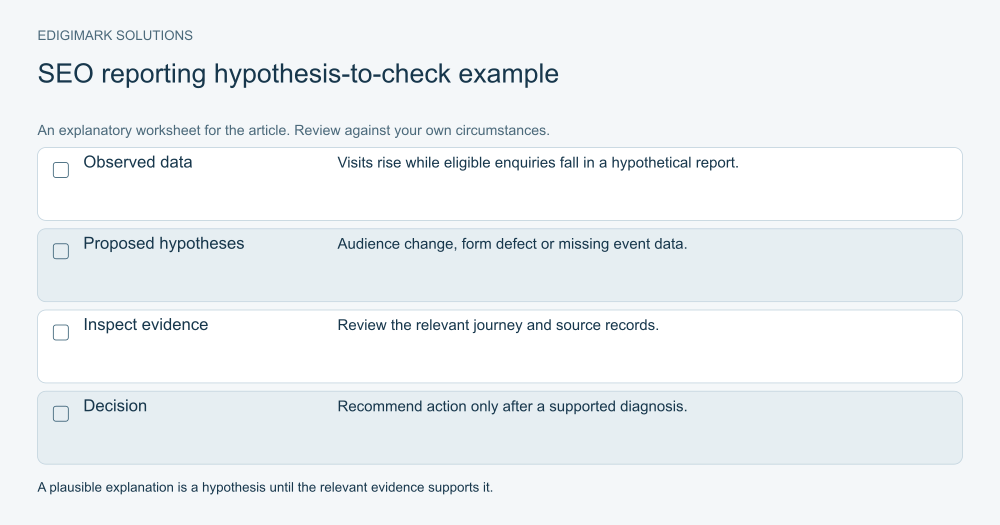
If supplied data show more visits but fewer eligible enquiries, ask ChatGPT to list possible explanations and the evidence needed to investigate them. A changed audience, a form defect or missing event data are hypotheses, not established causes. The analyst should inspect the relevant records before selecting a diagnosis or recommending a budget change.
Frequently asked questions
Can ChatGPT provide reliable search volume?
Do not assume a generated figure is verified. Use appropriate research evidence and identify the source, date and market. ChatGPT can organize supplied data without independently establishing it.
Does using ChatGPT make an article spam?
Assistance alone does not settle the question. Purpose, useful value, originality and policy compliance matter. Publishing repetitive pages primarily to manipulate search can create problems regardless of the tool.
Can ChatGPT verify its own citations?
It can help organize review, but important claims need actual source inspection. A plausible reference or confident answer does not prove that the source supports the wording.
Should ChatGPT publish the final article automatically?
Publication authority needs a defined and authorized workflow with evidence review and live verification. Drafting and publication are separate responsibilities.
What is the best SEO use for a beginner?
Start with a bounded task such as organizing supplied buyer questions or reviewing an outline. These outputs are easier to inspect than a request to generate and publish a large content library without source material.