Can AI-generated content rank on Google? Yes, AI assistance is not by itself a reason a page cannot appear in Search. The important questions are whether the page helps users, is accurate and original enough to add value, meets technical requirements and follows Google’s policies. Generating more pages without useful value can create a scaled content abuse risk regardless of how the text was produced.
The answer is about eligibility and quality, not a guarantee. A page can comply with policy and still fail to be indexed, selected or ranked as expected. Treat the production method as one part of an editorial process rather than a shortcut to visibility.

In this guide
- Can AI-generated content rank under Google’s current policies?
- What is scaled content abuse?
- What does AI content originality require?
- How should AI content sources and factual claims be reviewed?
- What does helpful AI-assisted content look like?
- Does technical SEO change for AI-generated pages?
- Can a detector establish whether a page will rank?
- How should an AI-assisted publishing workflow prevent weak pages?
- What should you do if existing AI content is weak?
- Which content-quality checks should guide publication?
- How should a compatibility-claim rewrite preserve supported scope?
- Frequently asked questions
Can AI-generated content rank under Google’s current policies?
Google’s Google AI content policy guidance describes useful research and structural assistance, while warning about content generated without added user value. It directs publishers to Search Essentials and spam policies rather than setting a blanket prohibition on AI-assisted text.
That does not mean every generated article is acceptable or useful. A draft can contain unsupported statements, invented references and repetitive advice. Those problems affect the reader regardless of whether the sentences sound natural.
The practical test is what the page contributes. Does it answer a real question with sufficient accuracy and context? Does it provide an explanation, evidence or decision framework that makes the reader better informed? Would it deserve publication if there were no keyword target attached?
What is scaled content abuse?
Google’s spam policies describe scaled content abuse as many pages created primarily to manipulate search performance without helping users. The policy concerns purpose and value, not only the specific production technology.
A site can create a large number of useful resources if each serves a distinct task and has appropriate editorial support. It can also create a small set of weak pages that do little for users. There is no safe or unsafe universal page count that replaces judgement about the work.
Avoid creating separate articles for minor wording variations when they answer the same question. A collection of near-identical introductions can compete internally and make the site harder to navigate. Consolidate related intent into a useful resource unless another page has a distinct reader task.
What does AI content originality require?
Originality is more than replacing words in existing articles. It can come from an original decision model, verified experience, a carefully designed checklist, an accurate worked example or a specific explanation of implementation trade-offs.
Use genuine expertise where available. Ask subject-matter owners about requirements, edge cases and common misunderstandings. Preserve the difference between their verified experience and an illustrative scenario created to teach a concept.
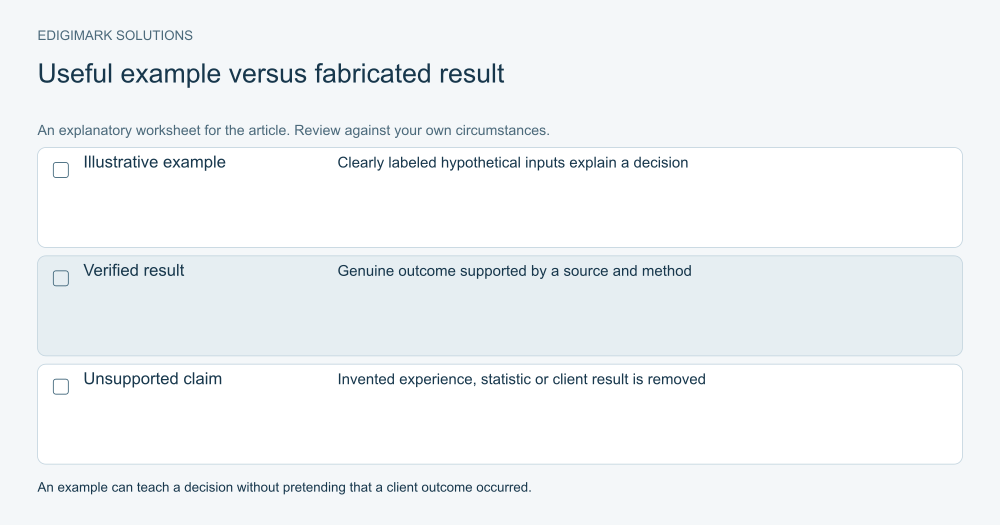
Do not fabricate first-hand use, client results, research methods or survey numbers. A hypothetical example can be useful when clearly labeled. It becomes misleading if described as a completed client engagement.
Edigimark’s digital marketing services can help connect editorial scope with audience needs and commercial decisions. The production process should identify the original contribution before drafting begins.
How should AI content sources and factual claims be reviewed?
Create a ledger of claims that require evidence: product capabilities, policies, prices, statistics and results. Open the cited source and verify that it supports the actual wording. A plausible URL or a model-generated reference is not enough.
Use current primary documentation for platform behavior. An article about a current search feature should not rely on a remembered interface or an old secondary summary. Record the review date and identify facts that are likely to need refreshing.
Separate factual claims from editorial recommendations. “The platform documents this control” is a fact with a source. “This is a useful starting priority for your team” is advice that should be justified by the business situation, not presented as a platform rule.
Keep the source’s limitations when paraphrasing. Eligibility is different from guaranteed inclusion. A benchmark result is different from a general promise. A feature available in one account or plan may not be available everywhere.
What does helpful AI-assisted content look like?
It addresses a clearly defined reader task with direct explanations, relevant examples and sufficient detail. It helps the reader decide what to do, what to check or when the advice does not apply. It avoids vague repetition designed only to reach a word count.
For a hypothetical B2B integration guide, useful content could explain the records involved, ownership of fields, duplicate handling and test scenarios. A weak version might repeat that integration improves efficiency without explaining any implementation decision.
Use headings that make the resource navigable. A direct answer can lead the page, followed by necessary context and exceptions. Tables and diagrams should clarify a comparison or process rather than restate slogans.
Web development services can support accessible presentation and dependable page behavior. Useful content still needs a usable reading and conversion experience.
Does technical SEO change for AI-generated pages?
The normal technical requirements still matter. A published page needs an accessible public route, appropriate indexation signals, coherent canonical information and usable internal links. The CMS saying “published” does not prove that the public frontend displays the intended page and metadata.
Google’s Search Essentials provide the baseline for technical eligibility and policy requirements. AI-generated wording does not bypass those fundamentals.
Check the live page, especially on a headless site. Verify its title, description, canonical, visible headings, content and images. Avoid claiming that a saved plugin field has reached the public frontend until it has been inspected.
Can a detector establish whether a page will rank?
An AI-text detector’s label is not a search-performance forecast. The relevant editorial questions concern the actual content: accuracy, originality, usefulness, scope and evidence. Rewriting merely to evade a detector can consume effort without improving any of those qualities.
Do not describe a generated draft as human-written to satisfy a marketing label. Identify actual review and expertise accurately. A named reviewer should only be represented as having reviewed the work when that review occurred.
Evaluate the page against its intended reader. If it explains a decision poorly, a favorable detector score does not make it good. If it provides a useful original framework and verified information, the production label alone does not explain its commercial value.
How should an AI-assisted publishing workflow prevent weak pages?
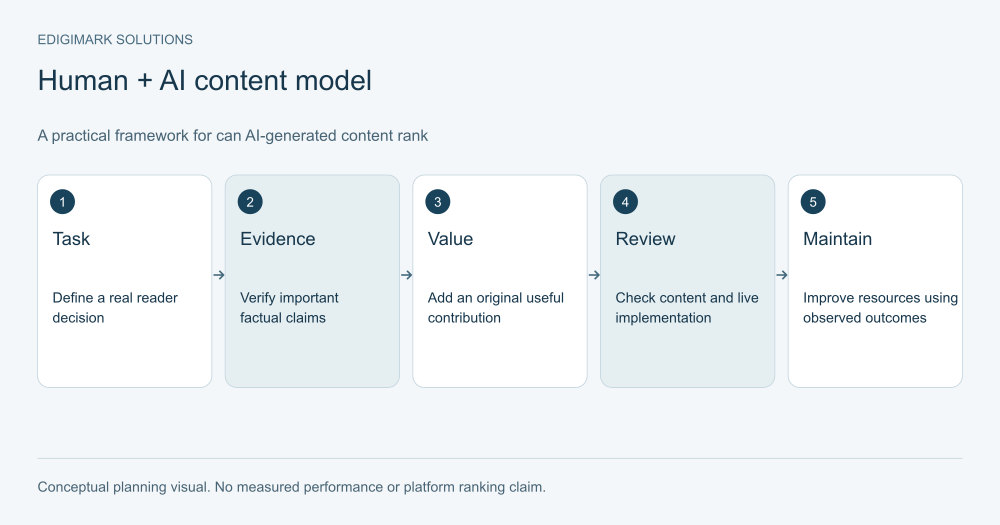
Approve the reader task and original contribution first. Develop a brief from verified facts and source material. Review the outline for duplicated ideas and missing decisions. Draft the article, then check factual claims and editorial usefulness separately.
Validate the live implementation after publication. Check the reading experience, links, images and metadata. Keep a maintained resource owner for future changes rather than treating publication as the end of responsibility.
Use data analytics services to connect content with observed search and commercial outcomes. Define the evidence before interpreting results. A page’s early traffic alone may not establish whether it supports useful evaluations.
If content supports an enquiry or lifecycle path, CRM integration and marketing automation can preserve context and appropriate follow-up. The content should lead to a truthful exchange, not an unrelated sequence.
What should you do if existing AI content is weak?
Review the pages by reader task and contribution. Consolidate overlap, correct unsupported claims, update obsolete facts and remove material that has no useful role. Do not simply add more paragraphs or repeat keywords to make the page appear more substantial.
Inspect whether the commercial promises remain accurate. A broad article can accidentally imply capabilities or results the business cannot verify. Align the page with approved service or product scope.
Prioritize resources close to important buyer decisions and technical issues that prevent useful access. Keep a record of meaningful changes so later performance comparisons can be interpreted with context.
Contact Edigimark to review an AI-assisted content workflow or improve existing resources around real reader value and verified search fundamentals.
Which content-quality checks should guide publication?
Ask whether the page answers a distinct reader task, whether important claims were checked and whether the public experience works as intended. If any answer is unclear, resolve the gap before treating the draft as a finished resource. A production deadline or favorable plugin score does not replace those checks.
How should a compatibility-claim rewrite preserve supported scope?
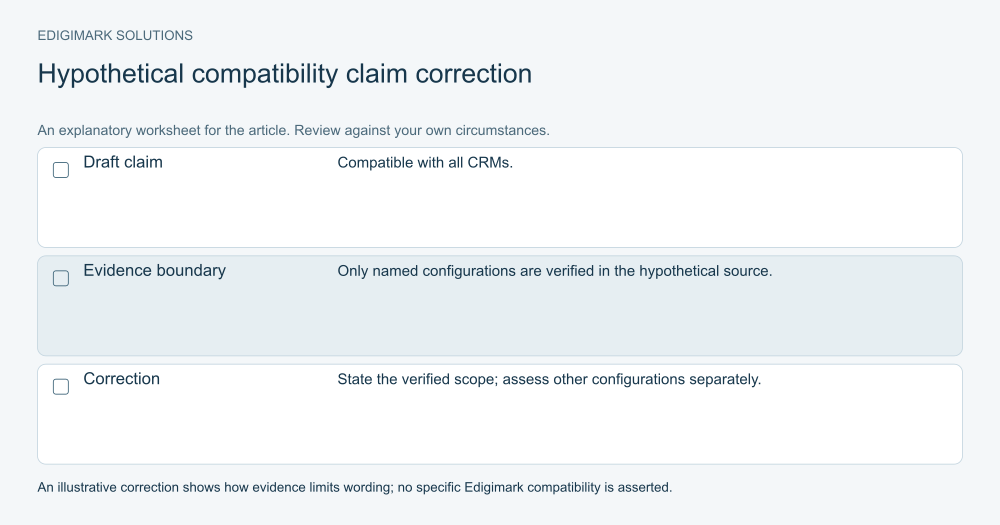
Consider a hypothetical draft claiming a service is compatible with all CRMs, while the approved evidence names only specific configurations. The reviewer should replace the universal claim with wording that matches the verified scope and identify other configurations as requiring assessment. This example illustrates correction; it does not assert that Edigimark supports any particular system.
Frequently asked questions
Is AI-generated content automatically banned by Google?
No. Google’s guidance focuses on useful content and policy compliance. AI assistance does not guarantee acceptance or performance, and low-value scaled production can violate spam policies.
Is human editing enough to make generated content useful?
Only if the review addresses facts, original contribution, reader decisions and scope. Correcting grammar alone does not repair unsupported claims or repetitive content.
Do longer AI-generated articles rank better?
Length alone does not establish value. Provide the detail the reader needs and remove repetition. A page should be as substantial as its task requires.
Should a business disclose AI assistance?
Represent production, authorship and review truthfully. Whether and how disclosure is appropriate depends on the context and expectations. Never invent a human author or imply a review that did not occur.
Can a compliant page still fail to rank?
Yes. Eligibility does not guarantee crawling, indexing or selection. Competition, relevance and many other factors affect observed performance. Measure actual outcomes and keep claims realistic.