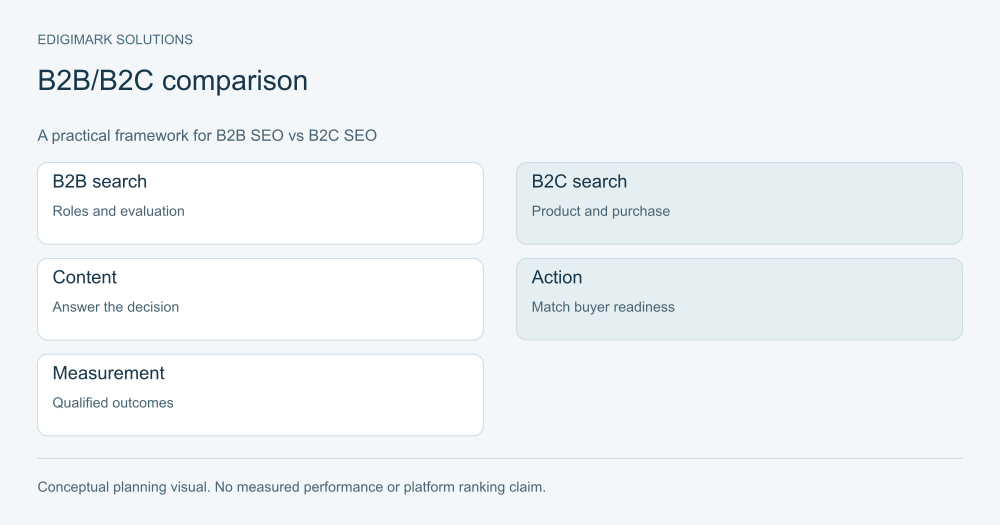
B2B SEO vs B2C SEO is a comparison of buying journeys, content needs and conversion measurement. Both require accessible websites and useful pages. The practical difference is what a searcher needs before acting: a consumer may decide for themselves, while a business buyer may need to persuade colleagues, evaluate implementation and justify an investment. Your SEO plan should reflect those decisions rather than copy a channel playbook because it worked in another market.
A product price does not settle the distinction. A consumer choosing a mortgage can research for months. A small business purchasing a low-cost utility may buy immediately. Start with observed buying behaviour, then use the B2B or B2C label to organise the work.

What stays the same in B2B SEO vs B2C SEO?
The foundations are shared: crawlable pages, clear navigation, accurate descriptions, useful content and a functioning next step. Google does not provide a separate set of basic technical requirements for business buyers. Its SEO Starter Guide explains the common principles of helping search engines understand content and helping people choose relevant results.
That means a B2B company should not tolerate a broken mobile form because most contracts are signed on desktop. A consumer brand should not publish thin product pages because purchases are comparatively simple. Both need content that answers the question behind the search.
They also need a reason to be trusted. The evidence may differ: business buyers might ask for implementation details and data-handling documentation; consumers might want product dimensions, delivery dates and returns information. In each case, proof should address the actual risk the buyer faces.
An integrated digital marketing plan starts with this shared foundation before making decisions about page types or publishing volume.
How do B2B search journeys differ from consumer journeys?
B2B search journeys often involve several people with different concerns. An operations manager researches a workflow problem. An IT colleague evaluates integrations. Finance asks about the commercial terms. A senior decision-maker wants the strategic case. Those searches can refer to the same purchase without using the same keywords.
For a hypothetical workforce software provider, “shift planning spreadsheet alternatives” could begin the journey. “Workforce software payroll integration” could support evaluation. “Workforce platform implementation timeline” could help a team prepare for approval. These queries call for different pages, even if every page eventually contributes to a demo request.
B2C search intent may sit closer to a visible product or immediate task: “waterproof walking shoes,” “same-day flower delivery,” or “how to clean a wool coat.” Yet the intent can still be research-oriented. A sizing guide may prevent a poor purchase; a maintenance guide may introduce the brand before a shopper is ready to buy.
The useful question is therefore not “How long is a B2B funnel?” It is “What must this person learn or confirm before the next decision?” Map those decisions from customer interviews, sales conversations, support requests and search results. Do not assume that every person moves through a neat sequence of blog, comparison page and enquiry.
How do keywords reflect B2B search journeys and B2C search intent?
In B2B, a small group of commercially relevant searches can be more useful than a broad topic with impressive traffic potential. A specialised integration query may connect with a qualified account, while a popular definition attracts students, job seekers and people outside the service area.
Build a keyword map with four columns: search question, likely role, decision being made and suitable page. Add a fifth column for the evidence you can provide. A keyword is a weak target if the company cannot answer it honestly or does not offer the solution implied by it.
For B2C, product attributes, use cases, comparisons, locations and availability can have immediate commercial importance. A retailer might need a category page for “wide fit running shoes” and a guide explaining how to assess fit. Publishing another general fitness article would not substitute for either page.
Volume is a useful planning input, not an automatic priority. Validate it for the relevant language and location where reliable tools are available. Also inspect the results: a query dominated by product listings calls for a different response from one dominated by explanatory guides.
When a keyword covers both markets, make the intended audience clear. A page about “expense tracking” should specify whether it addresses a household, a sole trader or a finance team. Ambiguity can produce traffic that has little reason to convert.
How should buying cycle content change?
Buying cycle content should answer the objections and tasks associated with the purchase. For B2B, that often means documentation that different stakeholders can reuse internally: a comparison of approaches, an implementation checklist, an integration explanation, an evaluation worksheet or a transparent service scope.
The best business content is not always gated. If a buyer needs to assess whether your product works with their system, placing every useful detail behind a form can slow evaluation. Give enough information to support an informed conversation. Reserve registration for an offer where the exchange is reasonable, such as a tailored assessment or an event with a clear agenda.
Consumer content often needs to reduce uncertainty about the item and fulfilment. Show real specifications, explain who the product suits, describe limitations, and make delivery and returns terms easy to find. A lifestyle image can help a shopper imagine using the product, but it should not replace dimensions or compatibility information.
Both markets benefit from a maintained content inventory. Record the page owner, the date checked, the product or service it supports and the trigger for a future update. A B2B integration guide becomes misleading when a connector changes. A consumer guide becomes misleading when a recommended product is discontinued.
What counts as a useful outcome in SEO conversion attribution?
For a consumer retailer, a completed purchase is usually a strong outcome. For a business service, a form submission can be much less conclusive. It could represent an appropriate buyer, a student enquiry, a supplier pitch or spam.
Define separate events for the meaningful steps. A B2B site might distinguish an enquiry, an accepted lead, a qualified meeting and an opportunity. A B2C site might distinguish product views, basket additions, completed orders, cancellations and returns. Do not collapse all those events into one conversion total and then infer revenue from it.
The next step on the page should also match readiness. A technical guide may offer an implementation discussion. A product comparison may link to relevant specifications or pricing. A first-time consumer visitor may need a size guide before checkout. Contextual actions generally tell you more than a repeated “Contact us” button inserted into every paragraph.
Our conversion rate optimization work connects page decisions with the quality of the resulting action, rather than treating every click as a commercial success.
Why does SEO conversion attribution need different reporting?
SEO conversion attribution becomes harder when the gap between a search visit and a sale is long. A buyer may read on one device, return through a branded search on another and later speak to sales through a colleague. Analytics can describe observed interactions; it cannot reconstruct every influence perfectly.
For B2B reporting, connect acquisition information with the CRM where consent and the technical setup permit it. Preserve the first known source, the latest meaningful source and campaign context rather than repeatedly overwriting one source field. Give sales a way to record what the prospect says influenced their evaluation.
For B2C, review revenue alongside product margin, refunds, repeat orders and acquisition cost. A page that drives purchases of low-margin items is not automatically more valuable than one that attracts fewer customers with better retention. Similarly, a sudden change in conversion rate can reflect stock availability or promotion timing rather than SEO quality.
Use cohort views when possible. Compare visitors or leads acquired during the same period, then allow enough time for the relevant buying cycle. A recently published B2B comparison page should not be judged against a mature page using closed revenue alone.
CRM integration and data analytics support that connection, but the definitions of lead quality and commercial value still need agreement between the people using the data.
How should buying cycle content shape page architecture and internal links?
A B2B architecture often needs to connect problems, solutions, industries and integrations without creating dozens of nearly identical pages. Every industry page should contain a real industry-specific explanation: constraints, workflows, terminology and evidence. Replacing the industry name in generic copy does little to help the reader.
A B2C architecture often centres on categories, products and attributes. Filters can help shoppers, but the technical treatment of filter URLs needs care. Decide which combinations deserve discoverable pages and which simply support navigation. An oversized index of near-duplicate combinations can make the site harder to maintain.
Internal links should follow the decision. A business integration guide can link to the relevant solution and a discussion about implementation. A consumer care guide can link to compatible products or accessories where that recommendation is useful. Use descriptive anchor text so the destination is understandable before someone clicks.
Avoid treating the blog as an isolated traffic machine. A useful guide needs a route to the service or product it supports, and commercial pages may need links back to evidence that makes the offer easier to evaluate.
What proof does buying cycle content need in B2B and B2C?
B2B proof needs context. If a case study says a process became faster, explain the starting point, the change, the measurement period and what else may have influenced the result. Where confidentiality prevents disclosure, use an explicitly labelled hypothetical example to explain the method instead of presenting invented client results.
Consumer proof benefits from specificity too. A review about fit, durability or delivery can be more useful than a generic statement that the product is excellent. Present genuine reviews accurately and distinguish editorial recommendations from customer feedback. Do not fabricate testimonials or imply that an illustration is a photograph of a real customer.
For both models, technical and commercial limitations belong near the claim. If a service only works in certain countries, say so. If a product requires a compatible device, show the requirement. Honest boundaries help the right buyer proceed and help an unsuitable buyer avoid a wasted enquiry.
How would the same topic look in two different markets?
Consider a hypothetical company selling water filtration equipment. Its consumer page might answer: Which model suits a household? What does installation require? How often is the cartridge replaced? What are the ongoing costs?
Its business page for a restaurant might address peak usage, maintenance responsibilities, compatibility with existing equipment, installation disruption and the documentation a manager needs to approve the purchase. A restaurant owner could still buy quickly, but the business context changes the content.
The keyword plan should reflect that difference. A general “water filter benefits” guide could support both audiences, while the commercial pages need separate details. Sharing useful background does not require forcing every visitor through the same offer.
This example is illustrative, not a client result. Its purpose is to show why the buying situation should drive content decisions even when the underlying product category is identical.
How do you turn B2B SEO vs B2C SEO into a practical plan?
Review a sample of your highest-traffic pages and your most commercially important pages. For each, ask who it serves, which decision it supports, what evidence it provides and what action follows. Then compare those answers with actual enquiries or purchases.
If a business website attracts many visitors but sales rejects most enquiries, investigate the keyword-to-offer connection before increasing publication volume. If a consumer store attracts product visitors but they abandon checkout, inspect availability, fulfilment terms and checkout experience before blaming rankings.
Give each proposed change an owner and a success measure. “Improve B2B content” is too broad to execute. “Add implementation prerequisites to the integration page and compare qualified enquiries over an appropriate period” is a usable action.
The right plan may include both approaches. A company serving households and commercial accounts can share technical foundations while maintaining separate journeys, offers and reporting. Discuss your audience mix with Edigimark if you need to decide where those journeys should connect.
What should the team bring to a B2B SEO vs B2C SEO workshop?
Bring five recent business opportunities and five recent consumer purchases where both audiences exist. For a single-market company, use a similar sample of relevant and unsuitable enquiries instead. Discuss the questions asked, the pages visited where known, the objections raised and the final outcome. This small review is a discovery exercise, not a statistically representative study.
Ask sales or customer service to explain the missing information they had to provide personally. Ask marketing which pages currently answer those questions. Ask the website owner whether visitors can find those pages without knowing the company’s internal terminology.
The differences usually become more actionable when they are expressed as tasks. “Business buyers need implementation information before booking” can lead to a specific page improvement. “B2B customers are more rational” is too broad and ignores the emotional and organisational pressures that affect business decisions too.
Document three outputs: the content gaps, the appropriate actions on those pages, and the data needed to judge the result. Assign the first improvement to the page with a clear commercial role and a credible evidence base. Revisit the workshop after the change has had time to receive relevant visits and enquiries.
This process also protects against over-segmentation. If household and business customers need the same safety information, maintain one accurate reference rather than two conflicting versions. Separate the commercial context where it matters, and share the technical explanation where that is genuinely useful.
Frequently asked questions
Is B2B SEO more difficult than B2C SEO?
Neither is universally harder. B2B can involve specialised topics and complex qualification; B2C can involve intense competition, large product inventories and changing stock. Difficulty depends on the market, website, available evidence and resources. Judge the actual search results and your ability to provide a better answer.
Can a B2B company target low-volume keywords?
Yes, if those searches represent a relevant decision and the company can serve the buyer. A low-volume integration or compliance-related query may be commercially useful. Validate its meaning through customer conversations and search results rather than assuming that a precise phrase always signals purchase intent.
Should B2C brands publish educational articles?
They can be useful when they answer real product or usage questions. Care guides, sizing explanations and comparisons can support discovery and customer confidence. Connect them to relevant products where appropriate, and measure more than article traffic to understand whether the content contributes to the business.
Do B2B pages need longer content?
They need enough information for the decision. A clear technical specification may be short; a complex implementation guide may need substantial detail. Length should come from necessary explanations, evidence and examples. Adding repetitive paragraphs to reach a target does not improve the buyer’s evaluation.
Can one SEO dashboard cover both models?
One dashboard can contain shared visibility measures, but commercial outcomes should remain distinguishable. Show qualified opportunities for business buyers and appropriate purchase or retention measures for consumers. Combining every action into a single lead or revenue number hides the differences the team needs to act on.