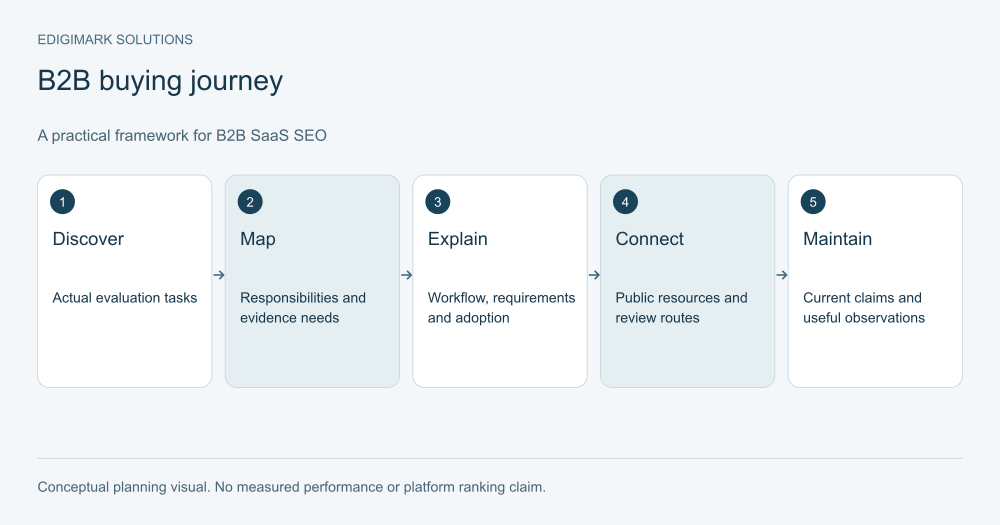
B2B SaaS SEO should answer the different questions that arise during a business software evaluation: workflow fit, technical requirements, implementation, evidence and the case for adoption. Build a connected resource set for the people involved, keep product claims current and offer suitable next steps. Search visibility is useful when the public content helps a relevant organization evaluate accurately.
A business evaluation can involve several responsibilities, but every company does not follow the same buying process. Discover which roles actually influence your audience’s decisions. Do not assume that a generic funnel explains the sequence, timing or concerns of every potential customer.
This guide focuses on SaaS buying committees and the content that supports their work. The suggested matrix is a planning aid, not a claim that all purchases involve five stakeholders or that a particular article will create an opportunity.
In this guide
- How does B2B software search intent reveal an evaluation task?
- How should you map SaaS buying committees without stereotyping roles?
- What SaaS workflow content helps users assess product fit?
- What evidence helps technical stakeholders evaluate SaaS fit?
- How should enterprise SaaS content handle security questions?
- How can finance and sponsors evaluate the business case?
- How should long sales cycle SEO support an evolving evaluation?
- How should B2B SaaS SEO organize a public resource library?
- What public delivery checks matter for enterprise evaluations?
- What does an illustrative stakeholder content plan look like?
- How should the content team handle internal champions?
- How should a B2B SaaS SEO report assess usefulness?
- How should B2B SaaS SEO priorities reflect review capacity?
- Frequently asked questions
- Build a resource set for the real B2B evaluation
How does B2B software search intent reveal an evaluation task?
Read the query in context. A search for a category definition may come from an early researcher, while a search for implementation requirements may indicate a more specific task. Neither wording proves the person’s job title or the stage of an entire organization.
Collect questions from approved discovery notes, evaluation conversations and support themes. Identify the task behind the wording: understanding an approach, checking a requirement, comparing alternatives or preparing internal approval. Keep private prospect detail out of public briefs.
Map each task to useful evidence. A workflow question needs a concrete example; a compatibility question needs verified scope; an implementation question needs prerequisites and responsibility. A general benefits paragraph cannot replace all three.
Distinguish demand evidence from an inferred opportunity. A recorded question establishes that someone asked it. It does not establish search volume or prove that the same concern is widespread. State the evidence level and validate important planning assumptions.
Use digital marketing services to align this question map with the offer and audience. The search program should reflect the actual evaluation rather than impose a ready-made persona diagram.
How should you map SaaS buying committees without stereotyping roles?
Start with responsibilities, then identify who performs them in the intended organization. A small company may combine several responsibilities in one person. A larger evaluation may distribute them across teams. The resource need matters more than an assumed title.
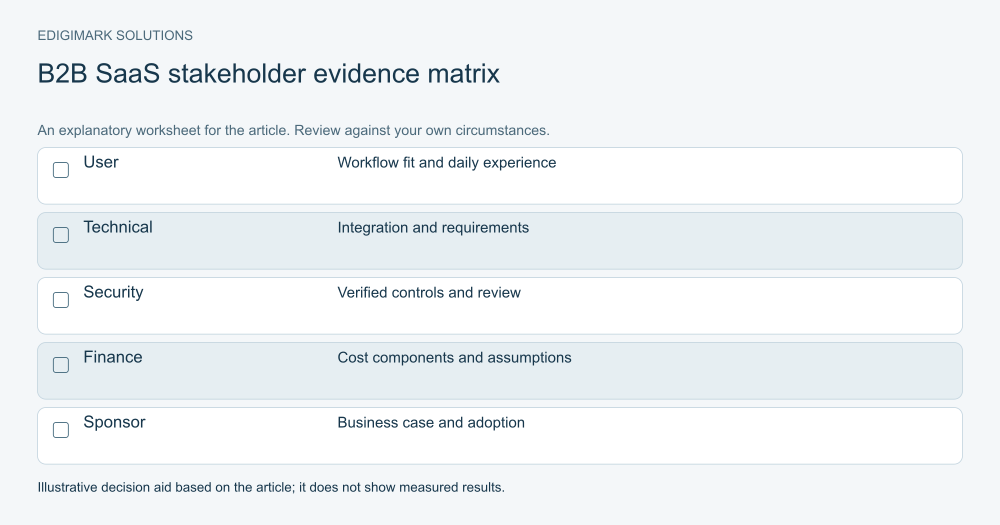
An illustrative matrix can include user workflow, technical fit, security review, cost assessment and sponsorship. Ask what decision each responsibility owns, what evidence it needs and what would prevent approval. Adapt or remove rows according to the actual audience.
Record shared concerns. Integration can affect daily users, technical owners and sponsors, but each may need a different level of detail. A concise overview can connect them to a deeper owning resource rather than creating conflicting explanations.
Avoid manipulative role targeting. The aim is to help people understand the choice and communicate it internally. Content should not hide material conditions from one stakeholder to make another stakeholder’s approval easier.
Review the matrix with sales and product specialists. Use real sanitized examples to find missing responsibilities or unnecessary assumptions. Keep it current when the product moves into a new segment or deployment model.
What SaaS workflow content helps users assess product fit?
Explain the starting workflow, the people involved and the steps the product supports. A buyer should understand how daily work changes, not only see an isolated feature list. Include the information that must exist before the workflow begins.
Show what remains a human or team responsibility. A product may automate assignment while still requiring a person to define rules or resolve exceptions. Hiding that work can create unrealistic expectations and a poor evaluation experience.
Use accurate demonstrations and permitted examples. Label a hypothetical workflow clearly. Do not present a mockup as a released screen or invent a customer endorsement to make the use case feel more persuasive.
Answer practical adoption questions at an appropriate depth. What setup is required? Which roles need training? What happens when the workflow is incomplete? Link to the owning documentation where the reader needs detail.
Choose a next step that supports evaluation. A walkthrough, trial or discovery conversation may fit depending on the product. Explain what the action provides so the reader can decide whether to involve colleagues.
What evidence helps technical stakeholders evaluate SaaS fit?
Publish verified requirements and compatibility information. Distinguish supported functions from project-dependent possibilities, and explain relevant plan or configuration conditions. A broad statement that the product “works with everything” is not useful technical evidence.
Describe the integration approach in clear terms. A native connector, API project and scheduled export have different implications. Identify records, direction, triggers and responsibility where those details are available and appropriate for the public page.
Explain implementation dependencies. A team may need access permissions, suitable source data or an internal owner. Do not treat these as minor footnotes if they determine whether the approach can work.
Use CRM integration when the evaluation includes the wider flow between website, product and sales systems. Scope the service to the actual task instead of assuming that a product integration page covers the full business process.
Keep technical details owned by a qualified specialist. A marketing writer can make the explanation clearer, but should not independently certify support for a system or configuration. Attach review responsibility and an update trigger to important capability claims.
How should enterprise SaaS content handle security questions?
Treat security claims as claims that need verification, not promotional adjectives. State the scope of publicly approved information and identify the appropriate review route. “Secure by design” alone does not answer a specific evaluation question.
For a certification or assessment reference, verify the exact organization, product, scope and current status with the responsible owner. Do not imply that one document covers every service or deployment. Link to an approved public reference where available.
Separate public explanations from controlled evaluation material. Some details may be provided through an authorized process. Explain how an evaluator can request the appropriate information without publishing sensitive material or promising that every request receives unrestricted access.
Keep factual boundaries beside the claim. If a control depends on configuration, responsibility or plan, state the condition. A broad headline should not erase that distinction.
Have the relevant security or technical team approve the wording. This section is a content governance recommendation, not a security assessment of any product. The website should support informed review while the appropriate specialists handle the actual evaluation.
How can finance and sponsors evaluate the business case?
Explain cost components and assumptions rather than inventing a universal return figure. Subscription, implementation, training, migration and internal operating effort can all be relevant. The actual components depend on the offer and organization.
Use a worksheet that lets the evaluator supply their own inputs when appropriate. Label hypothetical numbers as examples and keep assumptions visible. A calculator should not imply measured savings unless the underlying evidence supports that claim.
Describe the problem the product is intended to address and the conditions for realizing its benefit. The organization may need process changes, adoption and accountable ownership. A purchase alone does not establish the outcome.
Provide a concise summary that a sponsor can share internally, with links to deeper evidence. Keep the summary accurate when read independently. Important prerequisites should not disappear because the format is shorter.
Avoid treating the business case as a guarantee. The resource can help a team reason about its options, while the organization remains responsible for verifying its own assumptions and requirements.
How should long sales cycle SEO support an evolving evaluation?
Plan resources around decisions that can occur at different times. A team may return to the same compatibility question after involving a new stakeholder. A resource should remain understandable without requiring the reader to remember an earlier campaign message.
Use stable public URLs and descriptive headings for important explanations. Make useful sections easy to find and share. An internal champion should be able to point a colleague to the relevant condition rather than describe where it was hidden in a long page.
Keep the content consistent across formats. A sales handout, public comparison and technical explanation should not present different current capabilities. Maintain a shared fact record and identify which resource owns the deepest detail.
Avoid artificial urgency when the decision needs careful review. An appropriate next step can help the team resolve a requirement or collect necessary information. Pressure that ignores the evaluation task can reduce usefulness.
Use marketing automation for suitable follow-up coordination. Base the workflow on the person’s stated interest and the business’s approved process, rather than treating any page visit as permission for an aggressive sales sequence.
How should B2B SaaS SEO organize a public resource library?
Create a product overview that explains the core offer, then connect the relevant use cases, requirements, integrations, comparisons and implementation resources. Let the structure follow the audience’s task map rather than the company’s internal team chart.
Give each resource one clear owning purpose. A comparison can summarize compatibility and link to verified detail. An implementation guide can explain readiness without repeating every product benefit. This reduces contradictory duplicate explanations.
Use useful link labels. A colleague receiving a shared page should understand which destination answers the next question. Generic repeated links such as “learn more” can make a resource set harder to scan and explain.
Review the public/private boundary. Evaluation resources intended for public discovery should be available as intended outside the application. Controlled materials can have their own authorized process. Do not accidentally place the only useful public product explanation behind a login.
Assign maintenance owners across the library. Product changes should trigger review of the connected resources, including metadata, visuals and comparisons. A coherent architecture can still become inaccurate without ongoing responsibility.
What public delivery checks matter for enterprise evaluations?
Inspect the actual page across relevant devices. Long tables, expandable sections and embedded demonstrations can be difficult to use even when the editor looks correct. Important conditions and actions should remain understandable in the delivered experience.
For JavaScript-based pages, use appropriate rendering inspection. Google’s JavaScript SEO documentation explains its crawling, rendering and indexing process. Confirm that the public explanation and meaningful links are available as intended rather than assuming an interactive application view supplies them.
Check document and asset access. A promised requirements sheet should open through the stated process, and a demonstration should not lead to an obsolete or unavailable resource. Broken evidence can interrupt an evaluation even when the surrounding copy is clear.
Use web development to resolve reproducible delivery issues. Describe the affected URL, behavior, audience impact and acceptance condition so the fix can be verified.
Test the evaluation action through the receiving workflow. A successful confirmation should correspond to the intended record and routing. If different inquiry types need different teams, make that responsibility explicit.
What does an illustrative stakeholder content plan look like?
Imagine a hypothetical SaaS tool used to coordinate service requests. Users ask how assignment and escalation work. Technical owners ask which intake systems are supported. A sponsor asks what process changes adoption requires. These are distinct tasks within one evaluation.
The first release contains a verified product overview, an operations workflow example and a compatibility explanation. A short readiness worksheet helps the sponsor identify owners and prerequisites. Security-related claims go through the responsible specialist’s review, and controlled information follows the approved request route.
The comparison resource uses consistent criteria and current evidence for alternatives. It does not claim to be independent research if the vendor authored it. The workflow example remains labeled as hypothetical until a permitted real example is available.
The library links these resources where the reader needs them. The evaluation request explains what information helps the team prepare a useful discussion. Sales records missing evidence and repeated misunderstandings so later content addresses actual gaps.
No performance result is assumed. The plan would still need publication checks and defined observations before the company could judge its contribution. Its immediate value is better coverage of the evaluation’s questions.
How should the content team handle internal champions?
Provide clear, shareable summaries with accurate qualifications. An internal champion often needs to explain the option to colleagues, but the summary should not become a selective sales script that omits material conditions.
Offer a practical discussion worksheet. It can ask about the current workflow, affected teams, prerequisites and unresolved requirements. The worksheet helps the organization prepare, without pretending to know its priorities in advance.
Keep deeper evidence linked and current. A concise overview should lead to the owning requirement or comparison resource. If the source changes, review the summary so it remains consistent.
Explain who can answer specialist questions. A marketing page should not claim that every implementation or security concern has a universal public answer. A suitable review route is sometimes the most useful next step.
How should a B2B SaaS SEO report assess usefulness?
Review discovery observations, relevant inquiry fit and recurring evaluation questions separately. Use data analytics to clarify periods, event delivery and attribution rules before interpreting changes.
Add qualitative evidence from sales under an approved process. Which resource helps explain a requirement? Which claim creates confusion? Which question still lacks a useful answer? These observations can guide editorial work even when exact contribution to revenue remains uncertain.
Do not infer a whole committee from a single tracked person. Available analytics may show only part of the organization or journey. Treat account-level influence under a stated method and preserve unknown context.
Assess maintenance as well as publication. A library that answers important questions accurately is more useful than a growing set of stale launch assets. Report unresolved claim reviews and public delivery issues with a responsible owner.
How should B2B SaaS SEO priorities reflect review capacity?
Select the most important verified decisions first. Product scope, decisive prerequisites and a working evaluation action deserve attention before a large set of speculative role pages. Narrow the release to match the specialist evidence available.
Reuse approved factual material carefully. Keep the original condition and ownership attached to it, then adapt the explanation to the reader’s task. Do not turn a limited technical statement into a universal marketing promise during rewriting.
Keep an evidence backlog alongside the editorial roadmap. Some questions need a test, permission or specialist review before they become publishable. Showing that dependency is more useful than pretending the topic is ready because a writer can produce a draft.
Reserve maintenance time for the release set. Review capacity is an ongoing requirement, particularly when several stakeholder resources rely on the same changing product facts.
Frequently asked questions
Does every B2B SaaS purchase involve a buying committee?
No. Several responsibilities may sit with one person or be shared across teams. Map the actual evaluation and resource needs rather than assuming one universal committee structure.
Should we make a page for every stakeholder role?
Only when the role has a distinct useful task and appropriate evidence. Shared concerns can be handled by one owning resource with clear navigation and suitable depth.
Can security claims be used as SEO keywords?
Only communicate claims that the responsible specialists can verify and approve. Keyword demand does not establish a certification, control or assurance scope.
What helps an internal champion share the product case?
A clear summary, practical readiness questions and links to current evidence can help. Preserve material conditions so the summary remains accurate when shared independently.
How do we measure content during a long evaluation?
Use stated discovery, qualification and influence definitions, and review actual evaluation feedback. Explain attribution and identity limits rather than claiming a complete view of every stakeholder.
Build a resource set for the real B2B evaluation
Answer workflow, technical and organizational questions with evidence the business can maintain. Connect the resources and the appropriate review route. Contact Edigimark with your product, audience and recurring evaluation questions to scope a B2B SaaS SEO plan.