A B2B marketing automation funnel connects a prospect’s first interaction with qualification, sales follow-up, opportunity progress and closed deal reporting. Its value comes from reliable transitions: the right message reaches the right person, the CRM records what happened, and an accountable owner handles the next action.
Start with the buying journey and operating rules before building workflows. Automating an unclear funnel spreads the confusion faster. This guide shows how to specify the stages, data, exceptions and reporting for a practical acquisition to revenue workflow.

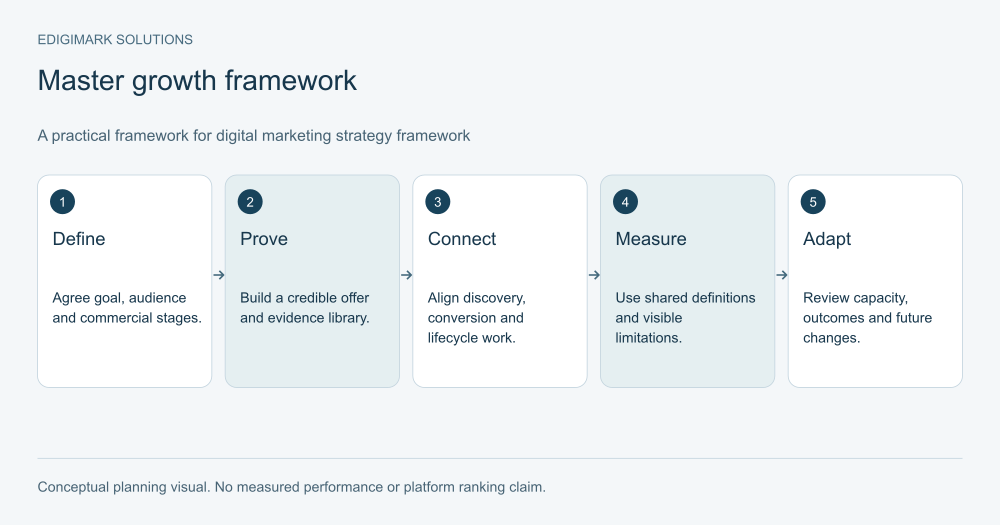
An editorial planning diagram; stages and examples are illustrative.
What should the funnel include beyond email nurturing?
The funnel needs six connected responsibilities: capture a meaningful interaction, identify the prospect when appropriate, assess fit and readiness, route the record, support the evaluation, and reconcile the commercial result. Email is one delivery mechanism within that system.
An anonymous visitor reading a guide is different from a known buyer requesting a technical assessment. The first interaction may require helpful content and respectful measurement. The second requires a clear response owner, an acknowledgement and a record of the request. Putting both into a generic newsletter sequence loses the distinction.
Build the funnel around observable states rather than aspirational labels. “Interested” is difficult to audit. “Requested a demo and meets the agreed company-fit criteria” gives the team a testable transition. A person can also move backwards, pause an evaluation or become ineligible. Your workflows must support these paths.
| Stage | Required evidence | Automation job | Human responsibility |
|---|---|---|---|
| First interaction | Valid page visit or campaign response | Preserve campaign context where available | Provide a useful next step |
| Known prospect | Submitted information and recorded preferences | Create or update a record | Resolve unusual requests |
| Qualified prospect | Agreed fit and readiness criteria | Route with supporting evidence | Accept or reject the handoff |
| Active evaluation | Confirmed problem and next meeting | Coordinate relevant resources | Guide the buying discussion |
| Opportunity | Sales-created commercial evaluation | Synchronize stage and communication rules | Maintain accurate deal information |
| Closed outcome | Recorded win, loss or deferred decision | Stop acquisition sequences and report | Confirm revenue and next ownership |
These are suggested CRM funnel stages. Adapt them to your sales motion rather than copying labels into a platform and assuming the process is finished.
How do you define qualification without overvaluing clicks?
Separate suitability from activity. Suitability covers the company, problem, implementation needs and ability to use the offer. Activity describes observable behavior. A busy researcher can accumulate activity without representing a viable buying opportunity.
Salesforce’s lead qualification model guidance distinguishes engagement scoring from prospect-fit grading. The useful operating principle is to keep those dimensions visible instead of hiding both inside an unexplained number.
For example, a hypothetical integration consultancy might require a supported CRM, an identified workflow problem and an implementation owner. Reading several introductory posts could justify more education. A request describing a broken synchronization process could justify immediate review. Neither behavior proves a budget exists.
Write disqualification and uncertainty rules as carefully as qualification rules. A student enquiry, support request, recruitment message or competitor research visit should not trigger the same sales sequence. An incomplete business enquiry can go to a review queue rather than being automatically rejected.
Review false positives with sales. Ask which supposed qualified leads were unsuitable and what evidence was missing. Change one rule at a time and keep its effective date. Otherwise, improved acceptance may simply reflect a different definition, making historical reports misleading.
Which data must follow a prospect from acquisition to revenue?
Preserve identifiers, timestamps and definitions. A useful minimum record includes the contact identifier, associated company where known, acquisition source, campaign identifier, conversion action, preference status, qualification evidence, current owner and stage-change dates. Opportunity records need their own identifiers and associations.
Avoid treating an email address as a permanent universal key. People change roles, use multiple addresses and share purchasing responsibilities. Define how contact, company and opportunity records relate, and how duplicates are reviewed. A company-level evaluation can involve several people without representing several separate deals.
Specify which system owns each field. The CRM might own opportunity stage, the marketing platform might own subscription preferences, and finance might own recognized revenue. Conflicting updates should have a clear precedence rule. A synchronization that repeatedly overwrites a salesperson’s stage with a stale marketing value can disrupt active deals.
Edigimark’s CRM integration services are relevant when the funnel needs consistent identifiers and dependable handoffs across systems. The desired outcome is an agreed data contract, not simply a connected-app badge.
Before activating a workflow, inspect a sample record through its entire journey. Can you explain where every important value came from? Can the receiving salesperson see the original request? Can reporting join the opportunity to the relevant acquisition interaction without guessing?
How should lifecycle automation choose the next message?
Use the buyer’s current task, readiness and preferences to select a message. An educational sequence should help someone understand the problem. An evaluation sequence should answer implementation, compatibility and commercial questions. A customer sequence should support adoption.
Create a content map with the triggering situation, useful asset, next action and exit condition. An integration guide might be appropriate after a buyer asks about compatibility. A procurement summary might be appropriate when a commercial evaluation begins. The same generic “book a demo” request in every message gives little reason to engage.
Do not assume a fixed sequence always represents progress. A buyer may enter through a pricing page and already understand the category. Another may need several educational interactions before involving colleagues. Allow requested actions to override lower-priority nurture paths.
Frequency and suppression deserve explicit ownership. A prospect who is in an active sales conversation should not receive conflicting automated offers. A preference change should propagate to every relevant campaign. Marketing automation also needs quiet states: sometimes the appropriate next action is to wait for a agreed meeting or a customer’s reply.
If you are designing these rules from scratch, marketing automation services can help connect content, triggers and lifecycle ownership into a maintainable system.
What makes a sales handoff reliable?
A reliable handoff has an assignment, supporting evidence, an expected response window and a feedback path. Sending an alert alone is insufficient. The system needs to know whether someone accepted responsibility and what happened afterwards.
The handoff record should summarize the prospect’s request in their own words, the qualification criteria met, relevant interactions, company association and any outstanding uncertainties. Keep the original source information available. A generated summary must not replace the underlying evidence.
Define rejection reasons that lead to action. “Bad lead” is too vague. Unsupported geography, incompatible product requirements, duplicate opportunity and no current project each imply a different response. Some should end acquisition contact; others should return to an appropriate educational path.
Create an escalation queue for unassigned records and overdue follow-up. Assign an owner to the queue itself. Without this, an automation can create a perfectly documented record that nobody actually handles.
A conversion rate optimization review can examine whether the form promises match the actual response. A technical assessment form that leads to a generic promotional email may disappoint a buyer even if the workflow executes exactly as configured.
How should opportunity stages change marketing communication?
Treat the opportunity as a shared commercial state. When sales records an active evaluation, marketing should support agreed questions and avoid unrelated acquisition messaging. When an opportunity closes, the communication path should reflect the outcome.
For a won deal, confirm the handoff to implementation or customer success before beginning onboarding. For a lost deal, record why it ended and whether any future contact is appropriate. For a deferred decision, identify a genuine revisit condition rather than restarting a relentless sequence.
Include existing customers in the suppression design. Someone requesting support should not be treated as a new prospect merely because they submit a public form. Expansion evaluations should remain distinguishable from initial acquisition so their economics and ownership can be reported accurately.
Ask sales to maintain a small set of dependable fields instead of demanding a large form at every stage. Required fields should support a decision, handoff or report. Excessive data entry often produces placeholder values that look complete but undermine the funnel.
What should closed deal reporting actually measure?
Report stage conversion, time in stage, rejection reasons, opportunity value and closed outcomes by cohort. Define the cohort using a consistent event, such as first qualified enquiry or opportunity creation. Do not divide this month’s wins by this month’s new leads when the two groups may be unrelated.
Distinguish pipeline value from revenue, booked value from recognized revenue, and attributed outcomes from proven incremental outcomes. A campaign associated with a deal may have supported the evaluation without being its sole cause.
Google Analytics describes attribution as assigning credit to interactions. CRM reporting adds commercial context, but it does not automatically eliminate incomplete tracking or prove causation. Show known and unknown source coverage rather than distributing all unknown revenue to a convenient channel.
Use data analytics services when the reporting challenge involves joining channel, lifecycle and commercial data. Require a written metric dictionary so a report can be interpreted consistently by marketing, sales and finance.
How do you test the workflow before scaling?
Create test scenarios covering a new valid enquiry, an existing contact, a duplicate submission, an unsupported request, a preference change, a sales rejection, a won deal and a failed integration. Use authorized test records and keep them distinguishable from actual leads.
For each scenario, write the expected stage, owner, message and report result. Check the negative paths as carefully as the happy path. A retry must not create duplicate contacts or send the same acknowledgement repeatedly. A failed enrichment step should not erase the information the prospect supplied.
Start with one audience and one acquisition path. Observe the real handoffs before expanding to more channels. Keep a versioned change log, a workflow owner and a rollback plan. When sales criteria change, review the associated forms, sequences and dashboards together.
The strongest next step is a short operating specification: stage definitions, field owners, routing rules, suppression rules, test cases and reporting definitions. Discuss your funnel with Edigimark if you need help translating that specification into connected implementation work.
What does a complete workflow specification look like?
Consider a hypothetical business that sells implementation services for a supported CRM. A visitor arrives through an integration guide and requests a technical assessment. The workflow should preserve the page and campaign context where available, create or update the contact, associate the company when the evidence supports it, and record the request as an assessment rather than a generic download.
The acknowledgement explains the next step and does not promise an assessment has already occurred. Routing checks the supported-platform field and implementation need. A suitable request goes to the responsible reviewer; an ambiguous one goes to a named triage owner. Neither path should invent missing company details or infer that the prospect has approved a purchase.
If sales accepts the request, the marketing record changes to an active evaluation state. General acquisition emails pause. A requested compatibility resource can still be sent when appropriate. If a commercial opportunity is created, it retains an association to the original request and its timestamp. When the deal closes, the workflow uses the recorded outcome to select the next path.
This example is a design exercise, not a client result. Its value is the traceability: a team can inspect every transition, explain why it occurred and identify who must act when it does not.
Which exceptions should the implementation worksheet include?
For duplicate submissions, decide whether to update the existing request, add a new activity or create a separate evaluation. A retry should not create a second opportunity merely because the integration timed out after the first write.
For existing customers, check account status before starting acquisition messaging. A support request needs a support route. An expansion request may need a commercial route, but it should remain distinguishable from new-customer acquisition.
For missing owners, use an explicit fallback queue with escalation. For rejected requests, require a meaningful reason and decide whether further contact remains appropriate. For integration outages, preserve the original payload and a retry status without exposing unnecessary personal information in logs.
For preference changes, establish the effective timestamp and ensure later workflows respect it. Test a contact already enrolled in several paths. A preference flag that is checked only at enrollment can leave an active sequence sending messages after circumstances change.
Who signs off the funnel before launch?
Marketing approves the offer, content and sequence logic. Sales approves qualification, routing and acceptance expectations. The CRM owner approves field mapping and stage authority. Analytics approves metric definitions and test exclusions. The person responsible for communication preferences approves the applicable handling rules.
Keep the sign-off concise. Each reviewer should inspect the parts they actually own and one complete test journey. Approval without a traceable test record provides little assurance that the design works.
After launch, hold a short exception review. Inspect overdue handoffs, failed synchronizations, conflicting states and unusual buyer replies. Decide whether each problem is a data issue, a rule issue or a responsibility gap. The funnel should become easier to operate as these cases are resolved, rather than accumulating silent workarounds.
Document the owner of every future change. A new form, campaign or product segment can alter the funnel even when nobody edits the main workflow. Require those additions to identify their conversion type, routing rule, suppression behavior and reporting treatment before activation.
Frequently asked questions
Is a B2B marketing automation funnel the same as an email sequence?
No. An email sequence handles one communication path. The funnel also includes identification, qualification, ownership, CRM transitions, sales feedback, suppression and commercial reporting. Emails should follow those operating rules.
Should every form submission become a qualified lead?
Only when the form and qualification criteria justify it. Downloads, support requests and demo enquiries represent different intentions. Record the action accurately and apply an agreed qualification rule rather than treating all submissions as equivalent.
Can automation decide when sales should follow up?
It can apply approved rules and create review tasks. Uncertain or unusual cases should retain a human review path. The salesperson also needs enough context to understand why the record was routed.
How do you prevent duplicate nurturing messages?
Define workflow priorities, mutually exclusive states, exit criteria and shared suppression rules. Test an existing contact entering a second campaign. A central view of lifecycle state is more dependable than independently managed campaign lists.
What is the first metric to improve?
Choose the largest meaningful handoff failure. If qualified enquiries are not accepted or followed up, fixing that transition is usually more actionable than increasing top-of-funnel traffic. Diagnose with actual stage records before choosing a target.