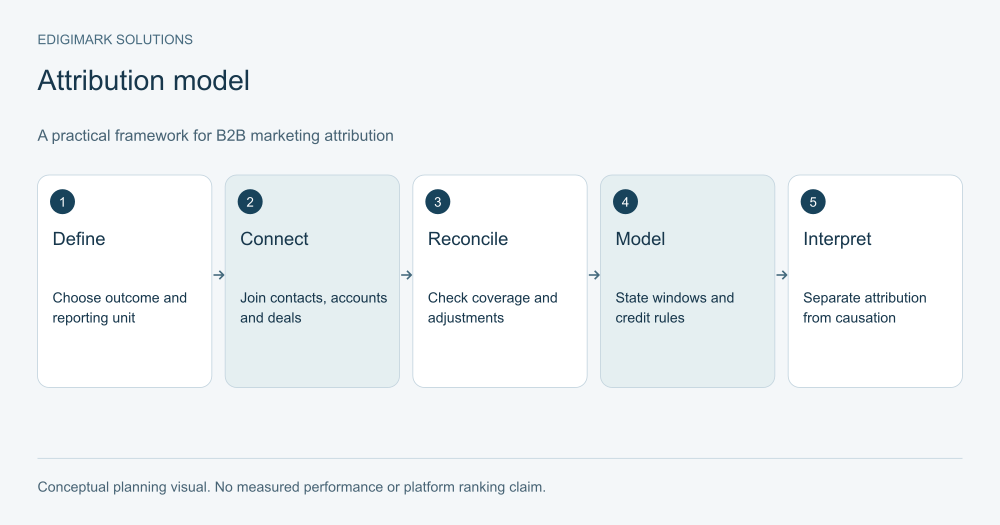
B2B marketing attribution connects recorded marketing interactions with enquiries, opportunities and revenue under an explicit credit model. Start with reliable identifiers and commercial definitions, then choose a model appropriate to the decision. Attribution helps organize evidence about a buying journey; it does not automatically prove which activity caused a deal or capture every influence.
The first question is what you want the report to answer. Campaign comparison, sales-support review and incremental budget decisions need different levels of evidence. A single model cannot remove all uncertainty simply because it produces a precise percentage.
In this guide
- How does B2B marketing attribution assign credit?
- What data foundation is required for CRM revenue tracking?
- Which marketing and sales conversion definitions should be connected?
- How should a B2B attribution model fit the reporting question?
- How does multi-touch attribution help, and where does it mislead?
- What role does offline conversion data play?
- How do you handle private sharing and unknown sources?
- How should account-level attribution be treated?
- What should the attribution implementation worksheet contain?
- How do attribution limitations affect budget decisions?
- What should a useful attribution dashboard show?
- How do you improve attribution without overengineering?
- What does an attribution reconciliation review look like?
- Frequently asked questions
How does B2B marketing attribution assign credit?
It assigns credit to observed interactions along a path to a defined outcome. A rule-based model applies a stated convention, such as crediting the last eligible interaction. A data-driven model uses the platform’s methodology and available data. Both depend on what was recorded and how the outcome is defined.
Google’s attribution documentation describes attribution as the allocation of credit and documents the models available in its reports. Your B2B commercial view may need additional CRM and finance data beyond the web or advertising report.
A buyer can read a public guide, discuss it privately, receive a partner recommendation and later request contact through a direct visit. Some of those influences may be absent from the recorded path. The model’s answer is a view of available evidence, not a complete reconstruction of the person’s thinking.
What data foundation is required for CRM revenue tracking?
Connect contact, company and opportunity identifiers without collapsing their different meanings. A contact is a person; a company may include several buying units; an opportunity describes a specific commercial evaluation. Several contacts can support one opportunity.
Preserve relevant dates, original request context, acquisition information and commercial stage history. Decide which system owns each field. The CRM may own opportunity status while finance owns recognized revenue. A marketing platform should not overwrite those fields with stale campaign data.
Define association rules and uncertainty handling. A shared domain does not always identify the correct legal or purchasing entity. A large parent company can contain subsidiaries with separate evaluations. Review ambiguous relationships rather than forcing every record into a convenient account.
CRM integration services can support these joins and ownership rules. Test a full authorized journey through enquiry, opportunity and outcome to verify that the relationships survive synchronization.
Which marketing and sales conversion definitions should be connected?
Keep enquiries, qualified leads, accepted leads, opportunities and closed outcomes distinct. A form submission is an action; sales acceptance is a responsibility decision; an opportunity is a commercial evaluation. They should not all appear as interchangeable “conversions.”
Define each event’s timestamp and deduplication rule. A repeated form submission should not automatically create another commercial conversion. A changed opportunity value should update the relevant record instead of becoming a separate sale.
Choose whether the report uses booked, invoiced, recognized or collected revenue. Preserve the convention in the metric dictionary. A CRM win does not necessarily mean all revenue has been recognized or received.
Record adjustments and exclusions. Test records, duplicates, cancelled deals and unsupported attribution windows can materially affect the analysis. A reproducible report includes these decisions rather than relying on undocumented manual cleanup.
How should a B2B attribution model fit the reporting question?
Begin with a simple, explainable view. A first-known interaction can help examine recorded discovery. A last eligible interaction can help examine recorded demand capture. A multi-touch view can distribute credit across several recorded interactions. These are analytical conventions, not universal truths.
| Business question | Useful view | Main limitation |
|---|---|---|
| How were identifiable prospects first recorded? | First-known source | Earlier anonymous influences may be absent |
| Which interaction preceded the enquiry? | Enquiry or last eligible source | Earlier education may receive little credit |
| Which recorded activities appeared during evaluation? | Opportunity interaction view | Association does not prove causation |
| How does the model distribute credit? | Multi-touch or platform model | Results depend on data and methodology |
| What changed because of investment? | Appropriate incrementality study | Design and sample constraints apply |
State the attribution window and eligible interactions. The same journey can yield different results under different windows. Choose a window that reflects the reporting question and available evidence, then preserve it for comparisons.
How does multi-touch attribution help, and where does it mislead?
Multi-touch attribution can prevent the report from assigning all recorded credit to one interaction by default. It can reveal that decision resources and sales-support activity appear in commercial paths. The usefulness depends on reliable records and clear eligibility rules.
It can also create false precision. A set of fractional credits may look scientific even when the interaction history is incomplete or the allocation is simply a chosen rule. Explain whether the weights are conventions, estimated values or platform outputs.
Do not offer deprecated platform models as current configuration instructions. Google documents that several older rule-based models are no longer available in its attribution reports. If your team builds its own analytical convention, identify it as an internal model rather than an available platform setting.
Compare models to understand sensitivity. If a channel’s apparent contribution changes dramatically when the convention changes, the report should show that uncertainty rather than presenting one view as a definitive verdict.
What role does offline conversion data play?
Offline conversion data can connect online acquisition with later qualification or commercial milestones recorded elsewhere. It requires an eligible matching method, defined conversion action, correct timestamps and appropriate handling of customer information.
Google’s offline conversion import documentation describes current supported approaches and notes its 2026 migration to Data Manager API for relevant uploads. Consult the live documentation for implementation rather than copying old API or menu instructions into a new integration.
Define which CRM milestone is sent and why. A sales-accepted enquiry and a closed deal represent different information. The reporting and bidding treatment should reflect that distinction, and duplicate uploads need a dependable prevention rule.
Validate reconciliation. Compare eligible CRM records, attempted uploads, accepted records and reported matches. A successful upload response does not necessarily mean every outcome was matched or will appear identically in every report.
How do you handle private sharing and unknown sources?
Preserve an unknown category. Do not assign unknown revenue to the most recent campaign merely to make totals appear complete. The report should show both known coverage and the commercial outcomes that cannot be confidently joined.
Use buyer-reported discovery information when appropriate. A voluntary question can reveal a partner, colleague or earlier resource that tracking missed. Keep it as reported information with its own provenance rather than rewriting the tracked source.
Private sharing can contribute to a buying decision without appearing in a click path. Acknowledge that limitation, but do not use it to claim unlimited influence for an unmeasured program. The strongest interpretation separates observed evidence, reported context and hypotheses.
Data analytics services can organize these layers into reporting that remains useful without overstating completeness.
How should account-level attribution be treated?
Account views help B2B teams examine several participants in one evaluation. They require dependable contact-company associations and a definition of the relevant purchasing entity. A parent-company rollup can be useful but should not erase subsidiary-level differences.
Keep opportunity association explicit. Not every interaction by someone at a company belongs to every opportunity at that company. An employee may be researching an unrelated topic or supporting a different initiative.
Record the opportunity’s prior state when a campaign begins. A program selecting already active accounts should not claim it created all their pipeline. Campaign influence and opportunity sourcing need separate definitions.
Use account narratives alongside aggregates. Reviewing a few complete journeys can reveal association errors, missing stakeholders or misleading stage definitions that a summary chart conceals.
What should the attribution implementation worksheet contain?
Document the outcome, reporting unit, source systems, identifiers, field owners, eligible interactions, attribution window, model convention and refresh schedule. Include exclusions and adjustment rules.
For each data join, specify the expected relationship and failure handling. A contact may be missing a company, an opportunity may be associated with several contacts, or a transaction may lack the identifier used in marketing. These cases need visible status rather than silent loss.
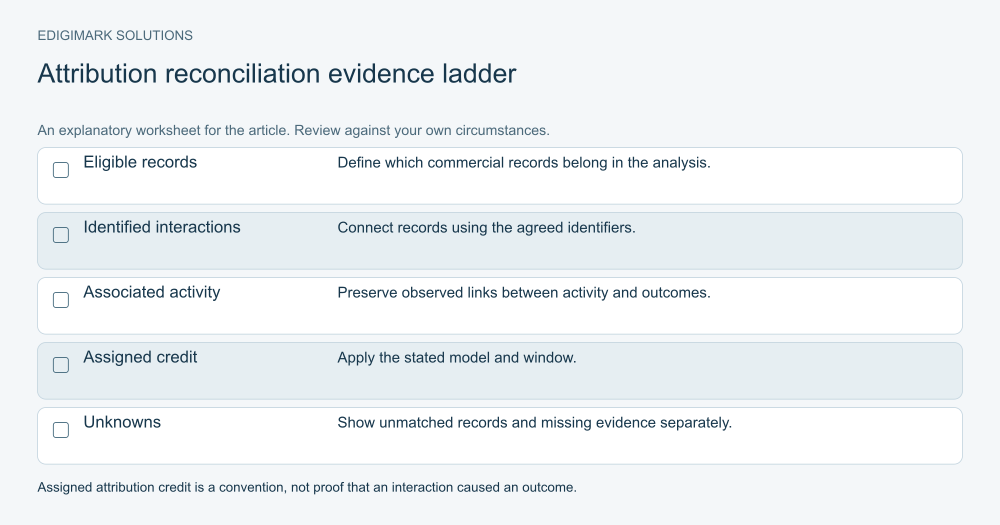
Write a reconciliation test. Start with a known authorized journey and trace its records through the systems. Confirm timestamps, associations, stage values and the resulting credit. Test duplicates, missing sources and adjusted outcomes as well.
Keep a model change log. A new attribution window or association rule can alter historical results. Recalculate comparatives where possible, or mark the periods as not directly comparable.
How do attribution limitations affect budget decisions?
Use attribution as one input alongside audience fit, delivery quality, commercial economics and experimental evidence. A channel with low credited revenue may support early education that later tracking misses. A channel with high credited revenue may capture demand created elsewhere.
Ask whether the budget decision requires an incremental claim. If the question is “what happens if we reduce this investment,” recorded association alone may be insufficient. An appropriately designed experiment or other causal analysis can be more relevant, subject to its own constraints.
Avoid judging small samples with excessive precision. A few deals can make campaign ratios volatile, especially when contract values differ widely. Show the underlying number of outcomes and relevant period alongside the headline ratio.
Edigimark’s digital marketing services can connect channel planning with these measurement limits. A practical plan defines what each activity can teach and which stronger evidence is needed before expanding it.
What should a useful attribution dashboard show?
Lead with the commercial outcome and coverage. Show how many eligible records were joined, which remain unknown and which definition is used. Then present channel or campaign credit under the stated model.
Include stage progression, not only revenue. Enquiry quality, sales acceptance and evaluation delays help identify operating problems before a long buying cycle produces completed outcomes.
Show the model and window beside the result. Do not hide these assumptions in a separate technical file that the decision-maker never sees. A short note can prevent a precise chart from being interpreted as causal proof.
Use marketing automation services when shared lifecycle state and suppression are needed to maintain coherent follow-up. Reliable operations improve the underlying evidence before a more complex attribution model is attempted.
How do you improve attribution without overengineering?
Start with dependable conversion definitions, source preservation, CRM associations and finance reconciliation. A modest model built on reliable records is often more actionable than a sophisticated allocation built on uncertain joins.
Prioritize gaps that change decisions. If accepted leads cannot be linked to opportunities, fix that relationship. If campaign context disappears during form submission, preserve it. If the commercial revenue definition is inconsistent, agree it before calculating return.
Maintain a clear distinction between technical collection and the buyer experience. Better data should support relevant communication and useful decisions. It should not encourage excessive collection with no defined purpose.
Contact Edigimark to build an attribution plan with explicit commercial definitions, reliable data joins and honest limits on what the evidence can establish.
What does an attribution reconciliation review look like?
Preserve source record identifiers during reconciliation. If a commercial record connects to several interactions, inspect whether the analysis intentionally represents those relationships or accidentally duplicates the commercial amount. Retain unmatched records with a stated reason; forcing a match can make a complete-looking report less dependable.
Start with the eligible outcome population and trace how many records pass each join. Count outcomes with valid commercial identifiers, associated contacts or accounts, relevant marketing interactions and sufficient timestamps. Keep the unmatched records visible at every step.
How should a team investigate a mismatch?
Inspect a sample of original records before changing the model. A mismatch can come from a missing identifier, an incorrect company association, a time-zone difference, a duplicate event or a commercial adjustment. Each requires a specific repair.
Do not resolve a missing association by assigning the nearest recorded interaction automatically. That may make the totals reconcile while creating a false relationship. Use a documented rule and preserve uncertainty when the evidence is insufficient.
What should an analyst record during model comparison?
Keep the same eligible population and outcome definition when comparing credit conventions. State any differences in windows or supported interactions. Otherwise, a model comparison can actually be a comparison of different data sets.
Show changes in distribution and the interpretation they support. If an early educational channel receives more credit under a multi-touch convention, that reveals model sensitivity. It does not independently prove that the channel created additional revenue.
How does the review inform a campaign decision?
Combine the attributed view with fit, execution and commercial economics. A campaign with many unsuitable enquiries may need a clearer offer. A campaign with strong evaluations but missing CRM links may need a data repair before its commercial contribution is judged.
If the decision depends on an incremental effect, identify a stronger evidence method suited to the buying process. The attribution report can help define the question and eligible population, but it should not be promoted into a causal study without the required design.
How do you keep the framework maintainable?
Assign owners to conversion definitions, source preservation, CRM associations, outcome reconciliation and model changes. Version the metric dictionary and record effective dates. Review the framework when offers, sales stages or platform integrations change, because those changes can alter the meaning of the report even when the dashboard layout remains identical.
Frequently asked questions
Does attribution tell us what actually caused revenue?
It allocates credit under a model. That can support useful analysis, but it is not automatically proof of causation or incrementality. The method, recorded coverage and business question determine the strength of the conclusion.
Is multi-touch attribution always better than last-touch reporting?
No. It can provide another useful view, but complexity does not repair incomplete data. Use an explainable model suited to the question and inspect sensitivity across conventions when necessary.
Can the CRM replace web analytics?
The CRM provides commercial and relationship context; web analytics provides a different view of digital activity. Connect their definitions and identifiers where appropriate rather than assuming either observes the complete journey.
Should unknown sources be redistributed proportionally?
Only as an explicitly labeled analytical assumption, if appropriate to the decision. Keep the original unknown coverage visible and show how the assumption changes the result.
What should be implemented first?
Define the commercial outcomes, preserve request context, connect records reliably and reconcile the result. A more elaborate credit model can follow once the data foundation is dependable.
Put the ideas to work
Explore our connected growth services →