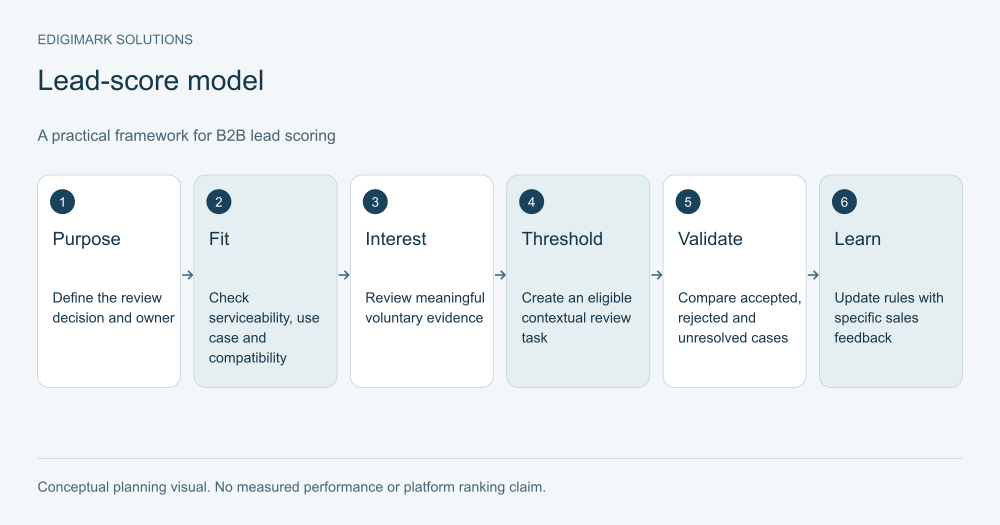
B2B lead scoring helps prioritise a useful sales review by organising evidence about account fit and meaningful interest. Define the decision the score supports, keep fit and intent distinguishable, and validate thresholds with sales feedback. A high score is a reason to inspect the evidence, rather than automatic proof that a person is ready to buy.
A model should make the team’s judgement easier to explain. If a salesperson sees only a number without the request, account context or supporting signals, scoring has added a label without adding much understanding.
This guide includes an original illustrative model and worked examples. The weights and thresholds are invented planning inputs, not benchmarks or a validated model for your business.
In this guide
- What decision should B2B lead scoring support?
- How should fit and intent scoring be separated?
- Which data should be trusted before scoring begins?
- What is an illustrative B2B fit score model?
- What is an illustrative interest score model?
- How should lead score thresholds trigger action?
- How do the worked scoring examples differ?
- How should repeated activity and score inflation be controlled?
- How should old intent signals be treated?
- How should account and contact scoring work together?
- What should lead scoring validation compare?
- How should sales feedback improve the B2B scoring model?
- How should the scoring model be launched safely and practically?
- What should the B2B lead scoring model card contain?
- What should the B2B scoring dashboard show beyond the total?
- How should a salesperson use the score in a conversation?
- Frequently asked questions
What decision should B2B lead scoring support?
Start with the action: prioritise review, select relevant nurture or identify an account needing clarification. The intended action determines which evidence matters and who must respond.
Do not begin by assigning points to every field and event the platform offers. A large model can become difficult to interpret while rewarding activity that has little commercial meaning.
Salesforce’s lead scoring training describes scoring as a way to assess interest and prioritise nurture. Apply that idea to a specific business decision rather than treat the score as an objective measurement of purchase certainty.
Marketing automation should connect the model with an accountable next action. A threshold that nobody monitors is not a sales handoff, regardless of how carefully the arithmetic is designed.
How should fit and intent scoring be separated?
Fit asks whether the account and need are suitable for the offer. Intent asks what meaningful evidence suggests that a relevant next conversation would be useful. Engagement can inform that assessment, but activity and intent are not identical.
Fit might include serviceable location, relevant use case and technical compatibility. A contact’s professional role can provide context when it affects the discussion, without assuming every relevant role has purchase authority.
Meaningful interest might include an explicit request, a substantive reply or a confirmed evaluation meeting. A single resource interaction is weaker evidence and should be treated accordingly.
Keep the two dimensions visible. A highly active unsuitable account and a quiet suitable account require different responses. A combined number can hide that distinction unless its components remain available.
Which data should be trusted before scoring begins?
Inspect the fields and events used in the model. Confirm their meaning, source, date and treatment of missing information. A “company size” property is unreliable if its values are inconsistent or copied from unverified assumptions.
Distinguish unknown from mismatch. Unknown compatibility should create a clarification need; confirmed incompatibility may require a different route. Treating both as zero without explanation can hide useful direct requests.
Verify event definitions. A scheduled meeting is not the same as a scheduling link click. A form submit event needs to represent the intended successful action rather than only an attempted button press.
CRM integration should preserve identity, relevant account relationships and sales feedback. Otherwise, one person may accumulate activity on a duplicate record while the receiving team sees an incomplete history.
What is an illustrative B2B fit score model?
Imagine a hypothetical business selling CRM implementation services. It wants to prioritise a review when the account fits the service and there is evidence of a useful discussion. This example is deliberately small and explainable.
The fit component has a maximum of 60 points:
| Fit evidence | Illustrative points | Required interpretation |
|---|---|---|
| Serviceable operating region confirmed | 20 | The business can provide the service there |
| Relevant implementation use case confirmed | 25 | The stated need matches the actual offer |
| Technical compatibility established | 15 | Known systems are within supported scope |
| Unknown value | 0 for that item | Record a clarification need, not a confirmed mismatch |
These weights are hypothetical. They are not recommendations that every CRM provider should use. The real model needs evidence from the business’s accepted and rejected work.
Professional role and company context remain visible to the reviewer without automatically adding more points. This keeps the example focused on delivery suitability and avoids confusing a title with verified authority or need.
What is an illustrative interest score model?
The same hypothetical business uses an interest component capped at 40 points. Its purpose is to surface meaningful context for review, with a limit on weaker repeated activity.
| Interest evidence | Illustrative points | Required interpretation |
|---|---|---|
| Substantive reply naming a relevant problem | 20 | A person has voluntarily clarified a need |
| Confirmed evaluation meeting | 15 | Verify the booking or accepted meeting state |
| Relevant requested resource | 5 | Topic interest; not proof of readiness |
| Repeated instance of the same scored item | No additional points in this example | Avoid unlimited accumulation |
The score sums the applicable evidence up to 40. A direct consultation request also has a separate human response route, even when the numerical model lacks enough data.
This model intentionally avoids email opens as proof of interest. Apple’s Mail Privacy Protection explanation describes background content retrieval regardless of engagement. More generally, a tracked interaction should be interpreted according to what it actually establishes.
How should lead score thresholds trigger action?
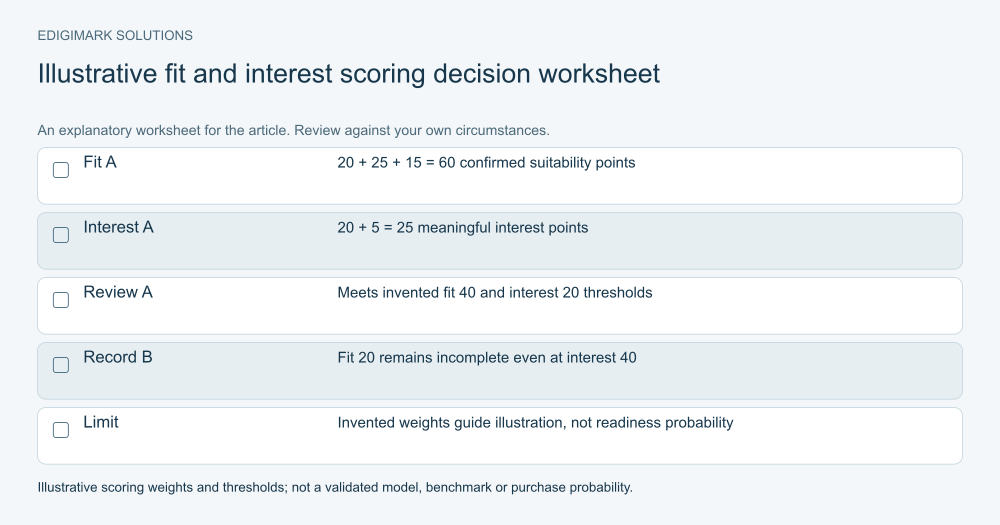
In this illustrative model, a record with fit of at least 40 and interest of at least 20 creates a sales review task, subject to eligibility and existing relationship checks. Those invented thresholds demonstrate logic, not a universal definition of sales readiness.
The task includes the component scores, supporting facts, original request and uncertainty. The receiving person decides whether a useful conversation or further clarification is appropriate.
A record with strong fit but limited interest may remain in relevant eligible nurture. A record with strong activity but unclear fit may need clarification. A confirmed mismatch should follow the agreed non-acquisition path rather than receive more sales pressure.
Do not mark every threshold-crossing record SQL automatically. Sales-ready leads should reflect the business’s agreed qualification and receiving-team judgement, with a clear definition of what has been confirmed.
How do the worked scoring examples differ?
Consider two invented records. Record A has a confirmed serviceable region, relevant use case and compatible systems. Its fit score is 20 + 25 + 15 = 60. It has a substantive reply and a requested resource, so interest is 20 + 5 = 25.
Record A meets both illustrative review thresholds. The action is a contextual review task, not an automatic sales-qualified label. The reviewer still needs to understand the need and appropriate next step.
Record B has only a confirmed serviceable region, so fit is 20. Its use case and compatibility remain unknown. Even if applicable interest evidence reaches the 40-point cap, it does not meet the fit threshold.
Record B needs clarification under this model. A direct request still receives an appropriate human response. The example shows why a single combined total can be misleading: activity cannot supply missing suitability evidence.
How should repeated activity and score inflation be controlled?
Decide whether an event should score once, have a capped contribution or apply only within a relevant time window. The appropriate choice depends on what the event means for the business decision.
Repeatedly opening the same resource is not the same as stating a new requirement. A model that adds unlimited points for weak repeated actions can prioritise the most observable activity rather than the most useful lead.
HubSpot’s lead scoring documentation includes group limits, event limits and decay options, with availability depending on the model and subscription. Verify the actual platform capability before designing the implementation.
Test repeated and delayed events. Confirm that the score and review task behave as intended when a record receives another update. A stable model should not create an unlimited series of duplicate tasks for the same unresolved relationship.
How should old intent signals be treated?
Decide how long a signal remains useful for the intended decision. A request about a postponed project may be less informative months later, while confirmed technical compatibility can remain relevant until the systems change.
Keep freshness distinct from fit. If old engagement expires, the account may still be suitable. If the business changes its supported scope, fit needs a separate review.
Use a time window or decay approach only when the team can explain it and the platform supports it. Any numerical period is a business hypothesis to validate, rather than a universal lead-scoring rule.
Preserve the history needed for a useful conversation. Reducing an activity score should not erase the original request or the reason a project was postponed. The human owner needs context, not just the current total.
How should account and contact scoring work together?
Decide whether the task concerns one person’s request or an account’s broader evaluation. Several contacts can represent different roles and questions within the same account.
Avoid simply summing every contact’s activity into an unexplained account score. A larger account can produce more events because it has more people, without necessarily having a clearer shared purchase intention.
Show the underlying evidence and relationship owner. A technical evaluator’s requirement and a commercial stakeholder’s question can both matter, but they should remain distinguishable.
Test association accuracy. An incorrect company link can make useful contact activity appear to support the wrong account. The scoring owner and CRM integration owner need an agreed process for correcting that relationship.
What should lead scoring validation compare?
Review the model against known accepted conversations, rejected handoffs and unresolved cases. Define the outcome being tested and make sure the records had enough time to reach it.
Look for high-score records that did not support a useful review and low-score records that did. Inspect the reasons rather than assume the threshold is the only problem.
Separate a lead mismatch from a process failure. A suitable request that sales never received should not be treated as evidence that the fit rule is poor. A missing reply record may make engagement appear lower than it was.
Data analytics can help create comparable cohorts and preserve the definitions. Be cautious with incomplete outcomes: lack of recorded progression is not always proof of lack of interest.
How should sales feedback improve the B2B scoring model?
Ask sales for a specific disposition and the next action. Useful reasons include confirmed fit mismatch, timing, unclear need, existing relationship and missing context. Define the options so the team uses them consistently.
Review a sample of cases with marketing. If high interest repeatedly reflects research rather than an active project, reconsider the signals. If suitable direct enquiries lack profile data, improve the review route rather than add arbitrary points.
Change one meaningful rule at a time when practical. Record the reason, expected effect and effective date. Compare the next eligible cohort with appropriate limits rather than claim improvement from a handful of examples.
Keep the purpose stable. The model should help choose a useful action. It should not be adjusted solely to generate a desired MQL total or make a dashboard look healthier.
How should the scoring model be launched safely and practically?
Run it in a review mode before allowing it to create consequential actions at scale. Inspect representative records and compare its proposed decisions with the receiving team’s judgement.
Test unknown values, direct requests, duplicates, current customers, existing opportunities and repeat-trigger behaviour. Confirm that the intended exceptions remain accessible and appropriately handled.
Ensure receiving capacity exists. A new rule can surface many historical records at once. Plan whether to review that group separately from newly captured requests so the team understands the source of the volume.
Assign model ownership, feedback ownership and an integration contact. The launch includes the process for investigating unexpected results, not only enabling the score property.
What should the B2B lead scoring model card contain?
Keep a short model card with the purpose, eligible records, fit rules, interest rules, exclusions, freshness treatment, thresholds and actions. Include the source of each important input.
Label illustrative starting weights and note which have been validated. Record unresolved data limitations and cases that require human review.
Add an effective date and change history. A threshold revision can alter reported qualification counts without a change in demand. The history helps analysts and sales interpret those changes.
The supporting graphic should show fit, interest, uncertainty, action and feedback as separate elements. It should not depict an invented score as a probability of purchase or a percentage of sales readiness.
What should the B2B scoring dashboard show beyond the total?
Show component scores, meaningful evidence, unknown fields, review ownership and disposition. A list sorted only by total can hide why the record is prioritised and what must happen next.
Report review quality and operational reliability alongside volume. Unaccepted tasks, missing context and duplicate alerts can undermine a model that looks promising numerically.
Inspect changes by audience and source where the data supports that view. A new campaign may produce different kinds of interest, and the model’s earlier assumptions may need review.
Ask Edigimark to connect lead scoring with sales qualification if your team has a score but cannot explain the evidence or action behind it. A useful model turns information into a reviewable next step.
How should a salesperson use the score in a conversation?
Use it to prepare relevant questions, not to tell the person that software has classified their intentions. Review the original request and confirmed facts before deciding how to respond.
If a field is unknown, ask for useful clarification in context. If the model is wrong, record the correction and disposition so the owner can investigate. The conversation should remain grounded in the person’s stated needs, while the score remains an internal prioritisation aid. That separation helps preserve both a useful experience and honest feedback about the model.
Frequently asked questions
What is a good B2B lead score threshold?
There is no universal threshold. Set it for a defined action using your fit criteria, meaningful signals and receiving capacity, then validate it against actual reviews and outcomes.
Should fit and intent be combined into one number?
They can be combined for convenience, but preserve the components. Strong activity should not hide weak or unknown fit, and a suitable direct request should remain visible without a long event history.
Can an email open establish buying intent?
No. Open tracking has limitations and does not confirm comprehension or purchase readiness. Use it cautiously and prioritise more meaningful evidence such as a relevant explicit request.
What happens when important fit information is missing?
Keep the uncertainty visible and provide an appropriate clarification or human review route. Do not silently treat unknown information as a confirmed mismatch or an invented fit.
How often should a scoring model be reviewed?
Review it on a schedule appropriate to the process and after changes in offer, audience, data or qualification definitions. Sales feedback and unexpected cases should trigger focused investigation sooner.