B2B lead generation without buying lists starts with relevant reasons for people to discover your business or welcome a conversation. Build useful search resources, credible partner relationships, specific paid offers and appropriately researched outreach. Preserve the source and context of every enquiry so follow-up reflects the exchange instead of treating an address as proof of interest.
Buying a database can make a contact count rise quickly, but it does not establish need, readiness or a relationship. The more useful question is how to reach businesses you can serve and give them a clear reason to evaluate your offer.
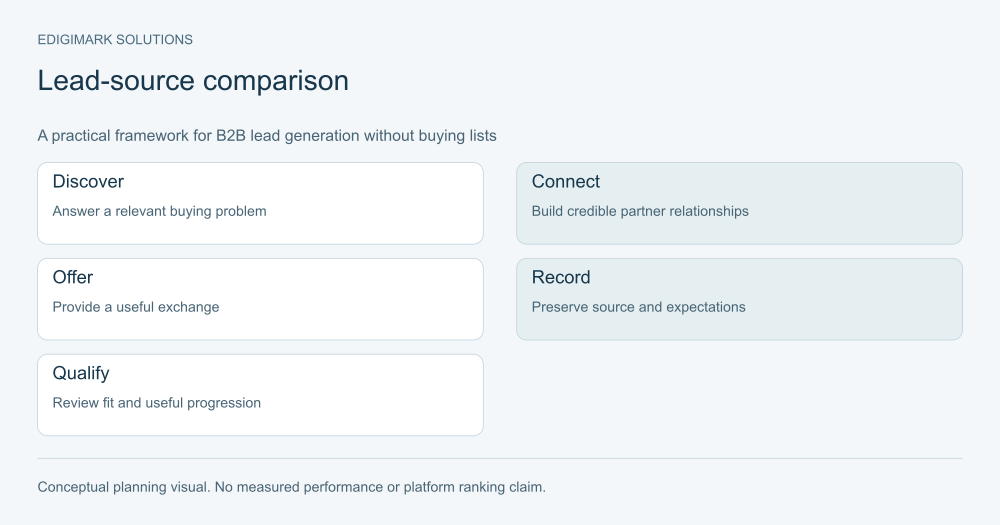
An editorial planning diagram; stages and examples are illustrative.
Why can a purchased list create a lead-quality problem?
A contact record is not automatically a lead. It may be outdated, associated with the wrong role or unrelated to a current buying need. Even accurate details say little about whether the person wants the proposed message or whether your business can solve their problem.
List-based volume can also distract the team from the offer. If a campaign fails, it becomes difficult to distinguish poor targeting, weak relevance, delivery problems and an unsuitable commercial proposition. The database provides reach without necessarily providing useful context.
This guide is an operating approach, not a legal assessment of a particular contact source. Your team should review the communication rules, permissions and platform requirements applicable to the actual audience and channel before outreach. Avoid assuming that “B2B” removes those responsibilities.
Which first-party lead sources should you build first?
Start with interactions your business can explain: explicit enquiries, event registrations, suitable product evaluations, partner introductions and subscribers who chose the relevant exchange. Keep the original action and preference context available.
A first-party record still needs qualification. A person downloading a general worksheet may want education rather than a sales call. Someone describing a supported implementation problem may be ready for a scoped discussion. Treat these as different situations.
Create an inventory of existing entry points. Check every contact form, webinar page, newsletter invitation, trial and partner referral route. Identify what each promises, who handles it and how its source is recorded. Some businesses already have useful lead sources but lose context during the handoff.
Edigimark’s CRM integration services can preserve those relationships. The goal is traceable request context and reliable ownership, rather than simply moving more addresses into a campaign tool.
How can organic B2B leads come from useful content?
Answer the questions that arise before a suitable purchase. Explain the problem, relevant approaches, product or service fit, implementation requirements and common trade-offs. Useful commercial content helps a buyer make a decision, including the decision that your offer is unsuitable.
A hypothetical integration provider could publish a guide to diagnosing synchronization conflicts, a supported-platform page and an assessment overview. The diagnostic supports research. The compatibility information helps fit evaluation. The assessment page provides a relevant route to action.
Avoid creating many slightly different pages for the same decision. Consolidate related wording into a substantive resource. Google describes people-first content as content built primarily to benefit users; apply that principle by making each page answer a distinct, useful task.
Include clear contextual links to the next resource or offer. A reader should not have to return to the homepage to discover what happens after learning about the problem. Content can remain helpful while providing an honest commercial path.
How do B2B partnerships create relevant introductions?
Work with organizations whose audience faces a complementary problem. A software implementation partner and a specialist training business may serve related buyers at different moments. The partnership becomes useful when each understands where the other’s offer fits.
Begin with a shared resource or discussion that helps the audience. Explain responsibilities, referral criteria, contact handling and any commercial relationship. Do not assume a partner’s entire database is available for unrelated outreach.
Salesforce’s referral-partner overview describes introductions as a partner contribution to the sales process. For your own program, write the criteria for a useful introduction and the feedback the partner receives; do not import a vendor’s claimed acquisition advantages as a guaranteed outcome.
Preserve referral provenance. Record the partner, introduction date, stated need and receiving owner. Check whether the prospect has agreed to the introduction. A forwarded spreadsheet with no context is materially different from a relevant, expected conversation.
What can paid acquisition do without a purchased list?
Paid search can reach people explicitly investigating a problem or solution. Audience-based distribution can introduce a relevant educational or assessment offer through the platform’s supported targeting. Both require a clear destination and commercial hypothesis.
Define the audience, problem, offer and meaningful outcome before spending. A broad “free audit” may attract unsuitable requests if the scope and fit are unclear. A specific assessment of a supported workflow gives the visitor more information about whether the exchange applies.
Keep the advertisement, landing page and response consistent. If the page promises an expert review, the first follow-up should explain how that review works rather than simply adding the person to a general promotional sequence.
Use conversion rate optimization services to assess submission quality, page clarity and handoff reliability. A cheaper form completion is useful only when the resulting request has a meaningful role in your funnel.
How should permission-based B2B prospecting work?
Begin with a relevant business reason, appropriate contact context and the requirements governing the channel. Research can identify a possible fit; it cannot establish private purchase intent. Phrase uncertain relevance as an invitation to assess fit rather than a claim that you know the company’s problem.
Keep messages specific and truthful. Explain the observed context, useful resource or reason for the conversation. Do not invent familiarity, misrepresent a referral or suggest a prior discussion that did not occur.
Where email is used, verify your provider’s rules and delivery requirements. Google’s Gmail sender guidelines describe authentication and unsubscribe requirements for applicable traffic. Technical compliance supports delivery, but it does not by itself establish that a recipient wants an outreach campaign.
Record declines and preferences so they govern subsequent actions. A prospect who indicates the offer is irrelevant should not remain in overlapping sequences. Scale a useful and permitted process only after verifying its quality, rather than scaling first and attempting to repair complaints afterwards.
How do professional participation and expertise support discovery?
Participate where relevant problems are actually discussed. Answer questions within your expertise, contribute practical explanations and make your affiliation clear. A thoughtful response can help people understand your approach without forcing a promotional link into every interaction.
Use the same evidence standard as your website. Explain what you know, what depends on the situation and which assumptions need checking. Avoid presenting an illustrative example as a client outcome.
Turn recurring questions into public resources. If several people ask about migration preparation, a useful checklist can serve the broader audience and support later sales discussions. The resource should add original organization or explanation rather than reproduce community conversations without permission.
Edigimark’s digital marketing services can help coordinate expertise, content and distribution around a defined audience. Professional participation still needs a useful contribution and appropriate respect for the forum’s rules.
How do events generate useful B2B contacts?
Choose an event topic around a decision the audience struggles with. A practical workshop on evaluating integration requirements may attract a different group from a general presentation about digital transformation. Specificity helps attendees decide whether participation is worthwhile.
Explain the registration exchange and subsequent communication. Deliver the promised resource or session, and provide an appropriate optional next step. Attendance does not automatically mean the participant wants a commercial call.
Use questions and feedback to improve the next resource. Distinguish attendees, relevant account participants and people requesting follow-up. These groups have different meanings in the report and should not be collapsed into a single qualified-lead count.
If an event involves a partner, agree on record ownership and follow-up responsibilities before registration begins. Ambiguous sharing can create duplicate contact and conflicting messages.
What should the website do with the interest these sources create?
Provide accurate service or product information, visible scope, useful fit criteria and a clear enquiry route. A visitor arriving from a partner or professional answer should be able to understand the offer without relying on the original introduction.
Keep the form usable and the confirmation clear. State what happens next and ensure a named owner receives the request. Check the mobile experience, required fields and accessibility of labels and errors.
Web development services can support these foundations when outdated pages or unreliable forms prevent useful discovery from becoming a conversation.
Remember that different sources may arrive with different context. A partner referral may already understand the category. A search visitor may need a problem explanation. Make both resources available rather than forcing every person through the same linear sequence.
How do you compare lead-source quality?
Compare fit, acceptance, opportunity progression, cost and operating effort over an appropriate period. Preserve cohort definitions and source coverage. Raw contact volume cannot answer whether a channel attracts businesses you can serve.
Partner introductions may require substantial relationship work. Organic resources require production and maintenance. Paid offers require media, destination and follow-up work. Include these costs when comparing sources instead of treating anything without an ad invoice as free.
Inspect rejected and stalled requests. Did the offer attract an unsupported need? Was the prospect still researching? Did a useful request go unanswered? Those findings reveal what to improve before increasing reach.
Data analytics services can connect source records to commercial stages. Attribution remains incomplete; a referral may have been influenced by earlier public resources. Keep recorded source and broader reported discovery context distinct.
What does a manageable first-party lead plan look like?
Choose one target segment, one recurring buying problem and two complementary sources. For a hypothetical integration business, these might be a public diagnostic resource and a relevant partner workshop. Both lead to an accurately scoped assessment page.
Define qualification, follow-up and suppression before launch. The team records the original request and source, reviews fit and responds with the promised next step. Unsuitable enquiries receive an appropriate explanation rather than being endlessly nurtured.
Set a review date aligned with your sales process. Inspect execution first, then audience quality and progression. If the form failed, repair it before interpreting the campaign. If the offer attracted incompatible needs, revise the promise. If suitable people engaged but did not act, review the evaluation information and next step.
Which operating safeguards keep this plan useful over time?
Assign an owner to each source and its destination. Partners need a relationship owner; content needs an accuracy owner; campaigns need a delivery owner; enquiries need a response owner. The report should show these responsibilities alongside activity.
Maintain provenance when records are imported or synchronized. A source label such as “other” should not erase the difference between an explicit assessment request and an event registration. That context determines appropriate follow-up.
Review inactive paths and outdated offers. A legacy event page can continue collecting information long after the session ended. A retired resource can promise follow-up nobody handles. Keep the active entry-point inventory small enough to inspect regularly.
Finally, measure the quality of the exchange. Did the reader receive the useful explanation, event or assessment they expected? A lead-source plan succeeds when it creates a relevant relationship and a dependable next action, not merely a larger table of contact details.
Contact Edigimark to design lead sources around your audience, offer and actual follow-up capacity.
What should a lead-source provenance worksheet record?
Record the original exchange, acquisition route, timestamp, stated need, preference context and receiving owner. For a partner introduction, keep the partner and expected purpose visible. For an event registration, keep the event and follow-up promise visible. For a commercial assessment, keep the buyer’s request available in its original form.
Do not flatten these records into an indistinguishable campaign list. The context determines what a useful next message looks like. A person who requested a resource should receive that resource; a person who requested a scoped conversation should reach the responsible reviewer.
How can you test a source before expanding it?
Use a limited, clearly defined audience and offer. Verify the destination, response owner and reporting path first. Then inspect whether the requests are relevant, whether the promised exchange was delivered and which questions delayed progression.
For a hypothetical partner workshop, review the registered audience, questions asked, optional follow-up requests and accepted evaluations. Do not count every attendee as a commercial opportunity. For a search resource, review the buying questions it attracts and the quality of subsequent requests, alongside traffic.
What if a source produces fewer contacts than the old database campaign?
Compare the intended commercial job and operating effort. Fewer suitable enquiries can be more useful than many records requiring substantial rejection work. That is a hypothesis to assess through acceptance and progression, not an automatic claim that one source is better.
Include production and relationship costs. First-party acquisition is not free simply because no list was purchased. Useful content, partnership maintenance and response handling consume time that belongs in the review.
How do you maintain the source inventory?
Give every active entry point an owner, review date and stated exchange. Remove outdated event forms, broken resource links and obsolete offers. Confirm that preference changes govern subsequent workflows rather than being stored in only one application.
Inspect a small sample of complete journeys regularly. Trace discovery, request, response and commercial result. This reveals missing provenance and mismatched follow-up that summary reports can conceal. The aim is a maintainable relationship system in which every record has a reason to exist and every promised next step has an owner.
Frequently asked questions
Can B2B lead generation work without a large database?
Yes. Useful search content, relevant partnerships, professional participation and specific offers can create enquiries. Start with a buying problem and traceable sources rather than a database-size target.
Are first-party leads always qualified?
No. First-party describes the relationship or source, not commercial fit. The original action, suitability and readiness still need to be assessed.
Is a partner introduction the same as permission for ongoing marketing?
Do not assume that. Understand the scope of the introduction, the person’s expectations and the requirements governing later communication. Preserve preferences and use appropriate follow-up for the actual exchange.
Should cold outreach be automated immediately?
First verify relevance, permissions, provider rules, message quality and response handling. Automation scales the process you specify; it does not make an irrelevant or unsuitable process useful.
What should replace a purchased-list volume target?
Use targets tied to relevant conversations, sales acceptance, qualified evaluation and commercial progression. Include the effort required and source quality so the team can choose where to invest next.
Put the ideas to work
Explore our connected growth services →