A B2B lead generation funnel connects relevant acquisition with an appropriate offer, qualification, sales acceptance and a commercial next step. Design it around what a buyer is trying to decide and the evidence your team needs to help. A reliable funnel makes the handoffs visible instead of treating every form submission as a sales-ready opportunity.
Start with the intended customer and a clear buying problem. Then decide which action is useful at each level of readiness. A diagnostic, event registration and consultation request can all generate contacts, but they represent different expectations and should follow different paths.
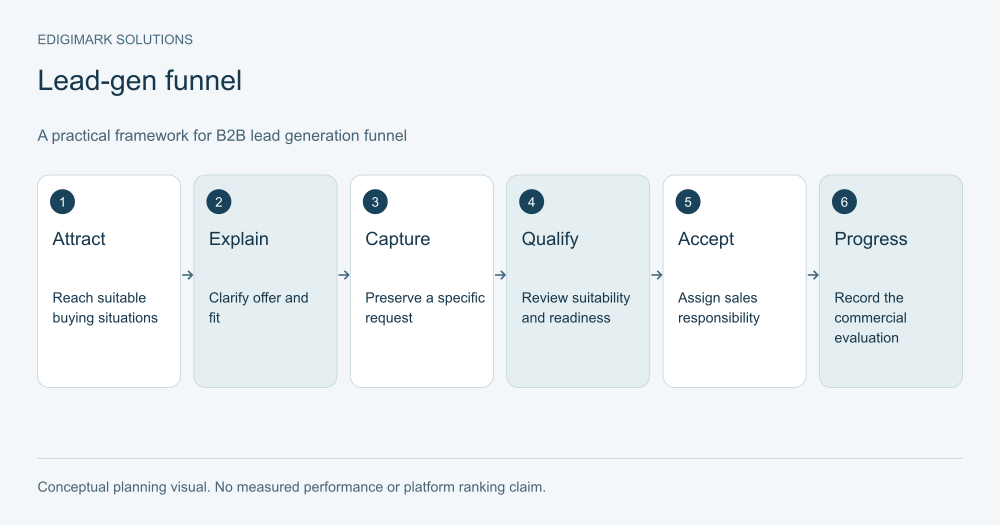
An editorial planning diagram; stages and examples are illustrative.
What should the B2B lead generation funnel start with?
Write the fit criteria and buying situation before selecting channels. Include the company circumstances, supported requirements, trigger and problem owner. State exclusions that keep the offer honest.
A hypothetical CRM integration service might fit companies using supported systems with an identified synchronization issue. An assessment enquiry from that audience is different from a general student question about CRM concepts. Both deserve an appropriate response; only one may fit the commercial funnel.
Map the actual buying responsibilities. The first person researching may need to involve operations, IT and a commercial approver. Your resource and offer should help that person move the decision forward without assuming they can authorize a purchase alone.
Edigimark’s digital marketing services can help connect this audience definition with channel and offer choices. The useful starting deliverable is a shared description of a qualified buying situation.
Which B2B acquisition stages are worth defining?
Use stages that represent an observable change in the relationship or decision. Awareness can describe anonymous discovery. An enquiry describes a recorded request. Qualification describes fit and readiness evidence. Sales acceptance describes ownership. Opportunity describes a commercial evaluation under your agreed definition.
| Stage | Observable evidence | Next responsibility |
|---|---|---|
| Discovery | Relevant interaction with content or campaign | Provide an understandable path |
| Evaluation action | Visitor checks fit, scope or implementation | Answer the buying question |
| Enquiry | Person requests a specific exchange | Preserve the request and acknowledge it |
| Qualification | Agreed fit and readiness evidence | Route or review appropriately |
| Sales acceptance | Named owner accepts follow-up | Respond with relevant context |
| Opportunity | Confirmed commercial evaluation | Maintain stage and stakeholder information |
Adapt these definitions to your business. Do not add stages simply because the platform supports them. A stage needs a purpose, owner, entry criterion and next action.
How do you choose an offer that attracts the right enquiry?
Offer something that helps the buyer’s current task. A early researcher may value an explanatory resource. An active evaluator may need a technical walkthrough or a scoped assessment. A person comparing agencies may need to understand process, responsibility and deliverables.
Make the exchange explicit. Describe what the person receives, which information is needed, what happens next and any relevant prerequisites. Avoid promising a personalized audit when the follow-up is only a generic sales pitch.
Check whether the offer reflects what your team can deliver. A detailed technical assessment needs qualified capacity. A trial needs a product experience that supports the intended use case. An attractive promise becomes a funnel problem when delivery is inconsistent.
Use real questions from relevant conversations to refine the offer. If prospects repeatedly ask whether a supported integration is possible, an integration assessment may be more useful than another general marketing ebook.
How should the landing page support qualification?
The page should explain the problem, suitable audience, scope, process, limitations and next step. Put essential fit information before the form so the visitor can decide whether the offer applies.
Use evidence you can verify. Explain methodology, provide accurate capabilities and label illustrative examples. Do not invent client outcomes or imply that a generic screenshot proves a result.
The form should ask for information needed to respond. A contact method, the relevant problem and a few meaningful fit fields may be enough for the initial request. Additional information can be gathered during a useful conversation when justified.
Conversion rate optimization services can assess the balance between friction and qualification. A higher submission rate is helpful only if the resulting requests remain useful and the team can handle them.
What does a workable lead qualification funnel require?
Separate fit, intention and activity. Fit describes whether the business can serve the prospect. Intention describes the requested exchange or current buying situation. Activity provides context but does not prove authority or commercial readiness.
Salesforce’s lead qualification overview distinguishes marketing-qualified and sales-qualified prospects through suitability and readiness. Use those ideas to create your own explicit criteria rather than inheriting an unexplained label.
Define a review path for uncertainty. An incomplete but relevant request may deserve clarification. An unsupported requirement may need a helpful explanation or referral. A duplicate enquiry needs consolidation. A support request should move to the appropriate service route.
Avoid a single score that hides why someone qualified. A salesperson needs the evidence: requested assessment, supported system, known problem and implementation owner where available. A number without context can encourage inappropriate follow-up.
What makes sales acceptance a meaningful stage?
Acceptance means a named person or team acknowledges responsibility for the next commercial action. It should have an expected response window and a feedback rule. Sending an email alert does not prove acceptance.
Provide the original request, qualification evidence and relevant resources. The receiving person should be able to respond to the buyer’s situation without reconstructing it from several systems.
Use specific rejection reasons. Unsupported requirements, duplicate opportunity, no current project and incorrect audience fit each imply a different path. “Low quality” alone cannot tell marketing which offer or campaign needs improvement.
Create a queue for unassigned or overdue requests. Assign a responsible owner to review that queue. Otherwise, useful enquiries may remain untouched while the acquisition report continues to count them as success.
CRM integration services can make these states and records available across teams. Agree on field ownership and stage authority so automated updates do not erase an active sales decision.
How does nurturing support prospects who are not ready?
Use relevant education and respect the stated exchange and communication preferences. A known prospect with a suitable problem but no current project may benefit from periodic decision resources. Someone actively evaluating needs different content and timing.
Map each sequence to a task: understand the problem, compare approaches, prepare implementation or reach a product milestone. Specify enrollment, exit and suppression rules. An active sales conversation should override unrelated acquisition sequences.
Do not assume repeated opens or visits always indicate buying readiness. Automated scanners and incidental research can distort activity. Use behavior as context and seek stronger evidence before applying a commercial label.
Marketing automation services can support these paths with consistent lifecycle state. The implementation should include quiet states and exception handling, not only messages designed to keep sending.
Which metrics diagnose the funnel?
Track conversion and elapsed time between defined stages. Report valid enquiries, qualification decisions, sales acceptance, opportunity creation and outcomes. Use cohorts so the numerator and denominator refer to related groups.
Inspect rejection and stall reasons. Many unsupported requests suggest a fit or offer problem. Slow acceptance suggests a handoff or capacity problem. Qualified conversations that fail to progress may reveal scope, implementation or commercial concerns.
Keep source coverage visible. Some buyers return through referrals or direct visits after earlier research. The recorded source may not describe every influence. Use appropriate buyer-reported information as additional evidence without rewriting it to fit a preferred attribution model.
Data analytics services can connect stage records with campaign information. Define whether metrics count contacts, accounts or opportunities and distinguish pipeline from actual revenue.
How do you test the funnel before increasing acquisition?
Create authorized test scenarios for a new suitable enquiry, existing contact, duplicate submission, unsupported request, incomplete record, preference change and sales rejection. Write the expected owner, state and message for each.
Test the full path rather than the form alone. Verify that the request reaches the CRM, context remains readable, routing succeeds, the acknowledgement is accurate and the record appears correctly in reporting. Test a failure and retry to confirm it does not create duplicates.
Check the mobile experience and accessible form labels. A buyer should understand what information is required and whether submission succeeded. Ambiguous confirmation can encourage repeat submissions or leave a person uncertain about follow-up.
Web development services can address reliable forms, confirmation experiences and conversion-page structure when those are the limiting factors.
What would a specific funnel worksheet look like?
For a hypothetical integration assessment, the audience uses a supported CRM and a second system with a known workflow issue. The landing page explains assessment scope and implementation prerequisites. The form records the systems, problem and contact method.
A suitable request goes to a technical-commercial reviewer. An ambiguous request goes to a triage queue. A confirmed support request routes to support. The acknowledgement states that a reviewer will inspect the details and does not promise a solution before the review.
When sales accepts the enquiry, the CRM records an owner and next action. If a commercial evaluation begins, an opportunity is associated with the original request. If the prospect is unsuitable, the specific reason is recorded and informs the page or targeting review.
The worksheet includes the expected response window, escalation route, suppression rules and commercial reporting definition. These details make the funnel operational rather than leaving it as a diagram of increasingly narrow shapes.
How should you improve a funnel with many leads but few opportunities?
Sample the actual records. Compare what the page promised, what the person requested, why they qualified, whether sales accepted them and what prevented progression. The answer may differ by campaign or audience.
If the audience is unsuitable, revise targeting and fit language. If the exchange is unclear, revise the offer and page. If the handoff is slow, repair routing and capacity. If a technical question stalls suitable evaluations, build a decision resource and involve the right expertise.
Avoid changing several parts simultaneously when you need to learn which one matters. Make a clear hypothesis, record the change and inspect the next relevant cohort. Maintain enough historical context to distinguish a genuine improvement from a redefinition of the stage.
The most useful next step is usually the smallest change that repairs a meaningful buying transition. Contact Edigimark to examine your acquisition-to-sales path and define the first handoff to improve.
What should the funnel’s operating agreement specify?
Write the conversion definition in the buyer’s terms. “Requested an implementation assessment” is more useful than “converted.” Record the promised exchange and the information required to deliver it. The team receiving the request should approve that promise before the campaign launches.
Specify the stage owner and expected next action. Marketing may own the initial record and acknowledgement, a triage reviewer may resolve uncertainty, and sales may own accepted commercial follow-up. Include the fallback owner when a person is unavailable or a routing rule has no match.
How do you handle requests that are incomplete?
Preserve the original information and ask a relevant clarifying question. Do not invent company details or treat missing fields as proof of poor fit. An incomplete request can still reflect a meaningful buying problem, especially when the form asks for information the visitor does not yet know.
Use a review state with an owner and deadline. The state should not become a permanent holding area. At review, the owner can qualify the enquiry, request clarification, route it elsewhere or record why the business cannot serve it.
How do you handle repeated requests from one account?
Check whether they describe the same evaluation, a new stakeholder joining it or a genuinely separate project. Keep the associated contacts visible while avoiding duplicate opportunity creation. A company can have several legitimate initiatives, so consolidation should also preserve distinct requests when the evidence supports them.
Document the rule rather than relying on individual judgement that varies by campaign. CRM associations, timestamps and the original request help the team decide consistently.
What should the sales feedback loop return to marketing?
Return an acceptance decision, useful reason and next commercial state. Include the actual objection when appropriate. A repeated concern about implementation effort may justify clearer scope content. A repeated unsupported requirement may justify revised targeting. A lack of response from a prospect may require investigating expectations rather than labeling the entire source poor quality.
Inspect a shared sample at a regular review. Marketing and sales should look at the same original requests and stage history. This prevents the discussion from becoming a disagreement between aggregate dashboard numbers and anecdotal impressions.
How do you keep the funnel maintainable?
Assign owners to forms, routing, sequences, CRM fields and reports. Keep a small change log that records the effective date and intended improvement. When a new offer is added, require its qualification, follow-up and reporting rules to be specified before launch.
Retire obsolete paths. An outdated form can continue creating records long after the offer has changed. A dormant sequence can restart under an unexpected enrollment rule. A maintainable funnel includes an inventory of active entry points and workflows, not only a diagram of the intended process.
Frequently asked questions
Should every B2B lead funnel have an MQL stage?
No. Use stages that support a real decision and responsibility. If your business can route clearly qualified enquiries directly to sales, an additional label may add little value. Definitions should fit the operating process.
How many fields should a lead form have?
Ask for what is necessary to deliver the promised response and assess immediate fit. There is no universal count. Review completion, request quality and follow-up burden together.
Can a B2B lead generation funnel work without paid advertising?
Yes. Organic search, partners, referrals, relevant professional participation and existing relationships can supply acquisition. Each source still needs an accurate offer and reliable handoff.
What if sales rejects most marketing leads?
Agree on criteria and inspect a shared sample of original requests. Determine whether the issue is fit, readiness, unclear expectations or response capacity. Specific rejection reasons provide better guidance than a general disagreement about quality.
Is funnel conversion rate enough to judge success?
No. Include audience fit, elapsed time, opportunity quality, operating cost and commercial outcomes. A higher rate achieved by weakening qualification may produce worse business results.
Put the ideas to work
Explore our connected growth services →