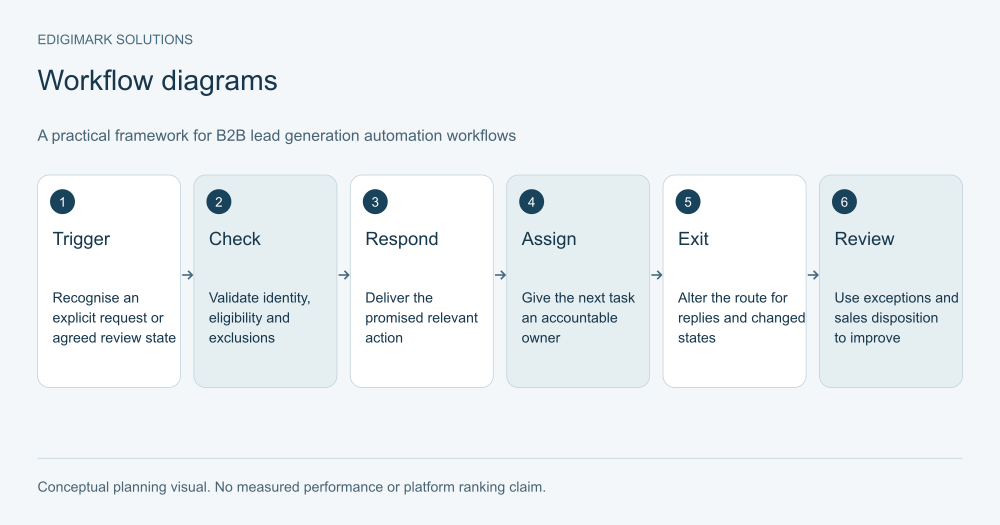
B2B lead generation automation workflows should connect an explicit customer action with a relevant response, reliable record and accountable next step. Useful starting points include demo request routing, resource delivery, qualification review and nurture that stops when a human conversation begins. Build eligibility, suppression and exception handling into every recipe before adding more messages.
The workflows below are implementation patterns, not vendor-specific instructions or performance guarantees. Adapt their triggers and timing to your process, communication preferences and available tools. Each includes a business purpose, actions, exits and an owner so the diagram can become an operable process.
In this guide
- What information should every B2B workflow specification contain?
- Workflow 1: How should demo request routing work?
- Workflow 2: How should a requested resource lead into relevant nurture?
- Workflow 3: What is appropriate consent-based form follow-up?
- Workflow 4: How should a lead scoring workflow create a review task?
- Workflow 5: How should nurture automation pause for human activity?
- Workflow 6: How should unresolved enquiry follow-up be handled?
- How should B2B lead generation automation workflows be prioritised?
- Which suppression rules should be tested across all workflows?
- How should B2B automation workflows be tested before launch?
- What should a B2B automation workflow dashboard report?
- What should happen when a workflow action fails?
- Frequently asked questions
What information should every B2B workflow specification contain?
Write the trigger precisely. A completed demo request, requested resource and internal qualification decision are different events. Name the record and context needed to recognise the intended event.
Define eligibility and suppression before actions. Consider relationship status, communication preferences, active sales activity, duplicate requests and missing information. A record can satisfy the trigger while remaining unsuitable for a particular message.
Assign an owner for the workflow and an owner for the resulting business task. The automation administrator may maintain the rule, while a sales coordinator resolves the enquiry. Make both responsibilities visible.
HubSpot’s workflow documentation illustrates the building blocks of enrolment, actions and exit configuration. Platform behaviour and subscriptions differ, so verify the actual tools rather than assuming a conceptual recipe can be copied unchanged.
Workflow 1: How should demo request routing work?
Purpose: ensure an explicit demo request reaches the appropriate person with enough context to respond. The trigger is a successfully submitted request, not a click on the demo button.
Validate essential fields and match the existing relationship. Capture the request, relevant product or service, company context and any stated requirements. Preserve uncertainty rather than invent a segment when the information is missing.
Send an accurate acknowledgement through the appropriate route. It should confirm receipt and describe a next step the team can fulfil. Avoid implying that a human has already reviewed the request.
Assign the established account owner where appropriate; otherwise use the agreed routing criteria. Create a receiving task with the request and relevant context. Missing routing data goes to a named coordinator, rather than an unmonitored “unknown” branch.
Define acceptance and escalation. If the assigned person is unavailable or the request remains unresolved beyond the business’s agreed expectation, expose the exception to someone who can act. The expected timing should reflect the promise and actual operating coverage.
Suppress competing introductory nurture when a human conversation begins. Test repeated requests from the same person and make sure the process preserves the relationship without creating conflicting owners. Measure received requests, accepted ownership, unresolved cases and useful conversations separately.
Workflow 2: How should a requested resource lead into relevant nurture?
Purpose: deliver the promised resource and offer appropriate help with the subject. The trigger is a completed resource request from an eligible contact.
Provide the correct asset promptly through the promised channel or confirmation page. Verify that its link works and that the content reflects the current offer. The initial fulfilment should not depend on a sales score.
Store the resource interest as context. It may help select relevant later content, but it should not automatically establish purchase readiness. Someone researching a topic may need information without wanting a sales conversation.
Where eligible and appropriate, offer a small nurture path around the decision the resource supports. A migration checklist might lead to material on data preparation and ownership. Each message should add useful information rather than repeat the download invitation.
Exit or alter the path when the person replies, changes preferences, requests a discussion or has an active related conversation. Define what happens when they request another resource so the combined experience remains coherent.
The content owner maintains the asset and the automation owner maintains eligibility and exits. Digital marketing can connect the resource with the audience’s actual question. Evaluate useful progression and feedback, not merely how many contacts received the full sequence.
Workflow 3: What is appropriate consent-based form follow-up?
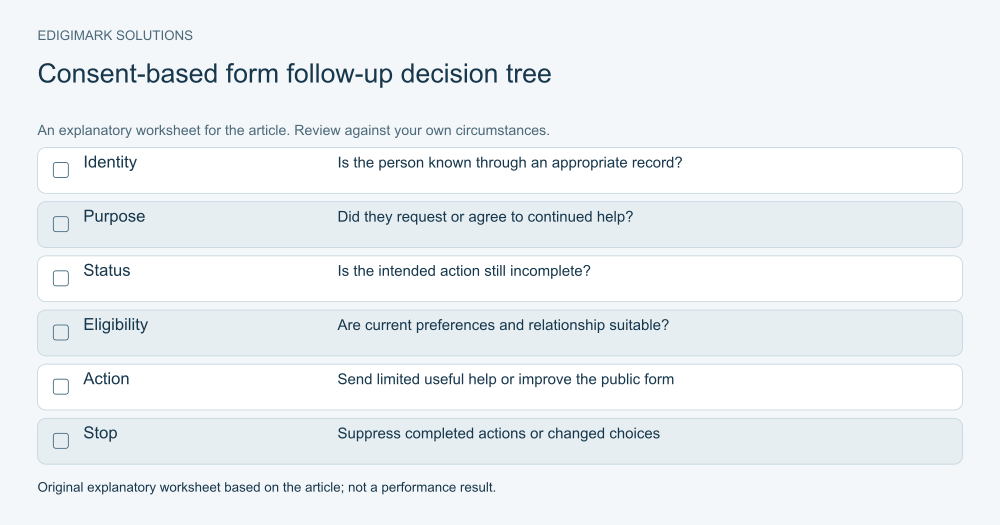
Purpose: help a known, eligible person complete an action they have explicitly requested or agreed to continue. This is not a recipe for collecting anonymous half-entered form details and sending unsolicited messages.
An appropriate trigger could be a person saving a request and choosing to receive a reminder, or an existing contact asking for assistance with an incomplete process. The record needs to show the agreed purpose and suitable contact route.
Before sending, confirm the action remains incomplete and the person remains eligible. If the completed request has already arrived through another path, suppress the reminder. If the relevant choice has changed, do not continue the old route.
Use a helpful message that states why it was sent and how to resume or get help. Avoid claims such as “we saw everything you typed” or pressure based on inferred behaviour. The reminder should support the requested task.
Set a limited, context-appropriate cadence and a clear exit. No response does not justify indefinite reminders. The workflow owner should review whether the path is useful and whether it creates confusion.
Microsoft’s contact-point consent documentation shows why communication eligibility may depend on purpose and destination. Verify your platform’s model. If identity or eligibility is not established, improve the public form experience rather than contact the visitor.
Workflow 4: How should a lead scoring workflow create a review task?
Purpose: surface relevant evidence for a useful human review. The trigger is an agreed score or category combined with required eligibility, rather than every increase in activity.
Keep fit and meaningful interest visible. The receiving task should explain why the record deserves review: a suitable account, a relevant request or another verified signal. A raw score without context makes the salesperson reconstruct the decision.
Check exclusions such as an existing opportunity, an active conversation, confirmed mismatch or duplicate review task. Provide a separate route for direct enquiries that should not wait for a score threshold.
Create one accountable task and record the review state. Define repeated-trigger behaviour so continued activity does not create unlimited duplicate tasks. The implementation owner needs to demonstrate this outcome with representative records.
Ask the reviewer to return a specific disposition and next action. Acceptance, unclear need, timing and fit mismatch produce different follow-up. Do not automatically label every threshold-crossing contact sales-qualified.
Validate the model using accepted and rejected cases. HubSpot’s scoring documentation describes attribute and activity scoring with subscription-dependent capabilities. The business still needs to determine whether its selected evidence supports the review decision.
Workflow 5: How should nurture automation pause for human activity?
Purpose: avoid generic messages competing with an active, relevant conversation. The trigger is a confirmed sales or service interaction state that the teams have agreed should change nurture.
Identify the reliable source for that state. A scheduled meeting or accepted owner may be useful; a click on a scheduling link does not prove a meeting was booked. Test the actual integration and event definition.
Pause or remove the person from competing generic paths as appropriate to the platform. Preserve useful operational messages that the person still expects. The decision should be made by message purpose, not by indiscriminately stopping every communication.
Make the current owner and relationship state visible. Marketing needs enough context to avoid restarting an introduction, while sales needs to know what content was already delivered and why.
Define a resumption condition. A conversation ending does not automatically mean the same sequence should restart. A postponed project may need later relevant help, while a confirmed mismatch may need no acquisition nurture.
The receiving team supplies disposition and the automation owner maintains the change in eligibility. CRM integration helps carry the state reliably. Verify changes that occur during delays, not only before the first message.
Workflow 6: How should unresolved enquiry follow-up be handled?
Purpose: prevent an explicit request from remaining unnoticed after assignment. The trigger is an unresolved operational state after the business’s agreed review point.
Check the current record before escalating. A salesperson may have acted through another route, or the contact may have replied with a different need. Keep the rule tied to a reliable state rather than an outdated task flag.
Create an internal reminder or coordinator task with the original request, current owner and outstanding action. This is an operational recovery workflow, not a justification for repeatedly messaging the customer.
If reassignment is necessary, preserve history so the new owner understands what happened. Avoid creating several simultaneous owners for the same request. Define who can resolve a routing conflict.
Use a truthful external update when needed and appropriate. If the business promised a response and cannot meet it, a person should choose an accurate explanation and useful next step rather than let automation simulate progress.
Measure the age and disposition of unresolved requests, with attention to capacity and data quality. A growing exception queue may reveal missing coverage, unclear ownership or an unreliable status update. Repair that cause instead of adding more reminders to the same broken process.
How should B2B lead generation automation workflows be prioritised?
Choose the recipe that repairs the most consequential observed gap. If demo requests are unassigned, routing and recovery come before a complex nurture path. If resource delivery is broken, fulfilment comes before scoring engagement with the asset.
Document dependencies. A pause-on-meeting workflow depends on reliable meeting status. A fit-based routing rule depends on usable account information. Resolve those foundations or provide a monitored fallback.
Start with a small eligible group and explicit acceptance criteria. The first launch should show that the process works and that the receiving team can maintain it. Expanding too many recipes together makes failures harder to isolate.
Marketing automation should connect each diagram with the business owner, content assets and test cases. A workflow is ready when someone can explain the next action and the exception route for a representative record.
Which suppression rules should be tested across all workflows?
Test changed preferences, active opportunities, current customers, confirmed mismatches and human conversations where those states alter the action. The exact rules depend on message purpose and the operating model.
Check overlap across workflows. A person eligible for three separate campaigns may receive an excessive combined cadence even when each path appears reasonable. Use a programme-level review of the experience.
Verify state changes while a record is waiting. A workflow that checks eligibility only at entry can behave differently from what the team expects after a new reply or preference change. Confirm the platform’s supported behaviour and test the intended outcome.
Keep suppression reasons inspectable. Business users should understand why a message did not send or a task was not created. An intentional exclusion should not be reported as a technical failure.
How should B2B automation workflows be tested before launch?
Create authorised test records for the ideal path and exceptions. Include existing identities, repeated requests, missing fields, changed eligibility and unavailable owners. Specify expected actions for each case.
HubSpot’s workflow testing guide describes previews that help check expected behaviour. A preview is useful, but the business also needs appropriate end-to-end verification of public capture and the receiving team’s process.
Inspect records, messages, tasks and exits. Confirm that the promised asset is available, the receiving person sees the context and repeat activity does not create an unintended duplicate action.
Record the test evidence and repair failures before broad expansion. Web development should participate when the public form or embedded tool is part of the path. A correct internal workflow cannot compensate for a failed public entry point.
What should a B2B automation workflow dashboard report?
Separate operational reliability from commercial progression. Show missing or rejected records, unassigned tasks, unresolved requests and relevant suppression reasons. These explain whether the process fulfils its promise.
Then report accepted handoffs, useful conversations and later outcomes where the data supports them. Define the audience, stage and observation period. Do not treat every completed workflow as a qualified lead.
Data analytics can help compare eligible cohorts and interpret changes in rules. A threshold or routing revision may change counts without a change in underlying demand.
Ask Edigimark to turn your workflow diagrams into an accountable process when automation exists but exceptions, ownership or sales feedback remain difficult to trace.
What should happen when a workflow action fails?
Classify the failure by what it prevents. A resource link failure affects fulfilment. A missing assignment affects ownership. A preference update failure can make the next communication decision uncertain. These need different responses even when the platform groups them under the same warning label.
Create a recovery task with enough context to identify the affected request and the action that remains outstanding. The owner should know whether a retry is appropriate, a field needs correction or the process needs human intervention.
Keep the customer promise visible during recovery. An internal retry schedule does not replace an appropriate response to a person who explicitly asked for help. If automation is paused, name the alternative route and the person monitoring it.
After recovery, check that delayed actions do not duplicate work already completed through another route. Confirm current eligibility and ownership before resuming the path. The business may have responded manually while the technical issue was being repaired.
Use the failure review to improve the recipe. If the same missing field repeatedly blocks routing, change the capture or fallback design. If a receiving queue is repeatedly overloaded, address coverage and priorities. Additional automated reminders are unlikely to solve an unresolved capacity problem.
Frequently asked questions
Which B2B workflow should be built first?
Choose the clearest observed operational gap with reliable inputs and an owner. Explicit request capture, delivery and routing are often easier to verify than a complex behavioural nurture programme.
Can we email someone who abandoned an anonymous form?
Do not use this recipe to collect partial anonymous entries for unsolicited contact. Follow-up needs an established identity, appropriate eligibility and a purpose the person requested or agreed to continue.
Should a high lead score automatically create an SQL?
No. It can create an agreed review task with evidence. Sales qualification should reflect the business’s actual criteria and appropriate receiving-team judgement.
Should all messages stop when sales starts a conversation?
Review competing nurture and message purpose. Generic introductions may need to pause, while expected operational communications may remain useful. Define and test the distinction rather than stopping everything indiscriminately.
How can repeated requests avoid duplicate tasks?
Define identity, request matching and repeat-trigger behaviour. Test the actual platform with repeated and delayed events, then verify that the result preserves one accountable response and useful history.