B2B demand generation helps relevant businesses recognize a problem, understand available approaches and develop confidence in a supplier before and during a purchase. It combines education, distribution, demand capture and sales support around a defined audience. Its purpose is useful commercial interest, not simply a larger contact database.
If people do not understand why a problem matters, a better form will not solve the problem. If interested buyers cannot evaluate the offer or speak to the right person, more awareness will not solve it either. A demand program needs both creation and capture, with evidence connecting them to business outcomes.
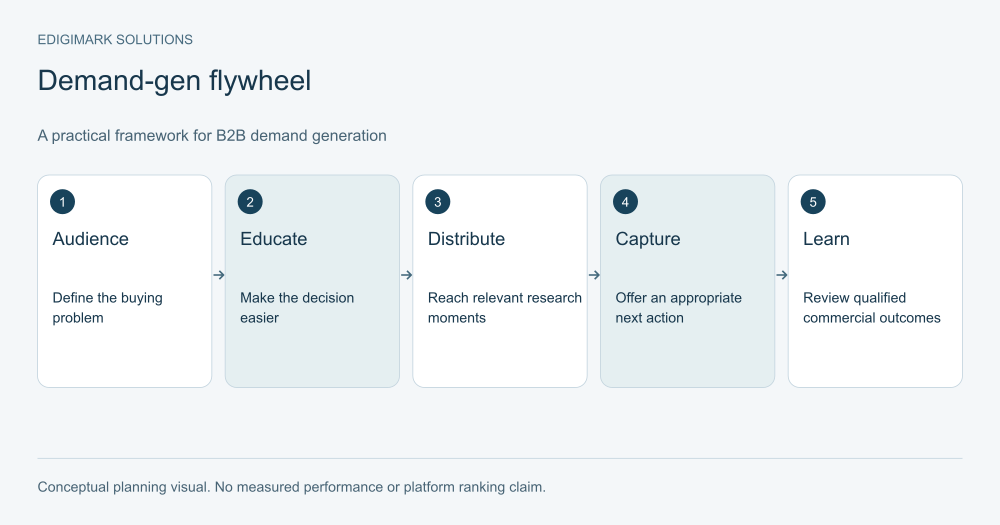
An editorial planning diagram; stages and examples are illustrative.
What does the demand generation definition include?
Demand creation helps people understand a buying problem and a possible response. Demand capture helps people who are already investigating find and evaluate your offer. B2B demand generation coordinates both, while supporting the conversations that happen between initial interest and a decision.
Salesforce’s demand generation overview describes awareness, education and progression towards a customer relationship as connected activities. The operating framework here applies that broad idea to audience selection, channel roles and measurement.
A hypothetical payroll software company might educate growing businesses about fragmented approval processes, publish an implementation checklist and offer a workflow assessment. These assets serve different buying situations. The checklist is useful even if the reader does not immediately submit a form; the assessment is useful when a team is ready to discuss its own process.
Demand generation does not mean convincing everyone to buy. Some readers will discover that the product is unsuitable. Clear explanations of fit, prerequisites and alternatives can improve the quality of subsequent enquiries. A smaller, better informed evaluation group may be more valuable than a large list built through ambiguous offers.
How is demand generation different from lead generation?
Lead generation creates identifiable opportunities for follow-up, usually through an enquiry, registration or other exchange. Demand generation develops the market’s understanding and interest, including activity that does not produce an identifiable contact immediately.
They overlap. A useful webinar can educate an audience and create registrations. A product comparison page can help anonymous research and encourage a relevant assessment request. The distinction is the job being evaluated, not a universal rule about which channel belongs to which department.
Avoid making every demand asset conditional on a form. A visitor comparing implementation approaches may need to share the explanation with colleagues. Access friction can prevent that discussion. Gate an asset when the exchange provides a clear benefit, such as a personalized diagnostic or a genuinely useful event, and explain the follow-up honestly.
Equally, do not remove all conversion opportunities in the name of demand creation. Someone with an urgent problem needs a visible route to action. Helpful content and clear commercial pages can coexist without turning every paragraph into a sales pitch.
How do you select an audience worth serving?
Define an audience through its circumstances, not only its job titles. Company size, operating model, current tools, implementation capacity and problem severity can be more useful than a broad label such as “decision maker.” Include the events that make the problem urgent.
Review real sales questions, lost opportunities, implementation requirements and customer-support themes. Use only information you are authorized to use, and keep identifiable customer details out of public content unless permission exists. The purpose is to understand recurring decisions, not to turn private conversations into unsupported testimonials.
Create a segment statement: “We help this type of company address this operational problem when this event occurs.” Add exclusions. A product designed for multi-site operations should not pretend that every small business needs its full feature set.
Then map the buying group. The person experiencing the problem may differ from the person approving the spend or assessing technical risk. Explain the value and constraints for each role. A department manager may care about workflow friction while an IT reviewer needs architecture and data-handling information.
Edigimark’s digital marketing services can help turn this audience definition into a coordinated content and channel plan. The useful deliverable is an agreed market and buying problem, before a publishing calendar.
Which demand generation channels should you prioritize?
Choose channels by the audience’s research behavior and the role the channel can perform. SEO can capture explicit questions. Paid distribution can test a message with a defined audience. Partnerships can connect a problem to an existing trusted relationship. Email can support known prospects who want relevant updates.
| Commercial job | Useful channel role | Evidence to inspect |
|---|---|---|
| Introduce an overlooked problem | Educational content distributed to a relevant audience | Relevant engagement and recurring buyer questions |
| Capture active investigation | Search-visible commercial and comparison pages | Qualified enquiries and evaluation actions |
| Support a buying committee | Shareable implementation and risk resources | Use in sales discussions and stakeholder follow-up |
| Maintain appropriate contact | Preference-aware lifecycle communication | Replies, requested actions and stage progression |
| Expand reach through trust | Partner education and co-developed resources | Fit of referred opportunities and partner feedback |
A channel earns priority when the audience, message, destination and measurement are ready. Starting a paid campaign without an accurate product page may buy attention that the website cannot convert into understanding.
Do not assume every channel needs a separate idea. One carefully developed problem explanation can become a guide, a webinar discussion and a sales resource. Adapt the format to the audience while preserving the same factual source.
What content creates useful demand?
Start with the decisions buyers struggle to make. Explain the problem, the consequences of leaving it unresolved, the available approaches and the conditions under which your offer fits. Commercial usefulness does not require exaggerated urgency.
Build several layers of content. A concise explanation helps a reader recognize the issue. A diagnostic helps them assess whether it applies. A comparison clarifies trade-offs. An implementation resource shows what adoption requires. A transparent product or service page offers an appropriate next action.
Original value can come from a clear decision model, a carefully labeled illustrative example or a specific implementation checklist. It does not require inventing survey statistics. If you have genuine research, describe the method and limitations. If you use an example, tell the reader that it is hypothetical.
Keep claims consistent across the website, ads and sales material. A broad advertisement promising effortless implementation creates avoidable friction when the product requires substantial configuration. Content should reduce uncertainty, including uncertainty that makes the buyer decide against the offer.
If the site cannot present these layers clearly, web development services can support the information architecture and accessible page experiences that distribution depends on.
How should sales and marketing share responsibility?
Agree on a commercial outcome, qualification evidence and follow-up process. Marketing needs feedback on which conversations are useful. Sales needs accurate context rather than an unexplained score attached to a contact.
Run a recurring review of accepted, rejected and stalled enquiries. Examine the original request, the content or campaign involved and the reason for the outcome. A form that attracts incompatible needs may need clearer fit language. A qualified enquiry that receives no response indicates an operating problem rather than a distribution problem.
Set expectations for each content type. Downloading an educational worksheet is different from requesting a proposal. Sales should not assume that every contact wants an immediate commercial conversation. The follow-up should match the exchange and recorded preferences.
Use CRM integration to preserve the connection between enquiries, companies and opportunities. The integration needs field ownership, duplicate rules and reliable timestamps. A dashboard cannot repair an inconsistent definition of a qualified opportunity.
Which B2B demand metrics help decision-making?
Use leading indicators to diagnose the program and commercial indicators to assess its contribution. Relevant audience engagement, evaluation actions and buyer questions can identify whether the message is useful. Sales acceptance, opportunity progression and closed outcomes indicate whether useful interest is reaching the business.
Keep demand metrics aligned with channel roles. A broad educational campaign should not be judged solely on immediate demo submissions. It also should not escape commercial accountability indefinitely. Define the expected learning period and which downstream signals would justify continued investment.
Report cohorts consistently. Prospects introduced during one period may become opportunities later. A monthly ratio using unrelated groups can mislead. Track progression for a defined audience or acquisition cohort while also reporting the current pipeline.
Distinguish association from cause. A buyer may have encountered several resources, colleagues and channels that are absent from tracking. Attributed pipeline is useful directional evidence; it does not prove what would have happened without the activity. Data analytics services can help organize known coverage and uncertainty into reporting that executives can interpret.
What should the first operating cycle look like?
Begin with one audience and one problem. Inventory the existing pages and sales resources, interview the team about repeated objections, and identify the largest gap between awareness and evaluation. Avoid launching many channels before resolving that gap.
Write a short hypothesis. For example: “An implementation checklist will help operations managers decide whether a workflow assessment is worth requesting.” Specify the distribution route, useful action, quality criteria and review date. This is a testable content decision, not a promised result.
Review the destination before launching distribution. Check that the explanation is accurate, mobile access is usable, the form works and the response owner understands the offer. If the action fails, the campaign cannot teach you whether the audience wants it.
At the review, separate execution failures from strategy findings. A broken form tells you little about demand. A functioning experience that attracts consistently unsuitable enquiries may reveal a positioning or audience mismatch. Record the learning and make the next change deliberately.
Demand generation becomes dependable when audience knowledge, useful assets, appropriate distribution and honest reporting improve together. Contact Edigimark to define the first audience, buying problem and measurement plan for your program.
How do you build a useful demand-generation brief?
A strong brief connects a buyer decision to an asset and a distribution plan. It starts with the situation the reader recognizes, the uncertainty they face and the decision the resource should help them make. It then identifies the evidence available, the useful next action and the person responsible for reviewing the commercial feedback.
For a hypothetical operations platform, the brief might focus on managers struggling to coordinate recurring approvals across locations. The asset explains three operating approaches and their implementation trade-offs. The desired action is an informed workflow assessment, not a form submission from anyone interested in productivity.
Specify what the asset must not imply. If the platform requires an existing process owner and configuration effort, those prerequisites belong in the explanation. If the company has no verified outcome study, use a clearly labeled planning example instead of suggesting measured savings.
The distribution plan should identify where relevant people already discuss the problem. Search may reach explicit questions; a partner may bring a trusted operational perspective; paid distribution may test a concise problem statement. Each route needs an appropriate destination. Sending every audience to the homepage makes it harder to understand what the test is actually measuring.
What should the team learn from the first campaign?
Write the learning questions before launch. Do readers recognize the problem? Which explanation leads to useful follow-up questions? Are the resulting enquiries compatible with the offer? Which implementation concern repeatedly prevents an evaluation from progressing?
Collect qualitative feedback alongside event data. Sales notes can reveal a misunderstood promise that a click report cannot explain. Customer-facing teams can identify whether a supposedly helpful resource creates confusion. Record these observations with enough context to distinguish a recurring theme from one unusual conversation.
Decide what would justify expansion. A functioning campaign that reaches relevant people and produces useful evaluation signals can support another controlled investment. A campaign with high attention and consistently incompatible enquiries needs a positioning or audience review. Define the decision explicitly so the team does not interpret every result as a reason to spend more.
How does the demand-gen flywheel improve over time?
Buyer questions inform content. Content supports distribution and sales discussions. Those discussions reveal new objections and decisions. The next content update addresses the most useful gap. This is a feedback loop, not a claim that every published asset automatically creates compounding growth.
Maintain a resource inventory with its audience, buying task, owner, last substantive review and commercial use. Retire outdated explanations instead of allowing contradictory pages to accumulate. A smaller set of accurate resources can support the program better than a calendar filled with indistinguishable introductions.
Review capacity before adding another segment. A new audience can require different implementation guidance, qualification criteria and sales expertise. Reusing the same message may save production time while reducing relevance. Treat segment expansion as an operating decision rather than a cosmetic change to an advertisement.
How do you preserve accountability across long buying cycles?
Agree on near-term learning milestones and later commercial review dates. The first review can assess whether the experience works and whether the audience is relevant. A later review can assess accepted enquiries and opportunity progression. Closed outcomes may require another review aligned with the actual sales cycle.
Keep those checkpoints connected. Early engagement should not be treated as permanent proof of commercial value, while a long buying cycle should not cause useful learning to be ignored. Report the evidence available at each checkpoint and the uncertainty that remains. That allows a business to invest thoughtfully without pretending the entire buying journey is observable.
Frequently asked questions
Is demand generation only for large B2B companies?
No. A smaller company can apply the same principles with one audience and a limited channel set. The scale of the program should match the sales capacity, buying journey and available evidence.
Is paid advertising required?
No. Search content, partnerships, expert participation and customer education can play useful roles. Paid distribution can accelerate a controlled test, but it cannot compensate for an unclear audience or unconvincing destination.
Should demand content always be ungated?
No. Choose access based on the reader’s task and the value of the exchange. Public explanations help research and sharing. Personalized assessments and events can justify registration when the purpose and follow-up are clear.
How quickly should demand generation produce revenue?
That depends on the buying cycle and audience readiness. Establish milestones and a review period based on your own sales process. Avoid adopting a universal promise that ignores procurement, implementation or commercial complexity.
What if engagement rises but qualified enquiries do not?
Check audience fit, the buying problem, conversion paths and sales follow-up. Engagement can reflect useful education without immediate purchase intent. It can also reflect attention from people your business cannot serve. Investigate before increasing spend.
Put the ideas to work
Explore our connected growth services →