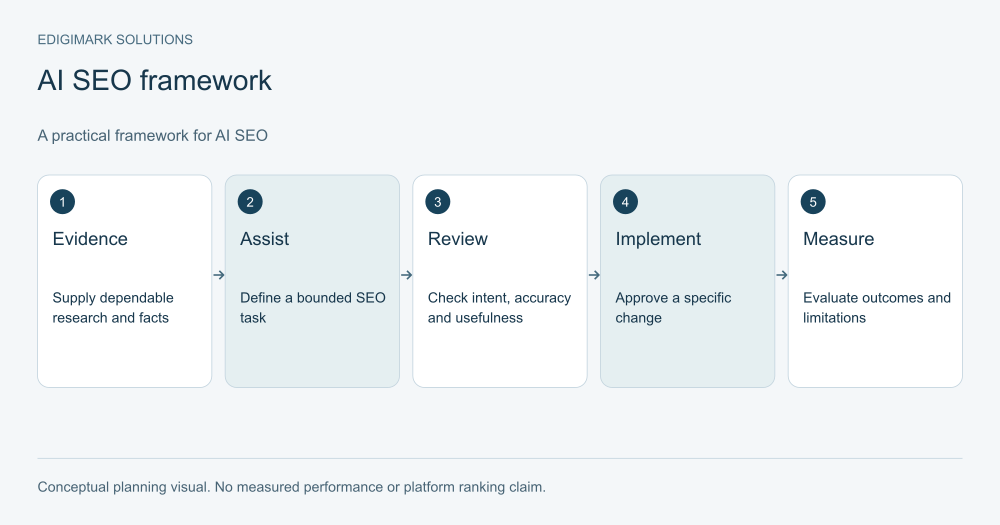
AI SEO uses artificial intelligence to assist search work such as organizing research, reviewing content and investigating technical data. It can improve how a team performs a defined task, but it cannot verify facts, establish search demand or guarantee rankings simply by producing a confident answer. Build the workflow around dependable evidence and an accountable reviewer.
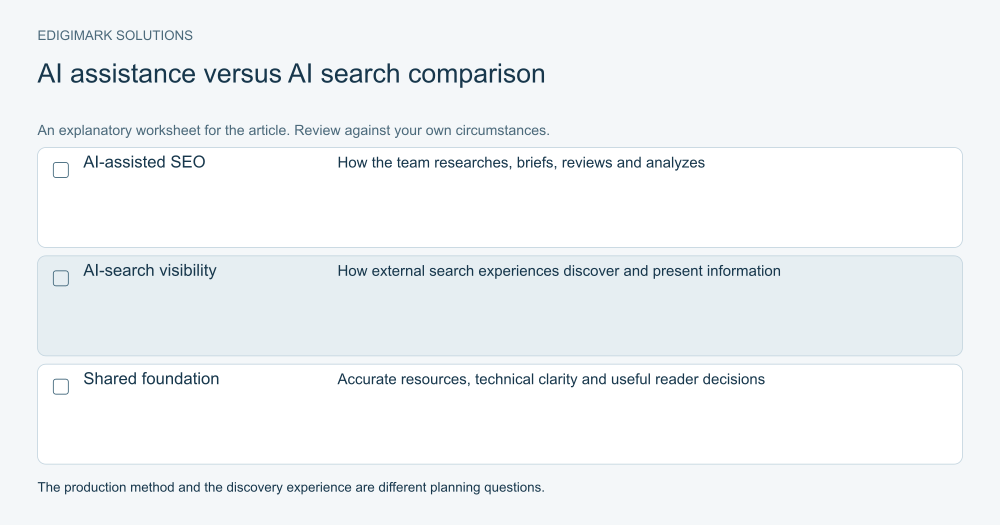
Two meanings often become mixed together. AI-assisted SEO describes using a tool to help do SEO work. Optimizing for AI search describes improving how useful information can be discovered in search experiences that include generated answers. The activities overlap, but they are different planning questions.
In this guide
- Which research and review tasks can AI-assisted SEO support?
- What does AI keyword analysis actually establish?
- How can AI support a content brief without creating commodity pages?
- How does AI SEO quality control protect factual accuracy?
- What technical SEO tasks can AI assist with?
- How is AI SEO different from improving AI-search visibility?
- How should an AI-assisted SEO workflow move from evidence to action?
- How should a business evaluate an AI SEO service?
- Which AI SEO pilot is practical for a small team?
- What should the AI SEO review record?
- What does a concrete AI keyword review example show?
- Frequently asked questions
Which research and review tasks can AI-assisted SEO support?
It can organize supplied questions, propose topic groups, compare a draft with an approved brief, summarize a crawl export and identify issues worth investigating. It can also help explain technical findings in language a business owner can use.
The quality of the result depends on the source and task. A crawl export with clear columns provides evidence for an issue review. A prompt asking for “the best keywords” without market or search data invites plausible guesses. The output should identify uncertainty rather than conceal it.
Use AI to make a workflow inspectable. Require the proposed finding, supporting input, implication and next verification step. A statement that a page “has bad SEO” is less useful than a documented duplicate-title pattern with the affected URLs and a review question.
Edigimark’s AI-powered solutions can help scope these assisted tasks. The goal is useful analysis within a defined boundary, not unrestricted authority to modify a website.
What does AI keyword analysis actually establish?
It can group wording and propose interpretations from supplied evidence. It does not inherently know reliable search volume, competition, market differences or your commercial fit. Those require appropriate research sources and business context.
Provide the candidate list, intended audience, market, existing page inventory and reader decisions. Ask the system to separate queries that represent different tasks and consolidate wording that serves the same task. Keep the rationale available for editorial review.
Validate proposed demand using the research tools and site data available to you. Label inferred opportunities as candidates when volume or difficulty has not been established. Do not publish fabricated metrics to make a keyword recommendation look complete.
Review cannibalization by intent as well as wording. Two pages can target different phrases while answering the same question. AI clustering can suggest overlap, but the editor must examine what the reader actually needs and what each page contributes.
How can AI support a content brief without creating commodity pages?
Start with the reader’s decision and original source material. Include approved product facts, relevant experience, research questions and limitations. The brief should specify what the page helps someone do and what it must not imply.
Ask for an outline that covers the decision without repeating the same introduction in every section. Include implementation requirements, comparison criteria or a useful diagnostic where the topic warrants them. More headings do not automatically mean more value.
Google’s AI-content guidance warns against generating pages without added user value. A useful brief should therefore identify the explanation, evidence or framework that makes this page worth reading.
Keep publication judgement outside the generation step. A draft can look polished while being unnecessary. Consolidate related material when it serves the same task, and avoid creating separate pages merely for minor query variations.
How does AI SEO quality control protect factual accuracy?
Create a claim ledger. Each important statement should have an approved source, responsible owner or explicit illustrative label. A model’s generated citation is a proposal to check, not proof the source exists or supports the claim.
Review capability, price and policy statements against current official information. Product versions and account availability can change. A remembered feature may no longer be available in the same plan or interface.
Check that summaries preserve limitations. An explanation shortened for a heading or snippet should not become a guarantee. For example, crawlability can support discovery, but it does not prove that a page will be indexed or selected for a generated answer.
Use a second review focused on the reader. Is the explanation specific? Does it distinguish facts from advice? Does the hypothetical example teach a decision rather than pretending to be a client case? Correctness and usefulness need separate attention.
What technical SEO tasks can AI assist with?
Use authorized exports or reports to identify patterns in status codes, titles, canonical signals, internal links and indexation findings. Require the system to reference the relevant rows and avoid proposing a fix without considering the affected page’s purpose.
Technical findings need actual verification. A duplicate title may be intentional on a utility page; a redirect may be part of a valid migration; an indexing exclusion may protect private or redundant content. The business context matters.
Google’s SEO Starter Guide is a useful baseline for search fundamentals. Tool-assisted analysis should remain consistent with documented practices rather than inventing a new rule because the model can phrase it convincingly.
Web development services can support the actual implementation once the issue, intended behavior and risk are understood. A drafted code change should be reviewed and tested before deployment.
How is AI SEO different from improving AI-search visibility?
The first concerns your team’s production method. The second concerns how a search experience discovers and presents information. A business can use AI assistance poorly and publish unhelpful material, or use conventional editorial work to create a highly useful resource.
For Google, generative-search guidance reinforces established search foundations. Do not treat an AI-branded service as evidence that a special tactic is required.
Other services have their own access controls and documentation. Review those specifically instead of assuming one robots rule, schema type or measurement report applies everywhere. Keep discovery, citation and referral traffic distinct when reporting observed visibility.
AI SEO limitations include the inability to guarantee selection by an external system. A useful service can improve content and technical implementation; it cannot promise control over a generated answer.
How should an AI-assisted SEO workflow move from evidence to action?
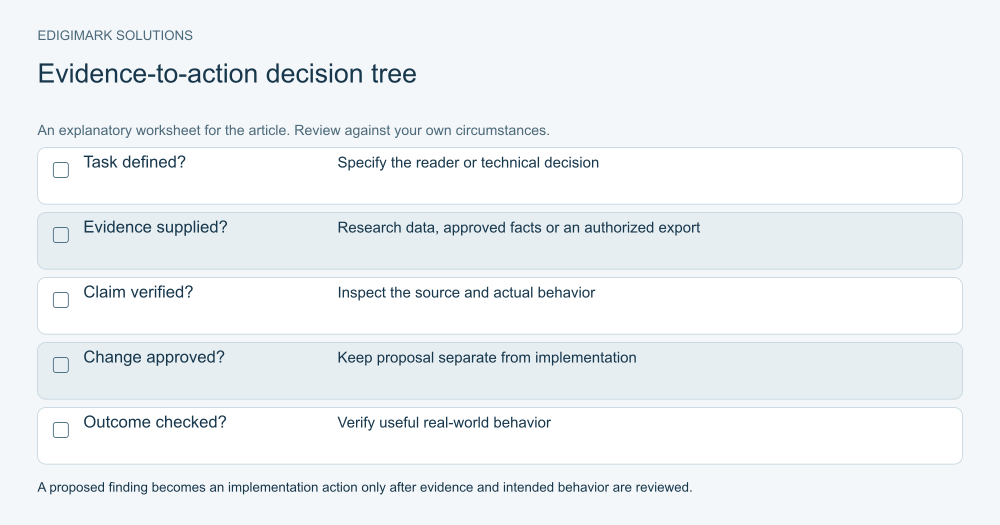
Use a sequence of evidence, task, proposal, verification and implementation. First gather authorized inputs. Then ask for a bounded analysis. Review the result against sources and business context. Approve a specific change and test the real behavior.
| Task | Suitable input | Review needed |
|---|---|---|
| Question grouping | Researched query and buyer-question list | Distinct reader intent and commercial fit |
| Brief creation | Approved facts, audience and source material | Original value and factual scope |
| Draft review | Article plus claim ledger | Accuracy, usefulness and duplication |
| Technical triage | Crawl or indexation export | Actual page behavior and intended purpose |
| Reporting summary | Defined, reconciled metrics | Arithmetic, attribution and causal language |
This separation prevents a proposed finding from becoming a site change without evidence. The reviewer should know what the tool inspected and what remains unverified.
How should a business evaluate an AI SEO service?
Ask which tasks are assisted, what inputs are used and who verifies results. Request a concrete example of a finding and its evidence. Ask how the provider handles uncertainty, obsolete sources and unsupported claims.
Evaluate deliverables through business decisions. A keyword list should explain intent and fit. A content plan should identify distinct reader tasks. A technical report should describe the actual issue and expected behavior after repair. A measurement report should state coverage and definitions.
Be cautious about outcome guarantees and secret platform metrics. A service should be able to explain its work in reviewable terms. An impressive score or large content count does not by itself demonstrate commercial usefulness.
Digital marketing services and data analytics services can connect assisted search work with audience, conversion and measurement goals. The integration matters more than the label placed on the production tool.
Which AI SEO pilot is practical for a small team?
Choose one recurring bottleneck. A hypothetical B2B service company might use AI to review briefs against actual sales questions. The input includes approved service scope, buyer concerns and proposed outlines. The output identifies missing decisions and duplicated sections.
The editor checks the findings, then compares the revised resource with the original brief. Useful evidence includes fewer unsupported claims, clearer decision coverage and manageable review effort. Ranking changes alone cannot isolate the effect of the assisted brief because many other factors can vary.
Another pilot could summarize a technical export for a developer. Require the affected URLs, source rows and proposed verification. The developer decides which findings are valid before modifying the site.
What should the AI SEO review record?
Record the task definition, input version, model or tool where relevant, reviewer, accepted findings, rejected findings and resulting action. Include the reason for significant corrections. This makes prompt and workflow improvements grounded in actual failure patterns.
Keep the claim and resource libraries current. When product facts or source documentation change, review the workflows that reuse them. An old prompt can continue producing outdated advice even when the team believes the tool is current.
Use marketing automation services when assisted outputs need to connect to an approved operational process, and CRM integration services when commercial evidence must remain traceable.
Contact Edigimark to identify an SEO task that can benefit from assistance while preserving evidence, review and a clear implementation boundary.
What does a concrete AI keyword review example show?
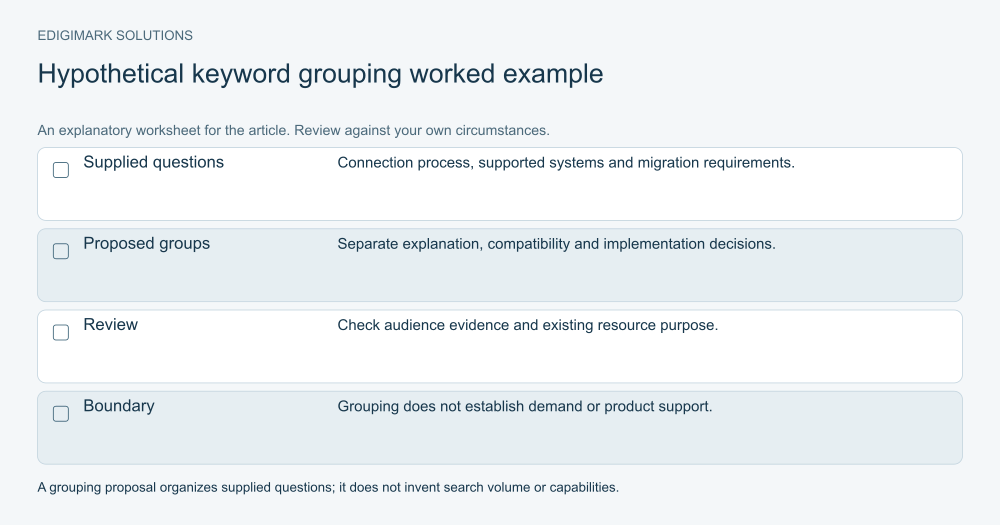
For a hypothetical integration topic, supplied questions might ask how the connection works, which systems are supported and what migration requires. An assistant can propose groups by those decisions. The reviewer then checks whether the wording reflects real audience evidence and whether a suitable resource already exists. The proposal does not establish search demand or supported capabilities.
Frequently asked questions
Can AI perform keyword research on its own?
It can propose and organize candidates. Reliable demand, market and competition claims need appropriate research evidence. Label unverified candidates honestly and validate commercial fit.
Does AI-written content rank better than human-written content?
The production label does not establish performance. Evaluate originality, accuracy, usefulness and the reader’s task. Do not assume a universal advantage for either method.
Can AI fix technical SEO automatically?
It can propose findings and changes when supplied with appropriate access and data. Actual modification needs a defined, authorized workflow, review and verification of the site’s intended behavior.
Does AI SEO mean optimizing for ChatGPT?
Sometimes the label is used that way, but AI assistance and AI-search visibility are different activities. Ask the provider to specify which work and measurement are included.
What is the biggest quality risk?
Confident output without adequate evidence. Require sources, uncertainty and a reviewer for important claims and actions, rather than treating fluent wording as verification.