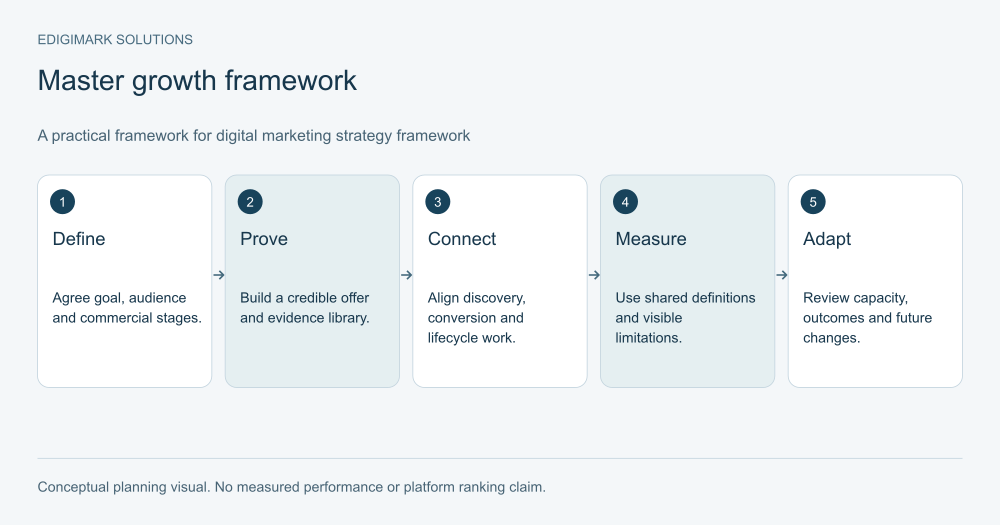
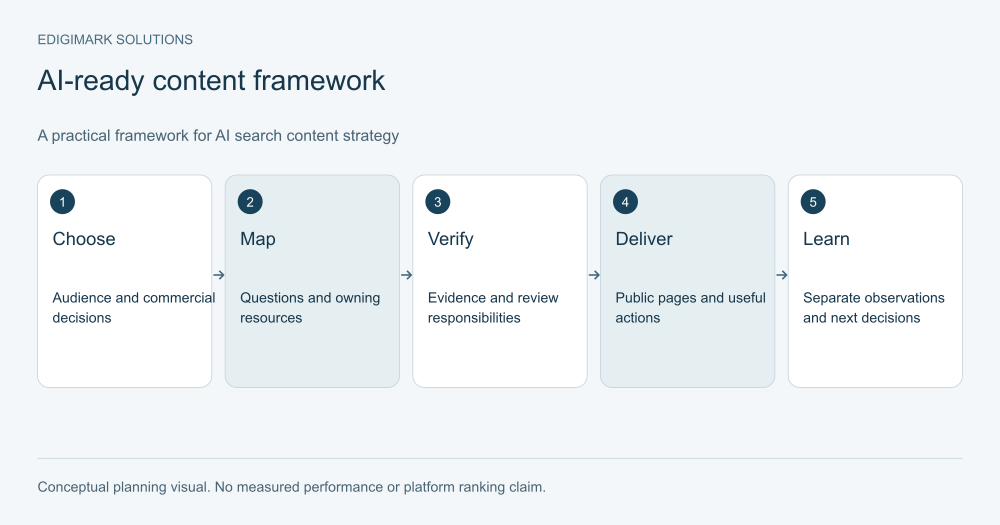
An AI search content strategy is a repeatable system for choosing useful audience questions, producing verifiable answers, delivering them on accessible pages and reviewing what happens afterward. Start with the decisions your business can help people make. Give each resource an evidence owner and a maintenance plan, then measure discovery separately from qualified business outcomes.
The difficult part is usually coordination. Marketing understands demand, specialists know the exceptions, editors shape the explanation, developers maintain delivery and analysts define outcomes. A strategy connects those responsibilities. Publishing more pages without that connection can expand the amount of content the business has to correct.
This guide presents an operating model for AI-ready editorial planning. Use it to bring SEO AEO GEO content into one practical program while preserving the different observations each channel provides. The framework is editorial advice, not a promise that a search or answer system will select a particular page.

In this guide
- What business decision should an AI search content strategy support?
- How does AI-ready editorial planning turn questions into a roadmap?
- What belongs in a content evidence program?
- How should AI content governance assign responsibility?
- How can SEO AEO GEO content share one useful brief?
- What should an AI-ready content delivery contract include?
- How should an AI search content strategy measure progress?
- What does an illustrative AI-ready release cycle look like?
- How should AI content governance handle reviewer disagreements?
- How should an AI search content strategy prepare for 2027?
- What should the AI search content strategy document contain?
- Frequently asked questions
- Build a content program your business can maintain
What business decision should an AI search content strategy support?
Choose a specific audience and a useful commercial boundary. A company selling an integration service might help operations teams assess readiness, compare delivery approaches and prepare a project brief. An unrelated high-volume topic would need a strong reason to enter that program.
Describe the audience’s starting situation. “Business leaders” leaves too much unexplained. “Operations managers replacing manual lead transfers between a form and CRM” provides a task, an existing constraint and a plausible next step. That context makes the research and eventual answer more precise.
Name the business outcome without assuming that content causes it. Relevant inquiries, better-prepared evaluations or reduced confusion about scope can be useful objectives. Define the observable event and any qualification rule before setting a target. An inquiry about an unavailable service should not automatically count as a successful lead.
Keep the program small enough to review. One audience, a few connected decisions and a manageable resource set can reveal delivery and evidence gaps. Expand when the process works, rather than treating a large publication count as the strategy itself.
Use digital marketing services to connect this scope with the wider acquisition plan. Content should have a role alongside the product, service offer, sales process and customer experience.
How does AI-ready editorial planning turn questions into a roadmap?
Collect questions from approved sales notes, support themes, onboarding conversations and search observations. Preserve the task behind the wording. Several variations of “Can these systems connect?” may belong to one compatibility decision, while “How do we recover failed transfers?” is a different operational concern.
Separate demand evidence from assumptions. A frequently raised sales question has a documented source. A topic suggested by a brainstorming tool is a hypothesis until checked. Record that distinction so the team does not present speculative demand as measured search volume.
For each proposed resource, write the reader’s decision, the useful answer, required evidence, owning page and next step. Include a reason to exclude the topic if the company lacks relevant knowledge or an appropriate service. Exclusion is a legitimate planning decision.
Prioritize using practical criteria: customer importance, relationship to the offer, evidence readiness, maintenance effort and current coverage. A small table with these explanations is often more useful than a numerical score whose weights nobody can defend.
Group resources around meaningful decisions. A readiness guide, compatibility page and troubleshooting explanation can form a connected journey. Avoid creating several nearly identical pages because minor wording variations appear in research. Each resource should own a distinct task.
What belongs in a content evidence program?
Build an inventory of claims the business is prepared to support. This can include verified service scope, current platform documentation, approved methods, genuinely collected research and permitted examples. Attach the source, review date and responsible person to important claims.
Distinguish a capability from a result. “We can configure this transfer” needs technical verification and scope. “This transfer increased revenue” requires measured evidence, a method and an appropriate account of other influences. Do not promote the first statement into the second because the stronger wording sounds more persuasive.
Plan useful original material. A transparent decision worksheet or annotated process can add value without pretending to be a performance study. If the company publishes research, explain the sample, collection method and limitations. If the example is hypothetical, label it accordingly.
Give specialists concrete review questions. Ask whether a prerequisite is missing, whether a described exception changes the conclusion and whether a capability is generally available or configuration dependent. “Please approve the blog” is a weak request because it does not explain what needs verification.
Keep evidence accessible to the reader where possible. Link the primary documentation beside the relevant platform claim. Explain the method near the result. An internal source register helps production, but it does not replace useful public context.
How should AI content governance assign responsibility?
Make an owner accountable for the resource after publication. That person does not have to write every sentence, but should know who can verify facts, approve sensitive examples and repair delivery. Ownership should survive a campaign’s end.
Define distinct review responsibilities. Marketing checks the audience and purpose. A subject specialist checks facts and conditions. An editor checks clarity and unsupported implication. A publishing owner checks the actual public page. An analyst checks measurement definitions and event delivery.
For AI-assisted work, retain a human review process that examines the output itself. Google’s guidance on generative AI content calls for checking accuracy and quality, including metadata. A fluent draft or a completed checklist is insufficient if nobody verifies the claims it contains.
Set boundaries for source material. Do not put confidential customer information into unapproved tools or publish private conversations as evidence. Use approved summaries and permitted examples. The article should not imply customer endorsement simply because an internal record exists.
Define what blocks publication: an unverified material claim, invented result, broken essential action or missing approval for an identifiable example. Make correction straightforward. A visible issue should lead to an assigned task and a verifiable fix, rather than a debate about whether the draft looks polished enough.
How can SEO AEO GEO content share one useful brief?
Use one core brief for the reader’s task and evidence. Traditional search, answer-oriented presentation and generative discovery should not require three conflicting versions of the company’s facts. The resource needs one coherent explanation and an accurate public identity.
Begin with a direct answer that includes essential conditions. Then explain the mechanism, alternatives and exceptions at the depth the task warrants. Headings should make sense in navigation, including when a reader arrives partway through the page.
Use formats that help the decision. A comparison benefits from consistent criteria. A process benefits from ordered steps and responsibility. A diagnostic task benefits from symptoms, checks and next actions. Formatting has a purpose beyond making a page appear optimized.
Place useful links at the moment readers need deeper detail. A guide can point to the owning service page after explaining when that service fits. Avoid repetitive promotional interruptions or unrelated link insertion. The internal journey should reflect the task map.
Specify the visual honestly. A conceptual responsibility map is appropriate when the article describes an operating model. A chart showing improved visibility needs actual observations and a method. Choose the asset because it clarifies something, not because every article needs an impressive-looking graph.
What should an AI-ready content delivery contract include?
Agree on the public URL, title, description, heading structure, images, source links and next action before release. Include the intended canonical URL and any URL migration requirements. Editors and developers should understand which system supplies each public element.
Inspect the actual page after publication. A saved title can differ from the rendered page; an image can fail outside the editor; a form can display without reaching the receiving team. Check the reader’s experience on the relevant viewport and follow the important links.
Use web development when template or delivery problems affect the content. An editorial strategy cannot compensate for an inaccessible resource or a broken inquiry path. Keep the technical issue attached to a responsible implementation task.
Test the action with an appropriate nonproduction or clearly identified test record. Confirm the destination and routing rather than assuming a successful button click means a useful lead arrived. Coordinate with CRM integration when website and sales records need a reliable handoff.
Store a release record with the approved content and essential checks. This creates a baseline for later updates and explains what the team actually verified. It should be concise enough to maintain, rather than a large document nobody revisits.
How should an AI search content strategy measure progress?
Maintain separate layers for publication quality, discovery and business outcomes. Publication quality concerns facts, delivery and completed review. Discovery concerns observed impressions, clicks, mentions or citations under a defined method. Business outcomes concern qualified inquiries and later stages under the company’s definitions.
Do not convert one layer into another. A citation observation does not establish a website visit. A visit does not establish buying intent. A recorded inquiry does not establish revenue. A useful report connects the observations where evidence permits and leaves the remaining uncertainty visible.
Keep the query or prompt sample stable enough to compare. Record platform, date, location where relevant and the question used. Treat repeated manual samples as observations, not a census of every answer system or every potential user.
For business measurement, define the inquiry and qualification criteria with sales. Use data analytics to clarify event delivery, reporting periods and channel definitions. Review changes in tracking before interpreting a content program’s apparent performance.
Use the results to make a decision. Improve a missing explanation, repair a delivery problem, retire an irrelevant topic or investigate an audience mismatch. A dashboard that reports numbers without changing priorities is an incomplete management tool.
What does an illustrative AI-ready release cycle look like?
Consider a hypothetical integration provider serving operations teams. Its first release addresses three decisions: whether the team is ready, which delivery approach fits and what information a specialist needs to scope the work. The provider selects these tasks because they occur in approved sales summaries, not because an invented volume estimate makes them appear attractive.
Marketing drafts the task map. A technical owner verifies prerequisites and failure-handling boundaries. The editor creates a readiness guide and a clear service explanation, using a conceptual worksheet rather than a fake case result. The publisher checks links, images and the public inquiry action.
The analyst records the release dates and existing measurement definitions. Sales agrees to mark inquiries about the relevant workflow and explain why some are unsuitable. Later reviews examine both discovery observations and lead fit, keeping those definitions separate.
The second release depends on what the first reveals. If readers repeatedly ask about field ownership, that becomes a new resource with specialist evidence. If the form loses submissions, the team fixes delivery before commissioning more articles. If demand evidence remains weak, marketing reviews the audience assumption.
This cycle is a suggested working method, not a claim about an Edigimark engagement. Its value is the connection between a question, a responsible answer, a functioning page and a later decision.
How should AI content governance handle reviewer disagreements?
Return to the claim and task. If marketing wants a broad promise but the specialist can verify only a conditional capability, keep the condition visible. Persuasive copy should explain the useful verified benefit rather than conceal the boundary.
If a specialist requests excessive detail, ask which reader decision requires it. Put essential prerequisites near the answer and move supporting technical depth into an appropriate section. The choice is about usable accuracy, rather than a contest between simplicity and expertise.
If evidence is unavailable, choose a different format. A method explanation can be useful while a results case study is premature. A planning worksheet can be useful while a market benchmark is unverified. Record the missing evidence so future work can revisit the opportunity responsibly.
Assign a final editorial owner to resolve ordinary presentation questions. Material factual disagreements should remain open until checked. A deadline can justify narrowing scope; it cannot make an uncertain claim true.
How should an AI search content strategy prepare for 2027?
Treat 2027 as a planning horizon. Build capacity for source checks, expert review, public delivery and maintenance. Reserve time for updating existing resources when products, services or platform documentation change.
Avoid basing the entire plan on a prediction that one answer interface will dominate. A clear public resource, verified evidence and a working business journey can support several discovery paths. Keep platform-specific work attached to current documentation and revisit it when the documentation changes.
Budget for fewer well-supported releases if review capacity is limited. A calendar should reflect the people available to maintain claims, not only writing throughput. Plan an evidence backlog alongside the topic backlog so important questions can become publishable over time.
Use marketing automation for suitable workflow coordination where it fits the process. Automation can route review tasks and reminders, but the person responsible still needs to resolve the underlying question and verify the result.
What should the AI search content strategy document contain?
Write the audience and commercial boundary in a short opening statement. Add the initial task map, evidence inventory, release set, owners and outcome definitions. A new contributor should be able to understand why these resources exist and what makes a draft publishable without reconstructing several planning meetings.
Document the dependencies that can delay a release. A compatibility explanation may require a current technical test. A case study may require customer permission and access to original measurements. A comparison may require verification of both products under matching conditions. Give each dependency a responsible owner and a practical decision if it cannot be resolved.
Include a correction route. Specify where readers or internal teams can report a problem and how the owner evaluates it. An urgent factual error should not wait for the normal campaign review. A minor presentation suggestion can enter the regular backlog. The strategy becomes easier to operate when different issues have a proportionate response.
Finally, state the review cadence and the questions that review will answer. Check whether the audience remains appropriate, whether published facts are current, whether the journey works and whether observations justify another release. Keep the document brief enough to use during production. Its purpose is to make decisions consistent, not to accumulate pages of planning language.
Frequently asked questions
Is an AI search content strategy separate from SEO?
It can share the same useful content and delivery foundation. Keep channel-specific observations and current platform requirements distinct while maintaining one accurate answer and business identity.
How many articles should the first release include?
Choose a set the team can research, review and maintain. The right size depends on evidence and delivery capacity. A publication count alone does not show audience coverage or quality.
Can AI tools write the whole content program?
Tools can assist with suitable tasks, but someone must verify claims, sources, metadata and examples. A business still needs accountable review and a public correction process.
What if specialists have little time for review?
Give them precise claim-level questions and reduce the release scope. Reusing approved facts can help, provided their conditions remain current. Do not replace missing specialist evidence with plausible-sounding assertions.
What is the most useful first measurement?
Verify that the resource and next action work, then use clearly defined discovery and qualification observations. Choose measures that inform the next decision rather than implying certainty the data cannot support.
Build a content program your business can maintain
Start with useful questions, verified evidence and clear responsibilities. Publish a coherent resource set, check the public journey and use observations to improve the next release. Contact Edigimark with your audience, offer and existing resources to scope a manageable AI-ready content program.