Account-based marketing for SaaS coordinates marketing and sales around a selected set of companies with a strong fit and a worthwhile commercial opportunity. It starts with account selection, then supports the people involved in each buying decision with relevant content, outreach and evaluation resources. Measure account progression and commercial outcomes rather than treating every contact as an independent deal.
ABM is most useful when the value and complexity of a purchase justify coordinated effort. It is not automatically superior to broad demand generation, and it does not become an account strategy merely because an advertisement targets a list of company names.

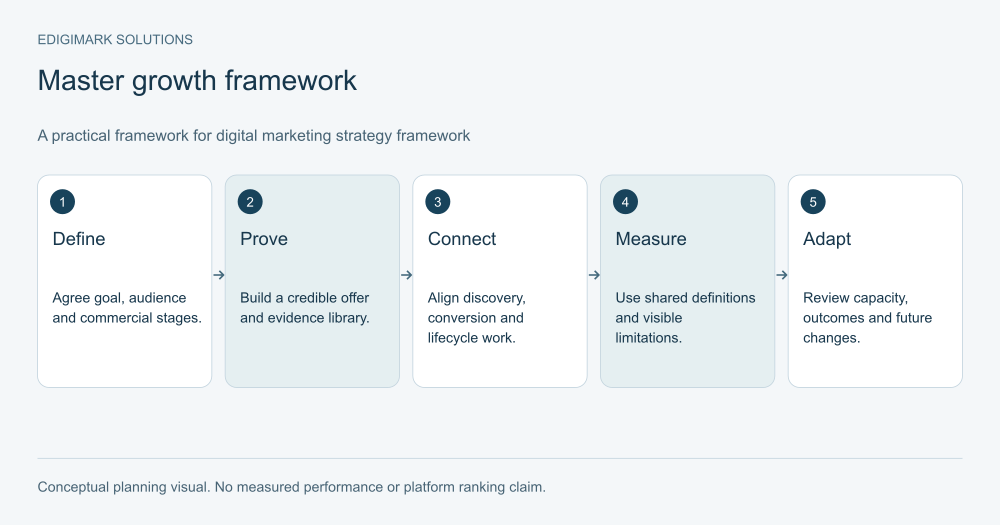
An editorial planning diagram; stages and examples are illustrative.
When does account-based marketing fit a SaaS business?
Consider account programs when the product serves a definable company segment, the evaluation involves several stakeholders and individual opportunities justify focused work. Sales must be able to act on the program. A marketing team cannot create a coordinated account experience if the receiving sales team lacks ownership or capacity.
Assess the economics before selecting tools. Estimate the effort needed to research accounts, develop content, coordinate outreach and support evaluation. Compare that with a realistic commercial opportunity using your own deal and retention evidence. Do not assume high contract value automatically means attractive economics if implementation demands are also high.
A hypothetical enterprise data platform may need to support technical, operational and procurement review. A simple self-service utility may be better served by scalable product education. Both can use account awareness, but the level of bespoke investment should match the decision.
How do you select SaaS target accounts?
Start with product fit and an observable buying problem. Relevant criteria may include operating model, existing systems, geographic support, company complexity and implementation capacity. Add known triggers when you have dependable evidence, such as a public platform migration announcement or an explicit enquiry.
Separate evidence from assumptions. A public hiring notice can suggest organizational change; it does not prove a company has a budget for your product. A third-party signal can prioritize research; it should not be presented to sales as a confirmed purchase project.
Create an account rationale for each priority company. Explain why the product may fit, what problem you can credibly help solve, which facts support the assessment and what remains unknown. Record an owner and review date. Remove accounts when their circumstances make the original rationale invalid.
HubSpot’s ABM setup documentation includes target-account, ideal-customer-profile tier and buying-role properties. Those fields are useful examples of the account and contact dimensions that need to remain distinct in a coordinated program.
Do not fill the target list to satisfy a volume goal. A smaller list with credible fit and available sales attention can be more actionable than a long list whose selection logic nobody can explain.
How should you tier an account program?
Use tiers to match effort to commercial relevance and evidence. A top tier can receive deeper research and tailored evaluation support. A segment tier can share resources around common needs. A broader eligible tier can receive scalable education without extensive custom work.
| Program level | Appropriate work | Required justification |
|---|---|---|
| Focused account | Specific research, stakeholder planning and tailored resources | Meaningful value, clear fit and owner capacity |
| Account segment | Shared use-case resources and coordinated outreach | Common problem and a coherent segment |
| Eligible market | Scalable education and demand capture | Relevant fit without sufficient evidence for bespoke effort |
These are suggested planning levels, not mandatory industry labels. The important rule is that custom work needs a reason. A new account should not enter the highest tier merely because a senior stakeholder is recognizable.
Review the tier after material changes. A promising account with no current project may move into a lower-effort education path. An eligible account that requests a technical assessment may warrant focused support. Tiering should follow evidence rather than remain fixed for the year.
How do you map buying committee engagement?
Identify the roles involved in the decision, the questions each role must answer and the evidence you can provide. A champion may understand the workflow problem. A technical reviewer may assess compatibility. A budget holder may examine scope and commercial risk. A procurement team may need contractual information.
Treat these as responsibilities rather than universal job titles. One person can hold several roles, and several people can share one role. Do not assume a visible senior title means that person owns the evaluation.
LinkedIn’s ABM training links account segmentation, buying-committee understanding, content and measurement. Apply that relationship by planning assets for the actual decision, rather than measuring success through exposure to one contact.
Build a stakeholder map with confirmed and unknown roles. Include how the team learned each fact. Avoid filling gaps with fabricated assumptions. An uncertain role is a research question, not a reason to send a confidently personalized message.
What does useful ABM personalization look like?
Personalization should make the decision easier. It can connect a verified operating context to a relevant use case, clarify implementation requirements or organize resources around a known question. Adding a company logo to a generic page provides limited decision value.
For a hypothetical SaaS platform supporting multi-location service operations, a segment resource can explain rollout considerations across locations. A focused account resource might address a compatibility question the prospect has actually raised. The first uses a common problem; the second uses authorized, specific information.
Do not imply you know an account’s private operational problems from public data alone. Phrase a hypothesis as a hypothesis. Explain why a resource may be relevant and offer an appropriate way to confirm fit.
Keep product facts consistent. Bespoke pages should not promise unsupported integrations or services to win attention. The product and implementation owners should approve any tailored capability explanation.
Edigimark’s digital marketing services can support coordinated messaging and content planning. The program still needs a verified account rationale and clear commercial ownership.
Which channels belong in a coordinated account program?
Select channels based on the people, context and task. Public educational content can support research. Relevant paid distribution can introduce a resource. Sales outreach can respond to a verified concern. Events and partner discussions can provide useful professional context. A focused landing page can organize evaluation information.
LinkedIn documents company targeting as a way to reach selected companies through its advertising platform. Platform targeting is one execution option; it does not substitute for account selection, content relevance or sales coordination.
Coordinate the messages and timing across channels. An active evaluation should not receive an unrelated acquisition promise while sales is discussing a specific scope. Multiple internal teams should not independently contact the same person with conflicting requests.
Use marketing automation services to support shared account state, suppression and useful follow-up where appropriate. Test exceptions involving existing customers, open opportunities and preference changes.
What should the account playbook contain?
The playbook needs an objective, account rationale, stakeholder map, relevant assets, outreach responsibilities, stage definitions and review rules. Keep it short enough to use in an actual account meeting.
Specify what counts as progression. A useful conversation with an implementation owner is different from an ad impression. A confirmed technical assessment is different from a downloaded introductory guide. The team should agree on evidence before interpreting activity.
For a hypothetical platform migration opportunity, the playbook may identify a supported source system, an operational problem and an unknown rollout owner. The first resource explains migration considerations. A follow-up invites the prospect to clarify the implementation context. The next stage requires an actual evaluation request rather than presumed intent.
Document stop and pause conditions. An incompatible requirement, a closed procurement process or an explicit decline should change the path. An account program that cannot stop consumes effort and risks an increasingly irrelevant experience.
How should the CRM support account-based marketing?
Keep company, contact and opportunity records connected but distinct. Contacts need buying roles and communication preferences. Accounts need fit rationale, ownership and program state. Opportunities need commercial stages, associated stakeholders and outcomes.
Define how parent and subsidiary companies are handled. A large corporate name may contain several purchasing units with different needs. Counting all activity at the parent level can conceal which entity is actually evaluating the product.
Deduplication and association rules matter. Multiple email domains, aliases or incomplete company names can fragment the account view. Review uncertain associations rather than forcing them into the most recognizable company.
CRM integration services can preserve these relationships across marketing and sales systems. Verify that an account’s commercial state remains authoritative when synchronization occurs. Stale campaign data should not overwrite an active opportunity stage.
What should ABM measurement report?
Report coverage, meaningful engagement, evaluation progression and commercial outcomes at the account level. Coverage asks whether the intended buying responsibilities are understood. Engagement asks whether relevant people interacted with useful resources. Progression asks whether the account reached a defined buying decision or next step.
Keep activity and commercial status separate. An account with several content interactions may still have no current project. An account with modest tracked activity may be in a serious evaluation through a partner or direct relationship. Recorded activity is an incomplete view of the buying process.
Compare cohorts carefully. Accounts selected because they already had active interest should not be used to claim that the program created all resulting pipeline. Document selection criteria, start dates and prior opportunity status.
Show investment as well as outcomes. Bespoke research, content, sales coordination and technical support all consume resources. A successful account program should be reviewed against the effort required, not only the headline contract value.
Data analytics services can help produce an account view with clear definitions and known coverage. Avoid treating attribution as proof that no deal would have occurred without the program.
How do you pilot the program without overbuilding?
Select a manageable group of accounts that meet written criteria and have available owners. Choose a common buying problem and a useful resource set. Confirm the data model, communication coordination and review process before buying additional tools.
Run an account review before launch. Can the team explain why each company is included? Are the stakeholder assumptions visible? Is there a relevant next action? Can sales handle the proposed response? If these questions are unanswered, a larger advertising budget will not make the program coherent.
During the pilot, inspect actual account stories. Which resource answered a useful question? Which assumption proved wrong? Where did a handoff fail? Which account should leave the focused tier? Keep these findings alongside the quantitative report.
Scale the parts that are repeatable. A segment implementation resource can support several accounts. A consistent role map can improve sales planning. Reserve custom production for decisions that truly require it. This protects both operating capacity and content quality.
What should an ABM review change next?
Use the review to decide whether to refine account selection, improve a decision resource, change channel coordination or resolve a data gap. Avoid labeling every disappointing result a need for more personalization. Sometimes the account is unsuitable, the timing is wrong or the offer does not address the problem.
Keep a record of the original hypothesis and the evidence that changed it. An account program improves through better judgement about fit and decisions, not through an ever larger collection of bespoke pages.
The first deliverable should be a usable account plan with named responsibilities and testable progression criteria. Contact Edigimark to assess whether account-based marketing fits your SaaS economics and build a focused pilot around credible buying opportunities.
How do you prevent account research from becoming speculation?
Use a short evidence ledger. For each account, record the observation, source, date, relevance to product fit and remaining uncertainty. A public statement about expanding locations may support an operational-growth hypothesis. It does not prove a procurement timetable or a confirmed software requirement.
Separate confirmed buyer information from public research and third-party signals. A question asked during an authorized evaluation carries a different meaning from an inferred interest score. The account plan should make that difference visible to everyone using it.
What belongs in a responsible account brief?
Include the company entity, supported use case, verified systems where known, account owner, current relationship, relevant buying roles and the next useful question. Leave unknown fields explicitly unknown. A complete-looking brief filled with assumptions can cause confidently irrelevant outreach.
Explain why each proposed resource is useful. A technical guide may help answer a compatibility question; a rollout checklist may help an operations owner define responsibilities. If the only rationale is that the company belongs to a target list, the resource may need more thought.
How should the program handle a change in fit?
Review material changes promptly. An account might adopt an unsupported system, change ownership, pause a project or become an existing customer. Update the tier and communication path rather than allowing old targeting to continue automatically.
Keep a reason for the change so historical reporting remains interpretable. Removing an unsuitable account should not erase the fact that the original selection criteria included it. The selection process can improve only when mistakes remain visible as learning evidence.
What is the minimum useful account meeting?
The owner explains the current buying situation, the most important uncertainty and the next useful action. Marketing identifies the available resource and any factual review required. Sales identifies the appropriate conversation and response path. Analytics flags missing associations or unreliable status information.
End with one or two accountable actions. A long discussion about engagement scores is less useful than resolving a specific evaluation question or correcting an account assumption. The meeting should improve the buyer’s decision experience and the team’s judgement about where to invest next.
Frequently asked questions
Does account-based marketing require an expensive platform?
No. A pilot can begin with dependable CRM records, shared account plans and useful content. Specialized platforms may help particular tasks, but purchase them after defining the workflow and data requirements.
How many SaaS target accounts should you select?
Choose a number the team can research, support and review properly. There is no universal target. The appropriate scale depends on tier, sales capacity, evaluation complexity and the effort each account requires.
Is company-targeted advertising enough to count as ABM?
It is one execution tactic. A coordinated account program also requires a fit rationale, buying-role understanding, relevant resources, shared sales ownership and account-level outcome review.
Should every account get custom content?
No. Reuse accurate resources for shared needs. Bespoke content is justified when it addresses a specific, verified decision that standard material cannot answer adequately.
Can ABM support existing SaaS customers?
Yes, when an expansion or additional use case warrants coordinated evaluation. Keep expansion opportunities distinguishable from new-customer acquisition and coordinate with customer-success ownership.
Put the ideas to work
Explore our connected growth services →