ABM vs demand generation is a choice about how to organize investment. Account-based marketing concentrates coordinated effort on selected companies; broader demand generation develops and captures interest across a relevant market. Choose according to account concentration, buying complexity, commercial economics and operating capacity. Many businesses benefit from a hybrid B2B strategy with clear responsibilities for both.
The wrong starting point is a fashionable label. A business with a small set of valuable, complex opportunities needs a different operating model from one serving many similar buyers through a self-service product. The decision should follow those conditions rather than a vendor’s category pitch.
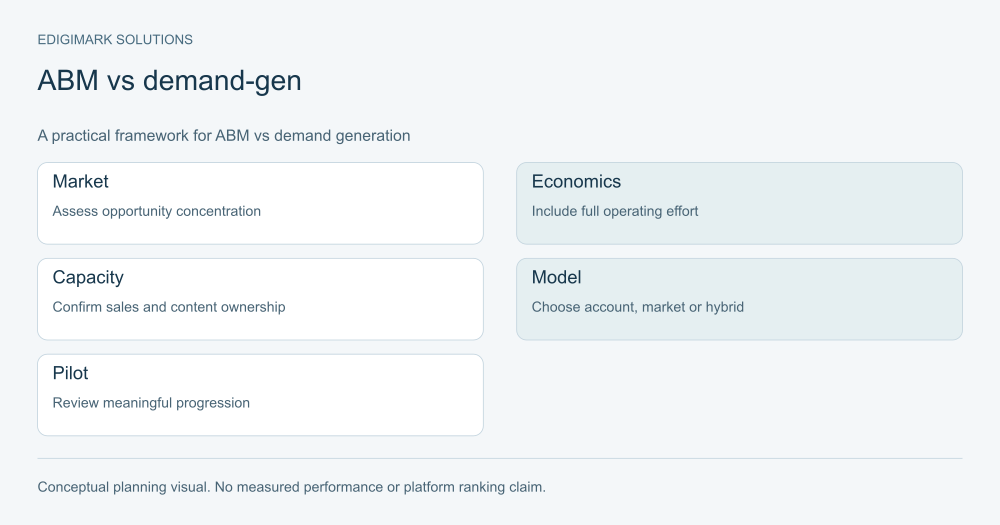
An editorial planning diagram; stages and examples are illustrative.
What is the difference between account-centric marketing and market-wide demand?
Account-centric marketing starts with companies selected for a credible reason. It coordinates stakeholder research, relevant resources and sales activity around their buying decisions. Market-wide demand starts with a segment and its recurring problems, then uses content and distribution to reach suitable buyers across that segment.
Salesforce’s account-based marketing introduction presents ABM as a way to generate demand with aligned sales and marketing. This helps explain why the approaches overlap instead of forming mutually exclusive categories.
A hypothetical enterprise integration platform might select companies with a supported architecture and a complex rollout problem. A simpler collaboration product might educate a broad group of small teams and capture self-service evaluations. Both create demand; the unit of planning and level of coordination differ.
Which conditions favor an account program?
An account program is more plausible when the eligible market is identifiable, individual opportunities justify concentrated work and buying decisions require coordination across roles. The team also needs enough access, product knowledge and sales capacity to provide useful support.
Account concentration matters. If a meaningful share of the potential business lies within a relatively limited group of companies, it may be practical to maintain focused account plans. If the market contains many similar small buyers, extensive custom work may cost more than it contributes.
Commercial value alone is insufficient. Include implementation effort, sales-support cost, expected retention and delivery constraints when examining ABM investment. A large contract can still be unattractive if servicing it consumes disproportionate resources.
Choose focused work because the buyer decision requires it. If a standard integration resource answers the question, reuse it. If a known stakeholder needs a specific compatibility explanation, tailored support may be justified.
Which conditions favor broader demand generation?
Broader demand generation fits a market where common problems can be addressed through reusable resources and many eligible buyers can encounter the offer. It is useful when the team needs to establish understanding, capture existing investigation or support a scalable evaluation route.
A business can still segment the market carefully. “Broad” should not mean indiscriminate. Industry, operating model, supported systems and buying circumstances can guide relevant content and distribution without requiring a bespoke account plan for every company.
The approach works best when the website explains fit and offers a useful next action. A scalable campaign that produces many incompatible enquiries reveals a targeting or positioning problem. Volume is not the definition of successful market-wide demand.
Edigimark’s digital marketing services can support this segment-and-channel planning. The important first decision is which buying problem and audience the reusable system serves.
How do the models compare operationally?
| Decision | Account program | Broader demand program |
|---|---|---|
| Planning unit | Selected company or account segment | Audience segment and buying problem |
| Research depth | Greater account and stakeholder detail | Repeated needs across the market |
| Content | Shared resources plus justified tailored work | Reusable education and evaluation assets |
| Sales coordination | Required for focused account actions | Required at qualification and handoff |
| Data view | Account, roles and associated opportunities | Cohorts, enquiries and commercial outcomes |
| Main capacity risk | Excessive bespoke effort | Excessive reach with weak fit |
These are tendencies, not fixed platform rules. A broad program can include account-based targeting, and an account program can rely heavily on publicly available educational resources.
How should you compare the economics?
Estimate the full operating cost of each approach using your own scope. Account work can include research, stakeholder planning, custom resources, coordination meetings and technical support. Broad demand work can include reusable content, distribution, landing pages, lifecycle operations and analytics.
Compare expected contribution over a defined period and state the assumptions. Do not assume every selected account will buy or that every captured lead has the same value. Use your actual acceptance and opportunity evidence when available; otherwise label the figures as planning scenarios.
Include capacity costs. A focused account campaign can consume sales time even when little advertising spend is visible. A broad campaign can create a qualification burden even when cost per submission looks low. Both need an assessment of the work created after the initial interaction.
Separate booked pipeline from revenue. An opportunity value is a commercial estimate attached to an evaluation, not a completed return. Include the likelihood and timing assumptions when using pipeline to assess investment.
What measurement errors distort ABM vs demand generation?
Selection bias is a major issue. A program that selects companies already showing active interest should not claim it created all subsequent pipeline. Record prior relationship and opportunity status at the program start.
Unit confusion is another issue. A broad report may count people while an ABM report counts accounts. Several people in one buying group should not become several independent opportunities simply to make the program look larger.
Different observation periods can also mislead. Complex account evaluations may take longer than straightforward self-service actions. Compare outcomes over periods suited to the buying motion while monitoring near-term learning and execution quality.
Data analytics services can help create consistent definitions for these comparisons. Keep unknown attribution coverage visible and distinguish recorded influence from evidence of incremental impact.
How can a hybrid B2B strategy work?
Build a reusable demand foundation, then add focused support where account economics and decision complexity justify it. Public problem explanations, use-case resources and implementation guides can serve the market and selected accounts. A focused program adds stakeholder context and coordinated action.
Define movement between the paths. A suitable company responding to a broad campaign may become a focused account when it requests a complex evaluation. A named account with no current project may move into a scalable educational path. The change should follow evidence, ownership and preferences.
Keep one source of product truth. A tailored account page should not make a stronger capability claim than the standard documentation. A broader campaign should not promise a simpler implementation than the focused sales team knows is realistic.
Use marketing automation services to coordinate lifecycle states and communication priorities. The automation should support shared operating rules rather than create independent sequences for every department.
What does a practical decision worksheet include?
List the eligible audience and estimate how concentrated the commercial opportunity is. Identify the typical buying responsibilities and implementation requirements. Describe the resources that can be reused and the questions that require individual support.
Record the team’s available capacity. Include marketing production, sales follow-up, product expertise and implementation assistance. A strategy that depends on unavailable people is not made feasible by buying a new targeting platform.
Write the evidence supporting account selection. Is fit based on verified systems, operating model and a recurring problem, or only a recognizable company name? For broader demand, write the segment exclusions and the reason the message should be relevant.
Then specify the next test. A focused pilot can assess whether coordinated resources help selected accounts reach a meaningful evaluation. A segment test can assess whether a clear buying problem attracts suitable enquiries. Neither should begin with a promise of a universal conversion rate.
How should the CRM connect the two approaches?
Use shared company and contact associations, qualification criteria and opportunity definitions. Focused accounts need an owner, rationale, stakeholder view and program state. Broad enquiries need preserved request context and an appropriate follow-up route.
When a contact moves into an active account evaluation, communication priorities should change. Generic acquisition messaging can conflict with a coordinated commercial discussion. Existing customers and open opportunities also need suppression rules that prevent contradictory offers.
CRM integration services can connect the records and stage authority across systems. Define duplicate handling and parent-subsidiary relationships before interpreting account engagement. A fragmented company view can make one evaluation look like several unrelated journeys.
What should a pilot review inspect?
Review the buying decisions supported, not only the campaign activity delivered. For focused accounts, inspect whether the right questions were understood and whether coordinated actions produced useful next steps. For broad demand, inspect audience fit, evaluation quality and the clarity of the offer.
Examine examples that did not progress. Was the account unsuitable? Did the audience misunderstand the promise? Was a technical question unanswered? Did sales fail to respond? These explanations indicate different actions and should not be collapsed into “the campaign underperformed.”
Keep the original selection and channel hypotheses visible. If the program changes, record why. This makes later commercial reporting more honest and helps the team understand which part of the strategy improved.
When should you change the investment balance?
Change it when the constraint changes. A market-wide program may uncover a segment where individual accounts need more coordination. A focused program may reveal repeated questions that deserve reusable resources. A sales-capacity constraint may require improving qualification before increasing either form of reach.
Do not expand bespoke production merely because it is visible. Ask whether the tailored material answered a decision that standard content could not. Do not expand broad distribution merely because it produces cheap attention. Ask whether the relevant audience is progressing into useful evaluation.
Conversion rate optimization services can assess whether both paths have suitable destinations and actions. A clear route for active buyers should coexist with useful resources for people still researching.
What is the recommended starting point?
Begin with the market, buying problem and delivery model. Build the minimum reusable resource set and a reliable enquiry path. Add focused account support for companies whose fit, value and decision complexity justify it. Write the criteria for that addition so sales and marketing apply them consistently.
For a hypothetical SaaS business serving both smaller teams and enterprise operators, the smaller segment may use public education and a representative trial. The enterprise segment may require a technical assessment and coordinated stakeholder resources. Both paths share product truth and commercial definitions, while their operating work remains proportionate to the decision.
A useful plan names the audience, channel responsibilities, account criteria, capacity requirements and review evidence. Contact Edigimark to compare those conditions and select an investment model your team can operate well.
What would a hybrid strategy brief look like in practice?
Consider a hypothetical software provider with two eligible segments. Smaller operators share a relatively straightforward workflow and can evaluate the product with standard guidance. Larger multi-location organizations require technical review, rollout coordination and several commercial approvals.
The reusable demand foundation explains the workflow problem, suitable use cases, supported systems and evaluation process. Smaller operators reach a self-service or lightly assisted path. Larger organizations can request a scoped assessment and, when fit is confirmed, enter a focused account program.
The account criteria include operating complexity, a supported requirement, a responsible owner and sufficient commercial relevance to justify coordination. A recognizable brand name is not enough. The program also records uncertainty: some selected companies may have no current project, and they should not receive the same intensity as active evaluators.
How is ownership divided in this example?
Marketing maintains the shared explanation, distribution plan and account-resource inventory. Sales owns the active commercial relationship and acceptance decisions. Product and implementation teams review capability and rollout claims. The CRM owner maintains account associations and stage authority.
An enquiry from a broad campaign does not automatically trigger bespoke content production. The team first checks fit, complexity and the buyer’s actual question. If the standard material answers it, the buyer receives that resource. If a specific evaluation requires a tailored explanation, a named owner scopes the work.
What evidence changes the investment balance?
If many eligible smaller buyers reach useful evaluations through reusable content, the team may expand that segment’s distribution. If suitable enterprise evaluations repeatedly stall on the same technical question, the team may build a shared implementation resource before funding more account outreach.
If focused accounts consume substantial support without a credible buying situation, review selection and tiering. If broad enquiries are incompatible, review the promise and audience. These findings support different changes; neither automatically means that the other strategy is superior.
What belongs in the quarterly decision record?
Record the original audience and selection assumptions, resources delivered, operating effort, meaningful progression and outstanding uncertainty. Include reasons for removing accounts or stopping tests. Historical decisions should remain understandable after the team changes the plan.
Use the record to decide where the next unit of effort has a useful job. That unit might be a new decision resource, cleaner qualification, better account coordination or a bounded distribution test. A clear commercial task provides a stronger rationale than a target percentage allocated to a fashionable channel category.
This hybrid brief is deliberately modest. It does not require an elaborate technology stack before the team can begin. It requires a shared audience model, accurate resources, dependable handoffs and disciplined review of the evidence those activities produce.
Frequently asked questions
Is ABM a replacement for demand generation?
No. It is an account-centered way to coordinate relevant demand work. Many account programs depend on shared educational resources and broader market activity.
Should startups always begin with broad demand generation?
Not necessarily. A startup with a small eligible market and complex, high-value evaluations may need focused account work early. The decision depends on the offer, economics and capacity rather than company age alone.
Does ABM guarantee larger deals?
No. Account selection may concentrate attention on larger opportunities, but results depend on fit, product value, competition and the buying process. Selection itself does not prove the program caused deal size.
Can both programs use the same content?
Yes. Accurate problem, comparison and implementation resources can support both. Tailor additional material when a specific decision needs information the shared resource cannot provide.
What if there is not enough data to compare returns?
Use explicit planning assumptions and a bounded pilot. Measure execution, audience fit and meaningful progression first, then update the commercial model as evidence accumulates. Avoid presenting uncertain estimates as observed ROI.
Put the ideas to work
Explore our connected growth services →