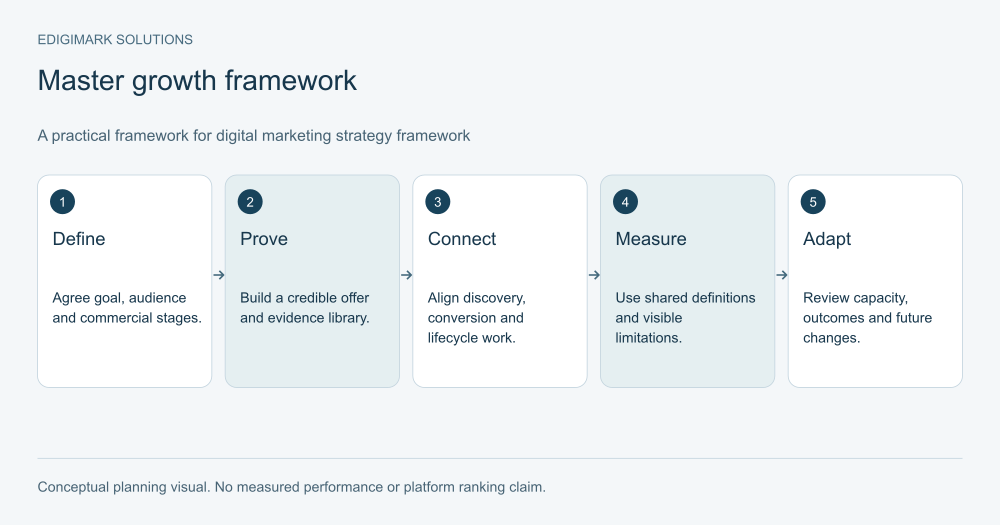
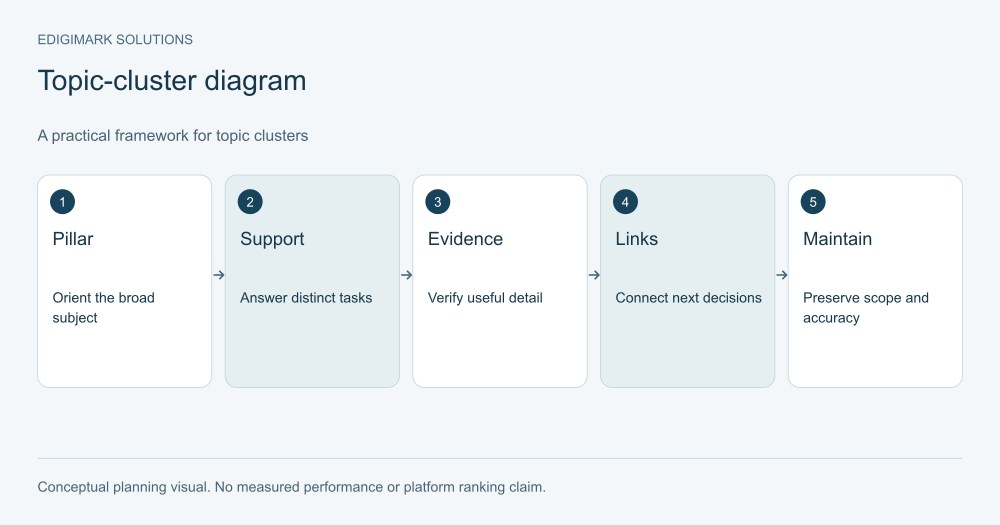
Topic clusters organize a broad customer subject into a useful overview and distinct supporting resources connected by relevant internal links. The pillar page helps readers understand the subject and choose their next question. Supporting pages answer narrower tasks in enough detail to be useful. The structure should improve navigation and coverage; it does not guarantee a ranking simply because it resembles a diagram.
The most important design choice is page purpose. A cluster of near-identical articles is still repetitive content. A good cluster gives each page a clear audience, decision, evidence requirement and relationship to the rest of the site.
In this guide
- What is a pillar page in a topic cluster strategy?
- How do you choose supporting pages for topic clusters?
- What should a topic-cluster page map contain?
- What does a useful cluster example look like?
- How should cluster internal links work?
- Do all supporting pages need to link to each other?
- How do you prevent topic overlap and cannibalization?
- What should useful pillar pages include?
- How do you sequence topic-cluster production?
- How do you evaluate content architecture quality?
- How should you measure a topic cluster?
- What should a cluster maintenance review include?
- How do you create a useful cluster brief?
- How do you repair a cluster built around keyword variations?
- What should a topic-cluster acceptance review check?
- Frequently asked questions
- Build a cluster that readers can use
What is a pillar page in a topic cluster strategy?
A pillar page is an overview that helps a reader understand a broad subject and find the relevant detail. It should provide enough substance to orient the audience, then connect to deeper resources where they help. A list of article titles alone may function as an index, but it does not necessarily teach the subject.
Choose a scope that your business can cover credibly. “Everything about technology” is too broad for a small specialist site. “Planning a CRM integration” can be a coherent subject if the company can explain requirements, data mapping, ownership and failure handling.
The pillar’s role differs from a service page. A service page explains the offer and how an engagement works. A pillar helps people understand a subject. They can connect, but forcing the overview to become a sales page can weaken its educational purpose.
Use a title and opening that make the scope clear. The reader should know whether the page is a planning guide, a technical reference or a broad introduction. A “complete guide” promise needs appropriate depth and boundaries.
How do you choose supporting pages for topic clusters?
Start with distinct customer decisions rather than a list of phrase variations. Each proposed page should answer a task that benefits from its own explanation. Prerequisites, alternatives, implementation and troubleshooting can all be meaningful supporting resources when their evidence differs.
Write a purpose sentence for each page. If two sentences are effectively identical, review overlap before writing. A page about choosing record ownership can differ from a page about resolving synchronization conflicts, even though both discuss integration data.
Check whether the evidence exists. A tutorial needs current tested steps. A comparison needs defined criteria and accurate facts. A planning guide may need subject-expert review. A cluster map should reveal these dependencies rather than label every row ready for publication.
Keep some questions within the pillar when they need only a short answer. Not every subheading requires its own URL. Split a resource when the task, audience or detail genuinely warrants separate treatment.
What should a topic-cluster page map contain?
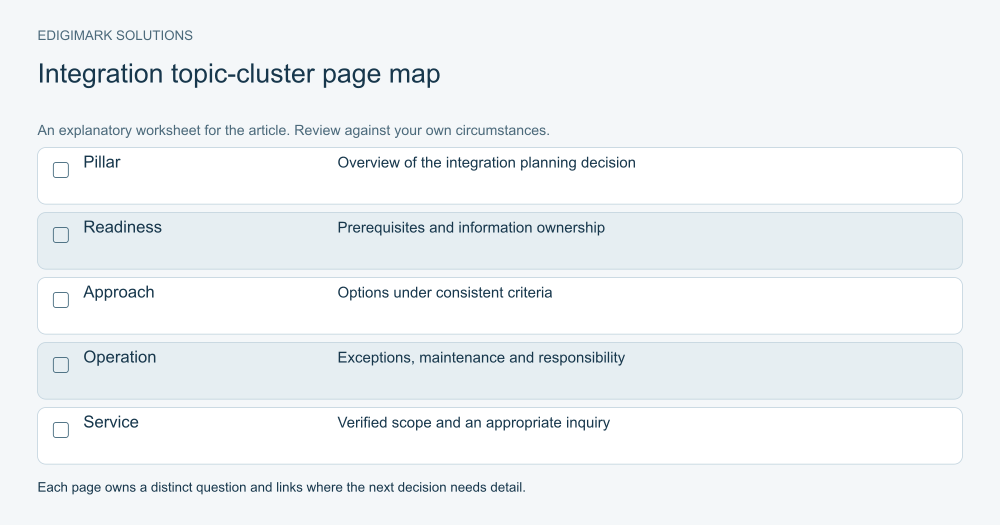
Create a record with the broad subject, pillar owner, supporting task, primary keyword, evidence packet, existing URL, proposed URL and related destinations. Include a scope note that distinguishes nearby pages.
Keep planned and published resources separate. A proposed slug is not a live link. Store the relationship in the map and add the contextual link after the destination is published and checked. This prevents a planning diagram from generating broken navigation.
Add the next useful business step. The step may be another explanation, a service scope page or a qualified inquiry. It should match what the reader has learned rather than force every supporting page into the same call to action.
Include review ownership. A cluster is an ongoing content architecture, not a one-time publishing campaign. Someone needs to know which facts and links change when the offer evolves.
What does a useful cluster example look like?
Consider a hypothetical company discussing CRM integration planning. The pillar introduces the goals, data responsibilities, process and common risks. It gives a reader a way to decide which detailed resource to inspect next.
| Supporting resource | Reader task | Evidence needed | Boundary |
|---|---|---|---|
| Integration prerequisites | Confirm readiness before configuration | Approved process and access requirements | Not a connector tutorial |
| Field mapping decisions | Decide which system owns each field | A verified example map and ownership rules | Not a general data-cleaning guide |
| One-way versus two-way updates | Compare synchronization models | Defined criteria and failure scenarios | Not a universal recommendation |
| Conflict handling | Understand what happens when records disagree | Current documented behavior or a planning framework | Not an invented product capability |
| Implementation scope | Evaluate professional support | Actual deliverables and exclusions | Commercial service resource |
The pages share a subject but answer different questions. The pillar helps readers see the relationships. The service resource can connect the planning knowledge with a real offer, such as CRM integration, when the fit is clear.
The example is a planning model, not a claim about published pages or client outcomes. A business should adapt it to its actual capability and audience before producing the resources.
How should cluster internal links work?
Use links where they help a reader continue the task. The pillar should point to useful supporting detail, and a supporting page can return to the overview when the broader context matters. Sibling pages can connect when one question naturally leads to another.
Google’s link documentation explains crawlable links and descriptive wording. The practical objective is a navigable site. Do not add links solely to recreate a perfectly symmetrical diagram if they interrupt reading or point to irrelevant detail.
Give each link a reason. A section discussing record ownership can link to a detailed mapping resource. A section explaining repeated manual handoffs can connect to marketing automation if implementation support is the relevant next step.
Keep links maintainable. If a destination changes scope, review incoming anchors and surrounding text. A URL can still work technically while no longer fulfilling the promise of the link.
Do all supporting pages need to link to each other?
No. A dense network can make an article harder to read without improving the user’s path. Choose links according to related decisions and useful context. The cluster is a conceptual organization, not a quota for every possible connection.
For the integration example, a prerequisite guide may link to field mapping and service scope. It may have no reason to link to a narrow troubleshooting article unless that issue affects readiness. A comparison can link to conflict handling because the failure model helps choose an approach.
Review the links as a reader. Can you predict the destination from the anchor? Does opening it resolve the uncertainty the sentence creates? If the link feels like an insertion to satisfy a checklist, reconsider the placement.
Use web development when templates, navigation or hub components need adjustment. Define the intended journey and public acceptance checks instead of issuing an abstract request to improve architecture.
How do you prevent topic overlap and cannibalization?
Keep ownership and scope visible. Each page should have a distinct central task, and updates should preserve that purpose. If editors repeatedly add the same explanations to several resources, the boundaries may need revision.
Inspect overlap in the actual content, not just the keyword column. Different phrases can lead to nearly identical articles. Conversely, two pages can share a term while serving genuinely different tasks, such as a service offer and a configuration reference.
When overlap is substantial, consider consolidation or clearer differentiation. Preserve useful information, choose the appropriate maintained resource and coordinate URL changes with the website owner. Do not merge pages blindly based on one tool label.
Document decisions so a future writer does not recreate a retired article. A useful note explains which page now owns the question and where narrower information belongs.
What should useful pillar pages include?
Open with a direct definition or planning answer, then explain the main decisions within scope. Give enough context to make the supporting links meaningful. A reader should not need to open every linked page just to understand the overview.
Use a comparison, process diagram or decision table where it clarifies the subject. Keep visuals accurate and label conceptual models. A cluster diagram shows relationships; it is not evidence of traffic growth.
Explain limitations and prerequisites. A pillar can become misleading if it presents a broad method without the conditions that change it. Put the important qualifications near the relevant recommendation, not only in a final FAQ.
End with a useful next action. The action may be to assess readiness, inspect a detailed resource or discuss scope. The pillar should support the reader’s reasoning rather than behave as a long advertisement.
How do you sequence topic-cluster production?
Begin with the broad scope and the highest-value tasks. You do not need to publish an entire cluster simultaneously. A useful overview and a few reliable supporting resources can establish a maintainable foundation.
Resolve evidence dependencies first. If the comparison requires technical review, schedule it before drafting. If the service page lacks clear scope, fix that destination before sending every article toward it.
Publish incrementally and verify each resource. Confirm content, headings, visuals and live links. Add contextual connections as destinations become available. Keep the map updated with actual URLs rather than assuming the planned slug was used.
Reserve maintenance capacity. A cluster with several platform-specific tutorials can become outdated quickly. Production scope should reflect the team’s ability to review facts and behavior over time.
How do you evaluate content architecture quality?
Ask whether a new reader can locate the appropriate level of detail. The overview should orient them, supporting pages should fulfill specific tasks and commercial resources should explain the offer. Follow a few realistic journeys on mobile as well as desktop.
Use Google’s SEO Starter Guide as a primary reference for general site organization considerations. Avoid claiming that a particular cluster shape is an official ranking system. The method is useful when it creates clearer information and navigation.
Listen to customer feedback. If people repeatedly ask where to find an answer that exists, the navigation may be weak. If they find a page but misunderstand the boundary, the explanation may need refinement.
Keep the assessment practical: missing resource, unclear distinction, broken link or confusing next step. These observations can become tasks with owners and verification.
How should you measure a topic cluster?
Assess the resources by their roles before combining their totals. The pillar may support broad understanding; a comparison may support evaluation; a service page may support qualified inquiries. One aggregate traffic number cannot establish whether each role is working.
Use data analytics to define relevant page groups and events. Examine useful transitions, inquiry fit and feedback. Keep attribution limits clear, especially where a buyer returns through several channels.
Record the publishing and update dates alongside campaigns and site releases. If performance changes, inspect the specific pages and audience mix rather than attributing the whole movement to the cluster diagram.
The next decision might be to fill an evidence gap, improve navigation or clarify a commercial destination. A measurement review should lead to work, not merely confirm that the library has grown.
What should a cluster maintenance review include?
Review facts, scope and links together. A product change can affect several pages in different ways. The comparison may need a new limitation, the tutorial may need new steps and the service page may need revised deliverables.
Inspect overlap after substantial updates. Supporting pages can gradually converge when editors add broad introductory material to each. Restore the distinct task or consolidate where appropriate.
Keep a small change log with the reason for each update and the reviewer. This helps the next owner understand which information was checked and which assumptions remain provisional.
How do you create a useful cluster brief?
Write the broad customer subject, primary audience and overview promise first. Then list supporting decisions with their distinct evidence requirements. A writer should understand why a question deserves a separate resource and what the pillar should say about it.
Include planned relationships rather than a mandatory link quota. State which resource answers the prerequisite question, which explains alternatives and which describes the offer. That model gives editors room to place links where the explanation creates a genuine need.
Check the brief against production capacity. A proposed cluster of complex technical resources may require more subject review than a small team can maintain. Start with reliable coverage and expand when the next task has evidence and an owner.
How do you repair a cluster built around keyword variations?
Imagine an existing library with several articles about “automation benefits,” “advantages of automation” and “why automate marketing.” Read their purpose sentences and actual explanations. If they all serve the same task, the problem is duplication rather than missing links.
Identify the strongest useful material and the question the business should own. One overview may explain the benefits and conditions. A distinct resource may help choose the first process. Another may explain governance or failure handling. These tasks justify separation because the reader’s decision and evidence differ.
Do not preserve every old URL solely because it once appeared in a publishing plan. Review current usefulness, incoming references and appropriate consolidation with the website owner. Preserve important information and verify the resulting navigation.
Then revise the map so future briefs cannot recreate the same overlap. The purpose note should describe the decision, not merely assign a slightly different keyword. Editors need to know where a new question belongs before producing another page.
What should a topic-cluster acceptance review check?
Confirm that the pillar supplies a meaningful overview and that supporting resources fulfill the tasks their links promise. Read headings and openings together to detect conflicting scope. Follow contextual links and verify their public destinations.
Check whether a reader can move from a broad question to a useful detail without encountering an unexpected sales pitch or another general introduction. The supporting resource should add the promised depth, not repeat the pillar in different words.
Review mobile navigation and diagram readability. A hub card or cluster graphic may look clear on a large canvas but fail to communicate relationships in a narrow layout. The text and links should still work without relying entirely on the visual.
Record unresolved gaps with owners. A missing technical fact belongs with the subject expert; a broken destination belongs with the website team; a scope conflict belongs with the editor. This final review turns the cluster from a diagram into a verified information structure.
Frequently asked questions
Do topic clusters guarantee Google rankings?
No. They organize resources and links; they do not create a guaranteed ranking outcome. Their value depends on distinct useful content, reliable delivery and relevance to the intended audience.
How many supporting articles should a cluster have?
Use the number needed to answer meaningful distinct tasks. A fixed quota can create repetitive pages. Keep short related explanations within the pillar when a separate resource would add little value.
Can an existing service page be the pillar?
It can serve as a central resource when the scope and audience fit, but an educational overview and a commercial offer often have different purposes. Make the primary task explicit before combining them.
Should we publish the pillar first?
Choose a sequence that avoids empty promises and broken links. You can publish an overview with available detail, then expand it as supporting resources are verified. Keep unpublished destinations out of live navigation.
What is the first step for an existing blog?
Inventory the pages, assign purpose sentences and identify overlap or missing decisions. You may find that updating and connecting existing resources is more useful than commissioning a new series immediately.
Build a cluster that readers can use
Choose a coherent subject, give each page a distinct task and connect resources where the next decision requires them. Edigimark’s digital marketing services can help align that architecture with acquisition priorities. Contact the team with your existing pages and audience to plan a maintainable cluster.