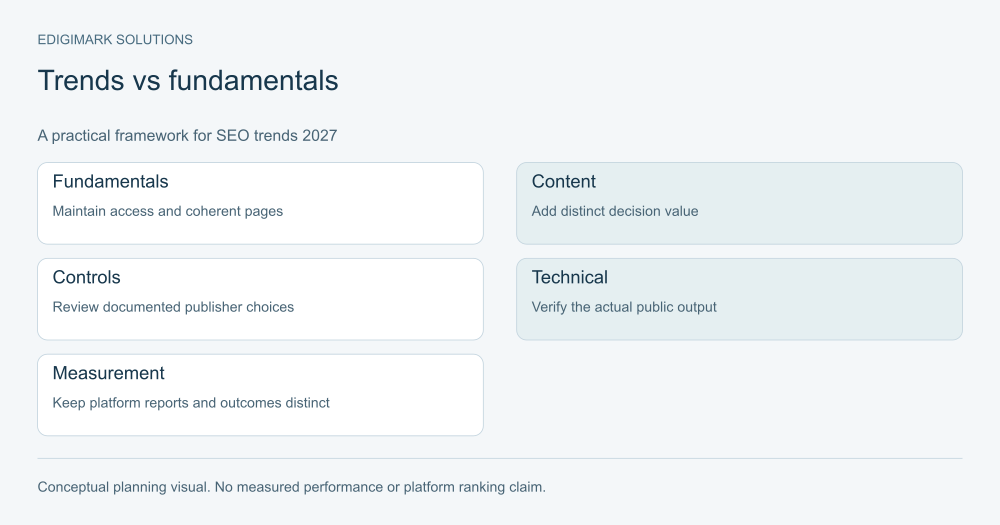
SEO trends 2027 are best approached through current evidence and durable search fundamentals. Prepare for more varied search presentation, clearer publisher controls and more demanding evaluation of useful content, while continuing to maintain technical access, accurate information and coherent page structure. Treat future interface and algorithm changes as uncertainties to monitor, not facts already known.
This outlook is written using information available in October 2026. It separates current documented features from 2027 SEO planning recommendations. No tactic can guarantee ranking, indexing or selection in a generated answer.

In this guide
- SEO trends 2027: what is changing in the search environment?
- Which durable SEO fundamentals remain worth funding?
- How should publisher controls influence 2027 SEO planning?
- Which SEO content priorities support better buyer decisions?
- How should technical teams handle headless and JavaScript sites?
- What should AI-assisted SEO work prioritize?
- How should SEO reporting distinguish appearances, visits and outcomes?
- Which SEO risk priorities belong in the annual plan?
- What should a practical SEO roadmap look like?
- How should an SEO roadmap remain useful under different 2027 scenarios?
- How can a 2027 SEO planning worksheet separate facts and hypotheses?
- Which SEO risk priorities deserve a concrete review?
- How would a practical SEO roadmap sequence the year?
- What should an SEO review show leadership?
- How should content and technical owners validate completed SEO work?
- Frequently asked questions
SEO trends 2027: what is changing in the search environment?
Search can present generated explanations alongside or within conventional discovery routes. A page may support a synthesized answer, attract a direct visit or help a user verify information encountered elsewhere. These are different visibility events and need different interpretations.
Google’s generative-search guidance continues to connect its features with search foundations. The useful planning response is to improve the resource and technical system, rather than treating AI search as a reason to abandon SEO.
Avoid forecasting exact traffic changes without audience evidence. Query mix, market, interface and task all matter. Use the reports and actual commercial paths available to your site.
Which durable SEO fundamentals remain worth funding?
Maintain accessible public pages, accurate titles, appropriate indexing signals, coherent canonicals and relevant internal links. Make sure the content explains the reader’s task and the site offers a useful next step.
Google’s SEO Starter Guide remains a useful baseline. The planning priorities are not novel merely because the year changes: a broken conversion page or inaccessible resource still affects the usefulness of search discovery.
Prioritize important commercial and implementation pages. A visitor should understand who the offer serves, what it requires and what happens after an enquiry. The next investment should follow a real gap rather than a fashionable label.
Digital marketing services can connect these priorities with audience and channel goals, while web development services supports the implementation.
How should publisher controls influence 2027 SEO planning?
Review controls according to their documented purpose. Google’s Search generative AI control was rolled out worldwide by August 31, 2026, and manages inclusion in specified generated Search features. It is distinct from training and general Search exclusion controls.
Treat a control change as a deliberate publisher decision. Understand the affected properties, inheritance and commercial implications before applying it. Do not use a generic instruction about “blocking AI” when different services and purposes require different settings.
Document the choice, responsible owner and review evidence. Check current official guidance before implementation because the affected feature list and product behavior can evolve.
This is an existing control to account for, not a prediction that it will first appear in 2027.
Which SEO content priorities support better buyer decisions?
Develop resources that add a distinct explanation, original evidence or decision framework. A page should help the reader understand scope, compare approaches or prepare implementation. Fluent summaries of familiar advice are easy to produce but may add little useful value.
Google’s people-first content guidance provides a useful self-assessment. Review the actual contribution and completeness rather than adopting a preferred word count or production label.
Consolidate overlapping intent. Different query wording can represent the same reader decision. Build separate resources when the task differs, not merely because another phrase is available.
Maintain a claim ledger for facts likely to change. Capability, price and policy statements need current sources and owners. Clearly label illustrative examples and avoid invented first-hand experience.
How should technical teams handle headless and JavaScript sites?
Verify the public output rather than assuming the CMS editor is the final page. A title, description or canonical saved in a plugin must be correctly delivered by the frontend. The live route should show the intended content, headings, images and metadata.
Google’s canonical documentation explains canonical signals and their use. A headless architecture needs coherent public URLs and implementation, not a CMS-domain canonical accidentally attached to the public article.
Test important templates and representative pages. Confirm status codes, metadata consistency, internal links and conversion behavior. When an architecture changes, review these outputs together because one template issue can affect many pages.
Web development services can support this verification and reviewed fixes. A plugin score is one editorial aid; it does not prove the public frontend has implemented every intended signal.
What should AI-assisted SEO work prioritize?
Use bounded assistance for organizing research, reviewing briefs and investigating exports. Supply dependable context and require source support. Important findings need factual and technical verification before implementation.
Do not invent demand metrics or generate one page per minor query variation. AI makes production easier; it does not create genuine expertise, commercial fit or user value automatically.
AI-powered solutions can help define tasks, evaluation cases and authority boundaries. Keep drafting, analysis and site changes as distinct responsibilities.
Measure whether the workflow improves useful accuracy and review effort. Generated volume alone is not an SEO outcome.
How should SEO reporting distinguish appearances, visits and outcomes?
Use the available platform-specific reports and keep their definitions visible. Google’s Generative AI performance report provides a documented view for its own generated Search features. It is not a universal report for all AI services.
Separate impressions, mentions, citations, referrals and commercial actions. A citation does not necessarily produce a visit, and a visit does not necessarily represent a useful enquiry. Define each metric before comparing periods.
Connect search with commercial outcomes through dependable records. Preserve unknown source coverage and buyer-reported discovery where appropriate. Avoid presenting attribution as complete proof of causal contribution.
Data analytics services and CRM integration can support these joins and definitions.
Which SEO risk priorities belong in the annual plan?
Review technical access, content accuracy, duplicated intent, inconsistent business facts, weak conversion paths and uncertain reporting. These are reviewable conditions that can affect the usefulness of the site across several discovery routes.
Do not respond to uncertainty by seeking inauthentic mentions or publishing unnecessary files described as universal AI requirements. Check tactics against current primary documentation and the reader’s experience.
Preserve author and review claims truthfully. A page should not imply a subject-matter review or product test that did not occur. Trust signals are useful only when they represent actual facts.
Conversion rate optimization services can examine whether search visitors receive a clear, truthful exchange when they reach the commercial destination.
What should a practical SEO roadmap look like?
Begin with an inventory of important pages, intended reader tasks and current technical findings. Identify shared template issues and neglected buying questions. Fix the largest relevant gaps before adding new content indiscriminately.
For each item, write the problem, proposed change, responsible owner and verification required. A canonical repair needs a live output check. A content update needs source and reader-task review. A conversion change needs functioning behavior and appropriate request quality.
Set a review period matched to the outcome. Technical behavior can often be checked directly. Search and commercial outcomes may require longer observation and careful cohort definitions. Do not call a page successful merely because it was published.
How should an SEO roadmap remain useful under different 2027 scenarios?
If generated answers become more prominent for your audience, accurate decision resources and platform-specific monitoring help you respond. If conventional results remain central, technical clarity and helpful pages still support them. If adoption differs by task, the site can serve both without requiring a rigid prediction.
Reserve a bounded monitoring and experiment allocation. Review new controls or reports when they affect the business, and avoid automatic implementation of every announcement. A change deserves action when it improves a defined task or resolves a material risk.
Record uncertainty honestly. A forecast about a future interface is not the same as a documented current requirement. Keeping that distinction makes the SEO plan easier to defend and update.
Contact Edigimark to prioritize durable SEO foundations, current AI-search opportunities and evidence-based improvements for 2027.
How can a 2027 SEO planning worksheet separate facts and hypotheses?
Create one row per proposed change. Include the affected URL or template, customer task, observed evidence, proposed action, dependencies, owner and verification method. Add a field identifying whether the change addresses a confirmed defect, an editorial gap or an uncertain opportunity.
For a confirmed defect, the evidence might be a priority page returning the wrong response or a form failing on a relevant device. The action and validation can be specific. For an editorial gap, the evidence might be repeated evaluation questions with no adequate explanation. The proposed page should answer those questions with verified facts. For an uncertain discovery opportunity, define a bounded observation or test before promising an outcome.
Keep diagnosis and remedy separate. A page with low traffic does not automatically need a longer article. It may serve a narrow audience well, overlap with another destination or fail to answer the intended question. Inspect its purpose and technical state before prescribing production.
Use the worksheet to expose dependencies. A compatibility explanation may require product-owner approval. A canonical change may require template work and internal-link updates. A reporting question may require agreed event definitions. The proposed SEO task should include the resources needed for those dependencies rather than presenting a recommendation as completed implementation.
Which SEO risk priorities deserve a concrete review?
Start with consequences. A technical exclusion affecting a commercially important page, an unsupported product claim or an unusable request journey may deserve attention before a cosmetic metadata change. The order depends on evidence and business context, not a generic score alone.
Review duplication with intent in mind. Two pages can use different wording while answering the same decision poorly. Conversely, a definition and an implementation guide may share vocabulary while serving distinct tasks. Evaluate purpose, evidence and useful navigation before merging or splitting pages.
Inspect maintenance responsibility. A technical tutorial without an owner can become inaccurate as interfaces change. A service page without scope review can retain a capability the business no longer offers. Record who receives change notifications and how the public material is checked after revision.
Review access controls proportionately. An accidental restriction and an intentional business decision require different responses. Do not alter crawl, indexing or generative-search settings without understanding the desired visibility and the service-specific effects. The review should produce a documented choice and an appropriate verification plan.
How would a practical SEO roadmap sequence the year?
In the first phase, establish the priority audience, useful page purposes and basic reporting definitions. Inspect important templates and customer journeys. Resolve confirmed barriers and collect the source material needed for substantive content improvements.
In the next phase, update or create resources around unmet decisions. Connect them to relevant service and evaluation destinations. Verify the public page, links, metadata and intended action after release. A content task is incomplete if an approved draft never becomes a usable destination.
Once the foundation is operating, choose a manageable discovery experiment. Define the platform, questions, observation method and review date. Keep reported appearances, visits and commercial actions separate. If the evidence does not support an investment decision, redesign the observation rather than inventing a return estimate.
Use later reviews to maintain useful material and retire overlap. A growing library should not consist only of additions. Consolidation, correction and better navigation can be more useful than new pages when the existing decision journey is already fragmented.
What should an SEO review show leadership?
Present the business question, completed changes, verification evidence, relevant outcomes and remaining uncertainty. Use a small number of examples that show why the work matters: a previously missing implementation explanation, a repaired enquiry path or a clarified service boundary.
Distinguish delivery from discovery outcomes. The team can verify that a page was published accurately and a form works. It cannot guarantee a particular external search appearance. This distinction makes progress assessable without implying control over search systems.
State the next decision and required capacity. If the proposed content programme needs expert interviews, include their availability. If a technical issue requires development, identify the affected template and release plan. Leadership should be able to approve a concrete scope rather than a vague request to “do more SEO.”
Preserve unresolved gaps. Missing source data, incomplete observations and conflicting definitions should appear in the review with an owner and next step. A credible plan can contain uncertainty; it should not conceal it behind a polished chart.
How should content and technical owners validate completed SEO work?
Define verification before assigning the task. A corrected canonical needs a check of the relevant public pages and supporting links. A revised explanation needs source approval and a review of its rendered wording. An improved form needs a successful submission and correct downstream handling.
Keep the checks proportional to the change. A small editorial correction does not require an unrelated site-wide experiment. A template change can affect many pages and may require representative checks across the affected types. The owner should understand the scope rather than repeat a fixed checklist without context.
Record the original issue and the evidence of resolution. This makes later diagnosis easier when the site changes again. A dated screenshot, test record or documented observation can show what was checked and under which conditions.
Return unresolved questions to the backlog with a named owner. For example, an improved explanation may reveal that service prerequisites are still unclear. The correct next step is to obtain the authoritative facts, not add confident wording merely to close the content ticket.
Use this operating discipline when evaluating AI search SEO trends as well. A visibility observation can prompt investigation, while a public factual correction can be verified directly. Keep the external appearance and the internal implementation result distinct in the review.
Frequently asked questions
Are SEO trends 2027 already established facts?
Future developments are uncertain. This guide uses current documentation to identify planning priorities and clearly labels recommendations for the coming year.
Is traditional SEO becoming irrelevant?
Do not assume that. Technical access, useful content and coherent public pages remain important foundations. Evaluate your audience and actual outcomes across available search experiences.
Is special AI markup required for Google visibility?
Consult current official guidance rather than a generic vendor claim. Google does not describe a special universal GEO markup requirement in its current optimization guide.
Should every old article be rewritten for AI?
Review actual reader value, accuracy and overlap. Improve resources with specific gaps. A rewrite solely to sound AI-friendly may add little useful value.
What should be checked first on a headless site?
Inspect the actual public route, content, title, description, canonical, links and conversion behavior. Saved CMS fields need frontend verification.
Put the ideas to work
Explore our connected growth services →