SEO for digital marketing agencies should make the agency’s audience, service scope and evidence clear to suitable prospective clients. Prioritize useful service and evaluation resources, explain the problems the agency can address and connect a realistic inquiry process. Judge progress using qualified demand and delivery observations alongside search visibility.
An agency’s own website competes for attention while demonstrating how it communicates and plans. Broad claims about doing everything for everyone can obscure fit. A focused resource set helps buyers understand whether the agency’s approach, responsibilities and evidence match their situation.
This guide covers agency lead generation SEO for the agency’s own acquisition. It focuses on agency positioning, service keywords and comparison content. It does not claim that one specialization is best for every agency or that a specific publication plan will produce a guaranteed number of clients.
In this guide
- How should SEO for digital marketing agencies reflect positioning?
- How do agency service keywords become a useful page plan?
- What should an agency service page explain?
- How can agency lead generation SEO use a focused resource cluster?
- How should agency SEO content present evidence of its own work?
- How should agency comparison content help buyers choose?
- What should an agency say about search and AI visibility outcomes?
- How should an agency’s own audit offer work?
- What does an illustrative agency content roadmap look like?
- How should agency inquiry forms support qualification?
- Which public website checks should agencies prioritize?
- How should an agency review organic acquisition performance?
- How should agencies maintain proof and positioning over time?
- Frequently asked questions
- Let clear scope and useful evidence guide agency SEO
How should SEO for digital marketing agencies reflect positioning?
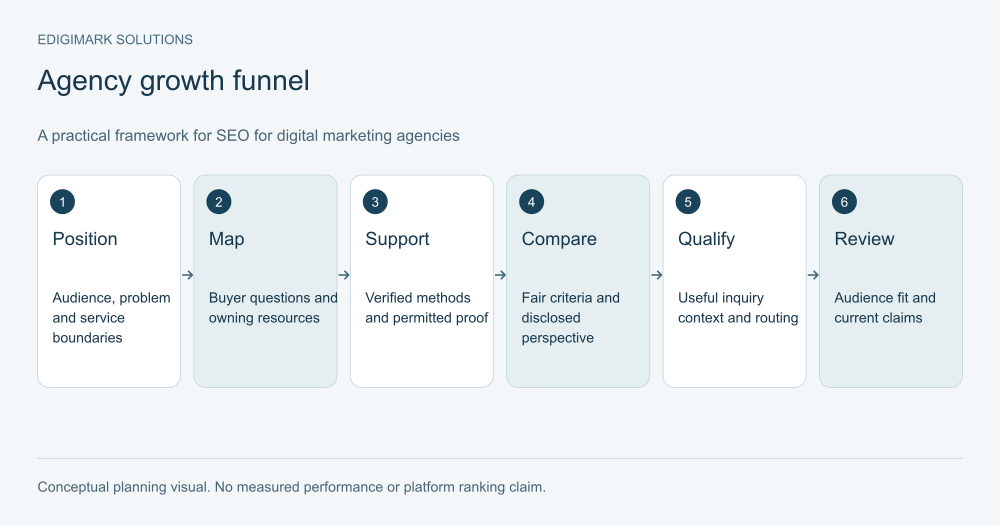
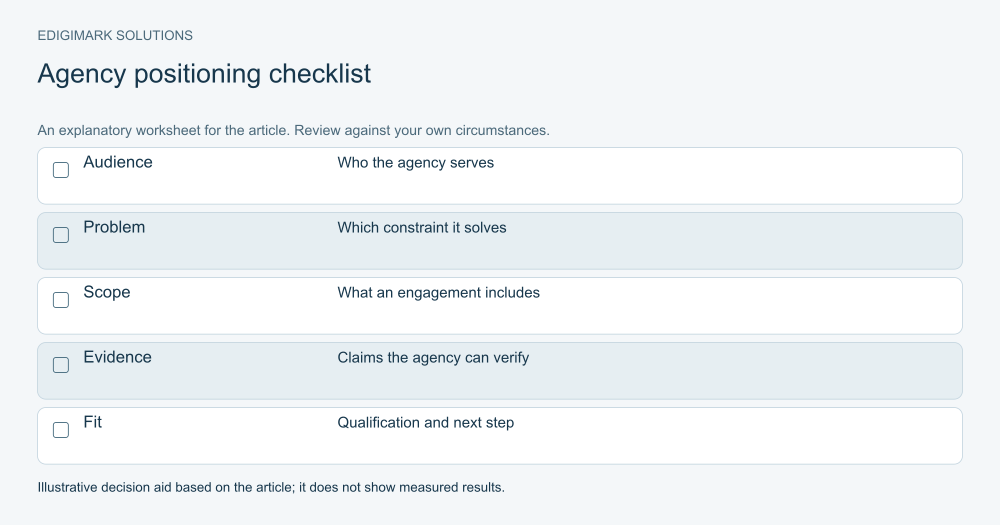
Write who the agency serves, which problem it helps address and what an engagement includes. “A growth partner for ambitious businesses” sounds positive but gives little practical context. A more useful explanation identifies the audience, constraint and service responsibility.
Separate a market preference from proven delivery experience. An agency may want to serve a new segment, but should not claim a track record it has not established. Describe the current capability and approved evidence honestly while developing the new offer.
Define important boundaries. The agency may handle strategy and implementation for one channel while relying on the client for product decisions or specialist approvals. Those responsibilities should be understandable before a proposal conversation.
Review whether the positioning matches capacity. A broad multi-channel promise needs a delivery process and people capable of fulfilling it. SEO content should not expand the apparent offer beyond what the agency can responsibly support.
Use digital marketing services to connect positioning with the wider acquisition plan. The website should explain the actual business rather than serve as a collection of attractive phrases.
How do agency service keywords become a useful page plan?
Start with buyer tasks: selecting a type of help, understanding an engagement, comparing approaches and preparing for a conversation. A keyword list becomes useful when each group maps to a decision the agency can help answer.
Review approved inquiry and sales summaries. Identify where prospects misunderstand service scope or request work the agency does not offer. Those questions can reveal gaps that a search-volume list misses.
Distinguish informational and commercial tasks. Someone asking how to define a metric needs an explanation, while someone evaluating an analytics engagement needs scope, process and evidence. Both can be relevant without belonging on identical page templates.
Combine wording variants that ask the same question. Creating separate near-identical pages for small phrase differences can make the site confusing. Give each resource a clear owning purpose and explain when another URL is genuinely needed.
Record unknowns. If search volume is not verified, leave it unknown. If audience demand is inferred from a small set of conversations, say so in the planning record. Honest uncertainty supports better decisions than fabricated precision.
What should an agency service page explain?
Begin with the problem, audience and useful scope. Describe what the engagement includes, how it starts and what the client must contribute. Generic promises about better growth should not replace an explanation of the work.
State deliverables and responsibilities. Strategy, implementation, reporting and ongoing optimization can be separate tasks. Explain which are included and which require a different arrangement so the reader does not infer a universal full-service package.
Show the method at a useful level. A discovery, diagnosis, plan, implementation and review sequence can help buyers prepare when it reflects the agency’s actual process. Avoid inventing a proprietary method merely to give ordinary work a branded label.
Provide appropriate evidence. A permitted case example needs truthful scope and supported outcomes. A method explanation can show reasoning without implying measured client performance. Distinguish the two formats clearly.
Offer a suitable next action. Explain whether the first conversation evaluates fit, gathers information or prepares a scoped recommendation. A useful action should not imply that every request receives a complete free strategy.
How can agency lead generation SEO use a focused resource cluster?
Choose a cluster around a relevant client problem. For an agency offering analytics implementation, useful tasks might include defining key actions, assessing tracking gaps, choosing reporting responsibilities and preparing a measurement brief. Each resource should answer a distinct question.
Connect education to the owning service where it helps the reader. An article can explain when specialist assistance is useful and link to scope. It should remain helpful for someone who wants to understand the task before contacting the agency.
Avoid filling the library with unrelated broad topics simply because they are popular. A topic needs a clear audience role and relationship to the offer. Otherwise the agency can acquire visitors who have no relevant reason to evaluate it.
Use a task map to manage overlap. A broad guide can summarize and link to a deeper resource; the deeper resource should not restate the entire guide. Review existing coverage before commissioning another variation.
Maintain the cluster as the service changes. Educational explanations, service scope and inquiry expectations should remain consistent. A large library is useful only when it preserves a coherent journey and accurate facts.
How should agency SEO content present evidence of its own work?
Explain what the agency did and what others contributed. A case study should not imply ownership of a client’s entire outcome if the work covered only one component. Keep the scope and attribution appropriate to the evidence.
Report metrics under compatible definitions and periods. A change in tracking can affect the apparent result; a concurrent campaign can influence demand. State material context instead of presenting a simple before-and-after chart as complete causal proof.
Use permitted client references. A logo, quotation or project description should reflect the actual permission and relationship. Do not invent testimonials or extend a limited approval into a broad endorsement.
When results cannot be published, choose an honest alternative. An annotated deliverable, decision worksheet or method guide can demonstrate useful thinking. Label illustrative material accurately and avoid replacing missing evidence with fabricated numbers.
Keep past and current scope distinct. A historical project can be valid evidence while a service package has changed. Review references and explain the difference so a buyer does not assume every old arrangement remains available.
How should agency comparison content help buyers choose?
Compare approaches under consistent criteria. An internal team, specialist freelancer and agency engagement can differ in coordination, responsibility and available capacity. Explain how those differences matter under the reader’s conditions.
Avoid making one option universally superior. A narrow task may fit a specialist; a broader coordinated engagement may need several responsibilities. A useful comparison helps the buyer understand when the agency’s offer fits.
If naming alternatives, verify current facts from appropriate primary sources. Do not use invented ratings, unverified prices or selective plan details to manufacture an advantage. Date the review and assign maintenance ownership.
Disclose the agency’s perspective. A vendor-written comparison can still be useful when the criteria and limitations are transparent. It should not claim independence or a testing method that did not exist.
Connect the comparison to a preparation resource or fit conversation. Help the reader gather the information that changes the choice, rather than push a sales action before the evaluation task is understood.
What should an agency say about search and AI visibility outcomes?
Describe the work the agency can verify: research, useful content, technical delivery, measurement and review. Keep outcome expectations conditional and tied to evidence. A service explanation should not imply control over a platform’s selection or ranking decisions.
Google’s guide to hiring an SEO explicitly cautions against guaranteed first-place rankings. An agency’s own website should avoid such guarantees and explain how it evaluates recommendations and reports observations.
For answer and generative discovery work, name the observations being reported. Mentions, citations, referrals and qualified inquiries have different meanings. Do not combine them into one unexplained visibility score and present it as a business outcome.
Explain the method for any monitoring sample. Record the platform, question set and observation conditions. A selected sample does not establish what every user sees or prove that one editorial change caused selection.
Verify current platform claims before using them in service content. A fashionable phrase does not establish a supported mechanism. Scope advice to what the agency can explain and maintain using appropriate documentation and actual evidence.
How should an agency’s own audit offer work?
Define the audit’s purpose and boundaries. A preliminary public review, a paid technical assessment and a strategic discovery engagement are different offers. Explain the information required, deliverable and intended next decision.
Avoid fabricating diagnostic findings before inspection. A prospective client should not receive claims about broken measurement or missed revenue merely because a template needs an alarming message. A useful diagnosis needs evidence.
For preliminary work, request only the access and material appropriate to the scope. Sensitive systems and broader permissions belong to an agreed process. An agency website can explain that process without making unrestricted access appear routine.
Make the handoff reviewable. Findings should identify the affected resource, observed issue, reasoning and proposed action. A tool score is an input that needs interpretation, not a complete implementation plan.
Give the prospective client a useful next decision. They might resolve an issue internally, request a deeper assessment or decide the agency is not the appropriate provider. An honest audit can support those outcomes without forcing every finding into a sales pitch.
What does an illustrative agency content roadmap look like?
Imagine a hypothetical agency specializing in measurement implementation for B2B services. Its website currently offers broad growth language and a large set of unrelated marketing articles. Sales repeatedly explains what the engagement includes and how website events connect to business records.
The agency first clarifies its service page with responsibilities, prerequisites and approved evidence. It then publishes resources on defining key actions, preparing a measurement brief and understanding attribution limits. Each article answers a useful task and connects to the owning service when appropriate.
A comparison resource explains internal implementation, specialist support and a coordinated engagement under consistent criteria. A method example uses a conceptual event worksheet rather than invented revenue results. Any client case waits for permission and supporting measurements.
The fit form asks for the current problem and relevant systems at a proportionate level. A test checks that the receiving team gets the context. Marketing and sales agree on which requests qualify before evaluating the release.
This is a planning example, not a reported agency result. It shows how positioning and evidence can guide a coherent roadmap without relying on fabricated volumes or universal outcome promises.
How should agency inquiry forms support qualification?
Ask for the minimum context needed to decide whether a conversation is appropriate. A problem summary, relevant service and organization context may be enough initially. Avoid collecting sensitive credentials or private customer data through a general inquiry form.
Explain the next step. State whether the agency will assess fit, clarify requirements or discuss a scoped engagement. Do not promise a response time, detailed audit or guaranteed recommendation unless that is the approved offer.
Test routing and receiving records. Use CRM integration when the website supplies sales context. Confirm that service interest and submission state are preserved and that someone accepts responsibility.
Use conversion rate optimization to investigate a specific obstacle or misunderstanding. Simplifying the action should still preserve the conditions that help the agency evaluate fit.
Record why inquiries are unsuitable. Requests for unsupported services, unclear goals and mismatched engagement scope require different responses. A raw lead total cannot show which problem the content should address.
Which public website checks should agencies prioritize?
Inspect the delivered service pages, evidence and inquiry actions. The site’s own implementation should not contradict its claims about clarity or reliable delivery. Check relevant viewports, important links and embedded assets through the ordinary user journey.
Review the titles and descriptions against actual content. A persuasive search title should promise what the page delivers, not imply a case result or guarantee that does not exist. Accurate metadata is part of the reader’s first expectation.
Use web development when template, navigation or form behavior needs implementation work. Define the affected URL, reproducible issue and acceptance condition.
Check internal links between education, comparisons and service scope. A useful label should lead to the promised answer. Repair obsolete destinations when the offer changes or resources are consolidated.
Keep the resource set manageable. An agency with limited review capacity can often maintain a focused useful library more reliably than a large archive of changing platform claims.
How should an agency review organic acquisition performance?
Separate discovery observations, completed inquiries and qualified opportunities. Use data analytics to clarify definitions, periods and measurement delivery before interpreting trends.
Review whether the attracted audience matches positioning. A broad informational page can generate attention while contributing little to the intended evaluation. Explain its role before comparing it with a focused service resource.
Use approved sales feedback to identify missing explanations. If prospects repeatedly misunderstand implementation responsibility, correct the owning page. If suitable inquiries stall after submission, investigate the handoff rather than assume the content failed.
Keep attribution limits visible. A client may discover the agency through search, receive a referral and return directly. Report the chosen model without treating it as a complete causal account of every influence.
Attach an action and owner to important findings. The review should guide a correction, investigation or next resource. Avoid celebrating publication volume or traffic growth that does not inform the agency’s commercial decisions.
How should agencies maintain proof and positioning over time?
Review the offer when delivery capacity or specialization changes. Update service scope, inquiry expectations and supporting resources together. A positioning statement should describe the agency the buyer can engage today.
Maintain a public claim register for important results and credentials. Record evidence, permission, conditions and a responsible reviewer. This helps avoid inconsistent figures across service pages and sales materials.
Use marketing automation for appropriate reminders and review coordination. Automation can route a task, but a responsible person must still verify the fact and accept the update.
Retire or revise unsupported claims promptly. If evidence becomes unavailable or the service changes, narrow the wording rather than leaving a strong promise in place because it once converted well.
Frequently asked questions
Should an agency specialize before starting SEO?
It needs clear audience and service scope, but the appropriate level of specialization varies. Describe actual capability and evidence rather than adopting a niche claim the agency cannot support.
Can a broad blog bring agency clients?
It can attract relevant readers when the topics support a useful evaluation journey. Define each resource’s role and assess lead fit rather than assuming broad traffic creates clients.
What evidence can an agency publish without client permission?
Use material it is authorized to share, such as its verified methods or labeled conceptual examples. Do not publish identifiable client work, quotations or results beyond the permission available.
Should agency comparison content claim independence?
Only if that accurately describes its production and relationship. A vendor perspective can still be useful when disclosed and supported by fair criteria and current facts.
Is a tool audit score enough to qualify an opportunity?
No. A score needs interpretation, and commercial fit depends on the actual problem, service scope and engagement conditions. Use evidence and agreed qualification criteria.
Let clear scope and useful evidence guide agency SEO
Build resources that explain the offer and help suitable clients evaluate it. Connect a reliable fit conversation and maintain the public claims. Contact Edigimark with your agency positioning, services and current evidence to scope a practical organic acquisition plan.