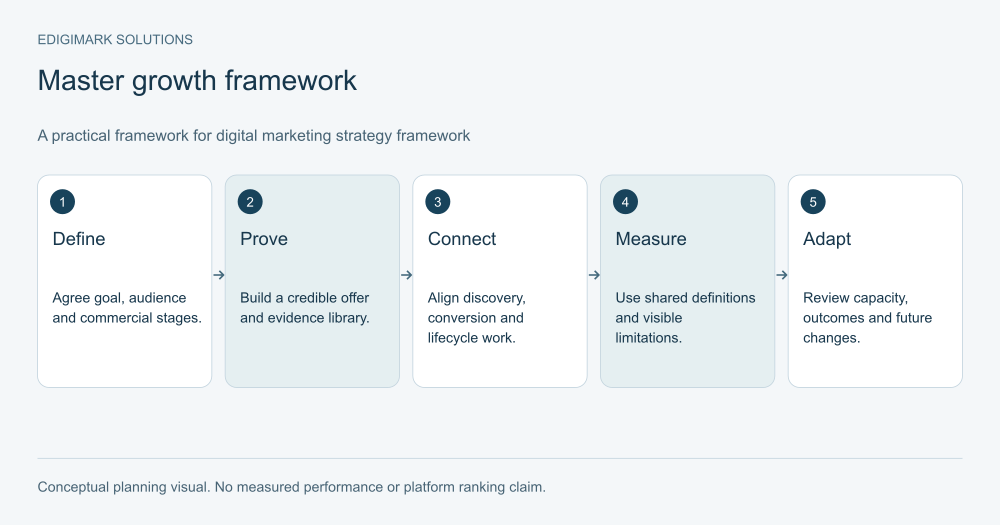

An SEO content strategy for lead generation connects relevant search demand with the questions buyers need to answer before they inquire. Plan distinct resources for the buyer journey, supply credible evidence and make the next step clear. Measure qualified leads and later progression separately from traffic so the program supports your actual offer.
Publishing more articles is not automatically the answer. A business may need clearer service scope, a comparison resource or a functioning inquiry path before it needs another broad introduction. The useful strategy begins with a customer decision and an offer the company can fulfill.

In this guide
- What should an SEO content strategy for lead generation accomplish?
- How do you map buyer journey content?
- What should commercial content mapping include?
- Which pages should come before broad traffic content?
- How do you choose topics without chasing volume alone?
- What should a lead-focused content brief contain?
- How should SEO conversion paths be designed?
- What evidence helps content earn a suitable inquiry?
- What does a worked lead-generation content plan look like?
- How do you connect content with sales follow-up?
- How should organic lead generation be measured?
- How do you improve a plan that attracts traffic but few leads?
- What should a lead-generation content prioritization workshop decide?
- How do you maintain a lead-focused SEO content strategy?
- How do you review content and lead qualification together?
- How should the strategy balance acquisition and education?
- Frequently asked questions
- Build content around suitable demand
What should an SEO content strategy for lead generation accomplish?
Define what a valuable inquiry looks like. Service fit, organization type, buying role, geography where relevant and timing may all matter. A submission count is incomplete if the requests are outside the business’s scope.
Choose the outcome according to your sales model. A self-service product may need a suitable trial user; a consulting service may need a scoped conversation; a complex implementation may need an accepted opportunity. These are different events with different dependencies.
Record who owns the definition. Sales and marketing should agree on qualification before reporting performance. Otherwise, the content team can celebrate increased forms while sales experiences a larger screening burden.
Use the definition to assess topic fit. A popular query that attracts an unsuitable audience can be a weaker opportunity than a recurring implementation concern among target buyers. Estimated traffic is an input, not the whole prioritization model.
How do you map buyer journey content?
Map the decisions, rather than assuming everyone follows a neat funnel. A person may learn a concept, compare alternatives and then return to a prerequisite question. The website should help with those transitions without requiring a fixed sequence.
Use practical stages: understanding the problem, evaluating approaches, preparing for implementation and selecting support. Existing customers may need separate resources for use or troubleshooting. Keep those roles clear in the content plan.
For each decision, identify the question, evidence and appropriate next action. A definition needs clarity. A comparison needs consistent criteria. A service evaluation needs deliverables and exclusions. A readiness guide needs prerequisites and ownership.
Review the existing pages against this map. You may have many educational articles but no explanation of implementation scope. That gap can prevent useful traffic from becoming suitable inquiries.
What should commercial content mapping include?
Create one record per resource with its audience, task, primary phrase, page type, evidence packet, current URL and next step. Include scope boundaries and the owner who can verify facts. Keep planned URLs distinct from live destinations.
Connect a content topic with a relevant offer, but do not force the connection. A resource about disconnected customer records can support CRM integration. A guide to repetitive handoffs may support marketing automation. The destination should match the decision.
Add a qualification note where necessary. If the service applies only under certain conditions, readers should understand that before they inquire. Clear exclusions can reduce unsuitable requests while helping the right buyer proceed confidently.
Use the map to coordinate work. A new article may depend on a service-page update, an approved diagram or analytics definitions. Those dependencies belong in the plan before writing starts.
Which pages should come before broad traffic content?
Inspect core service and product pages first. They should state the problem addressed, scope, process, prerequisites, evidence and action path. A confusing commercial destination can waste the attention educational content creates.
Next, address questions that stall evaluation. Buyers may need to understand compatibility, responsibilities, cost components or alternatives. These questions often reveal useful resources closer to a purchase decision than a generic category overview.
Then build educational content that introduces the relevant problems and connects to deeper resources. Keep it useful for readers who are still learning. A page can support later demand without requiring an immediate sales request.
Do not neglect current customers. Clear support resources can reduce confusion and make the website more useful overall. Evaluate them by their role rather than forcing lead-generation metrics onto every page.
How do you choose topics without chasing volume alone?
Assess business fit, customer need, evidence readiness and existing gaps. A topic should be answerable by the company and useful to the intended audience. If the central claim is unverified, schedule the evidence work before production.
Use keyword estimates responsibly. Record the tool, market and date. Keep unknown volume or difficulty labeled unknown. Customer questions and first-party observations can justify a topic without inventing a demand number.
Review current result types and intent. A query that appears commercial may actually be dominated by free-tool or job-search needs. Your planned page must fit a meaningful task, not merely contain the phrase.
Consider the maintenance cost. A platform-specific tutorial needs more ongoing review than a stable planning framework. Choose a content portfolio the team can keep reliable, not just launch.
What should a lead-focused content brief contain?
Name the audience and decision, then state the answer the page should deliver. Include evidence, limitations, examples and a next step. The writer should be able to explain why the resource helps a suitable buyer.
Specify what the article should not claim. A guide should not promise a result the company cannot substantiate. A comparison should not omit meaningful tradeoffs. A hypothetical scenario should not become a fabricated client case.
Google’s people-first content guidance provides a useful quality reference. The practical question is whether the page helps the intended visitor complete the task. A full outline and repeated keyword do not establish that usefulness.
Add a subject reviewer and a public acceptance check. The fact owner verifies scope or capability; the production team verifies the delivered headings, metadata, visuals and links. These are separate responsibilities.
How should SEO conversion paths be designed?
Offer a next step that fits the reader’s current understanding. A broad guide may link to a comparison. A readiness resource may offer a scoping checklist. A service page can invite a qualified inquiry with clear expectations.
Avoid requiring every visitor to make a large commitment. Someone learning a concept may not be ready for a sales call. Give them a useful route to deeper information rather than interrupting the answer with repeated forms.
Use conversion rate optimization to examine friction and fit. Ask whether the next action follows the page’s promise. A visible button cannot compensate for an unclear offer or missing qualification information.
Test the action publicly. Follow the links, complete an approved test inquiry and confirm receipt. A saved form or success message is not sufficient evidence that the business receives requests correctly.
What evidence helps content earn a suitable inquiry?
Use evidence that answers the buyer’s concern. Scope tables show what an engagement includes. Process diagrams show responsibilities. Approved case studies can demonstrate an outcome under stated conditions. Current documentation can verify capability.
Keep the claim proportional to the evidence. A single project result is not a forecast for every reader. A hypothetical example can teach a decision without implying measured performance. A screenshot from a test environment should be labeled appropriately.
Give readers enough context to judge applicability. If a process assumes clean records, available access or an internal owner, state those prerequisites. Clear conditions help qualify demand before the form is submitted.
Maintain sources and review triggers. A commercially important claim can become outdated when the offer changes. The evidence owner should know which pages depend on it.
What does a worked lead-generation content plan look like?
Imagine a hypothetical service company offering CRM integration support. Sales repeatedly encounters uncertainty about data cleanup, system ownership and what standard implementation includes. The company has several broad CRM articles but no clear readiness or scope resource.
The plan first improves the service page. It explains deliverables, exclusions and how discovery works. Next, it creates a readiness guide with a field-quality checklist and an ownership discussion. A comparison resource explains one-way and two-way synchronization under stated conditions.
The articles link to the service where implementation support becomes relevant. They also remain useful for readers preparing internally. The company avoids separate near-identical articles for every wording of “CRM connection.”
Analytics records meaningful actions, and the CRM records qualification. The team reviews suitable inquiries and recurring confusion rather than claiming that every content visit creates pipeline. This is an illustrative plan, not an Edigimark case result.
How do you connect content with sales follow-up?
Give sales an index of resources by question and purpose. A representative should be able to share the page that answers a concern, not guess from a long list of titles. Keep the index aligned with current public URLs.
Collect feedback about misunderstanding. Ask which sentence caused confusion and what condition was missing. Specific feedback is more useful than a general request to make an article more persuasive.
Do not turn every sales objection into a new blog. Some belong in service scope or a proposal; others deserve a maintained public explanation. Choose the resource based on audience and evidence.
Use CRM integration where approved record continuity is needed. Marketing and sales should share definitions while avoiding unnecessary personal information in editorial tools or research packets.
How should organic lead generation be measured?
Keep discovery, website actions, qualification and opportunity progression separate. Google Analytics documentation on key events is a primary reference for configuring meaningful event reporting. A configured event still needs a business definition and delivery check.
Group pages by purpose. Commercial pages may be assessed through suitable inquiries. Educational pages may support useful transitions or later engagement. Support pages need their own task-oriented measures.
Use data analytics to inspect data quality and maintain definitions. Duplicate submissions, missing events or changed forms can distort comparisons. Fix reporting issues before drawing strategic conclusions.
State attribution limits. A buyer may encounter several resources and channels before inquiring. A last-click label is not proof of sole causation. Report what the records establish and keep qualitative feedback distinct.
How do you improve a plan that attracts traffic but few leads?
Diagnose the audience first. Review queries and landing-page purpose. If the visitors are outside your target market or seeking a different offer, adding more calls to action may not solve the problem.
Next, inspect the information journey. Does the page connect to a useful commercial destination? Does that destination explain scope? Are prerequisites and exclusions clear? Is the action path functioning and appropriate?
Then review qualification and follow-up. Suitable inquiries can be lost through delayed response or inconsistent routing. Content cannot independently fix a sales process that fails after submission.
Choose a specific correction and preserve a baseline. Avoid changing every element at once and attributing any later movement to the entire content strategy. The next iteration should follow the diagnosed constraint.
What should a lead-generation content prioritization workshop decide?
Bring marketing, sales and subject owners together around a small set of customer decisions. Ask which concerns recur, which resources already exist and which facts are ready. The workshop should result in a realistic release set, not an unlimited topic wish list.
For each proposed resource, state the user benefit and commercial role. A readiness guide may reduce unsuitable inquiries; a comparison may help buyers evaluate; a service update may clarify the offer. Different benefits deserve different measures.
Review evidence and production capacity. If a resource needs a technical example, identify who can verify it. If a diagram needs design work, schedule it. If the next step depends on a service-page update, resolve that dependency first.
Document why topics were selected. A recurring buyer concern can be a strong basis even when demand estimates are unknown. A high-volume term can be lower priority when fit is poor. The decision record should preserve that reasoning.
How do you maintain a lead-focused SEO content strategy?
Keep a page inventory with purpose, evidence owner and review trigger. Update important resources when service scope, product behavior or customer concerns change. Do not wait for an annual refresh if the central answer becomes inaccurate.
Review overlap periodically. Articles can converge as editors add more context. Preserve distinct tasks or consolidate where appropriate, coordinating any URL changes with the website team.
Keep the plan connected to the offer. As the business specializes or expands, reevaluate which content supports suitable demand. A strategy should change through deliberate decisions, not accumulate unrelated articles indefinitely.
Reserve time for maintenance and analysis in the budget. Production volume is only one component of a useful program. Evidence review, public verification and feedback keep the library credible.
How do you review content and lead qualification together?
Choose a small recent inquiry cohort and inspect the resources involved where approved data is available. Ask whether the pages accurately described the offer and whether sales used the same scope when responding. A mismatch can reveal that the content and qualification process have drifted apart.
Do not expose personal information in an editorial workshop unnecessarily. Summarize the issue by task and fit: the visitor expected a self-service connector, needed an unsupported record type or misunderstood who cleans the data. These observations can guide a correction without copying entire customer records.
Identify where the misunderstanding began. If the article promises broad compatibility while the service page is narrow, revise the article. If the article is accurate but the form gives no clue about scope, improve the inquiry path. If sales uses an outdated definition, update the shared qualification record.
Keep a short decision log and review the next cohort under the same criteria. This does not prove that one content edit caused an outcome, but it creates a consistent learning process. The team can see whether the same misunderstanding persists and choose another correction based on evidence.
How should the strategy balance acquisition and education?
Maintain a portfolio rather than forcing every page to sell immediately. Some resources explain the problem, others help compare and others describe the offer. Each should have a useful purpose and a clear relationship to suitable demand.
Avoid using education as an excuse for irrelevant reach. A broad article still needs an audience connected to your business. If the content cannot explain that relationship, reconsider why it belongs in the acquisition plan.
The balance should follow customer decisions and production capacity. Invest where missing information constrains a valuable task, then expand with evidence. This keeps the program commercially accountable while preserving the quality of the explanation.
Frequently asked questions
Does lead-generation content need to be sales-focused throughout?
No. Educational content should answer its task clearly. The commercial connection should appear where it fits the reader’s next decision, rather than replacing the explanation with repeated promotion.
Should we prioritize high-volume keywords?
Consider volume alongside intent, audience fit, evidence and maintenance. Relevant narrow questions can support valuable decisions. Do not invent estimates or treat volume as the only measure of opportunity.
What is a qualified organic lead?
It is an inquiry that meets your documented business criteria. Define those criteria with sales and keep the definition consistent. A completed form alone does not establish fit.
How can we measure content influence across a long sales cycle?
Connect approved website and CRM records where possible, preserve cohort timing and collect consistent feedback. State what remains unknown. An attribution model cannot reconstruct every influence with certainty.
What should we improve first?
Inspect the core commercial page and the most common evaluation question. Clear scope, credible evidence and a functioning next step often create a stronger foundation than another broad article.
Build content around suitable demand
Plan resources that help the right buyer understand, evaluate and act. Edigimark’s digital marketing services can connect that work with search, conversion and measurement priorities. Contact the team with your offer, qualification criteria and existing pages to scope the next improvement.