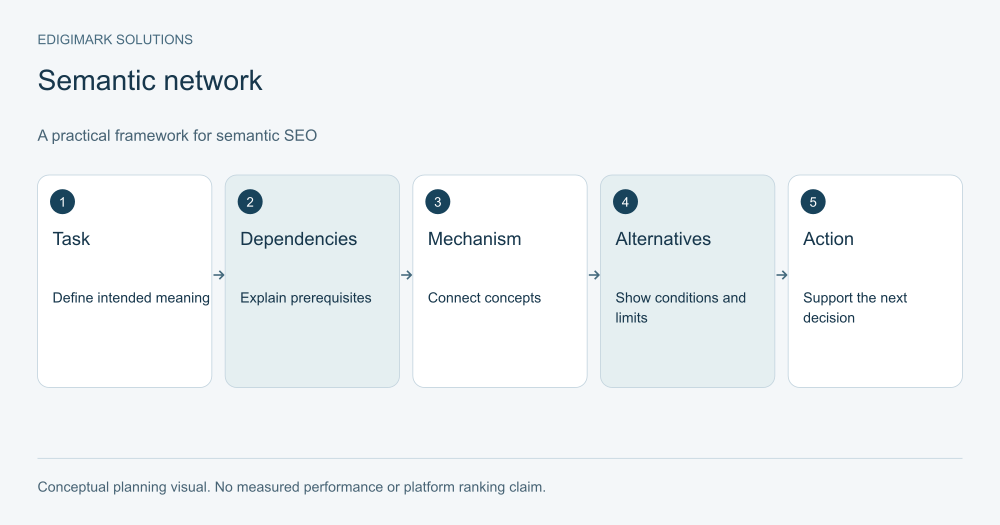
Semantic SEO focuses on the meaning of a page and the relationships between its concepts, rather than treating optimization as repeated exact-match words. Explain the user’s task, relevant entities, prerequisites, alternatives and conditions in clear language. The aim is a useful answer with appropriate topic coverage, not a list of related phrases inserted to satisfy a tool.
Keywords still help describe what people ask. The mistake is assuming that adding more variations automatically creates a better explanation. A page can contain every phrase in a brief and still fail to show how the ideas connect or what the reader should decide.
In this guide
- What does semantic relevance mean in practice?
- How is semantic SEO different from entity SEO?
- Step 1: define the task before selecting related concepts
- Step 2: explain prerequisites and dependencies
- Step 3: describe the mechanism and relationships
- Step 4: compare alternatives and limits
- Step 5: connect the explanation with an observable next step
- What does a semantic network look like for one task?
- How should semantic SEO use related terms without synonym stuffing?
- How should contextual search content use examples?
- What does a worked semantic SEO rewrite look like?
- How do you choose the right level of topic coverage?
- What should a semantic content brief contain?
- How do you review semantic clarity before publication?
- How should a semantic SEO review assess content usefulness?
- How do you run a concept relationship review?
- How should semantic content be maintained as the offer changes?
- Frequently asked questions
- Explain the relationships that change the answer
What does semantic relevance mean in practice?
It means the content addresses the intended meaning and context of the question. A word can have several meanings, and a short query can omit important conditions. The page should make its interpretation clear.
For a hypothetical B2B article about “lead routing,” the relevant context may include ownership, territories, existing accounts and exceptions. A paragraph about road routes uses the same word but serves a different subject. Even within marketing, routing software and a consulting implementation service have different scopes.
Google’s explanation of BERT describes language context, while its current ranking-systems guide identifies systems that understand meaning and relationships. These references support the importance of context; they do not publish a formula for a required list of semantic terms.
How is semantic SEO different from entity SEO?
Entity work clarifies specific identities and actual relationships: a company, product, person or system. Semantic content work explains the meaning of a broader task and its connected concepts. The two overlap, but they are not interchangeable.
A page can identify the correct software product while failing to explain how field ownership affects synchronization. It can also explain synchronization clearly while using inconsistent product names. Both issues deserve correction, with different owners and evidence.
Use precise subjects where ambiguity matters. Explain the concept relationships where the decision needs them. Do not turn either discipline into a quota of names or synonyms.
Keep the distinction useful for production. Identity facts belong in a verified record; explanatory relationships belong in the brief and reasoning. The writer needs both when the task depends on product behavior.
Step 1: define the task before selecting related concepts
Write the decision the page should help. “Help an operations manager choose a routing model” is more specific than “cover lead routing.” It immediately suggests criteria such as customer relationships, territory coverage and exception handling.
Identify the audience and what they already know. A beginner may need a definition, while an administrator may need a verified implementation detail. Combining both can work with clear navigation, but the article should not lose its primary task.
State scope exclusions. A planning guide may not provide setup steps for every platform. A comparison may not evaluate every available vendor. Those boundaries prevent unnecessary expansion into unrelated concepts.
Then choose the concepts that change the decision. If a term does not explain a prerequisite, mechanism, alternative, limitation or outcome, it may not belong. A tool’s suggestion should be evaluated against the task rather than accepted automatically.
Step 2: explain prerequisites and dependencies
Show what needs to exist before the recommended approach works. For a workflow, this may include reliable fields, approved access, a responsible owner and an exception path. These concepts are useful because they affect implementation.
Explain why each dependency matters. “Clean your data” is too broad if the reader needs to know which fields determine routing. A concrete explanation can identify missing territory values or duplicated account ownership without inventing a product capability.
Put essential conditions near the recommendation. If the opening promises automation but the prerequisites appear only at the end, a quick reader may receive a misleading answer.
Distinguish planning advice from platform facts. The need to decide ownership can be a general framework; the exact behavior of a connector requires current verification. Semantic completeness should not become an excuse to state untested details.
Step 3: describe the mechanism and relationships
Explain how the approach works at the level the audience needs. Identify the source, action, destination and responsible role. A mechanism gives meaning to a benefit claim.
For a routing example, an inquiry contains fields, rules evaluate those fields and a destination receives the request. The team needs to know what happens when no rule matches. Those relationships are more useful than repeating that routing is efficient.
Use consistent labels. If lead, contact and account mean different things, define them. Swapping terms for stylistic variety can obscure the process and make comparisons unreliable.
Choose an explanatory form that fits. A short sequence may show mechanism better than several paragraphs. A diagram can show dependencies, while a table can compare ownership choices. The visual should support the same meaning as the prose.
Step 4: compare alternatives and limits
An answer becomes more useful when it explains when another approach fits. The right choice may depend on team capacity, customer relationships, implementation effort or available data.
Define criteria before comparing options. A territory-based model and an account-owner model can each be appropriate under different conditions. A universal winner would conceal the context the reader needs.
State limitations plainly. “There are considerations” adds little. “The rule cannot determine ownership when the account field is missing” explains a specific failure. Include the consequence and the next check.
Do not add every alternative in the market if the article cannot evaluate them fairly. Choose the relevant approaches within scope and explain the boundary. Comprehensive topic coverage means enough detail for the task, not unlimited breadth.
Step 5: connect the explanation with an observable next step
Give the reader a practical action that follows the reasoning. They may need to inventory fields, compare criteria, verify compatibility or review service scope. The action should be specific enough to perform.
For system relationships, CRM integration can be relevant when professional implementation becomes the next decision. For repeated manual handoffs, marketing automation may fit. The destination should resolve the next uncertainty.
Define what can be observed after a change. A process may reduce repeated manual steps, but the business needs a measurement method before claiming a result. Do not turn an explanation of a mechanism into a guaranteed performance forecast.
Keep the article useful for readers who are not ready to inquire. A worksheet or related explanation can be an appropriate next resource. Meaningful progression is more useful than a forced commercial transition.
What does a semantic network look like for one task?
Use a compact relationship map rather than a cloud of words:
| Concept | Relationship to the task | Useful question |
|---|---|---|
| Customer ownership | Determines the appropriate destination | Who owns an existing account? |
| Territory | Provides a routing criterion | Which field defines coverage? |
| Data quality | Determines whether rules can be evaluated | What happens when values are missing? |
| Exception handling | Preserves an unresolved path | Who reviews unmatched inquiries? |
| Measurement | Checks whether the workflow helps | Which actions and failures are recorded? |
The map is conceptual. It does not claim to represent a search engine’s internal graph. Its purpose is to help a writer explain relationships that a reader needs.
How should semantic SEO use related terms without synonym stuffing?
Use alternative wording when it preserves meaning and helps readability. Do not insert a list of variants after a definition or force several related phrases into one sentence.
Check whether the terms are actually interchangeable. A lead and an opportunity may describe different CRM stages. A connector and an implementation engagement may describe different offers. Treating them as synonyms can make the page inaccurate.
Read the text for natural progression. Each paragraph should develop a useful idea. If a phrase appears only because a tool requested it, either explain its relevance or remove it.
Keyword research can identify questions and vocabulary, but editorial judgment chooses what belongs. A semantic term list is not a completed brief, and a coverage score is not proof of understanding.
How should contextual search content use examples?
Show the conditions that make a recommendation change. A hypothetical example can compare a team with stable territories and a team with multinational accounts. The routing decision differs because the relationships differ.
State the assumptions and avoid fabricated results. You can show how a choice is made without claiming that a real company increased revenue. The example’s value is in reasoning the reader can apply.
Use enough detail to avoid a vague story. Identify the fields, ownership rule and exception path where they affect the decision. Do not add invented personal details that distract from the task.
Follow the example with the general lesson and its boundary. The reader should understand which part transfers to their situation and what they still need to verify.
What does a worked semantic SEO rewrite look like?
Consider a hypothetical paragraph: “Lead routing software improves productivity and supports growth. Our advanced platform makes everything easy.” The text includes the topic but supplies little meaning.
A useful rewrite could explain: “A routing workflow assigns an inquiry according to agreed criteria, such as territory or account ownership. The team must define what happens when required fields are missing or two rules conflict. The appropriate model depends on customer relationships and who maintains the rules.”
The revised paragraph connects mechanism, prerequisite, exception and choice. It does not require an expanded list of synonyms. A real product page would then verify any specific capability before claiming that its software implements the process.
The article can add a table and a labeled example, then connect to a relevant implementation resource. This creates topic depth through reasoning rather than phrase repetition.
How do you choose the right level of topic coverage?
Ask whether the reader can complete the promised decision. Missing a critical prerequisite means the article is incomplete. Adding unrelated history does not make it more complete for that task.
Use scope boundaries to decide where detail belongs. A planning guide can summarize a technical concern and link to a verified reference. A tutorial can focus on the steps while pointing to planning context.
Review nearby pages for overlap. If several resources explain the same decision with the same evidence, consolidate or refine their scopes. Semantic breadth should not create a library of competing summaries.
Consider maintenance. A broad article with many platform-specific claims creates a large review burden. Keep the coverage proportional to the evidence and ownership available.
What should a semantic content brief contain?
Include the central task, audience, answer, relevant relationships, prerequisites, alternatives and evidence. Add scope exclusions and the next useful destination. Explain why each supporting concept belongs.
Give the writer a verified fact packet for product behavior. A conceptual relationship map cannot establish a current capability. The subject owner should check important technical details.
Choose supporting forms according to the reasoning. A comparison table, process diagram or worksheet should have a specific purpose. Do not request a generic infographic simply because the article needs an image.
Use digital marketing planning to connect the resource with the audience and offer, while preserving its distinct task. A brief should make both editorial and commercial roles understandable.
How do you review semantic clarity before publication?
Read the article for meaning, not just terminology. Can you identify the problem, mechanism, conditions and next action? Does each concept add a useful relationship? Are any labels ambiguous or inconsistent?
Ask someone outside the project to explain the recommendation. Their interpretation can reveal missing context the internal team assumes. Correct the explanation rather than blaming the reader for not knowing the terminology.
Inspect the public presentation. A table that clips important conditions or a diagram with unreadable labels can lose meaning. Work with web development when delivery obstructs the explanation.
Check links and the next step. The destination should fulfill the promise made by the context. A broad homepage link may not help a reader seeking a specific implementation detail.
How should a semantic SEO review assess content usefulness?
Choose observations that fit the task: relevant discovery, useful transitions, inquiry quality or feedback. Use data analytics to maintain definitions and page roles where measurement is appropriate.
Do not label a proprietary term score as proof of search understanding. A tool can flag omissions, but it cannot determine every audience need or establish a private ranking formula.
Keep attribution cautious. A page update can coincide with campaigns, offer changes or seasonality. Preserve the baseline and state what was observed rather than assigning every outcome to semantic edits.
Review customer confusion and follow-up questions. They can identify a missing relationship more directly than an aggregate traffic total. Use the feedback to improve the owning resource.
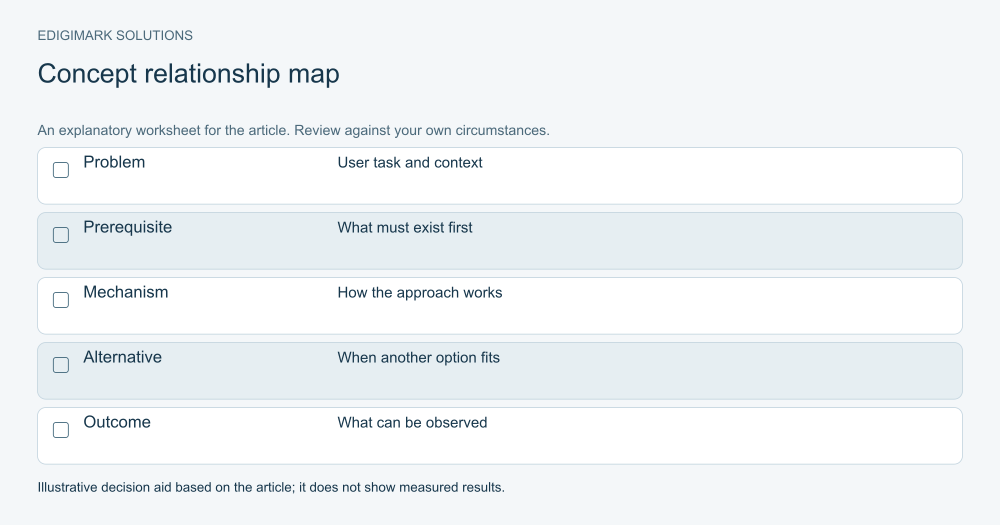
How do you run a concept relationship review?
Select the concepts that appear in the draft and ask what each one does for the reader. A prerequisite explains readiness; a mechanism explains behavior; an alternative supports choice; a limitation prevents overapplication; a measurement explains verification.
Mark terms with no clear role. They may belong in another resource, need explanation or be unnecessary. Removing them can make the article more useful even if a tool’s vocabulary score falls.
Then inspect missing relationships. A page can mention both data quality and routing without explaining why missing fields prevent rule evaluation. Add the connection rather than another definition. This is often the difference between topic vocabulary and practical understanding.
Review the conclusion against the conditions. Does the recommendation still hold when the stated prerequisite is absent? If not, place the qualification beside it. The article’s meaning should remain consistent from the opening through the example and next action.
How should semantic content be maintained as the offer changes?
A changed product capability can affect more than one fact. It may alter the comparison criteria, the implementation sequence or the audience the resource fits. Review those relationships together rather than replacing a single term.
Keep a short purpose and terminology record with the page. Future editors should know what the article owns and which labels have distinct meanings. This helps prevent gradual drift into a different task.
Listen for new questions that expose missing context. If customers repeatedly ask who handles an exception, the ownership relationship may need a clearer explanation. Decide whether to update the existing page or create a distinct resource based on the task and evidence.
Finally, verify the public presentation after changes. A new table column or longer diagram label can create a layout problem that obscures the meaning. Maintain the explanation and delivery as one useful resource, with separate owners where needed.
Frequently asked questions
Does semantic SEO mean using more synonyms?
No. Synonyms can help natural writing, but the main work is explaining meaning and relationships. Use terms accurately and remove variants that add no useful context.
Should every related concept appear in one article?
No. Include what the task needs and use supporting resources for distinct detail. Unlimited breadth can make an article harder to read and maintain.
Is a semantic coverage score a Google metric?
Do not treat a tool’s measure as access to an internal search metric. Understand its method and use it as one review input, alongside evidence and audience needs.
Can semantic SEO guarantee rankings?
No. It can improve relevance and understanding for a task, but selection remains uncertain. Report the practical improvement without promising a position.
What should we change first?
Choose a central paragraph and clarify the mechanism, condition and next decision. A useful rewrite can expose missing evidence before you expand the entire article.
Explain the relationships that change the answer
Build content around a real task and the concepts that help resolve it. Contact Edigimark with your page, audience and recurring questions to plan a focused content and search review.