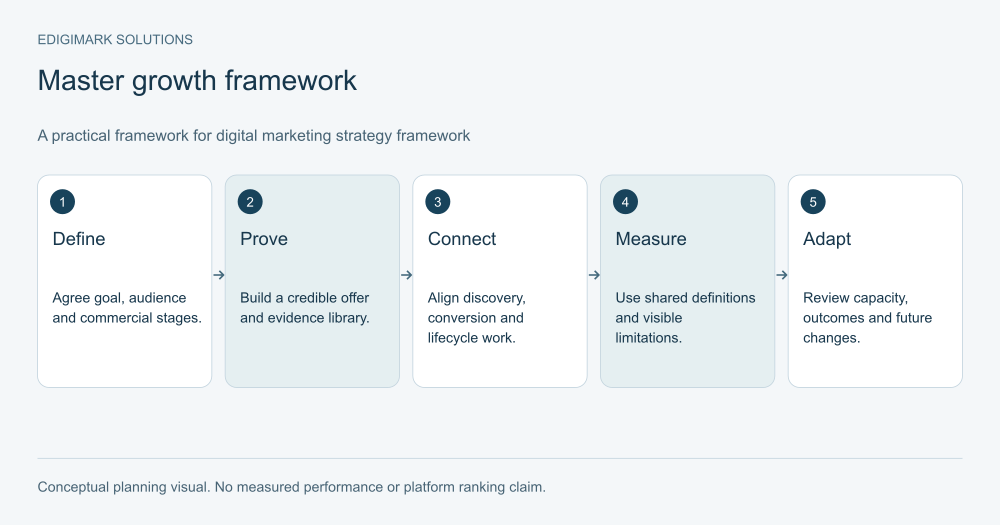
Search intent is the task a person wants to complete when they search: learning, finding a known destination, comparing options, buying or solving a problem. Targeting the right keywords means matching that task with a page that can fulfill it. A phrase is not a strategy until you understand who is asking, what decision they need to make and what evidence will help.
This matters commercially. A company can attract visitors while answering the wrong question or offering the wrong next step. An educational reader may need a definition, while a buyer needs scope and qualification. Clear intent analysis helps you choose the page type and content that fit each situation.
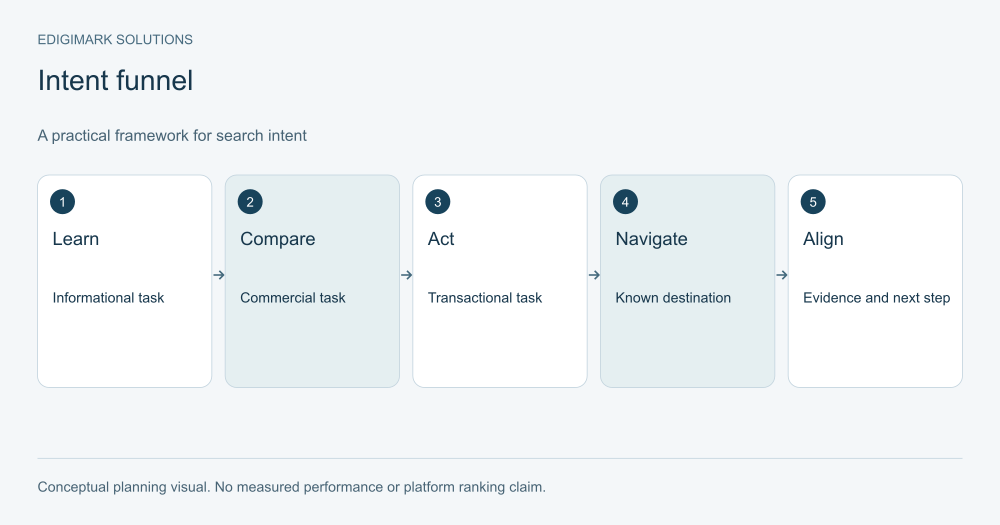
Conceptual framework for search intent; examples are illustrative.
What are the main types of search intent?
Use intent categories as a starting framework, not as rigid labels. Real queries can combine several motives, and a person can move between them quickly. The useful question is which task the page should primarily serve.
| Intent | Main task | Useful page approach | Common mistake |
|---|---|---|---|
| Informational intent | Understand a concept or process | Explanation, guide or worked example | Sending the reader directly into a sales pitch |
| Commercial intent | Compare approaches or providers | Criteria, alternatives, scope and evidence | Declaring a winner without showing tradeoffs |
| Transactional intent | Take a defined action | Clear offer, prerequisites and action path | Hiding practical requirements behind generic copy |
| Navigational intent | Reach a known resource | Accurate destination and clear identity | Competing with your own login, support or contact page |
These distinctions help plan resources, but the audience and context still matter. “Integration setup” may describe self-service configuration for one reader and a paid implementation inquiry for another. Inspect the evidence rather than assuming the wording has only one meaning.
How do you identify informational intent?
Look for a desire to understand: what something means, why it happens, how a process works or what prerequisites exist. The reader may be early in a purchase journey, but they can also be an existing customer or a specialist solving a specific problem.
Give the answer early and explain the conditions. A definition should distinguish nearby concepts. A process guide should show sequence and dependencies. A troubleshooting resource should help identify the cause rather than simply describe the product category.
Avoid treating every informational visitor as a future buyer. The page can remain useful while offering a relevant next resource. A high-pressure request form may be an inappropriate first step for someone who does not yet understand the issue.
For a hypothetical SaaS product, “what is lead routing?” calls for an explanation and examples. The product’s pricing page may be a useful later destination, but it cannot replace the initial answer. The page should earn that transition by helping the reader understand the problem.
How does commercial intent differ from transactional intent?
Commercial intent often involves evaluation: which approach fits, what criteria matter and how alternatives compare. Transactional intent is closer to a defined action, such as requesting a scoped service, starting a trial or booking an appointment.
A comparison page needs consistent criteria and meaningful tradeoffs. A transactional page needs clear scope, requirements and a functioning action path. Confusing the two can create a page that sounds persuasive but leaves the visitor unable to judge fit or proceed.
The distinction is not always sharp. A buyer may compare a few details before acting. A useful service page can therefore include decision criteria and a clear inquiry step, while preserving a coherent primary purpose.
Do not assume that the word “best” creates an opportunity for unsupported superiority claims. A reader usually needs to know what “best” means under their conditions. Budget, implementation capacity, compatibility and service scope can all change the answer.
What evidence should an intent analysis use?
Inspect current result types, wording, customer questions and available first-party behavior. Record the date and market where relevant. Search results show how the query is interpreted in that context, but they do not tell you to copy the existing pages.
Google’s ranking systems guide describes systems that understand meaning and intent. The practical editorial response is to serve the task, not to assume exact phrase repetition is the whole relationship between a query and a page.
Use customer conversations to interpret ambiguous language. A request for “automation cost” may mean software subscription cost, implementation cost or the effort needed to maintain workflows. Those meanings can require different content and different owners.
Review landing-page behavior carefully. A short visit does not automatically mean the page failed; a person may have found a quick answer. A long visit does not automatically mean satisfaction. Combine behavioral observations with the task and, where available, direct feedback.
How do you handle mixed search intent?
Identify the dominant task and the meaningful secondary task. A broad guide can include a short comparison, while a service page can explain a concept briefly. The problem begins when several unrelated tasks compete for the opening and structure.
Consider whether navigation can make the page useful. A structured resource with clear sections may serve a related set of questions. If the audience, evidence and next step differ substantially, separate pages may be clearer.
Write down why a single page or separate pages were chosen. This protects the architecture from drifting as new writers add material. A page that begins as a definition can gradually become a pricing guide without anyone making that decision explicitly.
Avoid creating a URL for every slight phrase variation. Similar wording may represent one task. Separate resources need a substantive distinction, such as a different audience, process or decision.
How should page type follow intent?
Choose a guide when the task requires explanation. Choose a comparison when alternatives need consistent criteria. Choose a service page when the user is evaluating a professional offer. Choose a tutorial when you can verify steps that help complete a specific operation.
Each type needs a different evidence packet. A tutorial needs current verified behavior. A service page needs accurate deliverables and exclusions. A comparison needs fair criteria and current facts. A broad outline with the same headings for every type misses these distinctions.
The title and opening should signal the choice. If a page promises a setup guide, it should not become an extended pitch with no executable guidance. If it offers professional implementation, it should not imply that a brief checklist covers every project.
Use web development when the intended format needs technical support, such as readable comparison tables or a functioning action path. Format and delivery are part of fulfilling the task.
What does search intent look like in a SaaS example?
Imagine a hypothetical SaaS company offering lead-routing software. An informational visitor asks what lead routing is. The useful resource defines it, shows a simple workflow and explains where ownership rules matter. It can link to a planning guide as the next step.
A commercial visitor asks how territory routing compares with account-based routing. The useful resource shows criteria, strengths, limitations and a worked scenario. It avoids declaring a universal winner because the right choice depends on customer relationships and operating rules.
A transactional visitor asks about implementation support for an existing CRM. The service or product page should explain supported scope, required access, configuration responsibilities and how to request an assessment. It should distinguish standard behavior from custom work.
A navigational visitor wants the support portal. They should reach the known destination quickly. Trying to redirect that task into a marketing article can create frustration even if the article is well optimized.
These pages can connect through appropriate links, but they should not all repeat the same explanation. Each owns a decision and supplies the evidence that decision requires. That architecture is more maintainable than a series of similar articles targeting different wordings.
What does search intent look like for a service business?
Imagine a hypothetical IT service company. “What is managed IT?” is an educational task. “Managed IT versus internal support” is an evaluation task. “Managed IT provider for our office” may be closer to a service inquiry, with location or delivery constraints that need verification.
The educational page can explain responsibilities and limitations. The comparison can discuss coverage, staffing, escalation and ownership. The service page can state what the company provides, who it fits and how scoping begins.
Avoid inventing geographic coverage to satisfy a phrase. A location page needs a real basis in service delivery and useful local information. A commercial opportunity does not authorize a misleading claim about offices, staff or availability.
Connect relevant resources with digital marketing services when planning acquisition, but preserve the distinction between the article’s example and the services Edigimark actually offers. Hypothetical teaching examples should not be mistaken for client results.
How does intent affect the next step?
Offer the action that fits the reader’s current decision. An educational page might invite them to inspect an example or a related explanation. A comparison page might offer a scope checklist. A service page can invite a qualified inquiry with clear expectations.
Reduce friction without removing qualification. A simpler form can help relevant users act, but a vague inquiry path can increase unsuitable requests. Explain what information helps the team respond and what happens after submission.
Use conversion rate optimization to investigate whether the next step fits. Ask whether the offer matches the information the reader has just received. A button color test cannot repair a fundamental mismatch between task and action.
Do not interpret every low immediate conversion rate as failure. Some pages deliberately support earlier decisions or existing-customer tasks. Evaluate the transition appropriate to the role, then examine later outcomes where the data supports it.
How should you measure whether intent is aligned?
Review relevant queries, landing-page purpose, meaningful actions and inquiry fit. Ask sales whether the page prepares suitable buyers or creates recurring misunderstandings. Keep those qualitative observations separate from analytics counts.
Use data analytics to define events and page groups. An aggregate conversion rate across educational, commercial and support pages can obscure important differences. Grouping by purpose makes the report easier to interpret.
Record changes that affect comparison: campaigns, offers, website releases and qualification definitions. An observed improvement does not automatically prove that one headline caused it. Preserve the baseline and describe what the evidence can establish.
When alignment appears weak, diagnose the specific issue. Is the audience wrong, the promise unclear, the answer incomplete or the next action premature? Each problem suggests a different correction. Adding more keywords is rarely a sufficient diagnosis.
What should an intent brief contain?
Include the audience, central task, query evidence, page type, direct answer, supporting decisions, evidence packet and next step. Add scope exclusions and related page owners. This makes the brief useful for both writing and later maintenance.
Ask the writer to explain the page’s purpose before drafting. If the explanation sounds identical to an existing article, revise the scope. If the answer depends on unresolved product facts, obtain review before commissioning more prose.
Use Google’s people-first content guidance as a reference for evaluating usefulness. The page should leave the intended reader better equipped to complete the task. A complete-looking outline is not sufficient if essential evidence is missing.
How do you maintain search intent alignment?
Review important pages when offers or customer questions change. A service may develop a narrower focus; a product may gain a new prerequisite; an audience may begin asking a different comparison. The page’s purpose should evolve through a deliberate decision.
Keep an inventory of ownership and scope. Periodically compare adjacent articles to detect convergence. Two pages can begin with different purposes and become duplicative after several updates.
Document merges and significant changes so future teams understand why a resource exists. A maintained architecture makes keyword targeting a coordinated information system rather than a collection of isolated briefs.
How do you resolve disagreements about search intent?
Ask each stakeholder to name the reader and task they are imagining. A marketer may picture someone learning the category, while sales pictures a buyer ready to scope a project. Both can be reasonable interpretations, but the page cannot prioritize both openings equally.
Bring the evidence into the discussion: query observations, recurring customer questions, existing landing-page behavior and the offer’s requirements. Keep assumptions labeled. A strong opinion about what buyers “must want” should not outweigh documented confusion from actual conversations.
Choose the primary purpose and decide how the secondary need will be served. A short explanation can support a commercial page; a contextual link can take an educational reader to a deeper offer. Separate resources are useful when the evidence and action paths genuinely differ.
Record the choice in the brief and review it after publication. This turns the disagreement into a testable planning decision rather than a permanent debate about wording. If the page attracts a different audience than intended, revise the hypothesis with evidence.
What does an intent alignment review look like?
Read the title and opening, then state the promise in your own words. Compare that promise with the page’s central evidence. If the title says “comparison” but the body only promotes one option, the alignment is weak. If the opening promises a tutorial but omits prerequisites and verified steps, the page needs a scope correction.
Next, inspect the next action. A request for a sales call can be appropriate after clear service evaluation, while an early definition may need a related resource first. The action should follow the reader’s understanding rather than interrupt it.
Finally, inspect the public experience. Headings, tables and links should preserve the same purpose on mobile. A page that explains the right decision but hides its comparison table behind unreadable formatting still fails the practical task.
Keep the result as a short record: intended task, observed mismatch, correction and verification. The review should produce concrete changes rather than a vague recommendation to “improve relevance.” Over time, these records show which kinds of misunderstanding recur and where the website architecture needs attention.
Frequently asked questions
Can one query have more than one search intent?
Yes. Context and wording can support multiple tasks. Inspect current evidence and your audience’s needs, then choose the page’s primary purpose. Separate pages may be appropriate when the tasks differ materially.
Are informational keywords less valuable than commercial keywords?
Their role differs. Relevant educational content can support understanding and later decisions, while commercial resources may serve more immediate evaluation. Value depends on audience fit and the business journey, not the label alone.
Should we change a page whenever result types change?
Investigate the change and your customer’s need first. A dated result sample can reveal an issue, but it should not trigger a wholesale rewrite without a clear reason. Preserve the page’s useful purpose unless evidence supports changing it.
Does matching intent guarantee a ranking?
No. It improves the page’s relevance and usefulness for a task, but search selection involves other considerations. Report the improvement without guaranteeing a specific position.
What is the fastest way to improve intent alignment?
Choose one important page, state its task and compare the opening, evidence and next step with that task. Correct the largest mismatch before expanding the article or creating another page.
Target a decision, then choose the keyword
The right keyword connects an audience need with a resource your business can provide reliably. Build the brief around that connection and verify the published experience. Contact Edigimark with your priority page and audience to discuss a focused search and content plan.