A SaaS digital marketing strategy connects acquisition, product evaluation, conversion, onboarding and revenue measurement around a clearly defined customer. Start with the buying problem and sales motion, then choose the channels, content and automation that help the right accounts move forward. A collection of campaigns becomes a strategy when the handoffs work.
Planning for 2027 does not require predicting every platform change. It requires knowing which commercial assumptions your team is making, how you will test them and what would justify changing the plan. This guide provides that operating framework using information available in October 2026.
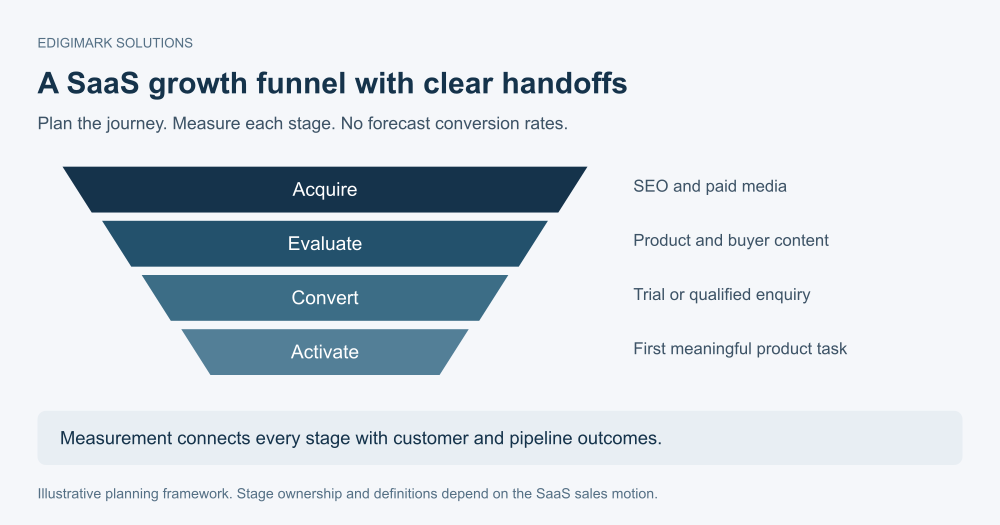
A planning framework. The stages describe responsibilities, not forecast conversion rates.
What should a SaaS digital marketing strategy start with?
Start with the ideal customer profile, the problem that triggers a purchase and the way a customer becomes successful with the product. Channel selection comes after these decisions.
A project-management product sold to individual consultants needs a different journey from a security platform purchased by an enterprise committee. The first may support a self-service trial. The second may require a technical assessment, procurement review and an implementation discussion. “Generate more leads” gives neither team enough direction.
Write a short strategy statement with five elements:
- The customer segment you can serve well.
- The operational problem you solve.
- The event that makes the problem urgent.
- The next meaningful buying action.
- The evidence that would show the customer is a good fit.
An illustrative statement might be: “Help operations leaders at multi-location service businesses evaluate whether our scheduling product can reduce manual coordination. Our next action is a workflow assessment, and qualification requires a recurring scheduling problem plus an implementation owner.”
This is a hypothetical planning example, not a client result. It is useful because it tells the team what to write, whom to reach and what to ask on the conversion page.
How does the SaaS marketing funnel connect your channels?
Give each channel in your SaaS digital marketing strategy a job before assigning a budget. A channel can introduce a problem, capture existing demand, support an evaluation or help a customer adopt the product. Its reporting should reflect that job.
| Buying situation | Useful marketing asset | Meaningful next signal |
|---|---|---|
| Buyer recognizes a recurring problem | Practical explanation or diagnostic | Relevant return visit or deeper evaluation |
| Buyer compares approaches | Use-case page or transparent comparison | Product-fit question or assessment request |
| Buyer evaluates implementation | Integration guide or implementation overview | Technical evaluation with a named owner |
| Buyer is ready to act | Clear trial, demo or consultation page | Qualified trial or sales-accepted enquiry |
| Customer starts using the product | Onboarding and education sequence | Completion of a meaningful product task |
The same asset may support several channels. A useful integration guide can help organic discovery, a paid landing page and a sales conversation. Preserve one accurate source instead of maintaining several inconsistent versions.
Edigimark’s digital marketing services provide a relevant starting point for connecting these activities around a shared growth plan.
Where does SEO fit in SaaS customer acquisition?
SEO should help buyers find the product while they investigate problems, compare options and evaluate fit. The strongest opportunity is often a neglected buying question, rather than another broad article about the software category.
Review the pages closest to the product first. Can a visitor understand the use case? Can they see relevant integrations? Does a comparison page explain genuine differences, including situations where an alternative might suit them better? Are implementation requirements clear?
Then build supporting content around questions that those pages cannot answer fully. A detailed article about scheduling multi-location teams might support the product use-case page. A guide to migration planning might support an implementation page. Link them where the relationship helps the reader.
Google’s Search Essentials remain the baseline for search eligibility and content quality. Treat the strategy above as an editorial recommendation for SaaS buying journeys, not as a guaranteed ranking formula.
Avoid building one page for every minor wording variation. If the audience and decision are the same, a single useful page can cover related questions. Separate pages need distinct reader tasks.
How should paid advertising support SaaS customer acquisition?
Use paid acquisition to test a defined audience, problem, offer and landing experience. Specify what the experiment can teach your SaaS growth marketing team before it begins.
A paid-search campaign might test whether buyers actively seek a particular integration. An audience-targeted campaign might test whether an operations problem resonates with a relevant job role. These experiments address different questions and should not be judged only by raw lead volume.
Keep the offer consistent with readiness. A visitor comparing implementation options may value a technical walkthrough. Someone learning about the problem may need an explanation before a demo request makes sense.
For each campaign, record the audience, landing page, conversion definition, qualification criteria and sales response owner. If those fields are blank, the team may buy traffic without learning whether it is commercially useful.
Budget expansion should depend on the quality of the resulting opportunities and the team’s capacity to serve them. Lower acquisition costs are attractive only when the acquired customers remain relevant to the product and business model.
When is account-based marketing useful for SaaS?
Account-based marketing is useful when a defined set of accounts can support the product’s commercial goals and several people influence the purchase. It gives marketing and sales a shared account plan.
Build the list from fit, not from company size alone. Consider the operating problem, implementation requirements, existing tools and the likelihood that the account can benefit from the product. A famous logo is not automatically a suitable customer.
Map the buying roles. The operational champion may need a workflow demonstration. IT may need security and integration information. Finance may need clear cost assumptions. Procurement may need implementation and commercial terms.
Create assets that address those needs, then coordinate outreach and follow-up. Personalized advertising cannot compensate for a weak fit assessment or an unclear implementation proposition. A smaller, well-researched account program can teach more than a broad list treated as a personalization exercise.
Where does conversion fit in the SaaS marketing funnel?
Inspect the conversion journey before adding more acquisition activity. A useful page explains the problem, shows the relevant product capability and sets an honest expectation for the next step.
For a demo request, clarify who the session is for, what it covers and what happens after submission. Request information that helps route or prepare the conversation. Every extra field should have a reason.
For a self-service trial, identify the first product task that demonstrates value. A signup alone may be a weak outcome if users never complete that task. Marketing and product should agree on the activation definition.
Review mobile layout, form errors, page performance and follow-up messages. Test the journey with someone who has not designed it. Ask them to explain the offer and the next step in their own words.
Edigimark’s conversion rate optimization services can support research and prioritization across this journey. The appropriate experiment depends on the specific friction you find.
What should marketing automation do first?
Automate reliable handoffs before attempting elaborate personalization. Capture the enquiry, preserve its context, assign an owner and make the follow-up expectation clear.
Separate a sales-ready request from an educational subscription. A person asking about implementation should not disappear into a general newsletter. A reader downloading a guide should not automatically be treated as a ready-to-buy opportunity.
Define suppression rules as carefully as enrollment rules. Existing customers, open sales opportunities, unsubscribed contacts and people who have already taken the intended action may need different handling. Duplicate or contradictory messages undermine the experience.
Connect workflow events to the CRM using stable identifiers and agreed fields. Document who owns lifecycle definitions and who can change them. Edigimark’s marketing automation and CRM integration services address these connected operational needs.
Automation is most useful when the team understands the process well enough to describe its exceptions. If no one knows when a lead should leave a sequence, adding more workflow branches will make the system harder to manage.
Which SaaS marketing metrics should you measure?
Measure your SaaS digital marketing strategy through customer progress, while preserving channel-level diagnostics. A channel report explains what happened in that channel. A growth report explains whether suitable customers moved forward.
Start with a shared glossary. Define an enquiry, qualified lead, sales-accepted opportunity, activated account and customer. For every rate, record the numerator, denominator, period and cohort.
Review acquisition volume alongside qualification. Review trial signups alongside activation. Review attributed pipeline alongside closed outcomes and acquisition costs. Keep product-led and sales-led motions separate where their stages differ.
Do not interpret an attribution label as proof that a channel caused the sale. It describes the credit assigned by the model and available data. Sales feedback, controlled experiments where feasible and customer conversations provide additional evidence.
Use data analytics to connect these views. The useful dashboard is the one that changes a decision: what to fix, what to test or where to invest next.
How do you prepare the plan for AI search?
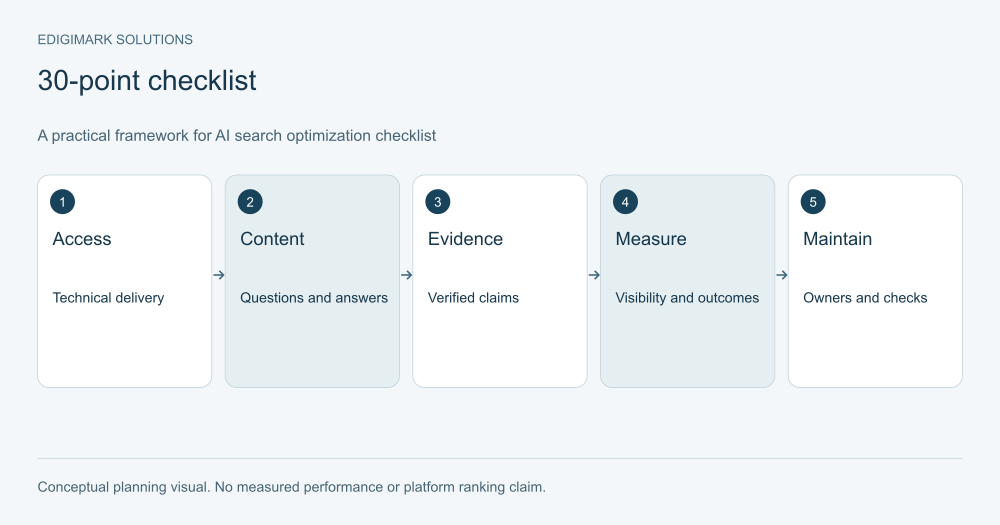
Make product and service information understandable, current and supported by evidence. Answer buying questions directly, identify the relevant entities and explain conditions that change the recommendation.
Google’s current generative AI search guidance treats this work as part of search optimization. Avoid building a second content library that repeats existing material under AI-themed titles.
For SaaS, practical evidence might include an accurate integration walkthrough, a clearly scoped implementation example or an explanation of a product limitation. Publish claims your team can substantiate. Do not turn hypothetical examples into customer success stories.
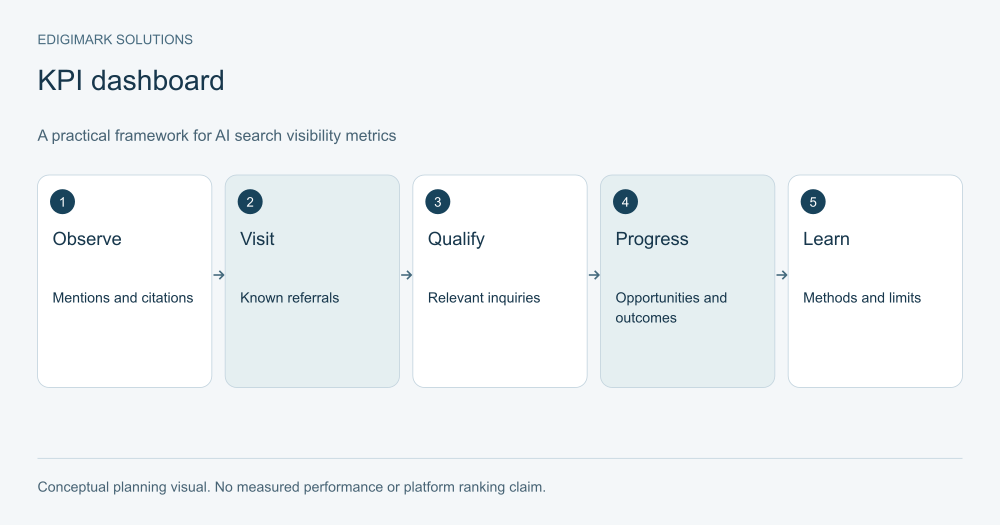
Track AI-assisted discovery as a developing source of evidence. A citation, referral visit and qualified opportunity are different outcomes. Define each before reporting progress.
A first-quarter plan for SaaS growth marketing
During the first month, inspect the journey and agree on definitions. Review product positioning, important pages, campaign tracking, CRM stages and follow-up ownership. Select the most important gap.
During the second month, implement a focused acquisition and conversion experiment. Build or improve the necessary asset, test the full enquiry journey and gather sales feedback. Record what would count as a useful result.
During the third month, review the evidence and expand selectively. Improve weak handoffs, retain useful assets and stop activity that produces poor-fit outcomes. Update the plan with what the business learned.
This sequence is a recommended working cadence, not a forecast of how quickly organic rankings or revenue will improve. The right pace depends on product fit, resources and the buying cycle.
How do you choose experiments when the evidence is incomplete?
A SaaS digital marketing strategy needs a way to choose between plausible ideas. Otherwise, the loudest request becomes the next campaign. Write the decision that an experiment will inform, the customer behavior it will observe and the constraint it must respect.
Consider a hypothetical integration page that attracts enquiries from the wrong company size. One possible explanation is unclear product positioning; another is overly broad targeting. Changing both at once makes the result harder to interpret. Start with the explanation for which you can obtain the strongest evidence. Review enquiry notes, ask sales what buyers expected and observe the page with someone who fits the intended audience.
Choose an outcome beyond the click. For a page experiment, that might be an assessment request with an implementation owner. For a trial, it might be completion of the activation task. Record the observation window and known data gaps before interpreting SaaS marketing metrics. A long buying cycle can make a week of pipeline data inconclusive.
Agree on the next decision in advance. Useful evidence might justify expanding the experiment, changing the offer or stopping it. An inconclusive result may justify improving the measurement rather than increasing spend. Keep a short decision log so the next person can understand why the team changed course. Include the owner and review date.
Who should own the SaaS marketing funnel?
Give one person responsibility for each handoff, with marketing, sales and product agreeing on the definitions. Ownership means investigating a failure and coordinating a fix; it does not mean every stage needs a separate department.
For a small team, the same person may own several stages of SaaS customer acquisition. Document those responsibilities anyway. A form can capture a suitable enquiry while a routing problem prevents anyone from responding. That is an operational failure, even if the campaign report shows a successful conversion.
Hold a recurring review around a few actual journeys. Trace one new enquiry from its landing page to its CRM record and follow-up. Trace one trial from signup to the first meaningful task. Look for missing context, duplicate messages and unclear next steps. These examples often reveal what a totals-only dashboard hides.
Keep the review focused on changes the team can make. A SaaS growth marketing discussion should end with an owner, a proposed action and the evidence to inspect afterward. Revisit the shared definitions when the product, offer or sales motion changes. Keeping an old lifecycle model after a major change can make otherwise accurate SaaS marketing metrics misleading.
Frequently asked questions
Which channel should a SaaS company start with?
Start with the channel that can reach a defined customer at a meaningful buying moment. Existing search demand may support SEO or paid search. A small account universe may support coordinated account-based activity. Validate the offer and conversion journey alongside the channel.
Should every SaaS company use a free trial?
No. A trial is useful when users can experience value with limited assistance. Products with complex data, integration or security requirements may need an assessment or guided evaluation instead. Choose the action that helps a suitable buyer make progress.
Is lead volume enough to measure success?
No. Lead volume needs qualification context. Track sales acceptance, activation or another meaningful downstream stage, then connect that cohort to customer outcomes. A large number of unsuitable enquiries can consume resources without advancing the business.
Does a 2027 strategy need a separate GEO budget?
It needs clear ownership of AI-search discovery, evidence and measurement. That work may share assets and resources with SEO, content and brand activity. Create a separate budget only when it supports a distinct, measurable program.
How can Edigimark help connect the plan?
Edigimark can discuss the relationship between acquisition, your website, automation, CRM and reporting. Bring the current funnel definitions and one example of a failed handoff to a growth strategy conversation. That gives the discussion a concrete starting point.
Put the ideas to work
Explore our connected growth services →