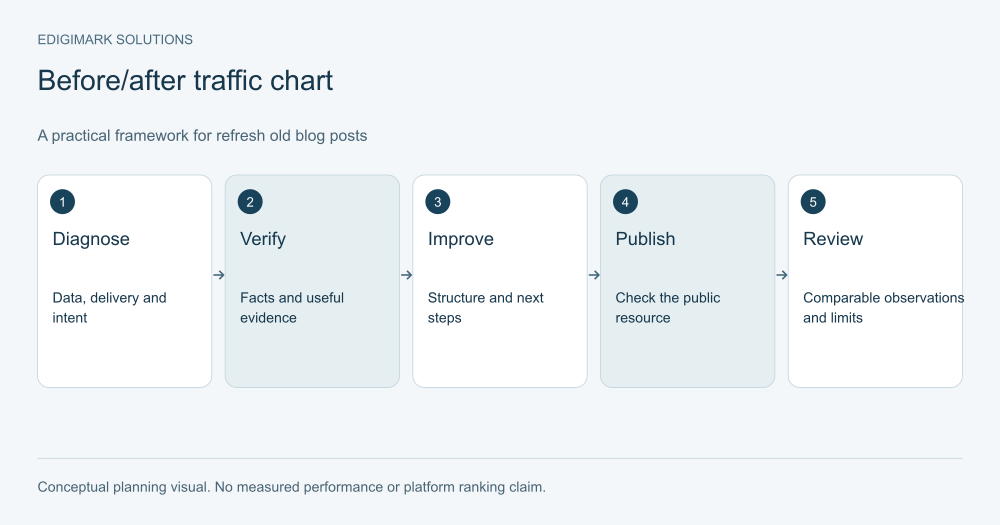
To refresh old blog posts, first diagnose what changed, then improve the facts, intent, evidence, structure and links that still serve a useful audience. Preserve a baseline and verify the public update. A content refresh can make a resource better, but it does not guarantee that traffic returns to an earlier level.
Do not begin by changing the date or adding generic paragraphs. A decline may come from reporting, technical delivery, demand, competition or a mismatch between the page and task. The useful response depends on the evidence. This guide gives eight checks for a focused blog update process.
In this guide
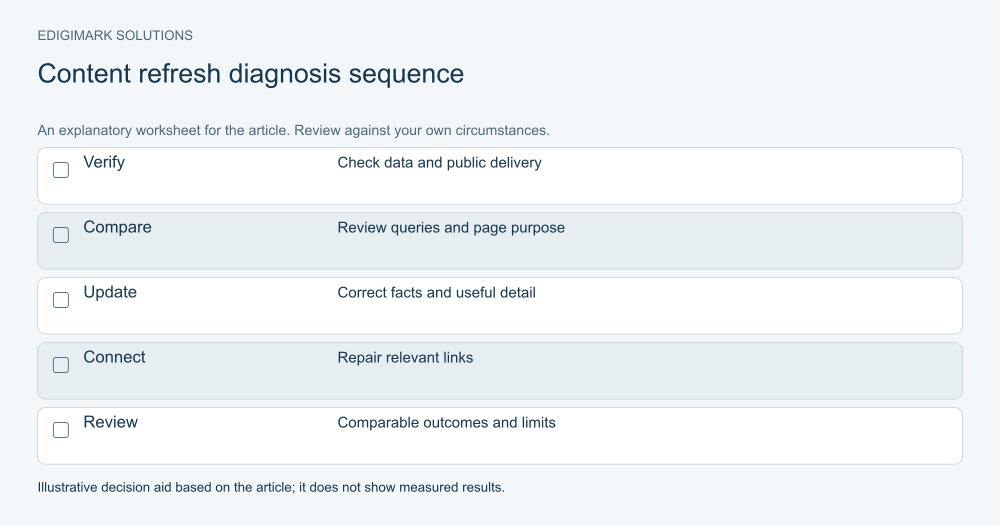
- Check 1: verify the traffic observation
- Check 2: confirm public delivery and URL behavior
- Check 3: refresh old blog posts around current search intent
- Check 4: update facts, sources and conditions
- Check 5: improve the explanation and supporting evidence
- Check 6: repair structure, navigation and internal links
- Check 7: review the action path and qualification
- Check 8: publish, verify and review comparable evidence
- What does a useful content refresh record contain?
- What does a worked blog refresh example look like?
- When should old posts be merged instead of expanded?
- How does an outdated content audit separate editorial gaps from demand changes?
- What should a content refresh strategy record before publication?
- How should an organic traffic recovery report present comparable observations?
- Frequently asked questions
- Refresh the resource, with a diagnosis and a record
Check 1: verify the traffic observation
Identify which metric fell, which period you are comparing and which pages are affected. Visits, impressions, clicks and qualified inquiries describe different observations. A decline in one does not automatically establish the same decline in another.
Review data quality and definitions. A changed tag, consent behavior, event configuration or channel rule can affect reporting. If analytics changed at the same time as the apparent decline, inspect delivery before concluding that the content lost its audience.
Google’s traffic-drop documentation provides a primary framework for investigating Search observations. Use the evidence available in your property and keep the page, query, device and market context attached to the comparison.
Preserve the baseline. Export or record the relevant view, dates and definitions before editing. The later review should be able to reconstruct what changed, rather than compare a new metric with an undocumented earlier screenshot.
Use data analytics when definitions or event delivery need correction. A content rewrite cannot repair missing measurement, and a misleading chart can send the editorial team toward the wrong task.
Check 2: confirm public delivery and URL behavior
Open the public page and inspect the actual content. Check whether it loads, shows the intended article and preserves important assets. A saved post can exist while a frontend route or template fails.
Review title, description, canonical and indexing directives where relevant. On a headless website, confirm that the frontend delivers the intended fields. Do not assume that an administration value reaches the public response.
Follow internal links and legacy destinations. A migration can leave old paths pointing to an unrelated page or missing resource. A technically successful redirect may still fail the reader’s original task.
Test the page on mobile. Tables, diagrams and navigation can become difficult to use after a template change. A content refresh should not overlook presentation that prevents readers from understanding the answer.
Bring specific findings to web development with affected URLs and expected behavior. Separate a technical failure from an editorial gap so the right owner can verify the correction.
Check 3: refresh old blog posts around current search intent
Write the task the page should serve now. Is the audience learning, comparing, preparing or acting? Inspect current result types and customer questions, then compare them with the article’s promise.
Do not copy a new competitor outline automatically. The competing resource may serve a different audience or offer. Identify the actual information gap your intended reader experiences.
Review the title and opening against the task. A page promising a comparison should show criteria and alternatives. A page promising a tutorial needs verified steps and prerequisites. A broad promotional introduction can create a mismatch even when the keyword appears.
Keep the scope distinct from nearby resources. A refresh can accidentally turn several articles into the same general guide. Update the purpose note before adding material so the library remains coherent.
If the task no longer fits the business, consider whether the page should be repurposed, consolidated or retired through a deliberate review. Keeping an old topic solely because it once attracted traffic may not serve the current offer.
Check 4: update facts, sources and conditions
Review important claims with their evidence owners. Product behavior, service scope, platform features and examples can become outdated. Replace unsupported statements with verified facts or narrower wording.
Inspect sources for meaning, not only successful responses. A documentation page may have changed or a feature may have been removed. A replacement link should directly support the claim, rather than merely discuss the same topic.
Preserve conditions that change the answer. A new prerequisite may require a revised opening, comparison or next step. Updating one sentence in the middle can leave the page’s central promise misleading.
Use actual dates where they matter. Do not present a future planning statement as an established outcome. If the article discusses 2027 from an October 2026 perspective, label the outlook and distinguish it from current facts.
Retain a review record. It should state what was checked, who owns the fact and which event triggers another update. A refreshed date without substantive verification creates little practical value.
Check 5: improve the explanation and supporting evidence
Ask what the reader still needs to decide. A missing criterion, unclear responsibility or absent example can be more important than a longer introduction. Add detail that changes understanding, not generic paragraphs to increase length.
Use a worked example with transparent assumptions. A hypothetical scenario can show how a planning framework applies without pretending to be a client case. Actual cases need permission, method and conditions.
Choose useful supporting forms. A table can compare alternatives consistently; a diagram can show sequence; a checklist can support readiness. A before-and-after traffic chart should use real data, not invented lines implying recovery.
Remove repetition and vague claims. “Seamless,” “powerful” and “best” need observable meaning or criteria. The refresh should make the recommendation more inspectable.
Keep the evidence proportional. Another company’s result is not a forecast for your reader. A documented observation may support a limited conclusion, while the article’s recommendation should explain its reasoning.
Check 6: repair structure, navigation and internal links
Read headings without the body. They should communicate the page’s subject and progression. Add the relevant topic where a broad heading loses meaning in navigation.
For a substantial resource, inspect the table of contents and heading anchors. Updates can leave links pointing to removed sections. Verify the public destination after import.
Review contextual links against the new explanation. A working URL may no longer fulfill the anchor’s promise if the destination changed scope. Choose the resource that owns the next task.
For an article about disconnected records, CRM integration can be relevant when implementation support becomes the next decision. For workflow handoffs, marketing automation may fit. Do not insert services unrelated to the article’s purpose.
Check incoming relationships as well. If the refreshed page has a new scope, overview pages or related articles may need revised anchors. A library update should preserve the information journey.
Check 7: review the action path and qualification
The next step should match the reader’s current understanding. A broad educational page may need a related explanation, while a readiness guide may connect to service scope. A premature sales request can create friction.
Explain what happens after an inquiry and which information helps the team respond. Clear expectations support suitable demand. Removing every condition may increase forms while reducing fit.
Test the actual action. Follow links, submit an approved test request where appropriate and confirm receipt. A success message does not establish that the business received the inquiry.
Use conversion rate optimization to examine mismatches and friction. A traffic decline and a conversion problem can coexist, but they need distinct diagnoses.
Keep page roles clear in reporting. A support resource or narrow definition should not be judged only by immediate sales forms. The action path should fit the task the page owns.
Check 8: publish, verify and review comparable evidence
Save the update, then inspect the public page’s content, metadata, assets and links. Keep implementation status separate from verification. A completed editorial ticket is not proof of successful delivery.
Record the changes and their intended benefit. Preserve the baseline and note campaigns, offer changes and releases that may affect the review. This supports a careful interpretation later.
Google’s core-update guidance cautions against reflexive quick fixes and guarantees of recovery. If a decline correlates with an update, assess the evidence and broader resource quality rather than assuming one element must be removed.
Choose a review window suited to the task and business cycle. Early observations can inspect delivery and relevant engagement; commercial progression may need more time. Recent inquiries and mature cohorts should not be compared uncritically.
End the review with a specific next decision. Improve a missing condition, investigate an audience shift or correct reporting. Do not keep rewriting the same page without a hypothesis.
What does a useful content refresh record contain?
| Field | Purpose |
|---|---|
| Original task and URL | Preserve what the resource owns |
| Baseline and definitions | Make comparisons reproducible |
| Diagnosed issue | Separate observation from assumption |
| Evidence and owner | Verify facts and recommendations |
| Substantive changes | Explain what was improved |
| Public checks | Confirm delivery |
| Review date and outcome | Guide the next decision |
The record does not need to be elaborate. It needs enough detail for another person to understand why the update happened and what remains uncertain.
What does a worked blog refresh example look like?
Imagine a hypothetical integration-planning article losing relevant visits after a website release. The team first checks data and public delivery. It finds that the article loads but one legacy link reaches a broad homepage and a comparison table clips on mobile.
The intent review also finds that the opening promises a setup tutorial while the body is a planning framework. The team corrects the promise, updates a capability source and adds a labeled ownership example. The technical owner repairs the destination and layout.
The page connects to appropriate scope and readiness resources. The team verifies the public update and records the changes. It later reviews compatible query and engagement observations, while noting concurrent marketing activity.
The report can describe improved delivery and the observed performance. It should not claim guaranteed traffic recovery or assign all movement to the content edit. The example is illustrative, not a measured Edigimark result.
When should old posts be merged instead of expanded?
Consider consolidation when several pages own the same task with substantially overlapping evidence. Choose the maintained resource based on usefulness and the site’s actual needs, not simply whichever title is newest.
Preserve valuable detail and coordinate URL behavior with the website owner. Review incoming links and navigation. A merge can create a better resource, but a rushed redirect to an unrelated destination can lose the task.
Document the decision so future briefs do not recreate the duplicate. Keep the owning page and scope visible in the editorial inventory.
How does an outdated content audit separate editorial gaps from demand changes?
Consider three illustrative cases. A tutorial loses clicks after its screenshots stop matching the current interface. Readers also report that the described menu no longer exists. The editorial gap is concrete: verify the new procedure, replace obsolete images and check the instructions from start to finish. The review can establish that the tutorial works again, even before enough traffic accumulates to evaluate discovery.
A seasonal planning article attracts fewer impressions after the relevant planning period ends. Its facts and public delivery remain accurate. Updating the title to imply year-round urgency may misrepresent the task. Compare equivalent periods, check whether the audience still needs the resource and make any genuine factual corrections. A demand change does not automatically justify a larger rewrite.
A service explainer keeps attracting readers, but inquiries mostly concern a service the company no longer offers. The practical issue is qualification. Correct the scope, explain the available alternative where useful and align the contact path. Lower traffic after an accurate scope correction could accompany a better audience fit. Assess both usefulness and the commercial definition rather than treating every decrease as a failure.
These examples are hypothetical diagnoses, not Edigimark results. Each ties a proposed change to observed evidence. Use the same discipline when several explanations remain plausible: document the uncertainty and avoid presenting a speculative cause as settled.
What should a content refresh strategy record before publication?
Keep the original purpose, diagnosis, chosen intervention and success definition together. Record the URL and important dependencies, the periods inspected and any concurrent campaign or tracking changes. Name the person responsible for factual approval and the person who checks the public page. A small record can prevent a future editor from repeating a failed intervention without understanding it.
Describe material changes precisely. “Updated the article” is too broad to explain the outcome. “Corrected the integration prerequisite, replaced outdated instructions and repaired the demo link” tells the next reviewer what actually changed. Store the prior version through the site’s normal version history so the comparison remains available.
Define acceptance separately from performance. Acceptance might require accurate steps, working links and a successful inquiry test. Performance might require reviewing relevant clicks and qualified inquiries over a comparable period. The page can pass publication acceptance while performance remains uncertain. Combining those states into one success label obscures the evidence.
For a proposed merge, document the surviving page’s purpose and the useful material being transferred. Check that the destination answers the displaced reader’s task. Include URL handling, internal links and asset references in the implementation plan. Consolidation should create a coherent resource, rather than redirect several unrelated purposes into a broad page.
How should an organic traffic recovery report present comparable observations?
Use the same definitions and comparable observation windows. Label the update date and explain other changes that might affect interpretation. If there is too little data, say so. A report can still show that outdated instructions were corrected and important links now work without implying measured search recovery.
Choose a chart only when the data supports its comparison. Avoid combining impressions from one system with sessions from another as though they were the same unit. Keep any segmentation visible, especially if one country or query group accounts for the apparent difference. A whole-site average can conceal the behavior of the refreshed page.
Close the record with the next decision: maintain, investigate another constraint, improve a missing section or stop making changes while evidence accumulates. This turns the refresh into a responsible maintenance process rather than a series of cosmetic edits made in response to daily fluctuations.
Frequently asked questions
Will refreshing a post recover its old traffic?
There is no guarantee. A refresh can improve usefulness and remove obstacles, but demand, competition and search selection can change. Report the practical corrections and actual observations.
Should we change the date after a minor edit?
Use dates accurately and reflect substantive review according to your publication process. A cosmetic date change should not imply that facts and evidence were checked.
How do we know which posts to refresh first?
Prioritize commercially relevant resources with clear information or delivery gaps. Consider customer impact, evidence readiness and maintenance, rather than traffic totals alone.
Should we add more words to declining articles?
Only when missing useful detail warrants it. More text cannot fix wrong intent, broken delivery or unverified claims. Diagnose the constraint first.
Can we create a before-and-after chart without data?
Use an explicitly conceptual workflow instead. A chart implying measured recovery needs actual compatible observations and a stated method. Do not invent performance evidence.
Refresh the resource, with a diagnosis and a record
Improve the task, facts and journey the page serves, then verify the public result. Edigimark’s digital marketing services can connect the review with wider search priorities. Contact the team with your page, baseline and recent changes to scope a useful refresh.