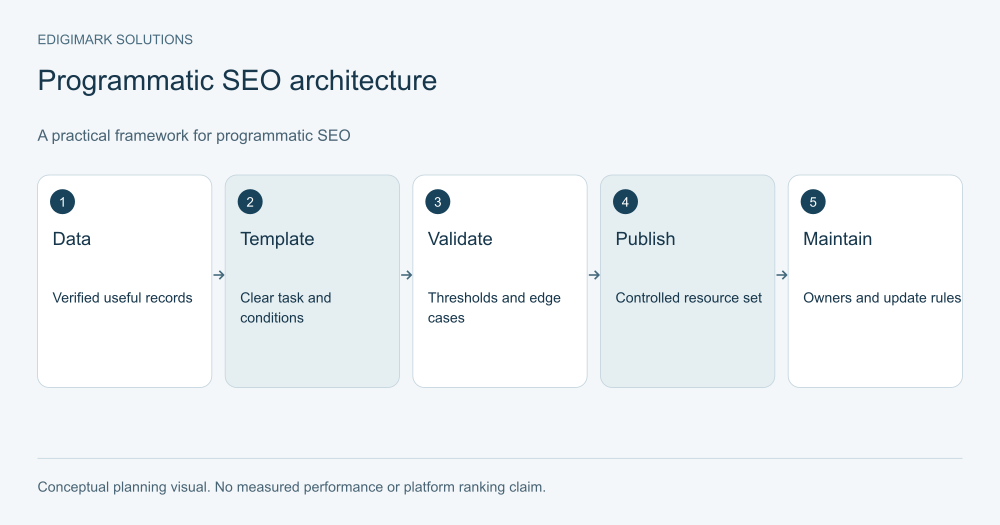
Programmatic SEO uses structured data and repeatable templates to create useful pages at scale. It can work when each page provides distinct information that helps a real user task, the data is reliable and the business can maintain the resource. It fails when scale produces interchangeable pages with little value, inaccurate claims or destinations nobody can reasonably use.
The core decision is not whether automation can generate the pages. It is whether the data and template together create something worth publishing. A directory, integration library or location-specific resource needs more than a changed heading and a long generic paragraph.
In this guide
- What makes programmatic SEO different from ordinary content production?
- When does programmatic SEO make sense?
- What are warning signs that the model will fail?
- What should a programmatic SEO data model contain?
- How do you design SEO page templates around usefulness?
- What publication threshold should scalable SEO pages meet?
- How do you validate programmatic content quality?
- How should directory SEO handle filters and combinations?
- When does a programmatic SEO library need crawl management?
- What does a good SaaS programmatic example look like?
- What does a weak scalable SEO example look like?
- How should you measure a programmatic SEO pilot?
- What maintenance process does scalable content need?
- What should a programmatic SEO proposal answer?
- How do you prevent template changes from altering claims?
- How do you decide whether to expand or stop the pilot?
- Frequently asked questions
- Scale useful information, with evidence and ownership
What makes programmatic SEO different from ordinary content production?
A programmatic system separates the reusable structure from the page-specific data. The template defines how information is presented; the data defines what is unique. The resulting page should still answer a clear task.
For a hypothetical software integration library, the template might show supported record types, prerequisites, sync direction and implementation notes. Those fields matter because they change the user’s decision. Replacing only the product name in an otherwise identical article would provide much less value.
Automation changes the production model, not the obligation to be accurate. A mistake in one field can spread across many pages. A template defect can create confusing content everywhere at once. The system therefore needs data validation, editorial rules and public checks.
When does programmatic SEO make sense?
It can suit a repeated user task supported by genuinely variable structured information. Directories, catalogues, integration references and comparable resource libraries can fit this model when the underlying information is useful and maintained.
The data must explain a difference the audience cares about. Availability, verified compatibility, service characteristics or current resource details can matter. A decorative distinction such as a swapped adjective usually does not.
The business needs the right to use the data and a process to keep it current. A dataset assembled without permission or verification can create risks and misinformation. Technical convenience does not establish that information should be published.
Also consider the maintenance burden. A company may be able to create thousands of pages but unable to review the facts when products change. The useful system is the one it can operate responsibly over time.
What are warning signs that the model will fail?
The strongest warning is that a page’s specific value cannot be explained without mentioning search traffic. If a direct visitor would find little useful information, the production model needs reconsideration.
Other signs include unreliable inputs, unsupported combinations, generic filler, invented location coverage and a template that hides missing fields with confident prose. A page should not imply a capability merely because two data labels can be combined.
Google’s spam policies address scaled content produced primarily to manipulate rankings without helping users. Programmatic publishing is not inherently the problem; the purpose and value of the resulting resources matter.
Check whether the system creates near-duplicates faster than the team can evaluate them. If the only distinction is a different phrase or city name, the business may be scaling a weak idea rather than a useful information product.
What should a programmatic SEO data model contain?
Start with the user’s decision and identify the fields needed to answer it. For an integration reference, the useful fields might include verified source and destination systems, record types, direction, prerequisites, limitations, documentation and review date.
| Field | Why it matters | Validation question |
|---|---|---|
| Capability | Establishes what the resource can do | Who verified this behavior? |
| Prerequisite | Prevents an unsuitable setup | Is the requirement current? |
| Limitation | Defines where the claim stops | Is the exception visible? |
| Source | Supports verification | Does it directly establish the fact? |
| Review date | Supports maintenance | What change triggers another check? |
Use explicit states for unknown, not supported and not applicable. These meanings differ. An empty field should not automatically become a positive claim or a generic fallback paragraph.
Keep provenance with the record. A later editor should know where a fact came from and who can check it. A large dataset without traceability becomes difficult to maintain even if the initial pages look polished.
How do you design SEO page templates around usefulness?
Make the page-specific information prominent. The opening should explain what this resource helps the reader decide, then present the relevant facts, conditions and next step. Do not bury the unique data beneath several paragraphs of repeated category introduction.
Use consistent labels so users can compare resources. If one page shows prerequisites and another omits them silently, the comparison becomes unreliable. Explain missing information or exclude records that do not meet the publication threshold.
Include a clear distinction between verified data and illustrative guidance. A hypothetical example can teach how to use the page, but it must not imply that an untested combination works.
Review the template on mobile with long labels and unusual values. A clean design with short sample data can fail when a real record contains a complex limitation. Test edge cases before expanding the library.
What publication threshold should scalable SEO pages meet?
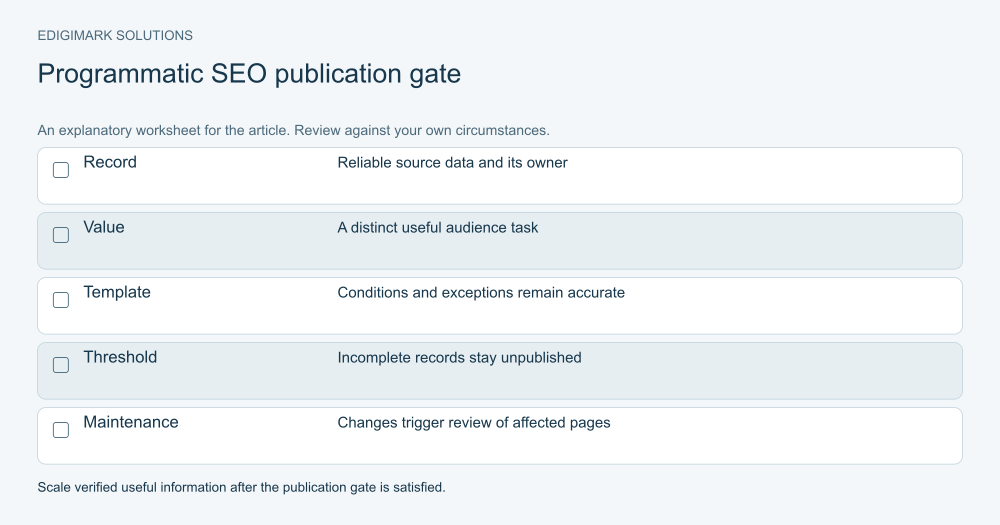
Define the minimum information a page needs to serve its task. The threshold might require a verified capability, source, meaningful condition and review owner. It should be based on usefulness, not a minimum number of automatically generated words.
Exclude combinations with no real basis. For example, a software pair should not produce an integration page merely because both names exist in the database. The business needs evidence for the relationship the page describes.
Decide how to handle incomplete records. Some can remain internal until verified. Others may serve a limited task if the uncertainty is explicit. Do not hide missing data with generic recommendations that create a false impression of completeness.
Keep the threshold testable. Editors and developers should agree on what passes and what happens when a record fails. This prevents a large publishing run from making inconsistent decisions.
How do you validate programmatic content quality?
Review the data, template and rendered pages separately. Data checks confirm facts and required fields. Template checks confirm structure and meaning. Rendered checks confirm that the public page actually delivers the intended resource.
Sample records with ordinary values, long values, missing fields and edge cases. A template may work for the common record but produce nonsense when a limitation changes. Inspect the opening, table, metadata and next action for each representative case.
Use automated checks where they can catch meaningful failures, such as missing required fields or malformed URLs. Retain manual review for judgments about usefulness, misleading implications and evidence. Automation cannot determine every editorial concern.
Coordinate with web development so the production system has clear validation and release behavior. The developer needs to know what should happen when a record becomes outdated or fails the threshold.
How should directory SEO handle filters and combinations?
Define which filtered views actually serve distinct user tasks. A useful selection may help compare available resources, while arbitrary combinations can create many redundant paths. The architecture should make the maintained resource set understandable.
Review the URL model with the website owner before publishing at scale. Decide how navigation, filters, preferred resources and unavailable combinations behave. Do not apply blanket indexing or canonical rules without understanding the content’s purpose.
Maintain a controlled URL inventory. A large number of possible paths is not the same as a large number of useful pages. The system should distinguish intended resources from redundant or nonsensical combinations.
Check that filtered states do not create misleading empty pages. A visitor should understand when no resource matches and how to adjust the choice. Generic text added below an empty list does not necessarily make the page useful.
When does a programmatic SEO library need crawl management?
Google’s crawl-budget guidance is aimed at very large or frequently updated sites and specific crawling problems. A small service site should not adopt an elaborate crawl program merely because it uses templates.
At scale, inspect whether the system generates redundant URLs, slow responses or outdated entries. Keep the intended inventory and sitemap aligned. Remember that crawling a page and indexing it are different stages.
Use observed problems to justify deeper work. If important resources are not being processed, investigate access, inventory, response health and usefulness. Do not assume that publishing more pages automatically produces more discovery.
What does a good SaaS programmatic example look like?
Imagine a hypothetical SaaS company maintaining verified integration reference pages. Each page states the systems involved, supported records, setup prerequisites, limitations and current source documentation. The template allows readers to compare those fields consistently.
The company does not generate every possible software pair. It publishes only verified relationships that meet the usefulness threshold. Missing or outdated records stay in a review queue. Product owners confirm changes when connector behavior evolves.
The pages connect to relevant planning resources and implementation scope. A user who needs professional help can find CRM integration where appropriate, while a user seeking technical detail gets the reference they came for.
The company verifies public output after releases and tracks relevant engagement and inquiry fit. The example illustrates a production model, not a claim about actual integrations or client results.
What does a weak scalable SEO example look like?
Imagine a service company generating a page for every city using the same paragraph with only the city name changed. The pages imply local coverage but contain no verified service details, practical distinctions or genuine local basis.
The problem is not merely repetitive wording. The resource can mislead people about delivery and provide little help in choosing the service. Adding more generic paragraphs would not resolve the missing evidence.
A better decision is to publish accurate service-area information and resources for genuine local needs, where the company can substantiate them. The scope should follow the business’s actual delivery model, not the number of available place names.
This principle also applies to product comparisons and technology combinations. A template must not manufacture a relationship or recommendation from labels alone.
How should you measure a programmatic SEO pilot?
Begin with a manageable verified subset. Define the user task, publication threshold and meaningful outcome. Track public delivery, relevant visits, resource usage and qualified actions according to the page’s role.
Use data analytics to maintain page groups and event definitions. A total across thousands of pages can hide that only a few serve useful demand. Inspect resource-level patterns and the quality of resulting inquiries.
Record the date of template and dataset changes. A new data source can change page meaning as well as performance. Keep the evidence and method visible when comparing periods.
Decide what would justify expansion. It may require reliable maintenance, demonstrated audience use and acceptable quality in edge cases. Page count alone should not be the success measure.
What maintenance process does scalable content need?
Assign an owner to the dataset and another to the template where appropriate. Define review triggers, stale-record behavior and removal or update procedures. The system should handle change deliberately rather than let old claims persist indefinitely.
Keep a traceable change log. If a capability is removed, know which pages and related resources depend on it. If a template changes a label or conclusion, inspect representative rendered outputs again.
Plan for incoming links and navigation when resources are merged or removed. The user should reach a relevant maintained destination or an appropriate response. Do not silently convert unavailable resources into unrelated promotional pages.
Use marketing automation principles carefully for review reminders and queues where relevant. Automating maintenance tasks can help; it does not transfer factual responsibility away from the owner.
What should a programmatic SEO proposal answer?
Ask what unique decision each page helps, where the data comes from, how rights and accuracy are handled and what happens when a record fails validation. Request a sample page with realistic edge cases rather than only the cleanest example.
Ask who owns ongoing maintenance and how the public resource is verified. A proposal focused entirely on launch volume may underestimate the cost of keeping thousands of claims current.
Finally, ask why scale is necessary. A conventional small resource set may serve the audience better when the data is limited or the tasks are not meaningfully repeatable. Automation should fit the information model, not become the objective.
How do you prevent template changes from altering claims?
Treat wording rules as part of the data model. If the template changes “may support” to “supports,” the meaning can become stronger across every page. A cosmetic rewrite can therefore create a factual problem even when the underlying records remain unchanged.
Give important conclusion logic an explicit owner. The developer implements the rule, while a subject expert verifies what the rule can legitimately infer from the inputs. A field that says a connector exists does not necessarily establish which record types it handles or which conditions apply.
Review before-and-after examples with ordinary and exceptional records. Inspect the opening answer, labels, limitations and next action. Preserve those examples so a later release can detect unintended changes in meaning.
Do not let a generic fallback conceal an error. A missing limitation field should produce a review state or an appropriately limited display, according to the publication policy. It should not generate confident text asserting that there are no limitations.
How do you decide whether to expand or stop the pilot?
Review usefulness, accuracy, public delivery and maintenance capacity together. Strong initial visits cannot justify scaling if the team cannot verify the facts. A technically stable template cannot justify expansion if readers find the resources unhelpful.
Inspect questions from actual users where available. They may reveal that a supposedly useful field is unclear or that an essential prerequisite is missing. Improve the information model before copying the same gap across more records.
Check the cost of keeping the pilot current. If every record requires extensive manual research, the model may still work at a smaller scope, but the proposed scale should reflect that effort. A realistic operating plan includes review time, not only generation speed.
Record the expansion decision and its conditions. The team may choose to publish another verified subset, refine the template or stop generating a category. A controlled decision is more valuable than continuing because a large page-count goal was announced earlier.
Frequently asked questions
Is programmatic SEO the same as AI-generated content?
No. Programmatic publishing uses repeatable structures and data; AI may or may not be involved. Either approach still needs useful content, verified facts and responsible maintenance.
How many pages should a pilot contain?
Choose enough representative records to test the data, template and edge cases without exceeding review capacity. A fixed large quota is less useful than a verified pilot with clear expansion criteria.
Can directory pages rank with little prose?
Useful structured information can serve a task without a long article. Evaluate the resource’s unique value and completeness rather than adding generic text solely to reach a word count.
Should we publish combinations with missing data?
Use explicit thresholds. Missing evidence must not become an implied positive claim. Some records should remain unpublished until verified; others may need clearly limited scope.
What is the biggest implementation risk?
Scaling an unverified data model or weak template can spread mistakes quickly. Establish validation, ownership and maintenance before expanding the page inventory.
Scale useful information, with evidence and ownership
Programmatic SEO is appropriate when the data and template create resources people can use. Edigimark’s digital marketing services can connect the model with search and content priorities. Contact the team with your dataset, intended audience and sample page to assess whether scale fits the task.