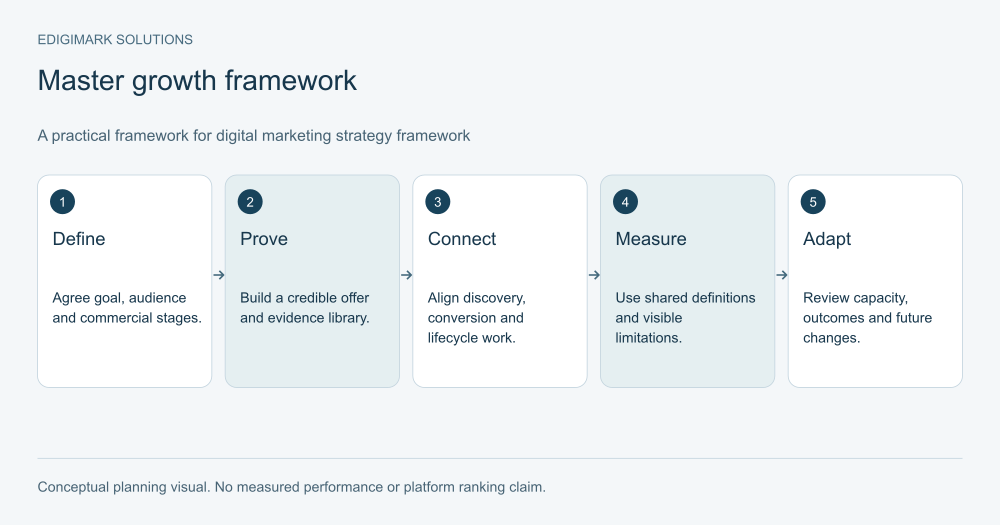

A paid advertising funnel connects campaigns, offers and follow-up around the decisions a customer needs to make. Use awareness activity to introduce a relevant problem or product, consideration activity to help evaluate it, and conversion activity to support an appropriate action. Retargeting and nurture should continue that conversation where permitted, while measurement follows suitable outcomes rather than treating every engagement as a sale.
The funnel is a planning model, not a prediction that each person will travel through every stage in order. Some buyers arrive ready to act. Others revisit information, involve colleagues or leave because the offer does not fit. A useful plan supports those paths without forcing everyone through the same sequence of ads.
In this guide
- What should a paid advertising funnel begin with?
- How should TOFU MOFU BOFU advertising be interpreted?
- Paid advertising funnel stage 1: introduce a relevant problem
- Paid advertising funnel stage 2: help people evaluate the approach
- Paid advertising funnel stage 3: support a meaningful conversion
- Stage 4: How should paid retargeting continue the conversation?
- Stage 5: Connect nurture and sales with full-funnel paid media
- Stage 6: Set up campaign stage measurement
- How should full-funnel paid media budgets be allocated?
- How does a paid advertising funnel avoid unnecessary sequences?
- What does a complete paid advertising funnel look like?
- What should a campaign stage measurement review inspect?
- What commonly breaks a paid advertising funnel?
- Who should own each paid advertising funnel handoff?
- Frequently asked questions
What should a paid advertising funnel begin with?
Begin with the customer decision and the business outcome. Define the supported audience, the problem the offer solves and the action that represents meaningful progress. Include the practical limits that affect fit: geography, product requirements, service capacity or implementation conditions.
Map the questions people need answered before acting. A consumer product buyer may need to understand use, dimensions, compatibility and delivery. A business buyer may need workflow, implementation, integrations and commercial scope.
Choose the campaign role from those questions. An introductory video, a comparison resource and a demo invitation can serve different tasks. The existence of a format does not create a reason to use it.
Connect the plan with digital marketing strategy so paid campaigns share accurate messaging and success definitions with organic content, the website and sales.
How should TOFU MOFU BOFU advertising be interpreted?
TOFU, MOFU and BOFU stand for top, middle and bottom of the funnel. They can help teams organise awareness, consideration and action, but the labels should not become rigid assumptions about an individual person.
At the top, the task may be recognising a problem or understanding a product use case. In the middle, it may be evaluating approaches, fit or requirements. At the bottom, it may be requesting a quote, booking a discussion, starting a suitable trial or buying.
Assign an offer to the decision it supports. A downloadable guide is not automatically middle-funnel if its content is basic awareness. A product demonstration is not automatically bottom-funnel if the audience is only exploring a category.
Use the labels for planning and then inspect actual behaviour and feedback. People can enter at different points, share resources with colleagues and return through another channel. The campaign should remain useful when the journey does not match the diagram.
Paid advertising funnel stage 1: introduce a relevant problem
Give the audience a recognisable situation and a reason to care. A hypothetical workflow software campaign might show how an approval request becomes difficult to track across disconnected tools. A consumer product campaign might demonstrate a practical use in a real setting.
Avoid a vague claim that the offer will transform everything. Explain one concrete problem or use case accurately. If the creative is a conceptual illustration, label it appropriately rather than implying that it shows a captured client result.
Choose a suitable next step. The audience may benefit from a clear explanation, a diagnostic worksheet or a product overview. Asking for an immediate meeting can be reasonable in some contexts, but it should not be the default for people who have not yet understood the offer.
Measure the role honestly. Reach, viewing and engagement can describe exposure and response; they do not by themselves prove demand or revenue. Include a plan to inspect whether the audience is relevant and whether later actions make sense.
Paid advertising funnel stage 2: help people evaluate the approach
Provide the information needed to compare options. Explain the workflow, requirements, trade-offs and circumstances where the offer does not fit. A useful comparison resource should help the reader make a decision rather than declare your option the winner under every condition.
For the hypothetical software campaign, this could mean comparing a manual process, a general task tool and a specialist workflow platform. The explanation should distinguish implementation effort, ongoing responsibilities and supported capabilities without inventing performance figures.
Connect the campaign to a destination that delivers the resource. If a form is used, explain the exchange and subsequent communication. If the information can be presented openly, consider whether registration is necessary for the intended decision.
Gather qualitative feedback where possible. A resource can attract many downloads while failing to answer the buyer’s important question. Sales and support conversations can reveal what remains unclear.
Paid advertising funnel stage 3: support a meaningful conversion
Make the action specific and proportionate. “Request a tailored implementation discussion” tells the person more than “Get started” when that is the actual offer. Explain what the action involves and any information needed to prepare.
The destination should help suitable people recognise fit. Include relevant proof, scope and limitations. A form that removes all qualification can increase raw submissions while creating more unsuitable enquiries.
Test the full task. Check the form, booking or checkout on relevant devices. Confirm that the action reaches the correct system and owner. Verify the promised resource or response is available.
Conversion rate optimization helps examine the decision barriers, while web development verifies the technical journey. A conversion campaign should not spend more simply because a broken form produces no recorded actions.
Stage 4: How should paid retargeting continue the conversation?
Retargeting can provide a relevant reminder or a missing answer where user choices and platform rules permit the audience use. Select the message according to the prior action and current offer.
Someone who viewed an introductory explanation may need a practical example. Someone evaluating implementation may need a checklist. Someone who completed a request should not keep receiving the same instruction to submit it again.
Maintain suppression and audience ownership. Existing customers, active opportunities and people whose needs were already addressed may require different messages. The available data and platform matching will limit what can be implemented, so verify the setup rather than assuming complete coverage.
LinkedIn’s Matched Audiences guidance illustrates engagement-based audience options. Each platform has its own requirements and capabilities; check the current account and relevant documentation before building a sequence around a feature.
Retargeting is a continuation tool, not proof that a campaign caused every later action credited to it.
Stage 5: Connect nurture and sales with full-funnel paid media
Deliver what the person requested, preserve the context and route the record appropriately. A guide downloader, a quote requester and a demo requester should not all receive a message that assumes the same readiness.
Define the human handoff. Sales should know the stated need, relevant offer and useful details already provided. If the enquiry is outside the supported scope, decide how it will be handled. If the person is an existing customer, route them to the appropriate process.
CRM integration connects records and outcome data, while marketing automation can support delivery, notifications and contextual follow-up. Stop or change automated sequences when someone replies, books a meeting or enters an active conversation.
Use feedback to improve acquisition. If suitable people repeatedly misunderstand the offer, revise the creative or destination. If a query or audience produces unsupported requests, investigate targeting and qualification. The funnel should learn from what happens after the click.
Stage 6: Set up campaign stage measurement
Give each stage a measure that reflects its role and connect it with later evidence. Awareness may use exposure and meaningful engagement; consideration may use resource use or qualified interest; conversion may use valid enquiries, activated trials or orders.
Do not count every stage action as an independent sale. One person can view, download, enquire and buy. A funnel report should show progression and overlap rather than add those actions into a misleading total.
Google’s conversion goal documentation explains how actions support goals. Its primary and secondary action guidance describes different reporting and bidding roles, subject to configuration. Review the actual setup so campaign optimisation reflects the intended outcome.
Use data analytics to connect observed stages with business outcomes. Keep attribution limits and cohort maturity visible, especially when a purchase involves several people or a long evaluation period.
How should full-funnel paid media budgets be allocated?
Allocate by the current gap, evidence and economics. A business with strong relevant demand but a weak destination may need page work before more exposure. A new category may need explanation before a large conversion campaign. A proven offer may justify a focused expansion.
There is no universal percentage that every funnel should assign to awareness, consideration and conversion. The customer, market and business stage influence the mix. A small budget may need one coherent path rather than separate campaigns for every diagram stage.
Include creative, page, tracking and follow-up costs. A campaign can appear inexpensive in media terms while requiring substantial operating work. Conversely, a shared page improvement can benefit several channels.
Reserve resources for learning. The first phase may reveal a qualification or form problem that needs repair. A plan using all available money on exposure can leave the important issue unresolved.
How does a paid advertising funnel avoid unnecessary sequences?
Allow ready buyers to reach the commercial action directly. A person searching for a provider should not need to download an introductory guide before requesting a relevant conversation.
Keep supporting information available for people who need it. A technical evaluator may want documentation before acting; another buyer may already understand the requirements. Clear navigation and contextual links let them choose the appropriate depth.
Use behavioural information cautiously. Opening a page does not prove a person reached a particular buying stage. A colleague might be researching on their behalf, or the visitor may simply be curious.
The funnel should provide useful options rather than assign certainty to every interaction. Review real questions and outcomes to improve the sequence without overinterpreting a click.
What does a complete paid advertising funnel look like?
Consider a hypothetical business selling a specialist project-management platform. An introductory campaign explains the difficulty of coordinating approvals across several teams. The destination provides an open explanation and an optional assessment worksheet.
A consideration campaign offers a comparison of approaches and an implementation guide. The commercial page explains supported workflows, prerequisites and the product demonstration. Suitable demo requests enter a defined sales process with the information already collected.
Where permitted, retargeting provides relevant implementation information to engaged visitors. People who request a demonstration are suppressed from repeated acquisition invitations or moved to an appropriate message. Sales outcomes feed a review of audience fit and offer clarity.
This example describes a possible operating model, not a client result or a promise of performance. Its value is that each asset answers a decision and each handoff has an owner.
What should a campaign stage measurement review inspect?
Verify the journey first. Are destinations live? Do forms and checkout work? Are promised resources delivered? Are records routed correctly? Are conversion definitions still accurate after recent changes?
Then inspect relevance and quality. Review a small anonymised sample of accepted and rejected outcomes. Ask what the campaign attracted and what those people understood about the offer.
Examine stage transitions without assuming a neat order. A decline in a resource-to-meeting rate can reflect audience, content, timing or follow-up. Locate the evidence needed before selecting a repair.
End with clear actions and owners. A report showing every stage in a colourful funnel is useful only when it leads to a practical decision about the customer journey.
What commonly breaks a paid advertising funnel?
Different teams can define success differently: advertising counts submissions, automation counts email opens and sales counts qualified meetings. Without shared definitions, each layer can look successful while the overall journey disappoints.
Other failures include irrelevant traffic, a resource unrelated to the offer, a page that overpromises, missing lead context and automation continuing after a human conversation starts. Attribution overlap can also inflate reported totals.
Repair the concrete issue rather than automatically adding another stage or campaign. More ads do not fix a broken form, and more emails do not fix an unsuitable offer.
Ask Edigimark to review your paid funnel if acquisition activity, website actions and sales outcomes currently operate as separate reports rather than one connected process.
Who should own each paid advertising funnel handoff?
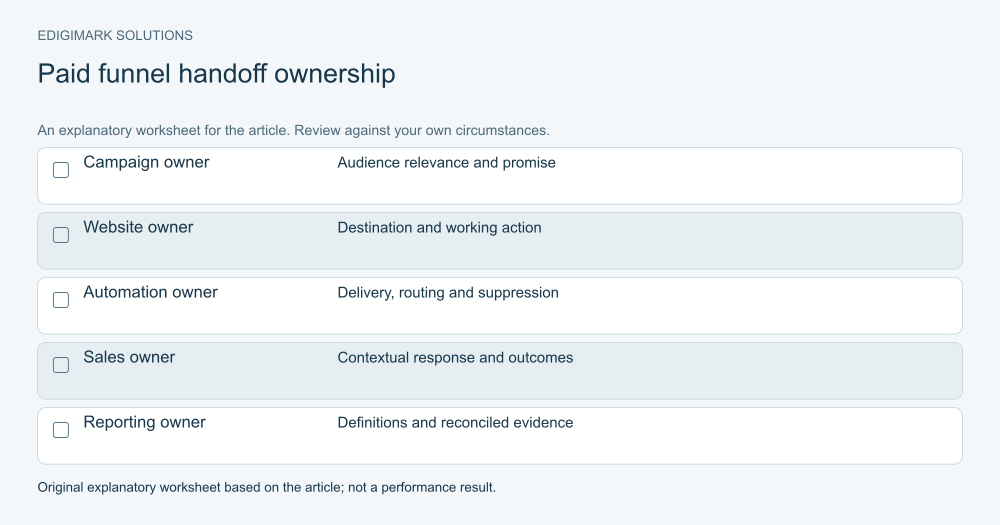
Assign ownership to transitions as well as assets. The campaign owner manages relevance and the offer promise. The website owner verifies the destination and action. The automation owner ensures delivery and routing. Sales owns the human response and outcome updates. A reporting owner checks definitions and reconciles the evidence.
This does not require a large team. One person can hold several responsibilities, but the responsibilities should still be explicit. A shared inbox with no assigned review process is not a reliable handoff merely because the form sends an email.
Document failure handling. If a CRM connection stops, who notices and how are requests recovered? If a resource link breaks, who repairs it and informs the appropriate owner? If an offer becomes unavailable, who changes the ads and page?
Keep the operating record short enough to use. Include the live destinations, intended actions, systems receiving the data and the verification schedule after material changes. The funnel becomes more dependable when the team can locate a failure and correct it without reconstructing the whole journey from memory.
Frequently asked questions
Does every business need separate TOFU, MOFU and BOFU campaigns?
No. The stages can help planning, but a small business may need a simpler structure. Separate campaigns when the distinction supports a real audience, offer or budget decision. The customer’s task matters more than reproducing a standard diagram.
Can a conversion campaign work without an awareness campaign?
It can, particularly when relevant demand already exists and the offer is ready. Some buyers arrive with an active need. Awareness can serve a useful role in other contexts, but it is not a universal prerequisite for every commercial action.
Is retargeting always necessary?
No. It depends on the journey, available permitted data, audience reach and economics. A useful reminder can help, while repetitive or inappropriate messages can waste attention. Give retargeting a defined role and evaluate it with its attribution limits understood.
What should count as a funnel conversion?
Define meaningful actions separately: resource use, valid enquiry, qualified meeting, activated trial or order, for example. Choose the campaign’s optimisation and commercial measures deliberately. Do not call every interaction a sale or add overlapping stages as unique customers.
How should a B2B funnel handle several stakeholders?
Provide information for the different decisions and preserve context when people engage. Technical, operational and commercial questions may need separate resources. Do not assume one contact represents the entire buying group or that every stakeholder will follow the same sequence.