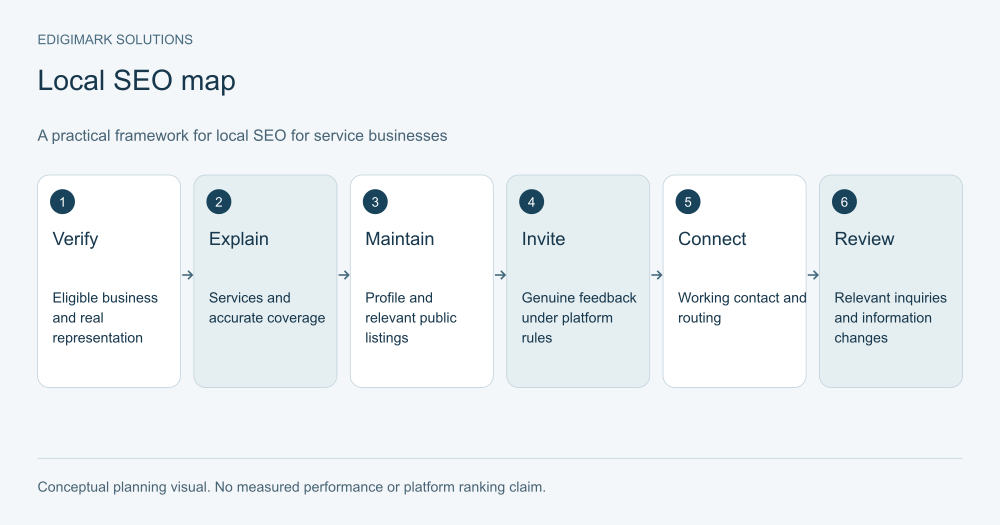
Local SEO for service businesses starts with accurate business information, an eligible and well-maintained local profile, useful service pages and a working contact path. Explain the services and areas you actually cover, invite genuine customer feedback under platform rules and keep the information current. Review relevant inquiries alongside local discovery observations rather than promising a fixed ranking position.
A customer needs to know whether the business handles their task, serves their location and can be contacted through the stated route. Local optimization is useful when it makes those facts easier to understand. A large set of location keywords cannot replace accurate coverage or a reliable service process.
This guide covers Google Business Profile, local service pages, local citations and customer reviews. It uses Google’s current primary guidance for platform requirements and distinguishes those requirements from the editorial and operational recommendations offered here.
In this guide
- What should local SEO for service businesses clarify first?
- How should Google Business Profile eligibility be checked?
- What Google Business Profile information needs regular attention?
- What does Google say determines local search ranking?
- What should local service pages explain?
- When do location pages provide distinct value?
- How should local citations and directories be managed?
- How should customer reviews be requested?
- How should businesses respond to reviews responsibly?
- What should the local contact journey include?
- What does an illustrative local SEO plan look like?
- How should local SEO performance be measured?
- What should a local information maintenance check include?
- Frequently asked questions
- Keep local business facts accurate and the next step usable
What should local SEO for service businesses clarify first?
Write the real business name, offered services and delivery model. A business may receive customers at a location, travel to customers or combine both. The website and profile should describe the actual arrangement rather than imply a storefront that does not exist.
Define service coverage with the operational team. Distinguish the places the business can normally serve from areas that need a separate assessment. Do not promise availability everywhere if travel, capacity or service type creates meaningful boundaries.
Clarify the customer task. A provider may handle routine planned work while excluding urgent requests, or offer some services only under specific conditions. Put decisive scope near the service explanation so the reader can judge fit.
Identify the contact and response owner. An accurate profile still provides a poor journey if calls go unanswered through the stated route or requests reach nobody responsible. Local discovery and operational delivery need to work together.
Connect the scope with digital marketing services. Begin with truthful business information and useful customer decisions before choosing a larger content or directory program.
How should Google Business Profile eligibility be checked?
Review eligibility and representation using the actual business arrangement. Google’s business representation guidelines describes eligible businesses with a customer-facing physical location or those traveling to customers. It also specifies conditions for service-area businesses and addresses. Do not infer eligibility from website content alone.
Use the real public business name. Avoid adding service or location phrases merely to influence discovery if those phrases are not part of the recognized name. Keep the profile aligned with the business’s actual representation.
For a service-area business without a customer-facing storefront, follow Google’s address-display guidance. A residential operating address should not be exposed as a storefront simply because it exists. The profile owner should verify the correct arrangement and settings.
Do not create profiles for invented offices or use a mailing address as evidence of operating presence. Check the current guidelines before adding a location or changing a profile structure. Different legitimate arrangements can have specific conditions.
Keep ownership and access under an approved business process. The responsible owner should know who can edit the profile and how information is reviewed. This helps the company resolve mistakes without losing control of its public identity.
What Google Business Profile information needs regular attention?
Review the business’s services, contact route, hours and relevant coverage information. Make updates when the real arrangement changes, rather than waiting for a campaign refresh. A customer arriving during inaccurate hours experiences a practical failure regardless of visibility.
Select categories according to the actual business. The representation guidelines describe categories as a way to represent the core business, not a place to insert every keyword. The profile owner should verify the most appropriate current options.
Use authentic, permitted photos that help customers understand the business or service. A conceptual illustration should not be presented as a real office, team or completed job. Accuracy applies to visuals as well as words.
Inspect profile links through the customer’s journey. The website destination should explain the promised service, and the contact route should reach the intended business. Do not assume an old link remains useful after a website migration.
Assign a review trigger for holiday hours, changed coverage, retired services and contact changes. A concise information register can help the profile owner and website editor update the same facts together.
What does Google say determines local search ranking?
Google’s local ranking guidance describes relevance, distance and prominence in its explanation of local results. These concepts help frame the work, but they do not provide a public formula that a business can control through a checklist.
Relevance concerns the match between the business and the task. Accurate service information can help describe that match. Editorial work should explain the actual offer, rather than attempt to create relevance through misleading names or unsupported claims.
Distance depends on the searcher’s location context. A business should not promise that profile edits will remove geographic constraints or make it appear equally for every person in a large region. Keep expectations tied to actual observations.
Prominence concerns how well known the business is in Google’s guidance. The practical business response is to maintain credible public information and genuine relationships, rather than invent endorsements or purchase manufactured reviews.
Google also states that a business cannot request or pay for a better local ranking. A useful service explanation can describe optimization work and observation methods while avoiding guarantees about a fixed local position.
What should local service pages explain?
Open with the service and appropriate customer situation. State what the business does, important scope conditions and how a customer can request help. A person comparing providers should not have to translate broad slogans into practical meaning.
Explain the process at a useful level. Describe what information helps the business assess the task, how scheduling or scoping works and what the customer should expect next. Use only commitments the business has approved.
Make coverage and exclusions visible. If a service depends on location or needs assessment, state that condition near the relevant explanation. Avoid an unrestricted headline followed by a buried qualifier that reverses the promise.
Use verified examples and permitted images where available. A labeled hypothetical example can explain a process, but it should not appear to be a completed customer job. Measured result claims require real evidence and a suitable method.
Connect a relevant contact action. A service page should make the next step understandable, including whether the action requests information, books an appointment or begins an assessment. The route should match the business’s actual process.
When do location pages provide distinct value?
Create a location page when it supplies useful, accurate information that changes the customer’s decision. This might include verified coverage, a real operating location, relevant service arrangements or an appropriate contact route. A place name alone does not create a useful resource.
Distinguish a physical location from an area served. A business can travel to an area without maintaining an office there. State the arrangement plainly so readers do not infer local staff or premises that do not exist.
Avoid duplicating a generic page across many towns with only the name changed. Review whether each resource helps a real customer answer a distinct question. If the service and coverage can be explained coherently on one page, that may be the clearer architecture.
Keep examples truthful. Do not invent a local job, testimonial or photograph to make a location page appear established. A genuine coverage explanation can be useful without fabricated local evidence.
Maintain the pages as coverage changes. Retired locations, altered contact routes or capacity changes should trigger an update. Accurate coverage is an operational fact, not just an SEO field.
How should local citations and directories be managed?
Choose public listings that help the intended customer verify or find the business. Relevant directories, professional references and actual community relationships can serve different roles. A large submission count is not a useful goal by itself.
Maintain consistent core information where the same fact appears. Business name, contact details, service scope and actual location should not contradict one another. This recommendation supports customer clarity; it should not be presented as a guaranteed ranking formula.
Keep a listing inventory with the URL, owner, information shown and review date. Prioritize prominent or relevant listings where mistakes could confuse customers. A practical correction plan is more useful than indiscriminate directory expansion.
Do not create invented partnerships, memberships or endorsements. A reference should describe the actual relationship and comply with the destination’s requirements. A prominent organization’s name does not make an unsupported association true.
Review old listings when the business moves or changes contact details. The website may be correct while a customer still reaches an obsolete number through another source. Correct the information where the business is authorized to do so.
How should customer reviews be requested?
Invite genuine feedback from customers through an ordinary approved process. Google’s review guidance prohibits incentives for posting, changing or removing reviews. A review request should not trade discounts or other rewards for feedback.
Do not solicit only customers expected to leave positive feedback. Google’s contribution policy prohibits selectively soliciting positive reviews and related review manipulation. Keep the process consistent rather than using satisfaction screening to direct only favorable customers to the platform.
Make the request easy to understand. A clear link or approved QR route can help a customer reach the correct review destination. Test the destination and avoid language that tells the customer what rating or wording to provide.
Use genuine experiences. Do not create employee-written customer reviews, purchase feedback or fabricate a testimonial. A real customer’s opinion should remain their own, rather than a scripted SEO asset.
Document who owns the request workflow and policy review. If a third party helps manage it, the business still needs to understand what is sent and under what conditions. A convenient automation should not conceal a prohibited practice.
How should businesses respond to reviews responsibly?
Use a helpful, proportionate response that addresses the feedback without exposing private customer information. A public reply should not reproduce sensitive service records or details that the reviewer did not choose to disclose.
For a concern requiring investigation, explain the appropriate private contact route. Do not promise a specific resolution before the business understands the situation. The reply should help the next step rather than become an argument in public.
Avoid pressuring the customer to alter or remove feedback. Follow the platform’s reporting route for content believed to violate policy, and keep genuine criticism distinct from a policy violation. A low rating alone is not evidence that the review is prohibited.
Use review themes as a learning input. Repeated confusion about scheduling or scope can reveal a service-page gap. Summarize the task without turning an individual customer’s private details into public content.
Keep review management attached to service responsibility. Marketing can coordinate the process, but operational owners may need to resolve the underlying issue. A polished reply cannot fix an inaccurate service promise by itself.
What should the local contact journey include?
Provide a working action that matches the business model. A customer may need to call, request a quote, schedule a visit or submit a short problem summary. Label the action and explain what happens next.
Ask for proportionate information. Service type, location and a brief task description can help determine fit. Avoid requesting unnecessary sensitive information through a general lead form. Use the appropriate later process for detailed material.
Check mobile usability. A contact button should be easy to use, the number should be correct and the form should communicate errors clearly. A customer arriving from a local result should not have to struggle through an unrelated navigation path.
Use conversion rate optimization to investigate specific friction while preserving accurate qualification. A higher raw submission count is not automatically better if the requests fall outside service coverage.
Verify routing through CRM integration where the website supplies business records. Confirm that location and service context arrive correctly and that a responsible person receives the request.
What does an illustrative local SEO plan look like?
Imagine a hypothetical service provider that travels to customers and has no public storefront. Its profile and website use inconsistent descriptions, and the contact form does not ask which service the customer needs. Some inquiries concern work outside its actual coverage.
The business first verifies profile eligibility and representation under Google’s current guidance. It corrects the public service and contact information, follows the appropriate address-display rules and assigns an owner for updates. It does not invent additional offices to broaden apparent presence.
The website gets a clear owning service page and an accurate coverage explanation. A location resource is added only where the business can supply distinct useful information. A conceptual process diagram explains request, assessment, scheduling and follow-up without pretending to show measured performance.
The feedback process invites genuine reviews consistently, with no incentives or selective positive solicitation. The contact route is tested, and the receiving team records relevant service and location context.
Later reviews examine actual discovery observations and suitable inquiries under stated definitions. The plan does not assume a guaranteed rank improvement. It demonstrates how truthful information and a functioning journey create practical work a keyword list alone would miss.
How should local SEO performance be measured?
Separate profile observations, website actions and qualified service inquiries. Each system has its own definitions and coverage. A profile interaction does not necessarily establish a completed booking, and a click does not prove that a call was answered.
Define a relevant inquiry using real coverage and service scope. Record unsuitable location or service requests as distinct reasons. This helps the business decide whether to clarify information or change routing.
Use data analytics to align reporting periods and event delivery. Note contact or tracking changes that may affect comparisons. Do not attribute every apparent change to the latest profile edit.
For local result observations, preserve location context and method. Results can differ by the searcher’s situation, so a selected manual check should not be presented as a universal position for every customer.
Use the report to choose the next action. Correct inaccurate hours, clarify coverage, repair a contact path or investigate an operational gap. The most useful finding is one the business can address and verify.
What should a local information maintenance check include?
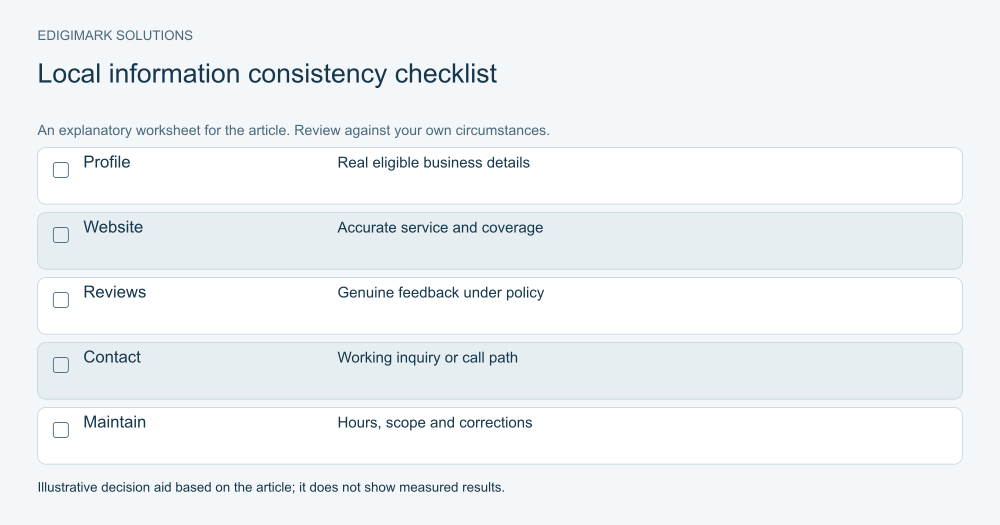
Review profile, website and important listings when core facts change. Include name, contact, hours, services and coverage. Assign an owner for each destination and preserve the date of material updates.
Inspect public links and contact actions after website changes. A migration or template update can break a previously useful route. Use web development for reproducible page or form delivery issues that require implementation.
Check the evidence in visuals and examples. A photo should remain an accurate representation, and an old case reference should not imply an unavailable current service. Keep illustrative diagrams labeled as conceptual.
Review the feedback workflow against current platform rules. Request templates and third-party settings can change over time. The responsible owner should understand the actual process, not merely assume it remains compliant because it worked earlier.
Frequently asked questions
Can a business without a storefront use Google Business Profile?
An eligible business traveling to customers can have a service-area profile under Google’s conditions. Verify the actual arrangement and follow the applicable address and representation guidance.
Should we make a page for every town we serve?
Only when each page offers useful accurate information. A clear coverage resource may serve the task better than many near-identical pages. Do not imply offices or teams that do not exist.
Can we offer a discount for a Google review?
Google prohibits incentives for posting, changing or removing reviews. Invite genuine feedback through a consistent approved process without rewards or prescribed ratings.
Is consistent directory information a ranking guarantee?
No. Accurate public information helps customers understand and reach the business. Do not present a listing count or consistency checklist as a guaranteed local ranking formula.
What should we measure beyond local visibility?
Review working contact actions and qualified inquiries under clear service and coverage definitions. Check whether suitable customers reach the responsible team and receive the intended next step.
Keep local business facts accurate and the next step usable
Maintain the profile, service explanation, coverage and genuine feedback process together. Verify the public contact journey and use observations to guide corrections. Contact Edigimark with your services, coverage and current resources to scope a practical local SEO plan.