Keyword research for AI search combines the language people use with the decisions they are trying to make. Research keywords, questions, entities and conversational prompts, then group them into distinct tasks that your business can answer reliably. The output should be a page plan with evidence and a purpose, rather than a long list of phrases to repeat.
The method still needs discipline. A prompt suggestion is not verified demand. A keyword tool’s volume is an estimate under its own conditions. A question from sales can be commercially important even when a tool has little data. Keep these evidence types separate so the plan remains assessable.

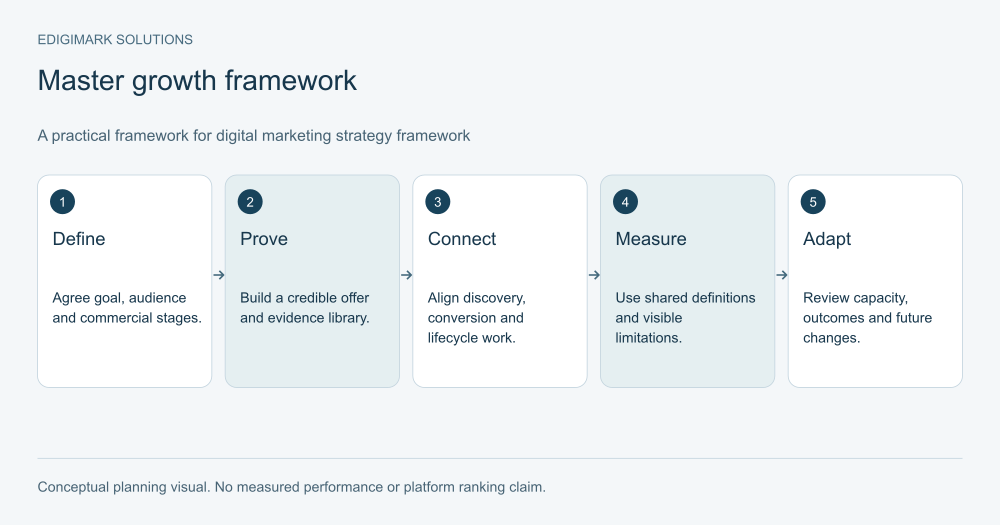
Conceptual framework for keyword research for AI search; examples are illustrative.
What changes in conversational keyword research?
A short query can hide substantial context. “CRM automation” might come from a founder exploring options, an administrator configuring a workflow or an operations lead comparing implementation services. A conversational request may state the context directly: team size, existing systems, constraints and the desired outcome.
Research should therefore identify the problem, audience and conditions behind the language. The same central phrase can support different tasks, but it does not automatically justify separate pages for every condition. Decide whether the answers materially differ.
Google’s current guidance explains related query generation in AI search and cautions against unnecessary content proliferation. Its AI search optimization guide is a primary reference. Use this context to research connected needs; do not pretend to know a platform’s complete internal query sequence.
What should you define before collecting keywords?
Start with your offers and audience. List the services or product capabilities you can actually deliver, the customers they fit and the problems they address. Record exclusions as well as strengths. A commercially appealing keyword is a poor target if the company cannot satisfy the resulting inquiries.
Name the objective of the research. Are you improving a service page, planning a content cluster, diagnosing irrelevant visits or supporting a new product? The objective determines which evidence matters and how broad the collection should be.
Agree on market and language where relevant. Results and demand estimates can vary by location and language. If those choices remain undecided, label the research provisional rather than presenting a market-neutral sample as verified local demand.
Create a brief inventory of existing pages. Record what each page owns, its intended audience and current gaps. Research should not produce a new article plan that ignores resources the company already maintains.
How do you collect a useful seed list?
Begin with the terms customers use to describe their problem and your offer. Include category names, service names, alternatives, prerequisites and common failure modes. A seed list is a starting vocabulary, not the final page architecture.
Use approved sales and support material where available. Summarize recurring questions without exposing personal information. A question about implementation delay can reveal a valuable planning resource even if no one uses a polished category phrase in the conversation.
Inspect existing site searches and available query reporting. Google’s Performance report documentation explains its basic views and scope. Keep a record of what your data source can show and its limitations rather than assuming it captures every search or discovery interaction.
Add terms from product documentation and implementation workflows. These can expose practical concerns such as field mapping, permissions and handoff ownership. Avoid treating internal terminology as customer language until you verify that the audience understands it.
How do you find question keywords?
Group questions by the decision they express: definition, fit, process, cost components, alternatives, risk and troubleshooting. This classification gives the research structure. It also highlights when several phrasings belong to one useful resource.
For a hypothetical automation provider, questions may include which process to automate first, what data must be cleaned, who owns the workflow and how failures are handled. These questions are connected, but a tutorial for one system may require a different page from a planning guide.
Record the exact phrasing alongside a normalized task. The original wording preserves customer language; the task label helps the team consolidate variants. Do not rewrite every question into a keyword-shaped phrase and lose the concern that made it valuable.
Check whether the business can answer the question with evidence. If the answer depends on a policy that does not exist or a capability nobody can verify, the research has found an internal gap before it has found a publishable topic.
How should you use keyword tools responsibly?
Treat volume, difficulty and related-term outputs as inputs with definitions. Record the tool, market, date and match conditions. Do not combine incompatible estimates into one apparently precise demand score.
Use tool outputs to identify possibilities and compare broad patterns. Then inspect intent and business fit. A high-volume phrase may attract an audience seeking a free product rather than your professional service. A low-volume implementation concern can matter to a valuable buying decision.
Do not invent a volume where the data is unavailable. Label it unknown or unverified. If a term has no estimate, you can still prioritize it based on recurring customer evidence and its role in the buying journey, while stating that basis.
Keep a separate field for research confidence. A term supported by current results, customer questions and first-party observations deserves a different confidence label from a phrase suggested by one tool. The label should reflect the evidence, not the writer’s enthusiasm.
How does search intent mapping work?
Inspect current result types and the task they serve. Guides, product pages, comparisons and local listings suggest different interpretations. Record the observation rather than copying every competing outline.
Then compare the result pattern with your audience’s need. A broad definition query may be useful for education, while a service-specific query may deserve a commercial page. A term can have mixed intent; decide whether one resource can satisfy the meaningful interpretations without becoming confusing.
Write a page-purpose sentence for each proposed asset. “Help an operations lead compare routing models” is clearer than “target lead routing keywords.” It guides the format, evidence and next action.
Review proposed pages together. If several purpose sentences are effectively identical, consolidate them or refine their boundaries. Search intent mapping should reduce duplication, not provide a new label for publishing every phrase separately.
What role does entity research play?
Identify the products, systems, organizations, roles and processes connected to the task. Then explain relationships that matter. For an integration decision, the source system, destination system, record type and responsible owner are more useful than a long list of technology names.
Use the research to identify missing context in a brief. A page may need to distinguish one-way updates from two-way synchronization, or account ownership from territory routing. Those concepts explain the decision rather than function as interchangeable supporting keywords.
Avoid adding entities because they sound sophisticated. A term belongs when it clarifies scope, prerequisites, alternatives or failure. The reader should be able to explain why it appears in the article.
Keep company and product names accurate. Entity consistency starts with reliable information. It is not a promise that adding a name repeatedly will create a knowledge panel or an AI recommendation.
How should conversational prompts enter the research?
Use prompts as examples of context-rich questions. Build them from actual audience concerns rather than asking a tool to invent unlimited variations. Record the audience, task and assumptions for each prompt.
Separate branded from unbranded prompts. A request naming your company can assess whether public information is accurately represented. An unaided question can explore discovery. Those are different tasks and should not share a single visibility measure without explanation.
If you inspect answers, preserve the date, platform, prompt and relevant conditions. A response is an observation, not verified search volume or a stable ranking. Use it to identify information gaps and potential sources, then verify technical claims against appropriate primary documentation.
Do not publish a page solely because one prompt produced an answer you dislike. First ask whether the underlying customer question matters, whether the answer is inaccurate and whether your site can supply useful evidence.
What should the keyword map contain?
Use a practical record for each planned page: primary phrase, supporting questions, customer task, audience, intent observation, evidence, current page owner, proposed format and next step. Add market, research date and uncertainty fields.
Keep proposed and verified URLs distinct. A planned slug should not be reported as a published resource. Related links can be recorded for later implementation without inserting destinations that do not yet exist.
Include a scope note that distinguishes nearby articles. For example, a planning guide can own process selection, a service page can own deliverables and a tutorial can own configuration. The note helps editors maintain the distinction as content grows.
Use the map to coordinate digital marketing with the website structure. If the plan requires a new commercial page or navigation change, identify that dependency before commissioning a series of articles.
How do you prioritize the researched opportunities?
Consider business fit, evidence strength, user need, existing gaps and production capacity. A topic with strong relevance but weak evidence may need an interview or product review before writing. A topic with little commercial connection may be lower priority even when estimated demand is attractive.
Look for opportunities to improve an existing page first. If a service page omits a recurring prerequisite question, a focused update may help more than another broad article. The research should guide the most useful intervention, not always create a new URL.
Account for the next step. A resource about disconnected customer records may connect to CRM integration. A workflow-planning guide may connect to marketing automation. Keep the commercial transition appropriate to the reader’s stage.
Choose a manageable first cluster. The team needs time to verify facts, design examples, implement links and maintain the pages. A large spreadsheet does not create the capacity to deliver its rows reliably.
What does a worked research example look like?
Imagine a hypothetical business offering lead-routing implementation. It starts with the category phrase, but sales evidence reveals recurring concerns about territories, existing accounts and ambiguous inquiries. The team groups the questions into planning, implementation and troubleshooting tasks.
It inspects current results for relevant phrases and records the page types. It reviews available first-party data and keeps unknown demand estimates blank. Subject experts identify the conditions that change a routing recommendation.
The resulting map proposes one planning guide, a clearer service page and a narrow troubleshooting resource where the behavior can be verified. It does not create separate articles for every wording of “how to route leads.” Each page has a distinct purpose and evidence packet.
The team publishes incrementally, checks public delivery and reviews relevant engagement and inquiry fit. Data analytics supports the evaluation. The example illustrates a method, not a measured result or a claim about Edigimark’s customers.
How should keyword research be maintained?
Refresh the map when offers, customer questions or result patterns materially change. Preserve earlier research dates so a future editor can understand why a topic was selected. Do not erase the record each time a tool produces a new phrase.
Collect feedback from published pages. If customers ask a follow-up the article does not resolve, add it to the question library. Decide whether it belongs in the existing resource or represents a distinct task.
Review overlap periodically. Articles can converge as they are updated. Clear ownership and scope notes help prevent a library from becoming a collection of competing explanations.
How do you evaluate competitor coverage without copying it?
Inspect the tasks competing resources answer, the evidence they provide and the questions they leave unresolved. Record observations in plain language. “This page compares setup responsibilities but omits failure handling” is more useful than “this competitor has more headings.”
Distinguish a genuine gap from a difference in audience. A consumer tutorial may not need the procurement detail your enterprise buyer requires. The opportunity is to help your intended reader, not to combine every competing section into a longer article.
Look for information your business can verify. An implementation team may be able to explain handoff ownership or show an approved process diagram. That evidence can create a useful distinction. Do not claim first-hand experience merely because competitors use it effectively.
Keep the source date and URL with the observation. Competitive research is a dated snapshot, and the resource may change. A later editor should be able to distinguish what you observed from a general assumption about the market.
What should a keyword research review meeting decide?
Review proposed page purposes before debating individual phrases. Ask whether the audience is clear, the task matters, the business can answer it and an existing page already owns it. These questions can eliminate unnecessary production before writing begins.
Next, review evidence gaps. Assign an interview, documentation check or data request where needed. A topic can remain in the backlog while its facts are unresolved. Calling it high priority does not make it ready for publication.
Then agree on the first release set and its dependencies. A guide may need a service-page update before its next step makes sense. A comparison may need approval to publish product details. A planned cluster may need a navigation resource so readers can find the pages.
Document the decision and the uncertainty. If the team selected a topic because customers repeatedly ask about it, say so. If volume and difficulty remain unknown, keep them unknown. The map should preserve the evidence behind prioritization rather than imply every row was supported by the same kind of research.
What makes the final keyword brief ready for a writer?
A ready brief includes a page-purpose sentence, primary topic, supporting questions, intended audience, evidence packet, scope exclusions and next step. It also identifies the fact reviewer and public resource the page should connect with.
Ask the writer to explain the planned answer before drafting. If the answer remains vague, resolve the question rather than substituting a word count. This small check can prevent a broad article that covers the vocabulary while missing the decision.
The brief should leave room for editorial judgment. A writer may find that a table explains alternatives better than five repetitive sections. Require the useful promise and evidence, while allowing the format to serve the reader.
Frequently asked questions
Is keyword research for AI search different from ordinary keyword research?
It adds explicit attention to conversational context, connected questions and evidence, while retaining demand and intent research. The useful outcome remains a relevant page plan rather than a special set of phrases guaranteed to trigger AI citations.
Should we target every prompt variation?
No. Group variations by their task and answer. Separate pages only when the audience, decision or evidence materially differs. Maintaining one strong resource is often more useful than managing many near-duplicates.
What if a question has no search-volume estimate?
Record the uncertainty. Recurring sales or support evidence may still justify the topic. Explain why it matters commercially instead of inventing a volume or treating missing data as proof of no demand.
Can an assistant generate our whole keyword strategy?
It can suggest possibilities, but the team must verify intent, business fit, factual evidence and existing page overlap. Generated phrases are inputs, not completed research.
How many supporting keywords should a brief include?
Include the concepts and questions necessary to fulfill the page’s purpose. A fixed quota can encourage irrelevant additions. The brief should explain why each supporting topic belongs.
Turn research into a useful page plan
Choose a customer task, collect evidence and define a distinct resource before writing. Edigimark can help connect that work with content, search and website priorities. Contact the team with your offers, audience and existing pages to scope the research.