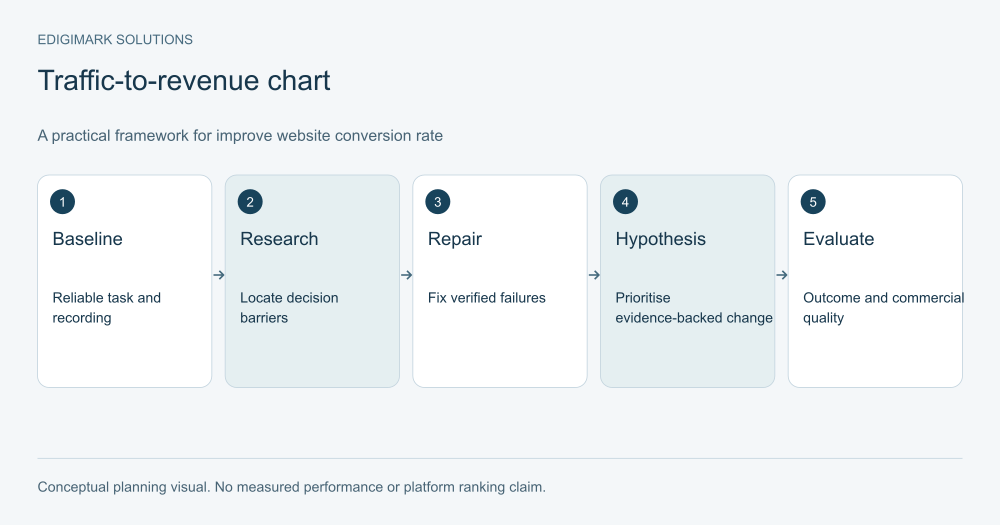
To improve website conversion rate with existing traffic, identify where suitable visitors lose the information, confidence or ability needed to act. Repair verified failures, prioritise evidence-backed hypotheses and evaluate changes against meaningful actions and commercial quality. The aim is to make the current audience’s journey more useful, rather than assume that a new layout will automatically create demand.
Holding traffic constant is a planning constraint. In the real world, visitor mix and behaviour can still change. Record those changes and use appropriate experiments or cautious observation before claiming that a page revision caused a result.
In this guide
- What does it mean to improve website conversion rate?
- Step 1: How do you establish conversion efficiency before changing the page?
- Step 2: How does conversion funnel analysis locate a barrier?
- Step 3: Which verified failures should be repaired immediately?
- Step 4: How do you make the offer easier to evaluate?
- Step 5: How should proof reduce the relevant uncertainty?
- Step 6: How can the action and form become more useful?
- Step 7: How should CRO prioritization choose an experiment?
- Step 8: How should website A/B testing evaluate the change?
- What if website conversion rate improves but business value declines?
- How can existing traffic improve without changing every page?
- What would a focused website conversion project look like?
- How do you sustain conversion improvement?
- How can the team compare proposed improvements fairly?
- What should the conversion outcome review say about visitor mix?
- How should improvements be handed over to the operating team?
- Frequently asked questions
What does it mean to improve website conversion rate?
Define the action and the relevant population. A qualified enquiry, activated trial and completed order have different meanings. Users, sessions and visitors exposed to a page are different denominators.
Keep rate and volume distinct. An illustrative page receiving 1,000 eligible visits and ten meaningful actions has a 1% rate. With the same eligible population and twenty actions, it has a 2% rate. These are invented inputs to explain arithmetic, not a forecast or client result.
The commercial effect depends on quality. Twenty unsuitable submissions are not necessarily better than ten appropriate enquiries. For purchases, margin and returns matter. For software, activation and retention can matter beyond signup.
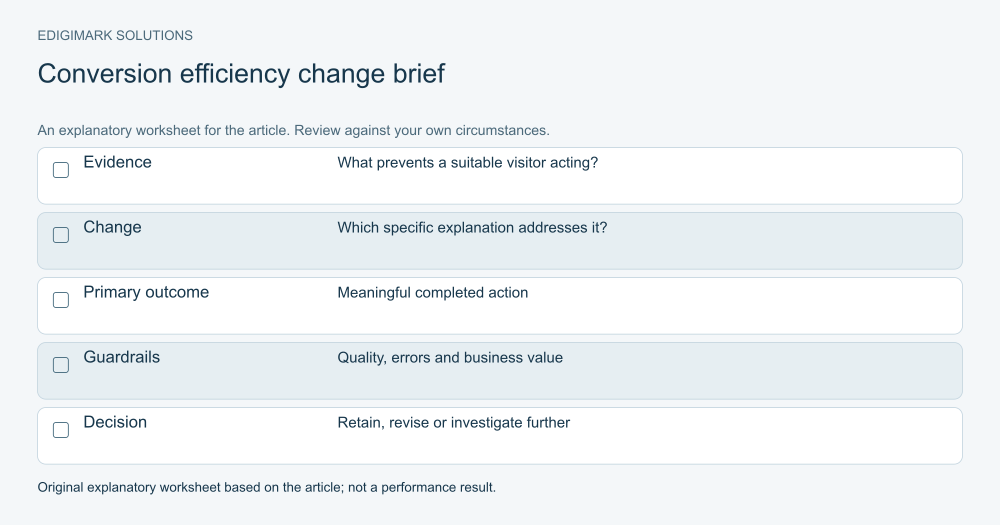
Choose the outcome the team can measure reliably and the guardrails it should protect. Conversion rate optimization connects that definition with research and practical improvements.
Step 1: How do you establish conversion efficiency before changing the page?
Verify the existing journey. Complete the form, booking, trial or purchase on relevant devices and confirm receipt. Inspect the measurement action and counting method. A broken route or duplicated event can invalidate the baseline.
Record the current outcome, audience context and important commercial conditions. Include promotions, availability, pricing changes and known traffic differences. A rate observed during a special offer may not describe the normal experience.
Use meaningful segments where there is enough evidence. A mobile form problem can disappear inside an overall average dominated by desktop traffic. A specific page may serve a better-fit audience than a broad guide.
Keep the baseline small and usable: task completion, relevant action counts, qualification and material issues. A complex dashboard is not necessary if it cannot answer which decision needs attention.
Step 2: How does conversion funnel analysis locate a barrier?
Map the task from entry to confirmation and business receipt. Identify the information and controls needed at each step. Include external scheduling, payment or account setup where they belong to the journey.
Use analytics to see observed transitions, then inspect the task to understand possible reasons. A drop-off can represent confusion, lack of fit, an interruption or a technical fault. The metric alone rarely chooses the correct explanation.
Google Analytics funnel exploration guidance describes how defined sequences can be examined and how open or closed funnels affect entry. Check that the report’s structure matches the task instead of treating a default template as the visitor’s actual journey.
Review a small set of representative user sessions or task observations where permitted and appropriate. Avoid drawing a universal conclusion from one unusual visitor. Combine quantitative patterns with repeated questions and direct evidence.
Step 3: Which verified failures should be repaired immediately?
Repair actions that do not work: incorrect destinations, broken forms, invalid booking routes, missing order confirmation or failed enquiry receipt. Test unsuccessful states too, because a visitor should be able to correct an input mistake.
W3C’s form notification guidance explains the role of understandable error and success feedback. A generic failure message can leave a person unable to recover even when the underlying issue is small.
Check mobile interaction, overlays and keyboard access. A screenshot can look correct while the controls fail. Web development should verify the public task after the repair and document what was tested.
These are quality repairs, not speculative uplift ideas. Confirm that the failure was addressed, then observe commercial outcomes without pretending the repair guarantees a particular rate.
Step 4: How do you make the offer easier to evaluate?
Ask relevant visitors to describe the offer, who it suits and what happens after the action. If they cannot explain it, improve the information before debating minor design choices.
Clarify scope, requirements, process and limitations. A visitor may be interested but uncertain about compatibility, preparation, delivery or the commitment requested. Those concerns can be more important than button colour.
Use concrete language. A service page should explain the work; a product page should explain use and specifications; a trial page should explain what can be evaluated. Replace broad aspirational statements with information supporting an actual decision.
Do not remove important qualifications solely to increase the form count. A clearer limitation can reduce unsupported requests while improving the usefulness of the resulting conversations. Judge that change with the right quality measures.
Step 5: How should proof reduce the relevant uncertainty?
Choose evidence for the risk the buyer faces. A real product view can clarify capability. A process explanation can clarify implementation. A genuine project example can show relevant experience.
Contextualise any result and disclose conditions. An outcome from one project is not a universal promise. Testimonials should be authentic, and hypothetical examples should be clearly labelled.
Place evidence alongside the decision it supports. A compatibility statement is useful near requirements. An implementation example is useful near the process. A large collection of unrelated trust elements can create clutter without answering the concern.
Ask sales and support which uncertainty persists after visitors read the page. Their observations can guide a more specific proof section, provided the evidence exists. Never invent a customer result to fill a gap in the design.
Step 6: How can the action and form become more useful?
Name the next step accurately. “Request a project assessment” tells the visitor more than “Submit” when that is what happens. Explain the commitment and what the person receives.
Request information needed for delivery, qualification or routing. Remove unnecessary requests, but do not assume that the shortest form creates the best commercial outcome. Sales may need particular details to provide a useful response.
Place the action when visitors have enough context. A repeated CTA can be useful on a long page, but constant repetition can interrupt reading. Provide supporting routes, such as documentation, where they help evaluation.
Review the confirmation and handoff. CRM integration should preserve relevant context, and marketing automation can support delivery and routing. A completed action should not disappear into an unowned queue.
Step 7: How should CRO prioritization choose an experiment?
Create a problem statement, supporting evidence and proposed explanation. For example, repeated enquiries might show that visitors cannot tell which integration prerequisites apply. A focused requirements summary could be a reasonable hypothesis.
Assess impact relevance, evidence strength, implementation effort and dependencies. Do not give a subjective priority score the appearance of a precise uplift forecast. The score organises discussion; it does not predict performance.
Choose changes that address important decisions for suitable visitors. A cosmetic revision to a popular but irrelevant page may be less useful than a specific improvement on a commercial route.
Separate ready work from questions needing research or expert confirmation. If the product team has not confirmed a capability, the writer cannot responsibly solve the problem by making a stronger claim.
Step 8: How should website A/B testing evaluate the change?
Use a controlled experiment when the traffic, implementation and question support one. Define the eligible audience, variants, primary outcome, guardrails and decision method before launch. Verify exposure and recording.
There is no universal test duration or visitor count. The baseline, effect being investigated and analysis method influence the requirements. Do not repeatedly declare a winner from a favourable early fluctuation without following an appropriate decision method.
Microsoft’s experimentation guidance describes the importance of data-quality and guardrail measures alongside outcomes. For a business website, useful guardrails may include lead quality, errors, performance and commercial value.
If traffic is too limited for the intended test, use task research and careful observation. Report before-and-after evidence with its limitations, including changes in visitors or commercial conditions.
What if website conversion rate improves but business value declines?
Investigate the chain after the action. A simplified form can attract more unsupported enquiries. A discount can raise orders while reducing contribution. A trial offer can increase signups without helping users activate.
Compare appropriate downstream measures and allow outcomes time to mature. Keep raw counts visible for diagnosis while making the commercial outcome explicit.
The correct decision may be to revise or reject the change even when the initial rate rises. CRO should support suitable users and business value, not optimise one number in isolation.
Data analytics can join the evidence, but the business must agree on what constitutes a useful outcome and which trade-offs are acceptable.
How can existing traffic improve without changing every page?
Prioritise the journeys where a clear barrier affects a relevant audience. A useful requirements summary on one service page can deserve more attention than a site-wide redesign. A repaired checkout control can matter more than a new visual theme.
Use templates carefully. If a verified issue exists across the same component, a shared repair may be appropriate. If different pages serve different decisions, a universal rewrite can remove useful context.
Preserve working elements where evidence does not justify change. CRO is not an obligation to alter the site continuously. Maintenance, accuracy and reliable actions are part of the work too.
Record what changed and where. It makes outcome interpretation and later handovers more reliable, particularly when several teams work on the site.
What would a focused website conversion project look like?
Consider a hypothetical service page receiving appropriate visits but repeated questions about whether the service includes data cleanup. The team verifies the enquiry route and confirms that the uncertainty appears in customer conversations.
It adds a clear scope statement, explains what information is needed for assessment and adjusts the request label. It reviews suitable enquiries and sales preparation, with a controlled experiment where feasible or cautious observation otherwise.
The project does not assume that the page needs more traffic or a complete redesign. It addresses a documented decision barrier and gives the team a specific learning question.
This example is illustrative, not a client result or an expected uplift. The useful principle is the connection between evidence, change and measurement.
How do you sustain conversion improvement?
Maintain a research record, prioritised backlog and change log. Include negative and inconclusive findings so the team does not repeat the same idea without context.
Review the journey after important releases, offer changes and integration updates. A previously repaired path can fail again when a dependency changes. Assign an owner for the verification.
Combine website data with sales and support observations. The site should answer recurring questions accurately and preserve context for the people handling outcomes.
Discuss your conversion efficiency with Edigimark if you need to improve the usefulness of current traffic before committing more acquisition spend.
How can the team compare proposed improvements fairly?
Use the same brief for competing ideas. Each should name the audience, problem evidence, proposed change, dependencies and outcome. That makes it easier to compare a content clarification with a form revision without giving preference to whichever looks more dramatic in a mockup.
Ask what would make the idea unnecessary. If customer research shows the offer is already understood, another headline rewrite may be a weak priority. If the form field supports essential routing, removing it may create a new problem. A proposal becomes more useful when its assumptions can be questioned.
Keep a category for uncertain ideas requiring research. They do not need to be discarded, but they should not compete with verified failures as though the evidence were equal. This distinction helps the team use limited development capacity more responsibly.
What should the conversion outcome review say about visitor mix?
Record whether the page received a different proportion of relevant sources, devices or markets during the comparison. A rise in conversion can reflect a better-fit audience rather than the page revision. A decline can reflect more introductory visitors rather than a worse experience.
Use segmentation only where the data supports interpretation. Small groups can move sharply by chance, and examining many slices can produce appealing but unreliable stories. Start with the distinctions related to the hypothesis and business decision.
Include commercial changes such as availability, promotions and service scope. If several factors changed together, the report should describe the combined observation without assigning the entire effect to one element. Honest interpretation makes future prioritisation more reliable.
How should improvements be handed over to the operating team?
Provide the final page version, the reason for the change and the verification record. Explain which statements require subject review and which technical dependencies need testing after releases. A later update should not accidentally remove the information that addressed the original barrier.
Assign ownership for the remaining observations. Sales may need to report qualification, support may need to watch recurring questions and analytics may need to verify counting. State the next decision and when the relevant evidence is expected, rather than leaving the project permanently labelled “in progress.”
The handover closes the implementation task while preserving the learning loop. Conversion efficiency improves through maintained decisions and reliable operations, not only through launching another variation.
Frequently asked questions
Can conversion rate improve without more traffic?
It can when a suitable audience faces an addressable barrier, but the result is not guaranteed. Identify the issue, implement a relevant change and evaluate meaningful outcomes. Traffic relevance and underlying demand still influence what the website can achieve.
Should forms always be shortened?
No. Remove unnecessary friction while keeping information needed for delivery, routing or qualification. A shorter form can increase submissions and reduce their usefulness. Evaluate suitable outcomes rather than raw completion alone.
What if the site has too little traffic for testing?
Use task research, customer questions and verified repairs. Focused before-and-after observation can help, but disclose its limits. An experiment that cannot answer the question is less useful than a clear research process suited to the site.
Is a higher conversion rate always good?
Only when the action and quality support the business. More low-fit leads, low-margin orders or inactive signups can weaken value. Keep qualification, commercial outcomes and important guardrails alongside the rate.
Which change should be made first?
Repair verified failures preventing the action or its receipt. Then address the strongest evidence-backed clarity or usability problem on an important journey. Save uncertain cosmetic choices for appropriate research or experiments rather than placing them above a broken path.