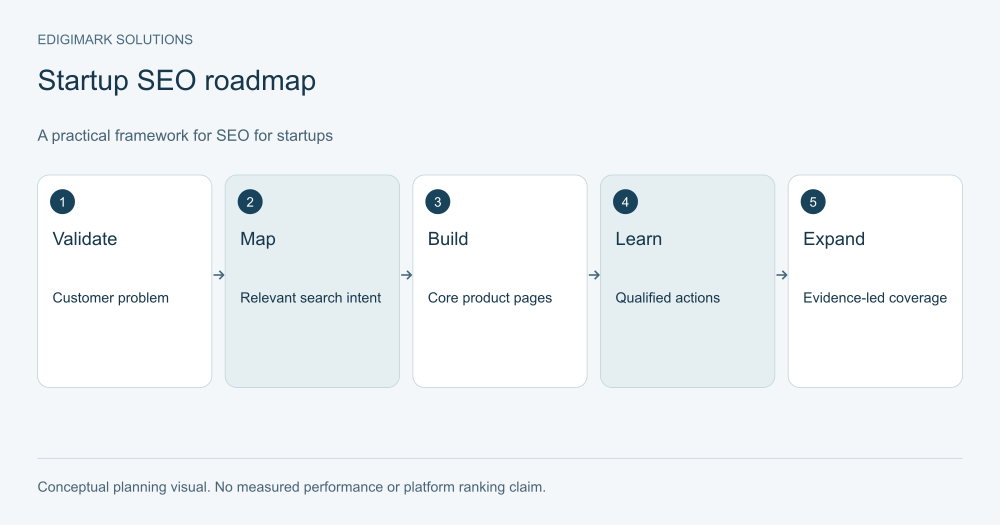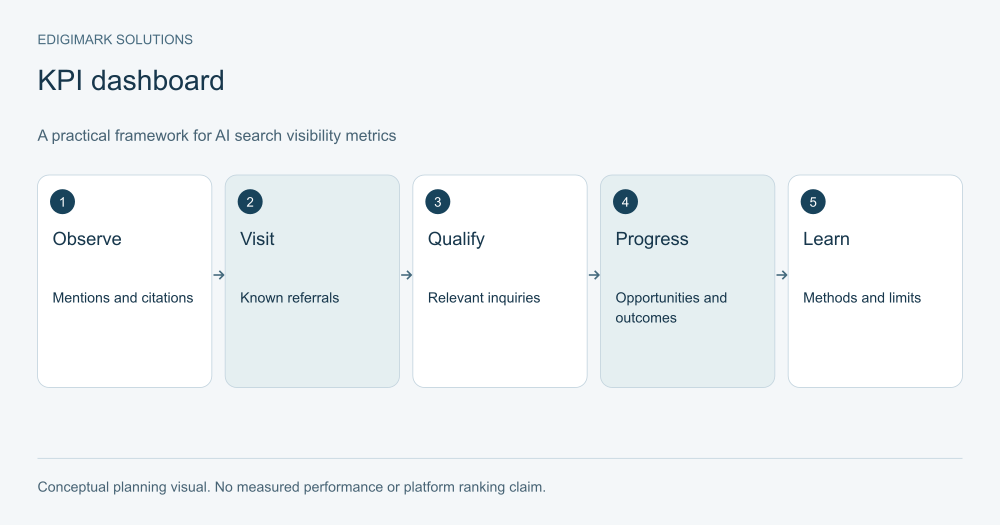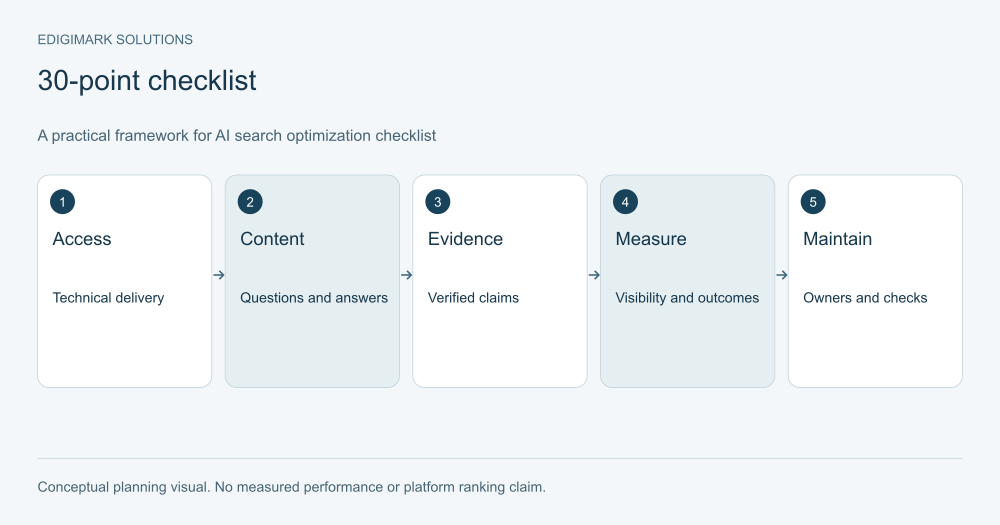
How AI search is changing SEO can be understood as a shift in where discovery and evaluation happen. People can ask a search service to explain, compare or refine a problem before choosing a website. Businesses still need discoverable pages, but their content also needs to help users judge specific questions across a longer, less linear journey.
The practical change is in planning and measurement. A broad keyword and a ranking position no longer describe every useful encounter with a brand. A person might read an AI answer, visit a cited implementation guide and return later to a service page. Your job is to make those pages useful and connect the journey without claiming that every mention produces a lead.
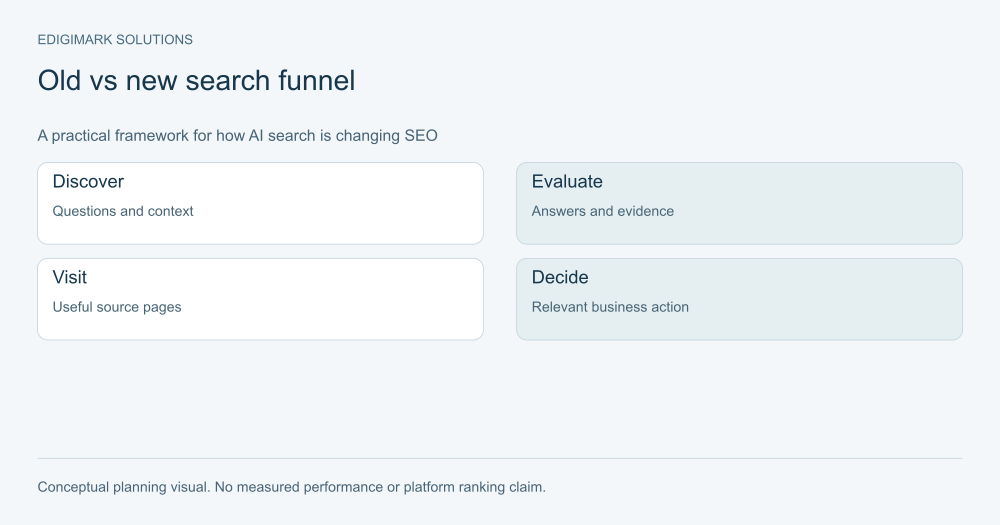
Conceptual framework for how AI search is changing SEO; examples are illustrative.
How AI search is changing SEO: what differs in AI-assisted discovery?
Traditional search often gives a user several pages to inspect. An AI interface may summarize information, compare alternatives or ask for further context. The user can continue the conversation before deciding which source to open. These are different interaction patterns, even when both rely on the same underlying web content.
For a hypothetical operations manager looking for workflow software, the first request might describe a bottleneck rather than name a category. A follow-up might introduce a budget constraint. Another might ask whether a proposed tool works with an existing CRM. A single short keyword misses much of that context.
This does not mean every buyer has abandoned ordinary search. Avoid designing your strategy around an assumed universal behavior change. Map the important decisions your audience makes and build resources that help with those decisions regardless of the interface they use.
What is query fan-out, and why does it matter?
Google describes query fan-out as generating related searches to gather information for an answer. Its current AI search guide gives the mechanism’s context. A business should respond by understanding connected customer needs, rather than creating a page for every possible variation of a prompt.
Suppose someone asks how to reduce customer onboarding delays. Related questions may involve integration, handoffs, data preparation and training. If your product genuinely addresses one of those areas, a precise page about it can be more useful than a broad article that repeatedly claims to streamline operations.
The editorial implication is to explain relationships. Show which problem a feature solves, what needs to exist before it works and where another approach is preferable. Resist the temptation to treat guessed fan-out queries as a secret keyword list. You cannot see or control all queries a system generates.
What remains valuable in technical SEO and AI answers?
A page must exist as a usable resource before anyone can rely on it. Broken URLs, inaccessible content, contradictory canonicals and poor mobile layouts remain practical obstacles. These problems can prevent visitors from reaching an answer even when the topic selection is sound.
For a headless website, inspect the public page rather than assuming CMS metadata reaches the frontend. Check the title, description, canonical, visible content and structured data in the actual response. A saved field in an administration panel is only one stage in delivery.
Use a small representative set of pages when auditing a template, then confirm exceptions such as redirects, filtered pages and older content. Prioritize fixes by business impact. A broken request form on a valuable service page matters more than a cosmetic warning on an unused archive.
Coordinate this work with web development. The SEO brief should describe the observable problem, affected URLs and acceptance checks so the technical team can verify the intended outcome.
How does the AI search impact on SEO change content briefs?
A useful brief names the audience, the decision and the evidence the page can provide. “Write about automation” is too broad. “Help an operations manager determine which handoff to automate first, using a dependency table and failure scenarios” gives the writer a concrete task.
Include the questions a buyer asks before and after the central question. A page can answer prerequisites, selection criteria and limitations without becoming a collection of unrelated keyword variations. The sequence should reflect the user’s reasoning.
Specify the boundaries of the article. An integration overview should not pretend to be a technical setup guide if the team cannot verify configuration steps. Link to the detailed resource or direct the reader to a scoped discussion. Honest scope makes a page more useful than inflated comprehensiveness.
Why should evidence become an AI-assisted discovery requirement?
AI summaries can compress context, so the original page needs to make the basis of important claims easy to inspect. A comparison should show its criteria. A case example should identify its circumstances. An implementation recommendation should explain when it fails.
Build a small evidence inventory before commissioning an article: approved screenshots, product documentation, interview notes, methods and data the company can publish. If an asset does not exist, use a clearly labeled hypothetical example instead of implying first-hand experience.
An effective editorial review asks whether each claim can survive a customer challenge. What would a buyer need to verify it? Who owns the fact? When might it become outdated? Those questions improve both the article and the team’s sales explanations.
How should SEO and AI answers affect the website journey?
A cited informational page may become a user’s first contact with the company. It should therefore explain its context, connect to relevant services and offer a next step that matches the question. A reader learning a definition may want an example, while a reader evaluating implementation may want a scoping checklist.
Do not force every visitor into a high-commitment sales form. Build useful transitions from the article to a service explanation, then to an inquiry. Keep links descriptive so people can predict what the destination contains.
For instance, a guide to reducing manual handoffs can link to marketing automation where implementation support is relevant. If the central obstacle is disconnected records, the appropriate next resource may be CRM integration. Link because it resolves the next uncertainty, not because every page must mention every service.
What should AI search impact on SEO measurement include?
An isolated ranking position is a useful observation but an incomplete account of discovery. A sampled AI mention is also incomplete. Neither says whether the user understood the offer, opened the page or became a qualified opportunity.
Keep channel metrics, page metrics and commercial metrics separate before relating them. Record visits by available source information, meaningful actions, inquiry quality and subsequent outcomes. A source can be missing because of application behavior, privacy restrictions or navigation patterns; missing attribution is not proof that a channel has no influence.
Use data analytics to define events and connect approved marketing data with the CRM. Report what the data can establish and identify what remains inferred. A readable report with clear uncertainty is more actionable than a precise-looking number built on weak assumptions.
How can teams compare conventional search and AI-assisted discovery?
Create an illustrative journey map with three paths. One begins with a category query and leads to a product page. Another begins with a problem question, moves through an explanation and later returns through a branded search. A third begins with an AI comparison and opens a cited resource.
For each path, list the information needed at each decision. Then inspect whether your website actually provides it. You may find an excellent top-of-funnel article with no clear connection to service scope, or a detailed service page that assumes readers already understand the problem.
The map is a planning tool, not a measured conversion model. Do not draw a traffic chart and present it as a before-and-after result unless you have real data. The point is to find information gaps and then test whether closing them helps visitors move forward.
What does a sensible 2027 plan for SEO and AI answers look like?
Treat 2027 as a planning horizon, not a collection of known future outcomes. Reserve time to monitor platform changes and review your assumptions. Keep the core budget attached to work with lasting utility: accurate service information, technical reliability, evidence and clear paths to action.
Run a limited experiment on a coherent set of pages. Define the starting condition, improvements, expected user benefit and review date. For example, a service cluster might gain a comparison table, a prerequisite guide and clearer internal links. Measure relevant engagement and lead quality as well as discovery.
If a tactic depends on a claimed private ranking signal or guaranteed inclusion, request evidence before investing. The team should be able to explain why the work helps customers even if an interface changes next month.
How should AI-assisted discovery ownership change?
Search specialists cannot maintain reliable answers alone. Product teams own feature behavior, operations teams own implementation processes, sales owns recurring objections and developers own delivery. Give each group a clear review responsibility without turning every update into a committee decision.
Keep a change log for important claims. If pricing, compatibility or service scope changes, the owner should know which pages need review. A quarterly publishing plan is not enough if the underlying facts change in between scheduled edits.
The practical operating model is a small shared backlog: customer question, page owner, evidence needed, technical dependency and review date. This turns “AI readiness” into work that can be assigned, checked and maintained.
How do you redesign a brief for AI-assisted discovery?
Take a hypothetical service company planning an article about automated lead routing. The old brief might specify a keyword, a word count and several competitor headings. A better brief names the actual decision: whether the company should route inquiries by territory, product interest or account ownership.
The writer needs criteria rather than slogans. Territory can help with regional coverage but fail for multinational accounts. Product-based routing can improve specialization but create confusion when one buyer asks about several services. Account ownership can preserve relationships but needs a rule for inactive owners. These are concrete tradeoffs a reader can use.
Build the article around those alternatives, then add a worked scenario. Make it clear that the scenario is hypothetical and show the assumptions. For example, an inquiry from an existing customer may go to the account owner first, while a new prospect with ambiguous product interest may need a manual review queue.
The page then becomes useful for multiple related questions without having to predict the exact prompt that brings a person to it. Its value comes from resolving a real choice. The surrounding site can offer a detailed implementation resource and a service discussion when the reader is ready.
What should a controlled query fan-out and SEO experiment include?
Select a coherent page set and write down the reason for the experiment. If the aim is better buyer understanding, specify the information gap you expect to close. If the aim is improved discovery, identify relevant query groups and the data you can actually obtain. Avoid changing every variable at once.
Record the baseline period, traffic source definitions, meaningful events and qualification criteria. Also record product launches, campaigns, seasonality and website releases that could influence the outcome. You may still be unable to isolate causation, but these notes reduce the chance of assigning every change to your content edit.
Choose a review date that suits your business cycle. A long sales process requires follow-up beyond the first visit. Early measures can include relevant engagement and inquiry quality; later measures can include opportunity progression. Do not combine preliminary and mature cohorts without labeling them.
Decide in advance what would trigger another iteration. If readers reach the comparison table but do not understand the difference between options, improve the table. If they submit irrelevant inquiries, revise scope and qualification. If the page attracts relevant attention with little volume, consider distribution before concluding that the resource has failed.
How do you handle contradictory SEO and AI answers observations?
Suppose visits to an informational article fall while branded visits and qualified inquiries rise. That pattern is worth investigating, but it does not prove that AI summaries caused the increase. Review changes in campaigns, product awareness, offline activity and attribution before forming an explanation.
Ask whether the same audience is represented in both periods. A change in market or device mix can alter averages. Ask whether the inquiry definition changed. A shorter form might increase submissions while decreasing the proportion that sales accepts. Clear metric definitions matter as much as the chart’s direction.
Use more than one kind of evidence. Customer interviews, sales notes and page behavior can help interpret aggregate numbers. Keep them separate in the report: what the analytics recorded, what customers reported and what the team infers. This allows a leader to evaluate the conclusion without confusing an explanation with a measurement.
When uncertainty remains, choose a low-risk next action with practical value. Clarify an important answer, repair an inquiry path or add missing evidence. These changes can help regardless of which interface started the journey. Do not spend heavily on a speculative explanation merely because it sounds timely.
The goal is a learning process that improves the website and marketing plan. A channel label should organize evidence; it should not prevent the team from noticing a simpler explanation for what customers are doing.
How should managers explain the AI search impact on SEO?
Translate AI search impact on SEO into concrete responsibilities. Sales supplies recurring objections and checks whether the answers help real conversations. Subject experts verify claims and exceptions. Content editors turn that evidence into readable resources. Developers confirm public delivery, and analysts document what the reporting can establish.
Use a short briefing that explains the customer task, the proposed change and the verification method. Avoid asking the team to “optimize for AI” without specifying the work. A precise task such as clarifying implementation prerequisites is easier to assign and assess.
Keep commercial expectations realistic. The first release may improve the information available to buyers before enough data exists to judge acquisition impact. Report delivery progress separately from performance, and preserve the baseline for later review. This lets stakeholders understand both what has improved and what remains uncertain.
When a new platform announcement appears, ask whether it changes a dependency, a measurement definition or a user need. If it changes none of those for your business, it may require monitoring rather than an immediate rebuild.
Frequently asked questions
Does AI search mean organic website traffic will disappear?
No one can responsibly promise a universal traffic outcome. Some questions can be resolved within an interface; others require a detailed page, product interaction or conversation. Evaluate your own audience and content rather than extrapolating a single industry example.
Should we write separate articles for every conversational prompt?
Usually not. Combine variations that share one task and answer. Create separate pages when the audience, decision or evidence is genuinely different. Excessive duplication creates maintenance work and can confuse visitors.
Are brand mentions as valuable as citations?
They represent different observations. A mention can expose a name without offering a visit. A citation provides a source link, while an actual visit creates another measurable event. Relevance and downstream behavior matter more than combining all three into one count.
Should we move our whole SEO budget to AI visibility tools?
Evaluate the tool’s coverage, sampling method and business use before making a large commitment. Reliable website delivery and useful content remain necessary investments. A monitoring dashboard does not correct the information it measures.
What is the first practical change a small team should make?
Rewrite one important brief around a customer decision, then check the published page’s evidence and next step. This produces a visible improvement and a repeatable process without requiring a large new program.
Build a discovery strategy around the decisions you can help
Review your most commercially relevant pages and ask which uncertainty each one resolves. Then close the gaps in evidence, delivery and navigation. Edigimark’s digital marketing team can help connect that work with an integrated search plan. Share the pages and buyer questions you want to improve through the contact page.
Put the ideas to work
Explore our connected growth services →