Google AI Overviews optimization starts with an accessible, useful page that Google can index and show with a snippet. Check the site’s inclusion in Google’s generative AI search features, resolve technical barriers and provide clear answers supported by evidence. The work improves eligibility and usefulness; it cannot guarantee that Google will cite the page.
For a business website, begin with a valuable buying question. A useful goal is to help a relevant buyer understand a problem, compare options or evaluate a service. Appearing in an answer is only one possible step toward that commercial outcome.
This guide reflects documentation checked on 6 October 2026. Google’s controls and reports can change, so confirm the current interface before implementing a recommendation.
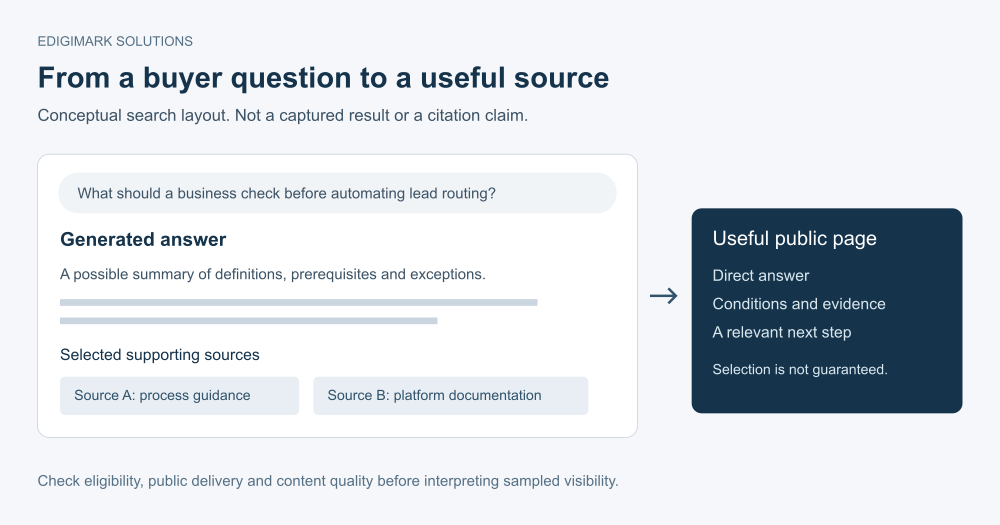
Conceptual search layout for explanation. This is not a captured Google result or a claim that Edigimark appears in an AI Overview.
What does Google require for AI search eligibility?
Google’s current generative AI optimization guide connects AI-search visibility with its search foundations. Review page eligibility and the site-level generative AI control before investigating content changes.
Use this short sequence:
- Confirm that the intended public URL works.
- Inspect indexing and snippet eligibility.
- Review the relevant Search Console property’s generative AI control.
- Check whether the page resolves the target question accurately.
- Record a baseline before changing the page.
Keep eligibility separate from selection. A technically eligible page may not appear for a particular question. That observation alone does not prove that the page is broken or that a specific competitor has a secret optimization method.
How do you check the Search generative AI control?
Inspect Settings → Search generative AI in the relevant Search Console property. Google’s control documentation describes inclusion, exclusion and inheritance from parent properties. Inclusion is the default; a child property may inherit another property’s choice.
Record which property you inspected and whether its value is inherited. A domain property and a URL-prefix property can have a relationship that matters to the observed setting.
If a site has been excluded intentionally, discuss the business decision with the owner before changing it. A content writer should not override a publisher’s participation choice. If inclusion is intended, document that intention and verify the effective value.
Do not confuse this control with page-level noindex, crawler access or model-training preferences. Maintain a short register of the controls, their purpose and their owners. That prevents a future technical cleanup from changing a policy decision accidentally.
Which technical issues affect AI Overviews SEO?
Investigate issues that prevent people or search systems from receiving the intended content. Start with a small sample of important pages rather than a long list of minor warnings.
| Check | What to inspect | Why the finding matters |
|---|---|---|
| Public response | Status code, redirect destination and page content | A working editor preview does not prove the public page works |
| Indexing controls | Page robots directives and relevant headers | An unintended noindex can exclude an important asset |
| Canonical | Intended public URL and duplicate-page relationships | Conflicting URLs make the source of record unclear |
| Content delivery | Main answer and essential details in the served page | A blank or partial public response cannot help the buyer |
| Internal discovery | Links from relevant pages and navigation | An isolated article is difficult for readers to find |
| Mobile experience | Readability, interaction and form behavior | Useful information needs a usable next step |
Canonical decisions should follow the actual architecture. Google’s canonicalization documentation explains canonical signals and consistency. For a headless site, distinguish the CMS content location from the public article location.
Record evidence for each issue: the URL, observed response, expected behavior and owner. “AI readiness is low” is too vague to guide an implementation team.
How should you choose content for Google AI Overviews optimization?
Choose pages that answer a meaningful question and are relevant to the business. A page with a clear commercial relationship is easier to evaluate than a broad article chosen only because a tool reports an AI opportunity.
Look at sales conversations and support questions. Which uncertainties repeatedly delay evaluation? Which service requirements are misunderstood? Where does the website force a reader to contact someone just to learn a basic condition?
For a marketing automation provider, a useful question might be: “What needs to be defined before automating lead routing?” An article can explain lifecycle stages, ownership, required fields and exception handling. The value lies in resolving that problem, not in adding “AI Overview” to the title.
Edigimark’s digital marketing and marketing automation pages provide relevant commercial destinations when the article genuinely addresses those services.
Before drafting a new page, check whether an existing page already serves the same audience and decision. Improve the existing source where appropriate. A new URL should have a distinct job.
What makes an answer useful enough to stand on its own?
A useful answer states the conclusion, the conditions and the next practical step. It gives enough context to avoid a misleading interpretation when read outside the full article.
Consider this illustrative rewrite:
Vague version: “Automation helps companies grow efficiently.”
More useful version: “Automate lead routing after agreeing on lifecycle definitions, ownership and the fields required to assign a lead. Keep a manual review path for records that do not meet the routing rules.”
The revised explanation identifies the process, prerequisites and exception. It is more useful to a buyer even if no answer engine ever selects it.
Use headings that introduce genuine questions. Keep definitions close to the concepts they explain. Add tables when the reader needs to compare conditions. Use step lists when the order matters. Do not force every paragraph into a tiny answer box or repeat the same conclusion throughout the page.
How does evidence support AI Overviews SEO?
Use evidence that matches the claim. Platform documentation can support a technical requirement. A real implementation walkthrough can support a process explanation. Original research can support a finding when its method and limits are disclosed.
For every substantial claim, ask three questions: What establishes it? When was that source checked? What would make the claim inapplicable?
If the example is hypothetical, label it. If the advice is an editorial recommendation, explain the reasoning. If a result comes from a client project, obtain the actual data and permission before naming the client or publishing a number.
Avoid decorative statistics. A percentage does not make a page authoritative when its population, period and method are unclear. A well-explained implementation trade-off may be more valuable than a generic market statistic.
Make corrections manageable. Store the source link, review date and owner with the content record so that a later update can find the evidence efficiently.
Which AI search eligibility checks matter in headless WordPress?
Validate both the CMS record and the public page. In a headless architecture, these are separate checkpoints.
The CMS check confirms the saved title, description, focus keyword, canonical and intended schema. The frontend check confirms the public response contains the corresponding metadata and article content.
A practical test uses deliberately distinct values on a new draft or staged article. If the SEO title differs from the article heading, check which one reaches the public title tag. If a public canonical is saved, confirm that the rendered canonical matches it. This tests the mapping rather than relying on a field existing in the CMS.
Also inspect the Open Graph URL and structured-data identities. A correct canonical alongside CMS-domain article identities can still leave inconsistent signals. Address the narrow mapping defect with the appropriate developer rather than changing unrelated global settings.
Edigimark’s website development services can support a scoped delivery or metadata issue. The required fix depends on how the existing frontend reads and renders CMS content.
Which Google AI Mode and AI Overviews measures should you track?
Use the official reporting options available to the property, then connect search visits with meaningful business actions. Google documents a Generative AI performance report for its search features. Confirm the report’s dimensions and definitions before building a dashboard around them.
Keep a dated baseline for the affected page set. Record the content changes and any simultaneous technical, campaign or brand activity that could influence the result. Compare consistent periods and allow for seasonality where relevant.
Supplement reporting with a small, repeatable observation set. Record queries, dates, device or locale where relevant, whether an AI answer appeared and whether the page was linked. Keep those observations labelled as samples.
A screenshot is evidence of one result at one time. It is not proof of a stable ranking or the proportion of all users who saw the business. Third-party estimates can help observation, but inspect their method and coverage.
Use data analytics support to connect search discovery with enquiry quality. A commercially useful referral can matter more than a visible citation that brings the wrong audience.
A Google AI Overviews optimization checklist
Begin with one page and one clearly defined question. Confirm the public URL and indexing controls. Review the effective generative AI participation control. Inspect the delivered content and metadata. Fix access problems before expanding the content.
Next, rewrite the opening answer, clarify the conditions and add the evidence the reader needs. Improve the relevant internal links and the next action. Test the page on mobile and submit a test enquiry if it includes a form.
Finally, record the change date and review performance using a consistent page set and reporting method. Decide whether to extend the approach, revise the explanation or choose a more commercially relevant question.
This sequence produces a useful website improvement even when the answer engine’s selection remains uncertain. It also leaves the team with a clear record of what changed and why.
How do seven checks connect AI Overviews SEO and eligibility?
Use seven connected checks to organize Google AI Overviews optimization: public response, crawl access, indexing, snippet eligibility, canonical consistency, content evidence and measurement. These are an implementation sequence for this guide, not seven undisclosed ranking factors.
First, load the public page and confirm that it serves the intended information. Second, investigate relevant crawl restrictions using the site’s available logs and verified tooling. Third, inspect indexing evidence in the appropriate Search Console property. Fourth, review snippet controls separately from indexing. A page can have an indexing issue, a display constraint or both; the remedy depends on the finding.
Fifth, compare the declared canonical with internal links and the intended source of record. Sixth, review whether the main explanation supports its claims and answers the buyer’s actual question. Seventh, record how the team will observe the page after a change. Keep platform eligibility checks, including the generative AI participation control, in the same review record.
Give every finding a specific expected state. “Crawl access needs review” should name the URL, the observed failure and the person who can inspect the infrastructure. “Content needs improvement” should identify the unanswered question or unsupported statement. This prevents a Google AI Overviews optimization project from becoming a list of tasks that cannot be verified.
The checks may reveal that no technical change is needed. In that case, preserve the working configuration and focus on the source’s usefulness. Avoid changing robots directives, canonicals or participation settings simply because a tool cannot find an AI Overview for one query.
How should you interpret a page that has not been selected?
Treat absence from a sampled answer as an observation. It is not a diagnosis by itself. The query may not trigger the same answer format consistently, another source may better address the immediate question, or the available sample may be too small to support a conclusion.
Review the query and the page together. A broad buying question may require a comparison of approaches, while your page explains a narrow implementation step. That mismatch can make the page useful without making it the best source for the broader question. Choose a better measurement query or expand the explanation only when doing so serves the intended reader.
Inspect the cited sources for their role in the answer. Are they providing a definition, a product fact, a comparison or original evidence? Do not copy their wording or infer that every visible feature caused selection. Use the review to understand the information need and the evidence your own page can responsibly supply.
Keep AI Overviews SEO distinct from retrospective storytelling. If the team changes a heading and later observes a citation, the sequence does not establish causation. Several systems and sources may have changed during the same period. Describe the change and observation accurately, then look for repeated evidence before drawing a stronger conclusion.
Google AI Mode and other generated search experiences may offer additional observations, but maintain separate records where the surface and interaction differ. A success in one experience is not proof of identical behavior elsewhere. Useful AI search eligibility work establishes the page’s access and controls; content and commercial analysis determine what to improve next.
Who should own AI Overviews SEO maintenance?
Assign a named owner for the source page and a technical owner for access or indexing findings. Google AI Overviews optimization involves several responsibilities; an editorial review cannot approve an infrastructure change, and a technical fix cannot verify a product claim.
Review AI search eligibility after meaningful website changes. A migration, new publishing workflow or revised page template may change the delivered response, canonical or indexing directive. Test the actual public page rather than relying on a CMS preview.
Review evidence when the underlying product, service or platform requirement changes. Keep the source URL and the verification date beside the working claim. Changes to Google search snippets or participation controls should be checked against current documentation before the team revises its implementation guidance.
Set a regular review date, but also name the events that require an earlier inspection. A reported factual error, broken public route or failed enquiry journey should not wait for the next scheduled content audit. Record the correction and the outcome observed afterward.
Frequently asked questions
Can a business guarantee an AI Overview citation?
No. A business can improve eligibility, access and information quality, then observe the results. It cannot control which sources Google selects for every question. Reject a guarantee that is not supported by the platform’s actual behavior and documentation.
Should every blog target Google AI Overviews?
Every blog should have a clear reader task. Some topics may suit generated explanations, while others primarily support product evaluation, implementation or direct conversion. Choose the page’s purpose first and evaluate answer-surface visibility as one outcome.
Does an AI-search plugin solve the whole problem?
No. A plugin can support defined technical or editorial tasks. It does not establish that the public page is accessible, the content is useful or the frontend renders the intended metadata. Verify the complete journey through the existing architecture.
How often should the content be reviewed?
Set the cadence according to how quickly the underlying information changes. Product requirements and platform controls need closer review than stable definitions. Review sooner when a reader reports an error or a documented requirement changes.
What is a useful first step for Edigimark clients?
Bring one commercially important page, its target buyer question and any observed indexing or metadata problem to an Edigimark strategy conversation. That makes it possible to prioritize a specific improvement rather than an undefined AI-visibility project.
Put the ideas to work
Explore our connected growth services →