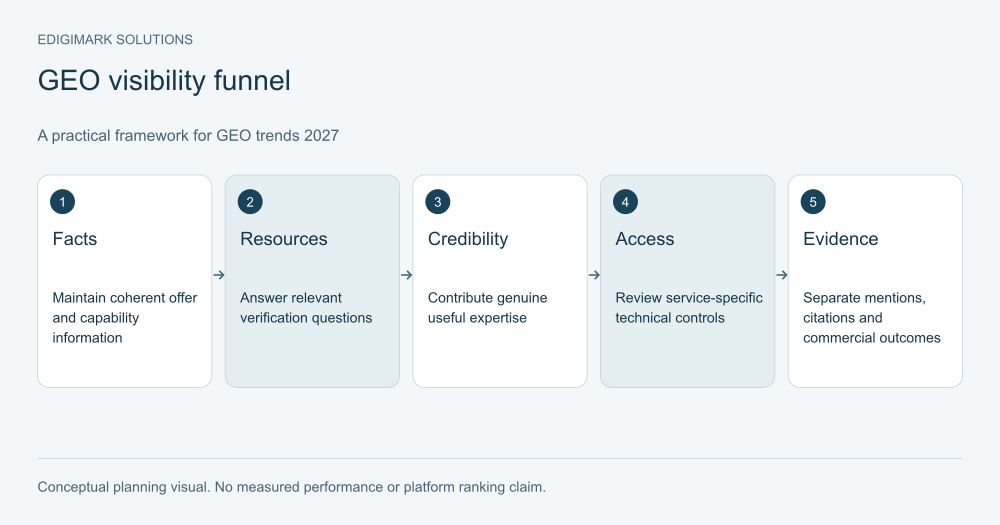
GEO trends 2027 should guide a brand toward accurate, discoverable information and honest measurement of generated-search visibility. Prioritize coherent business facts, useful resources, genuine external credibility and clear distinctions between mentions, citations and referrals. Treat future interface changes as scenarios to monitor, and avoid promises that a tactic can control an external answer.
This is a forward-looking planning guide based on information available in October 2026. It does not report future outcomes as facts. GEO is an industry label whose practical scope and measurement depend on the service being discussed.

In this guide
- GEO trends 2027: what does the AI citation outlook mean for content?
- Why does AI entity visibility require coherent information?
- Which external credibility work supports useful brand information?
- What should technical GEO planning priorities include?
- How should generative search brand visibility be measured?
- How can a brand separate visibility from commercial usefulness?
- What should a GEO planning worksheet contain?
- How should GEO planning respond to different 2027 scenarios?
- Which GEO claims should a buyer challenge?
- How should a GEO observation ledger distinguish different evidence?
- What should GEO planning priorities fund first?
- Frequently asked questions
GEO trends 2027: what does the AI citation outlook mean for content?
Develop resources that help a reader verify a meaningful claim or decision. A useful comparison, implementation explanation or clearly labeled worked example can provide more decision value than another broad introduction.
Keep important facts precise and source-supported. State the conditions that affect capability or suitability. If an external answer links to the resource, the arriving reader should be able to confirm the claim and understand its limits.
The original GEO research paper studied visibility approaches within a benchmark. It is research context, not a universal implementation guarantee for every current platform or a forecast of your brand’s results.
Why does AI entity visibility require coherent information?
Consistency helps people evaluate the business. The public website, product or service descriptions, profiles and sales resources should describe the same name, offer, scope and capabilities. Contradictions create verification friction.
AI entity visibility should not be reduced to placing a brand name repeatedly across pages. Explain what the organization actually provides, whom it serves and which evidence supports important claims. Keep author and review descriptions truthful.
For a hypothetical consultancy, an accurate service page, implementation resource and contact process form a coherent source of information. Invented awards, fabricated testimonials or claimed expertise without a factual basis do not improve that foundation.
Edigimark’s digital marketing services can help connect these resources around a useful audience and commercial task.
Which external credibility work supports useful brand information?
Contribute useful expertise where relevant audiences already discuss the problem. Develop genuine partner resources, accurate public explanations and appropriately attributed research. The work should have value for the audience independently of a visibility objective.
Avoid manufacturing mentions or treating every third-party reference as equivalent. An authentic technical contribution and an irrelevant promotional placement have different meanings. Do not claim that a certain number of mentions guarantees generated-search inclusion.
Google’s generative-search guidance warns against unsupported visibility hacks and emphasizes useful resources. Apply that principle by making credibility work truthful and decision-relevant.
Keep any partnership or commercial relationship clear where it matters. Public trust is harder to sustain when the resource implies independent endorsement that did not occur.
What should technical GEO planning priorities include?
Maintain accessible public pages, coherent metadata, appropriate canonical URLs and useful internal navigation. Inspect the actual public output rather than assuming a CMS field or plugin score represents frontend behavior.
Review each service’s documented controls separately. OpenAI’s crawler documentation distinguishes search, training and user-initiated activity. The same generic instruction should not be used to describe all three purposes.
Google’s Search generative AI control is a separate publisher decision for specified features. Its documented scope differs from general Search exclusion and training controls.
Web development services can support reviewed technical implementation. A change should have a defined purpose, responsible owner and live verification.
How should generative search brand visibility be measured?
Define the observed event. A mention is a name appearing in a response. A citation identifies a supporting resource, with or without the particular link behavior being studied. A referral is a visit recorded at the site. A commercial action is another distinct outcome.
Use platform reports where available and document the scope of research samples. Google’s Generative AI performance report concerns its own features. It does not measure every brand mention across other services.
Preserve query wording, date, market or location context and the interface used when conducting samples. Repeated observations can reveal a pattern, but a limited prompt set should not be represented as the entire market’s share of visibility.
Data analytics services can connect observed discovery with site and commercial evidence while preserving unknown coverage and attribution limitations.
How can a brand separate visibility from commercial usefulness?
Ask whether the mention or citation concerns the relevant offer and audience. A brand appearing in an unrelated context may have little value. A small number of visits from a specific evaluation resource may be more useful than broad attention, depending on actual outcomes.
Inspect the arriving experience. Does the page confirm scope and prerequisites? Is the next action accurate and functioning? Does the response meet the promise? Conversion rate optimization can assess this continuity.
Connect enquiries to appropriate records through CRM integration. Use marketing automation to support actual lifecycle state and preference-aware follow-up.
Do not assign all subsequent revenue to an observed citation. Buyers may use colleagues, partners and multiple resources. Attribution is a view of recorded relationships rather than full proof of cause.
What should a GEO planning worksheet contain?
Record the audience, buying questions, important factual claims, resource inventory, access controls and measurement definitions. Assign an owner to each resource and fact likely to change.
For a hypothetical enterprise SaaS brand, the worksheet might focus on implementation suitability. Relevant resources explain supported systems, data responsibilities and rollout requirements. The credibility work might include a genuine partner discussion that helps buyers understand a shared technical decision.
The measurement plan separates observed citations, referral visits and qualified assessment requests. It records unknown source coverage and sample limitations. The next decision might be to improve a specific resource or investigate a recurring verification question.
This makes the GEO plan a concrete operating document rather than a promise to make the brand appear everywhere.
How should GEO planning respond to different 2027 scenarios?
If generated answers become more prominent for the intended audience, maintain the relevant resources and examine documented visibility and buyer-reported discovery. If conventional search and partners remain dominant, the same accurate material can support those routes.
If a service changes its controls or reports, review the documentation and business implications before applying changes. New capability can justify a bounded experiment; it does not automatically justify replacing a functioning acquisition plan.
Keep a modest monitoring allocation with a named owner. Review current evidence at a defined interval rather than reacting to every anecdote about a citation. The goal is to learn which tasks and resources matter for your audience.
Which GEO claims should a buyer challenge?
Ask how the provider defines visibility, which platforms are included and what the sample observes. Ask which results are verified and which are planning estimates. Request the actual implementation and review steps behind a proposed tactic.
Challenge guarantees of mentions, citations or secret scores. A provider can improve resources, access and measurement, but it cannot fully control an external answer system. Genuine expertise should make the work easier to explain, not less reviewable.
Require truthful authorship, source and result claims. A useful program does not need invented outcomes to justify an accurate resource or a practical test.
Contact Edigimark to build a 2027 GEO plan with coherent facts, useful resources, appropriate technical controls and clearly defined commercial evidence.
How should a GEO observation ledger distinguish different evidence?
Use separate fields for the generated answer, brand mention, cited URL, referral and commercial action. Record platform, date, question wording and relevant context. A mention can exist without a citation; a citation can exist without a visit; a visit can exist without a qualified enquiry.
Consider a hypothetical observation: a generated explanation mentions a supplier but links to an independent resource. That is a brand mention and a citation to another source, not a referral to the supplier’s website. The ledger should preserve the distinction rather than counting all three as the same visibility result.
Another hypothetical observation might cite an accurate implementation page. The team can inspect the cited claim and destination, but it should not assume the answer appeared identically for every user. Record the conditions you actually observed and avoid implying a fixed placement.
Use these records to identify actionable issues: an inaccurate capability statement, an outdated cited page or a missing explanation that customers need. Verification and correction can be useful even when the observation does not support a precise commercial forecast.
What should GEO planning priorities fund first?
Start with authoritative business facts and useful evaluation resources. Confirm company identity, service boundaries, supported configurations and ownership of important claims. Connect related public explanations so a reader can investigate beyond a concise summary.
Then choose an observation process the team can maintain. A large question list is less useful when wording, platforms and dates are inconsistent. Select questions tied to real customer decisions and define the evidence you will collect. Expand only when the initial process informs a useful business action.
Finally, assign maintenance and escalation. If an observed answer describes an unsupported capability, the first task is to verify the current public facts and source material. The team should not manufacture extra promotional mentions or manipulate unrelated resources in an attempt to force a desired response.
Review the programme alongside broader discovery and commercial evidence. Generative search brand visibility may be one part of the journey, but it should not conceal website usability, offer clarity or enquiry handling. A coherent destination and accountable next step remain necessary when a visitor arrives.
Frequently asked questions
Do GEO trends 2027 guarantee more AI citations?
No. They identify planning priorities under uncertainty. External selection depends on the service and situation. Improve the resource and measure actual events without promising control.
Should every brand publish a large FAQ library?
Only when it answers distinct useful questions. Repetitive pages and generic answers can add little value. Prioritize important buyer decisions and accurate supporting resources.
Are brand mentions and referral traffic the same metric?
No. A name can appear without a visit. Define the event and its commercial relevance before comparing results or reporting growth.
Does allowing a training crawler guarantee search visibility?
No. Training and search discovery are distinct documented purposes. Review the specific service’s controls and avoid assuming one permission guarantees another outcome.
What is a practical first GEO investment?
Improve an important, inaccurate or incomplete resource and its public access, then define how relevant visibility and evaluation will be observed. Start with a clear buyer task.
Put the ideas to work
Explore our connected growth services →