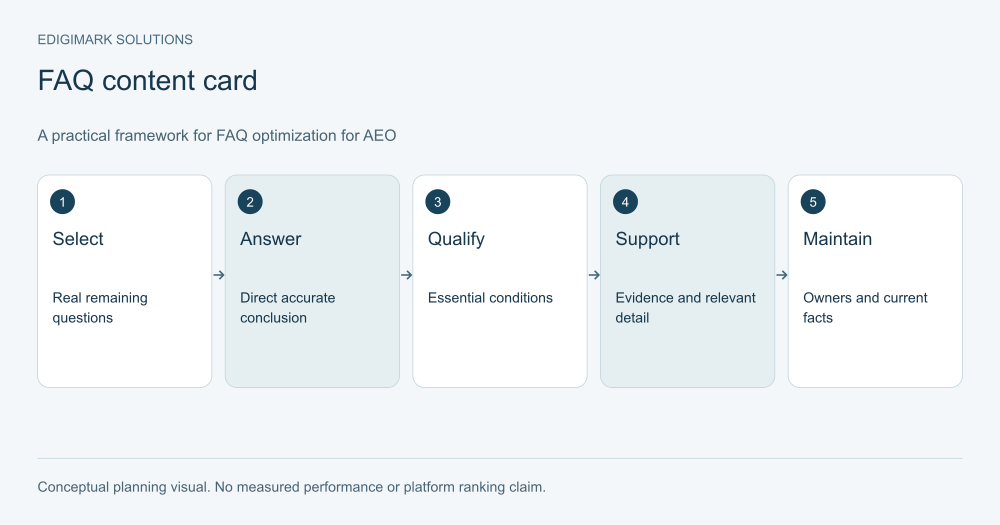
FAQ optimization for AEO means selecting real questions, answering each one directly and preserving the conditions that make the answer accurate. Use FAQs to resolve specific uncertainty left after the main explanation. They should help people understand and act, rather than provide another place to repeat a keyword or promise search visibility.
A useful FAQ is often small. Five well-chosen questions can be more valuable than twenty variations of the same phrase. The editorial task is to identify what remains unresolved, verify the answer and choose whether the information belongs in an FAQ or in the main page.
In this guide
- What should FAQ optimization for AEO establish about question intent?
- Which questions belong in the main content instead?
- How do you write concise FAQ answers without losing meaning?
- FAQ editing example 1: remove repeated commercial phrases
- FAQ editing example 2: preserve a timing condition
- FAQ editing example 3: distinguish capability from custom work
- FAQ editing example 4: answer an ownership concern
- FAQ editing example 5: clarify what a result claim means
- How do you choose FAQ content strategy priorities?
- What is the current FAQ schema eligibility situation?
- How should FAQ presentation work on the public page?
- What does a useful FAQ review worksheet contain?
- How do FAQs connect with conversion paths?
- How should FAQ performance be evaluated?
- What should an FAQ maintenance process include?
- How would you build a FAQ set for one service page?
- What should an FAQ question-quality review ask?
- How do you keep FAQ editing distinct from technical markup work?
- Frequently asked questions
- Answer the uncertainty that remains
What should FAQ optimization for AEO establish about question intent?
Identify the decision behind the wording. “Can you migrate our records?” may ask about capability, scope or readiness. “How long does it take?” may ask about dependencies rather than a universal timeline. A question needs enough context for the answer to be useful.
Collect concerns from approved sales, support and onboarding summaries. Remove unnecessary personal details before sharing them with writers. The goal is to preserve the task and customer language, not publish private conversations.
Group variations that share one answer. “Do we need to clean the data?” and “Can you work with duplicate records?” may belong to a readiness discussion. Create separate questions only when the decision or evidence differs.
Record why the question belongs. A recurring concern, an important exception or a prerequisite can justify it. A phrase suggested by a tool without an audience need is only a candidate.
Which questions belong in the main content instead?
Move central decisions into the main explanation. If readers cannot understand the page’s promise without the answer, it should not be buried in a final FAQ. Scope, major prerequisites and important limitations often belong near the opening or relevant section.
Use the FAQ for narrower remaining questions. It can explain an exception, a practical detail or how to proceed when a condition is unresolved. The distinction depends on the page’s purpose.
Avoid hiding commercially important exclusions. A service page that says implementation is simple and reveals custom-work restrictions only at the bottom can mislead a quick reader. Put the qualification beside the claim.
Review the FAQ and body together. A question may begin as a useful addition, then become redundant after the main article is updated. Remove or refine it when the owning explanation moves.
How do you write concise FAQ answers without losing meaning?
Begin with the conclusion, then add the essential condition and detail. “Yes, if the required fields are available and ownership rules are defined” is more useful than an unqualified “yes” followed by several vague sentences.
Use a clear subject. If two systems are involved, name which one performs the action. A short answer full of ambiguous pronouns can be harder to understand than a slightly longer precise answer.
Choose length by the question. A simple scope fact may need a short paragraph. A complex decision may need a section, table or separate resource. Do not compress it into a fixed word limit merely to make every FAQ card look identical.
Link to detail where it helps, but preserve a meaningful answer in the FAQ itself. “Contact us to find out” is often incomplete when the business can explain the relevant conditions publicly.
FAQ editing example 1: remove repeated commercial phrases
Weak question: “Why is our best CRM integration service the best CRM integration service?”
Useful question: “What does a standard CRM integration engagement include?”
The useful version asks about scope. Its answer should name actual deliverables, prerequisites and exclusions. It should not repeat the service name several times or claim superiority without criteria.
A relevant destination can be CRM integration when the page describes the actual offer. The link belongs because it helps inspect scope, not because the anchor needs several keyword variations.
FAQ editing example 2: preserve a timing condition
Weak answer: “Implementation is fast and seamless.”
Useful answer: “The schedule depends on access, data preparation and the agreed scope. The team should confirm those dependencies before committing to an implementation date.”
This hypothetical wording avoids inventing a universal timeline. A real service can provide an actual schedule range when it has a justified basis and clear conditions. The answer should explain what changes the estimate.
If timing is a major buying concern, give it a main section with a dependency table. The FAQ can address one specific exception rather than carry the whole explanation.
FAQ editing example 3: distinguish capability from custom work
Weak answer: “We can connect everything.”
Useful answer: “Standard scope covers the verified systems and record types listed on the service page. Custom objects, historical activity or unsupported connectors need separate review.”
The revised example makes the boundary visible. A company should use such wording only when it matches its actual scope. The writer must not invent a detailed exclusion merely to make the answer sound credible.
The answer helps qualify an inquiry. Readers can collect the information needed for review instead of assuming that a broad phrase guarantees support for their configuration.
FAQ editing example 4: answer an ownership concern
Question: “Who decides which system owns a record field?”
Useful answer: “The business should identify the responsible data owner and agree on the source of truth before configuration. The implementation team can document the rule, but it should not infer ownership from conflicting values.”
This answer explains a responsibility and its reason. It is more useful than “our experts handle it,” which leaves the customer’s role unclear. It can connect to a detailed planning resource if available and verified.
The example is a planning recommendation, not a claim about every software platform. A platform-specific answer needs current documentation or tested behavior.
FAQ editing example 5: clarify what a result claim means
Weak answer: “Automation guarantees better productivity.”
Useful answer: “The effect depends on the process and inputs. Define the manual steps, failure rate and review method before implementation, then compare compatible observations afterward.”
The revised answer gives the reader a measurement task rather than a fabricated outcome. If a real case result is used, state its method and conditions separately.
For measurement support, data analytics may be an appropriate next destination. The FAQ should still explain the principle rather than replace the answer with a sales link.
How do you choose FAQ content strategy priorities?
Prioritize questions that materially affect understanding or qualification. A prerequisite, exception or common misunderstanding can be more useful than a broad question whose answer already fills the article.
Use a small question inventory with task, evidence, owning page and reviewer. If several pages use the same FAQ, identify the authoritative explanation and keep summaries consistent.
Consider maintenance. A frequently changing capability answer needs an owner and trigger. A stable conceptual answer may need a different cadence. Publishing a question creates an obligation to keep its answer reliable.
Do not add a new FAQ section to every page by default. Some pages already answer the task completely. A format should be used because it helps the reader.
What is the current FAQ schema eligibility situation?
As of this article’s October 2026 review, Google’s official changelog states that FAQ rich results stopped appearing from May 7, 2026, and the feature documentation was removed in June. Google’s documentation updates establish that change.
Do not rely on older advice saying the feature is merely restricted to government or health websites. Also do not promise extra Google result space because a plugin offers an FAQ schema control.
Visible question-and-answer content can remain useful to readers. Its editorial value is separate from a discontinued display feature. Other systems may have their own documented uses of structured data; evaluate those individually rather than treating a schema type as a universal AEO mechanism.
No special FAQ markup can guarantee assistant citations. Keep the answer accurate and useful, and review current platform documentation before making technical eligibility claims.
How should FAQ presentation work on the public page?
Make questions easy to scan and answers easy to access. If expandable controls are used, test keyboard interaction and mobile behavior. A visitor should not have to fight the layout to read a qualification.
Keep related questions together and avoid long promotional blocks between them. A FAQ section is a reference aid. Its value can disappear when every answer ends in the same repeated sales paragraph.
Inspect the public heading structure and any section anchors. An imported question may be styled differently from the local draft. Confirm that navigation reaches the intended content.
Work with web development when layout or component behavior obstructs reading. The acceptance check should focus on the delivered interaction and answer, not only a component’s existence.
What does a useful FAQ review worksheet contain?
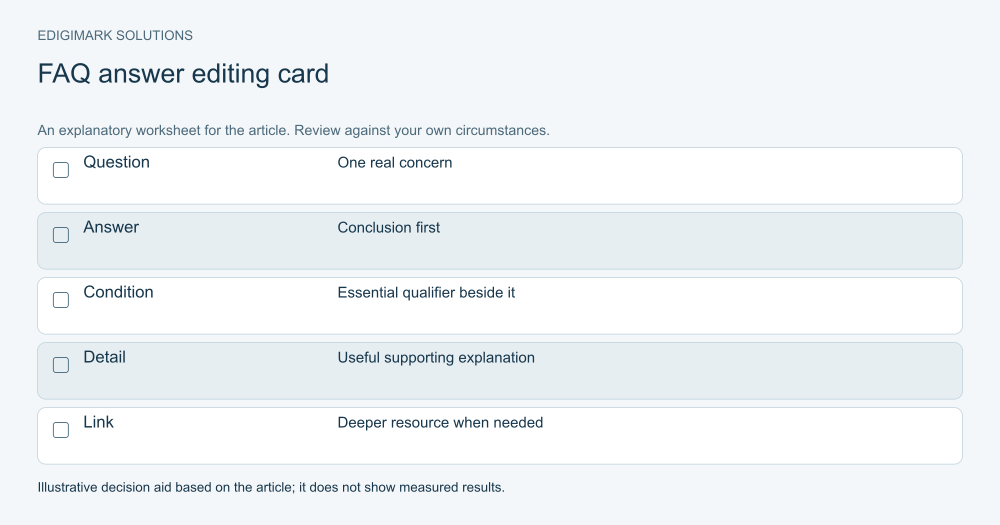
Use these fields for each proposed question:
| Field | Review question |
|---|---|
| Task | What uncertainty does this resolve? |
| Placement | Does it belong here or in the main explanation? |
| Answer | Is the conclusion direct and accurate? |
| Condition | What changes the answer? |
| Evidence | Who or what verifies the claim? |
| Maintenance | Which future change triggers review? |
The worksheet makes duplication and unsupported claims easier to find. It also prevents a writer from treating an FAQ as a blank space to fill with attractive phrases.
How do FAQs connect with conversion paths?
They can resolve uncertainty that prevents a suitable reader from proceeding. A scope answer can help the reader decide whether to inquire. A prerequisite answer can show what information to prepare first.
Choose the next step according to the question. A definition may point to an example; an implementation concern may point to scope; a measurement concern may point to a method. Avoid forcing every answer into a high-commitment form.
For workflow implementation, marketing automation may fit when the topic actually concerns that service. Preserve the answer’s usefulness for readers who are still preparing internally.
Review lead quality as well as submission totals. A clearer FAQ may reduce unsuitable requests, which can be useful even if the form count falls. The metric should reflect the page’s role.
How should FAQ performance be evaluated?
Use available task-oriented evidence. Customer feedback, recurring questions and relevant page actions can show whether the answers help. A tool’s score cannot establish comprehension.
Keep measurement limits clear. An expanded answer or longer visit may signal interest or confusion. Do not infer understanding from one interaction alone. Sales and support feedback can add context.
Record what changed and why. If a new answer addresses an exception, inspect whether the misunderstanding persists. This creates a learning process without claiming that one FAQ caused every commercial outcome.
What should an FAQ maintenance process include?
Give each important answer an evidence owner and review trigger. Product changes, service scope and repeated customer confusion should prompt checks. A scheduled review can supplement those triggers.
Maintain consistency with the main page. If the service exclusions change, update the opening, scope table and FAQ together where needed. One correct answer cannot repair contradictory information elsewhere.
Retire redundant questions. A FAQ section can grow indefinitely unless someone reviews its role. Keep the questions that add useful information and move substantial explanations to the appropriate owning section.
How would you build a FAQ set for one service page?
Imagine a hypothetical integration service page with a clear main scope section. The team collects questions about data cleanup, access, archived records, timing and ongoing ownership. It first decides which concerns belong in the core explanation.
Data readiness and standard scope are central to the offer, so the main page explains them. The FAQ then covers narrower cases: what information to bring to discovery, whether an unresolved custom field needs separate review and who should approve ownership decisions.
The answer packet comes from the responsible service owner. The writer does not invent a fixed timeline or promise universal compatibility. Each answer states what is known and what the team must inspect before confirming scope.
The editor checks for overlap. A question about archived records may need only a short qualification and a pointer to scope. A question asking for the entire implementation process should move to the main section or a detailed resource instead of becoming an oversized FAQ.
The public review checks question labels, expandable behavior if used and relevant destinations. Sales then reports whether the answers resolve the recurring concerns or create new ambiguity. The example demonstrates a workflow, not a measured lead increase.
What should an FAQ question-quality review ask?
Ask whether the wording belongs to the reader or the company’s promotional message. “Why are we the leading experts?” is a marketing claim disguised as a question. “Which tasks are included?” expresses a real evaluation need.
Ask whether one answer can fulfill the question. A compound question about price, time and compatibility may need separation. A vague question such as “Does it work?” needs a more specific subject and condition.
Ask whether the answer remains useful outside the surrounding paragraph. It should name the subject when necessary and preserve essential scope. This does not require repeating the company name; it requires avoiding unclear references.
Finally, ask what new information the question adds. If it merely restates the introduction, remove it. If it exposes a missing central explanation, improve the owning section. The FAQ should be the result of a thoughtful page review, not a fixed production requirement.
How do you keep FAQ editing distinct from technical markup work?
Review visible answers for usefulness and facts first. A markup decision cannot repair an unsupported answer. Technical implementation should describe the actual content and follow the current requirements of the system it is intended to serve.
Keep the responsibilities clear. The subject owner verifies claims, the editor organizes answers and the website owner reviews applicable technical output. A plugin offering a field is not sufficient evidence that the field creates a supported search feature.
Preserve accurate production records. Mark an answer as drafted, fact-checked or publicly verified according to the work actually completed. This prevents a successful import from being mistaken for a completed editorial and technical review.
Frequently asked questions
Do FAQs automatically improve AEO visibility?
No. They can improve understanding when they answer real questions well. Selection by an answer system remains uncertain. Avoid treating the format as a guaranteed citation technique.
Should the primary keyword appear in every question?
No. Use wording that reflects the actual concern. Repeating a phrase where it adds no meaning makes the section less readable and can distort question intent.
Can a FAQ answer link to a service page?
Yes, when the destination helps with the next decision. Provide a meaningful answer first, then use a descriptive link. A sales destination should not replace an explanation the business can give publicly.
Should we keep existing FAQ markup for Google rich results?
Review the current implementation and purpose with the website owner. Google’s FAQ rich-result feature is discontinued. Visible useful answers can remain, while technical changes should follow an authorized, evidence-based review.
What is the most useful first edit?
Choose one recurring question and make its answer direct, scoped and verifiable. Put the essential condition beside the conclusion, then remove unnecessary keyword repetition.
Answer the uncertainty that remains
Select questions for their usefulness and maintain the facts behind each answer. Edigimark’s digital marketing services can connect the FAQ review with a wider editorial plan. Contact the team with your recurring questions and current pages to scope the work.